From the conversion glossary
Concepts referenced in this article, defined.
Looking for the best Shoplift alternative for Shopify A/B Testing? Discover how CustomFit.ai helps D2C brands increase conversion rate ecommerce with no-code testing and personalization.
Concepts referenced in this article, defined.
Run rigorous A/B tests and personalize every visit on Shopify or any storefront — no engineers required.
Running a D2C brand on Shopify is part art, part science. You have your storytelling, your visuals, and your brand identity, and then you have data: real, measurable data that tells you what's actually driving conversions.
That's where A/B testing comes in. If you're using Shoplift (formerly Shoplift A/B Testing for Shopify), you probably already understand the value of testing your store elements. Shoplift is popular for its simplicity and Shopify-native integration. But as you scale and want to personalize experiences, run faster tests, and look deeper into visitor behavior, you may run into a few limitations.
That's where CustomFit.ai fits in as an alternative to Shoplift for Shopify A/B testing. It's a flexible, no-code, conversion-focused A/B testing platform built for ecommerce and D2C growth.
Here's why many Shopify brands move toward deeper experimentation, and how CustomFit.ai supports it.
Most D2C founders eventually realize that scaling isn't about doing more marketing. It's about optimizing what already works.
You don't always need more ads or influencers. Sometimes all you need is a better headline, an improved checkout flow, or a product image that tells your story better.
A/B testing gives you clarity. Instead of relying on opinions or gut feelings, it lets you make decisions based on user behavior.
A/B testing on Shopify answers questions like:
Each of these small questions hides a real revenue opportunity.
Platforms like CustomFit.ai keep the process simple, so even non-developers can launch, analyze, and roll out experiments.
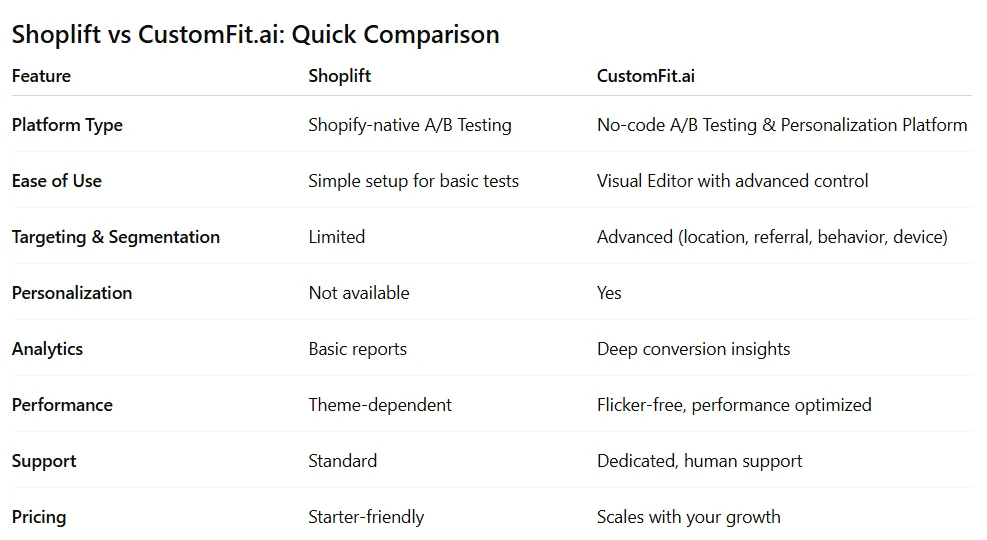
Shoplift is a Shopify app focused on simple, native A/B testing. It helps merchants experiment with store content, themes, and templates without third-party integrations.
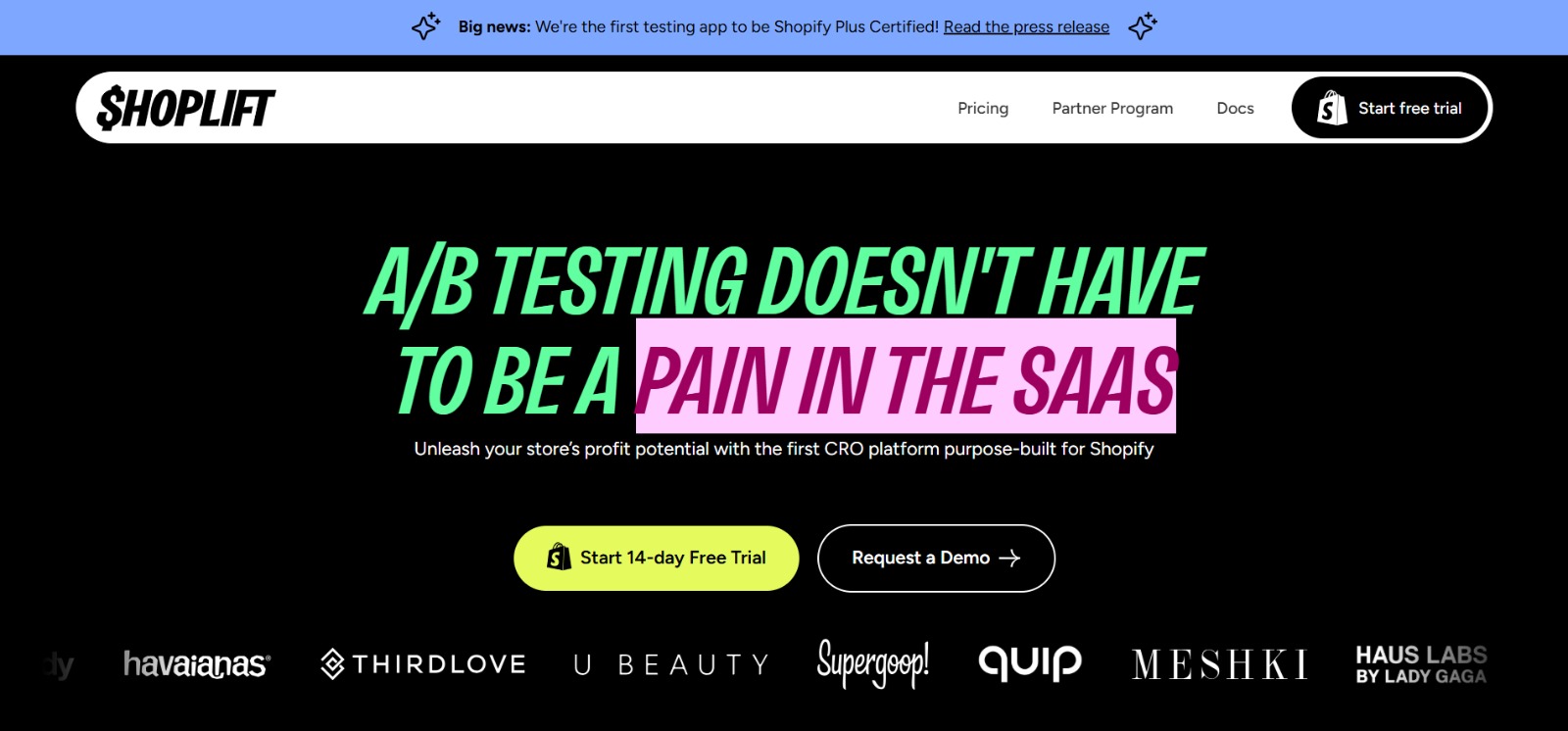
It's easy to set up and is a good starting point for basic A/B tests. For example, you can test hero banners, product headlines, or homepage layouts directly within your Shopify theme editor.
Where Shoplift does well:
As your ecommerce store grows and your experiments get more complex, though, you may notice some limits:
In short, Shoplift helps you start testing, but it isn't built for scaling experimentation. That's often where teams start looking at CustomFit.ai.
CustomFit.ai was designed for ecommerce teams that care about both conversions and experience. Rather than being a generic testing tool, it's built around the everyday challenges of D2C and Shopify stores, from cart drop-offs to checkout friction.
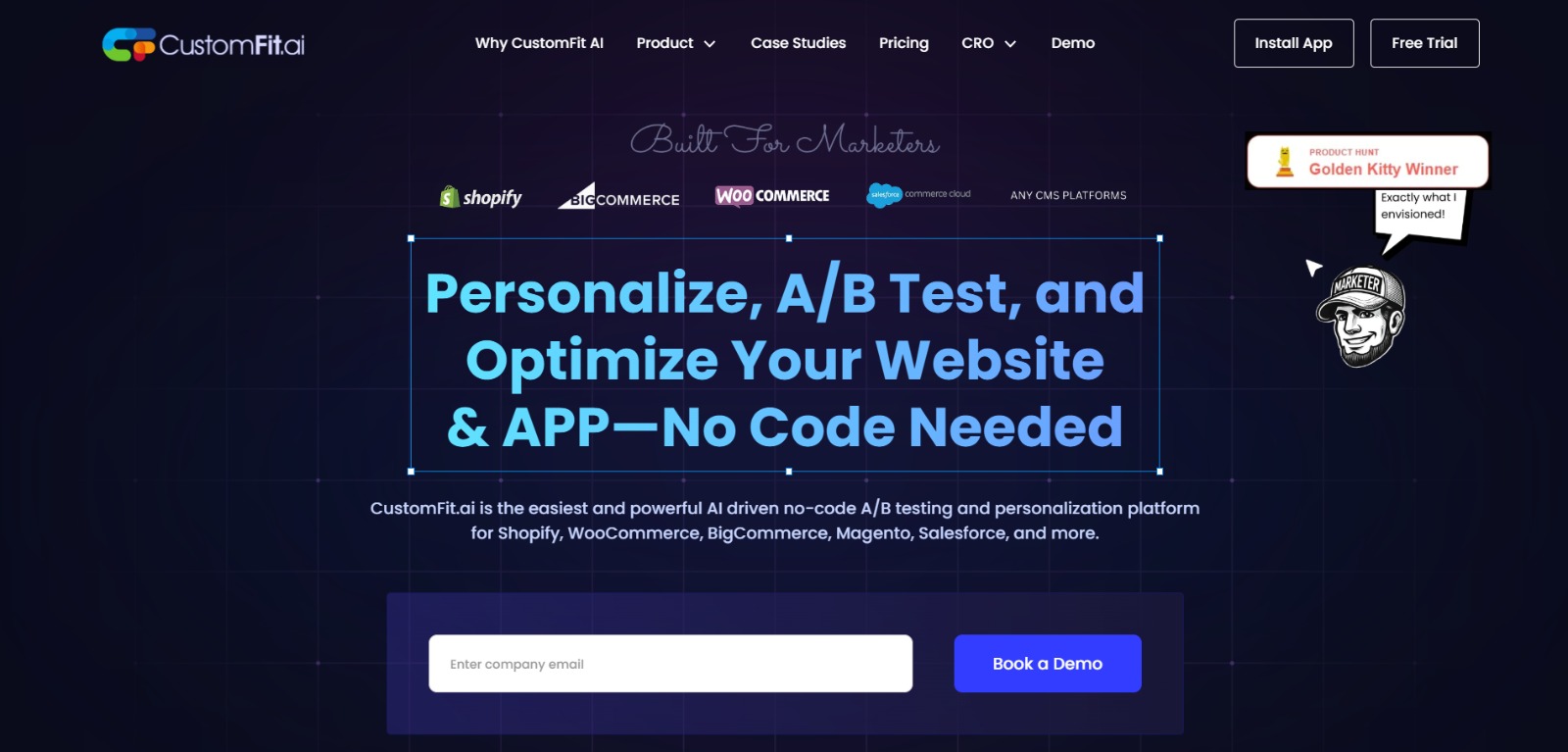
You can test your website, personalize your content, and optimize user journeys, all within a single A/B testing platform.
CustomFit supports A/B testing and personalised optimisation.
You don't need to touch code or switch between themes. CustomFit.ai's visual editor lets you make changes directly on your live Shopify site: text, buttons, banners, product placements, and more.
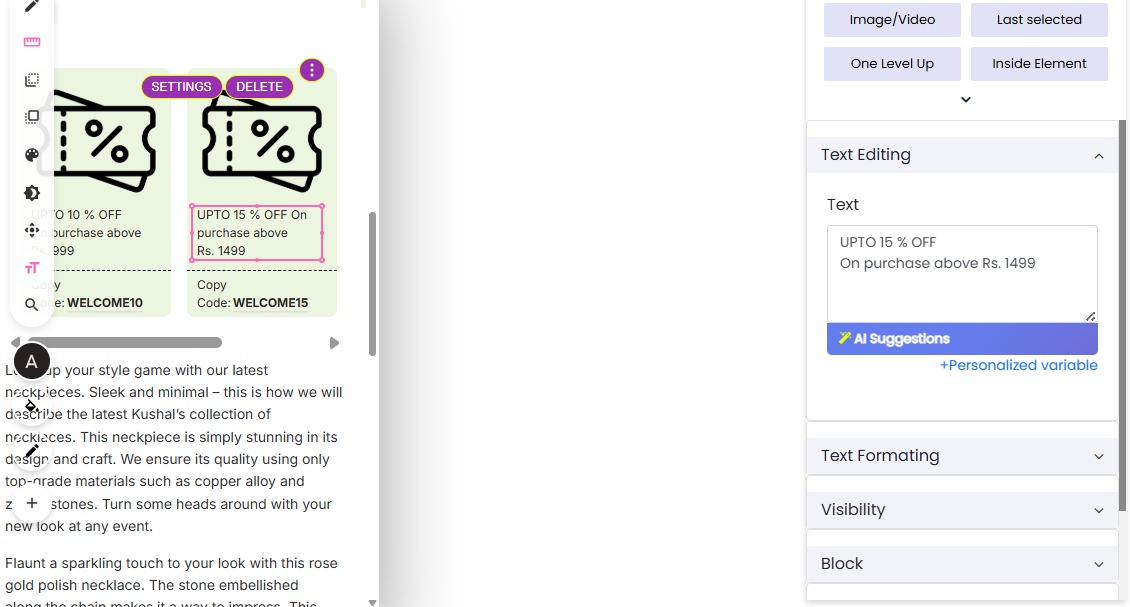
For example:
You can A/B test all of this instantly, with no developer dependency.
One of the bigger issues with many testing tools, including some Shopify plugins, is flicker: the split-second flash before the variant loads. It might seem small, but it affects trust and conversions.
CustomFit.ai renders variants without flicker, which keeps your site speed intact and your user experience clean.
Shoplift is good for one-size-fits-all tests, but ecommerce doesn't work that way anymore. CustomFit.ai lets you show different content to different audiences based on location, referral source, device type, or behavior.
Examples:
This kind of personalized testing gives your store a way to increase its ecommerce conversion rate faster than a static A/B test could.
Like Shoplift, CustomFit.ai integrates directly with Shopify, and it also supports product pages, collections, landing pages, and checkout optimizations.
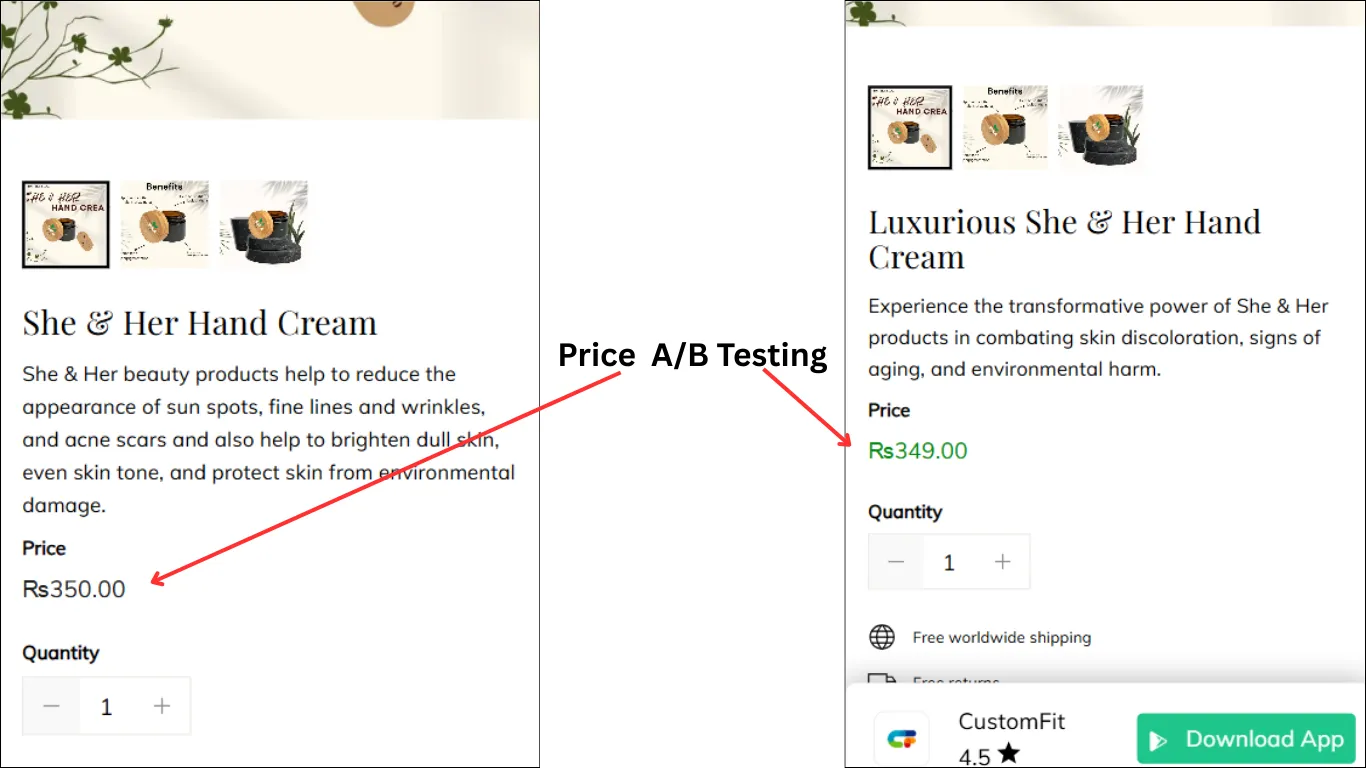
You can:
Shoplift shows which variant "won." CustomFit.ai tells you why. You can dig into user behavior, scroll depth, click rates, dwell time, and the purchase journey.
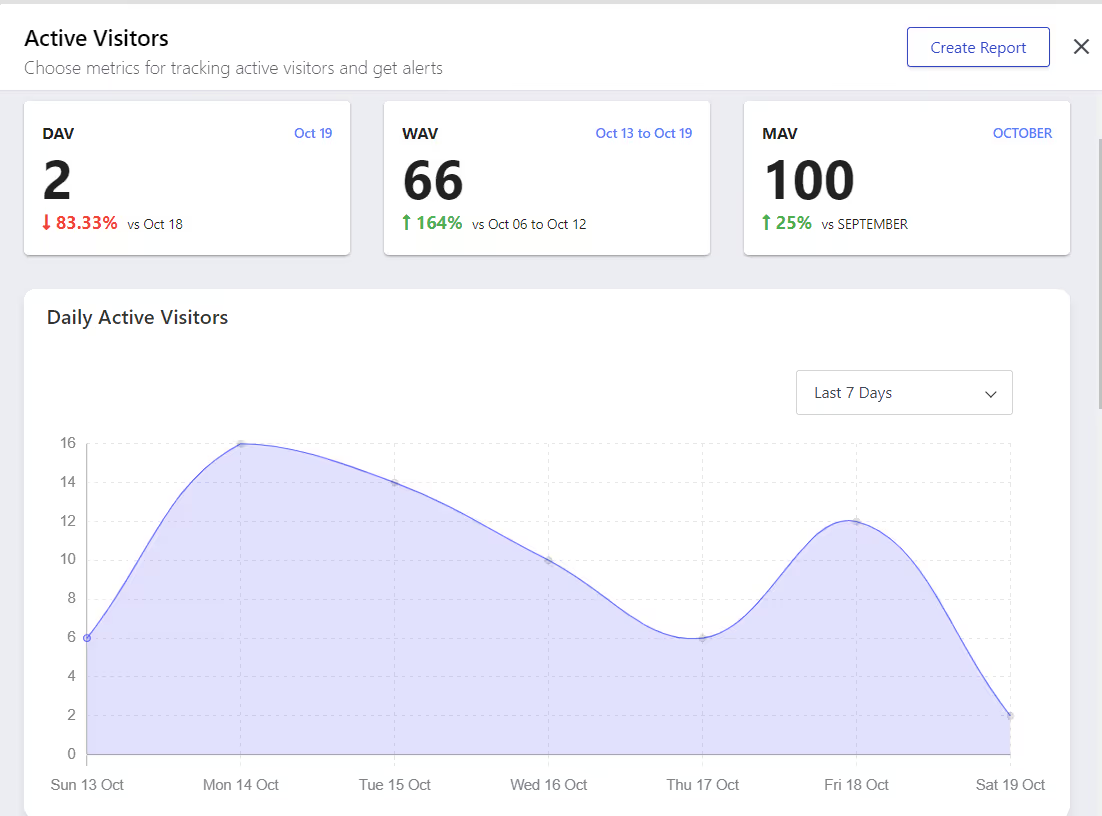
For marketers, this means you can finally answer: "What's working, for whom, and why?"
Unlike a typical plug-and-play Shopify app, CustomFit.ai's support is proactive. The team helps brands plan experiments, analyze results, and optimize based on the insights.
Switching doesn't mean starting over. For most Shopify stores, migration looks like this:
You'll get more flexibility in test design, richer insights, and faster execution.
A D2C footwear brand was using Shoplift to test homepage headlines, but they wanted to test add-to-cart CTAs, banner variations, and location-specific offers too.
They moved to CustomFit.ai. Within a month:
The difference came from testing with more intent, not from testing more things.
If you're moving from Shoplift to CustomFit.ai, here are five A/B tests worth running right away:
Test two hero messages, one emotion-driven and one offer-driven.
Test image-first vs. feature-first layout. Sometimes leading with benefits outperforms visuals.
Change text, color, and placement. For mobile users, sticky CTAs often lift conversions.
Test ₹999 vs ₹1,000, or "Flat ₹500 Off" vs "50% Off." Small changes in perception make big differences.
Test single-page vs multi-step checkout, or "Pay Now" vs "Proceed to Checkout."
Every test you run gives you something to act on, whether that's what to keep, what to change, or what to scale.
The biggest win of moving to a more advanced A/B testing platform like CustomFit.ai isn't any single test or metric. It's the habit of testing.
When your team gets used to testing instead of guessing, growth becomes more predictable. You stop arguing over design opinions and start talking about conversion data. In D2C ecommerce, that steady habit is what gives you an edge.
Q1. What is the best Shoplift alternative for Shopify A/B Testing? CustomFit.ai is a no-code A/B testing platform built for ecommerce and D2C brands. It offers advanced personalization, deep analytics, and direct Shopify integration.
Q2. Does CustomFit.ai replace Shoplift completely? Yes. While Shoplift focuses on simple theme-based tests, CustomFit.ai lets you run complex, personalized experiments across your entire store: product pages, checkout, and more.
Q3. Do I need coding knowledge to use CustomFit.ai? Not at all. You can create and launch tests visually, everything from CTAs to banners, without touching code.
Q4. Will A/B Testing slow down my Shopify site? CustomFit.ai provides a flicker-free experience and maintains your site speed through optimized script delivery.
Q5. How can A/B Testing help increase my ecommerce store's conversion rate? A/B testing identifies what works best for your audience, whether it's pricing, design, or messaging. Over time, these insights stack up and lead to a measurable lift in revenue.
Q6. Can I use CustomFit.ai with Shopify checkout pages? Yes. CustomFit.ai supports experiments and personalization even on Shopify checkout flows (Shopify Plus and beyond).
Q7. How is CustomFit.ai different from generic A/B Testing tools? It's built specifically for ecommerce, so you get relevant analytics, fast deployment, and setup that suits marketers rather than developers.
Q8. How soon can I expect results from my first test? Depending on your traffic, you can start seeing meaningful results within 7 to 14 days.
Shoplift gets you testing, while CustomFit.ai is built to help you grow from there.
If your goal is to move beyond simple split testing and start building personalized, data-driven customer journeys, CustomFit.ai is a reasonable next step. It's built for the reality of ecommerce, where every visitor, click, and second counts.
Moving from designing pages to testing experiences is often what separates growing D2C brands from ones that stall. With CustomFit.ai, the point isn't only to run tests. It's to learn from each one and adjust as you scale.