From the conversion glossary
Concepts referenced in this article, defined.
Explore Deborah O’Malley’s expert insights on A/B testing, CRO strategies, test design, segmentation, analytics, and the future of optimization in this detailed breakdown.
Concepts referenced in this article, defined.
Run rigorous A/B tests and personalize every visit on Shopify or any storefront — no engineers required.
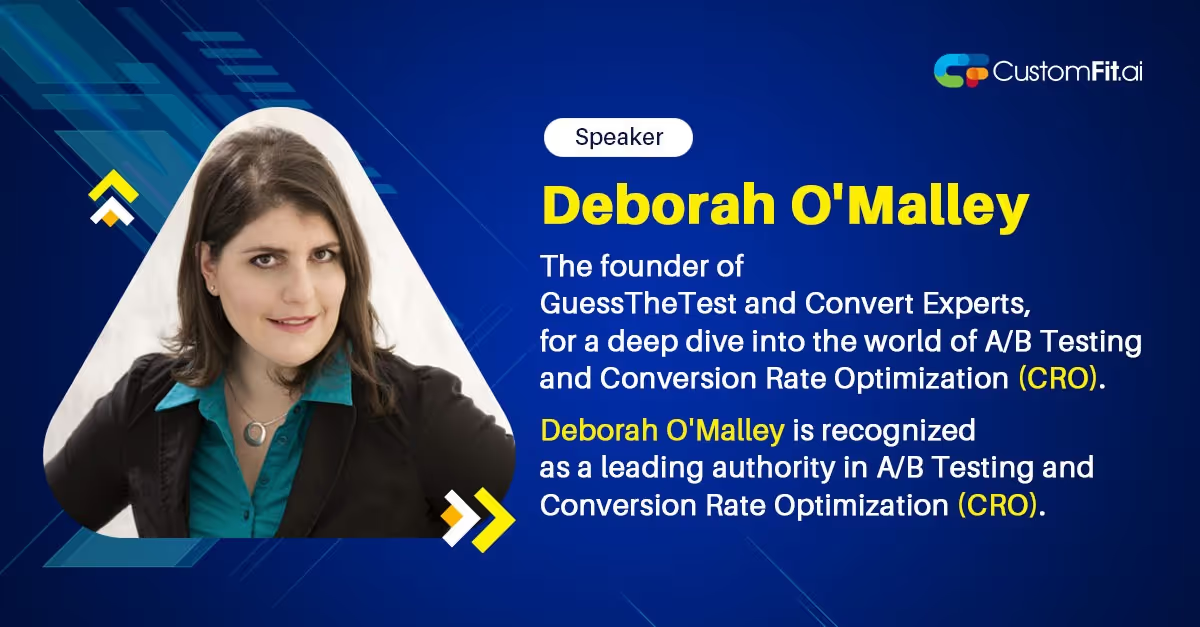
Ashwin Kumar, Co-Founder & CEO of CustomFit.ai, sat down with Deborah O'Malley, founder of GuessTheTest and Convert Experts, for an in-depth conversation on A/B testing and conversion rate optimization (CRO). What follows is a breakdown of the key ideas O'Malley shared, drawn from years of hands-on experimentation and research.
O'Malley traces her interest in human behavior back to childhood, including a Muppet Babies episode that stuck with her and got her thinking about perception. That curiosity carried through into formal study: she earned a Master's degree in eye-tracking technology and spent years on user experience research. Her career eventually landed on CRO and A/B testing, fields she describes as a mix of analytical rigor and creative problem-solving.
Convert Experts is O'Malley's consultancy. It takes an analytics-first approach to diagnosing and improving website performance, working with data from Google Analytics, heat mapping tools, and qualitative studies. GuessTheTest is a separate project: an interactive learning platform that presents real A/B test cases so practitioners can build intuition about what actually works in testing.
O'Malley is direct about what A/B testing is not: it is not a guess-and-check exercise. It follows a structured, scientific process. For A/B testing to produce reliable results, especially at scale, a few conditions have to be in place:
O'Malley shared one result that surprised even experienced marketers: a longer form with no discount outperformed a shorter form that offered a discount. The expected outcome was the opposite. The finding underscored that what works depends heavily on the specific audience, not on general best practices.
O'Malley names heat mapping as a particularly useful tool because it shows how real users actually move through a page, not just what they click. She also stresses that A/B testing is a field that keeps evolving, and staying current requires continuous learning rather than relying on what worked a few years ago.
For anyone starting out, O'Malley recommends beginning with analytics to identify where to test before deciding what to test. For experienced practitioners, the focus should stay on data discipline and methodological rigor. She points to GuessTheTest as a practical resource and is open to connecting on LinkedIn for more specific questions.
Beyond the fundamentals, O'Malley gets into the mechanics that determine whether a test produces useful information. Hypothesis creation matters: a vague hypothesis produces a vague result. Variant design and how you interpret outcomes are equally important. She also highlights statistical significance as something marketers need to understand at a working level, not just as a checkbox to clear before calling a test.
O'Malley covers how user psychology and design choices interact with conversion rates. Small changes in copy or layout can move the needle significantly, which is why well-scoped tests with clear hypotheses tend to produce clearer learnings. She ties A/B testing back to broader marketing strategy rather than treating it as an isolated tactic.
O'Malley is candid about where testing programs go wrong. Confirmation bias is common: teams look for data that validates what they already believe. Overreliance on quantitative metrics without qualitative context leads to misreads. Drawing conclusions before a test has collected enough data is another frequent mistake. Her recommended approach is to combine quantitative and qualitative research methods, and to build a culture within the organization where experimentation is normal rather than exceptional.
O'Malley expects machine learning and AI to take on more of the operational work in testing: automating test setup, flagging anomalies, and accelerating analysis. She also sees personalization and user experience becoming more central to conversion optimization, with teams expected to understand individual visitor behavior rather than just aggregate trends.