Is Your A/B Test Really a Winner? How to Double-Check Before Scaling

You finally see it in your dashboard.

Variant B is outperforming Variant A. The conversion rate is up. Revenue looks higher. Someone on the team says, “This is a winner. Let’s roll it out everywhere.”

This moment feels good. After weeks of planning, building, and waiting, it feels like proof that the work paid off.

But here is the uncomfortable truth many ecommerce and D2C brands learn the hard way.

Not every A/B test winner is a real winner.

Some “winning” tests quietly fail after rollout. Some perform well for a short window and then regress. Others lift one metric while hurting another that matters more. And some wins are simply statistical noise that looked convincing because traffic spiked or behavior shifted temporarily.

Before you scale any A/B test across your ecommerce store, especially during high-traffic periods or campaigns, you need to slow down and double-check what you are seeing.

This guide walks through how to validate whether your A/B test is truly a winner before scaling. We will cover behavioral signals, statistical checks, segmentation traps, and practical validation steps. We will also touch on how teams using an A/B Testing Platform like CustomFit.ai approach this process in a structured way without turning it into overanalysis.

This is not about doubting experimentation. It is about respecting it.
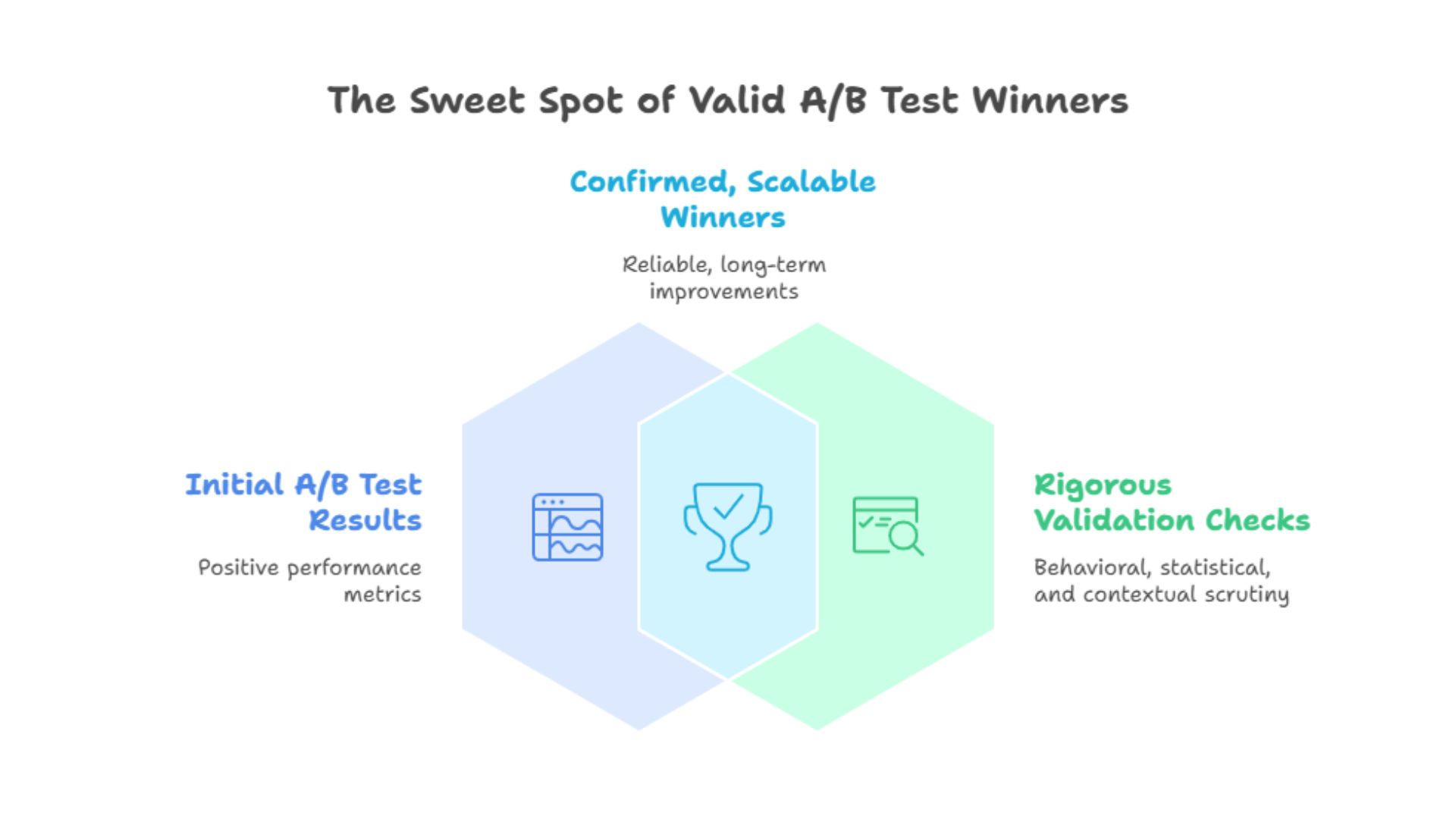
The Sweet Spot of Valid AB Test Winners

Why False Winners Are More Common Than You Think

A/B Testing is powerful, but it is also easy to misinterpret.

Most ecommerce teams run tests under real-world conditions. Traffic is uneven. Campaigns start and stop. Discounts overlap. Behavior shifts by device, region, and time of day.

In this environment, it is surprisingly easy for a test to appear successful without being truly reliable.

Here are a few reasons false winners show up so often.

  • Short test durations that capture unusual traffic patterns

  • Results driven by a single segment rather than the whole audience

  • A focus on one metric while ignoring downstream effects

  • Seasonal or campaign-driven behavior skewing results

  • Changes that increase clicks but reduce purchase intent

When teams rush to scale without validating these factors, they often end up rolling out changes that do not actually increase conversion rate over time.

Step One: Confirm You Tested the Right Goal

The first question to ask is deceptively simple.

What exactly did this test optimize for?

Many A/B tests are set up around convenient metrics instead of meaningful ones. For example:

  • Clicks on a button

  • Engagement with a banner

  • Scroll depth

  • Time on page

These metrics are not useless, but they are often proxies. During the holidays or high-intent periods, proxies can mislead.

Before scaling, ask:

Did this test improve the metric that actually drives revenue?

For an ecommerce store, the most reliable primary metrics usually include:

  • Add to cart rate

  • Checkout initiation

  • Completed purchases

  • Revenue per visitor

If your test “won” on clicks but did not move add to cart or checkout completion, you need to pause. That does not automatically make it a bad test, but it does mean it is not ready to be scaled globally.

Teams using a structured A/B Testing Platform typically define a single primary metric upfront and treat other metrics as secondary signals. This clarity makes post-test validation much easier.

Step Two: Check Whether the Lift Is Consistent Over Time

One of the most common traps in AB testing is early excitement.

You launch a test. After a few days, Variant B looks clearly ahead. The numbers feel convincing. But early results are often unstable.

Behavior changes throughout the week. Weekends behave differently than weekdays. Campaign launches can temporarily inflate intent.

Before calling a test a winner, review performance across time slices.

  • Did Variant B outperform consistently across multiple days?

  • Did it hold up during both high-traffic and low-traffic periods?

  • Did performance spike early and then flatten or reverse?

A true winner usually shows steady improvement rather than sharp peaks.

This is especially important for ecommerce brands running paid traffic. A short-term surge from ads can make a variant look stronger than it really is.

If you are using a platform like CustomFit.ai, reviewing performance trends over time rather than a single aggregate number helps avoid scaling on shaky ground.

Step Three: Validate Statistical Confidence Without Obsessing Over It

Statistics matter, but they should guide decisions, not paralyze them.

Many teams either ignore statistical confidence entirely or get stuck chasing perfect significance that never arrives.

The practical approach sits in the middle.

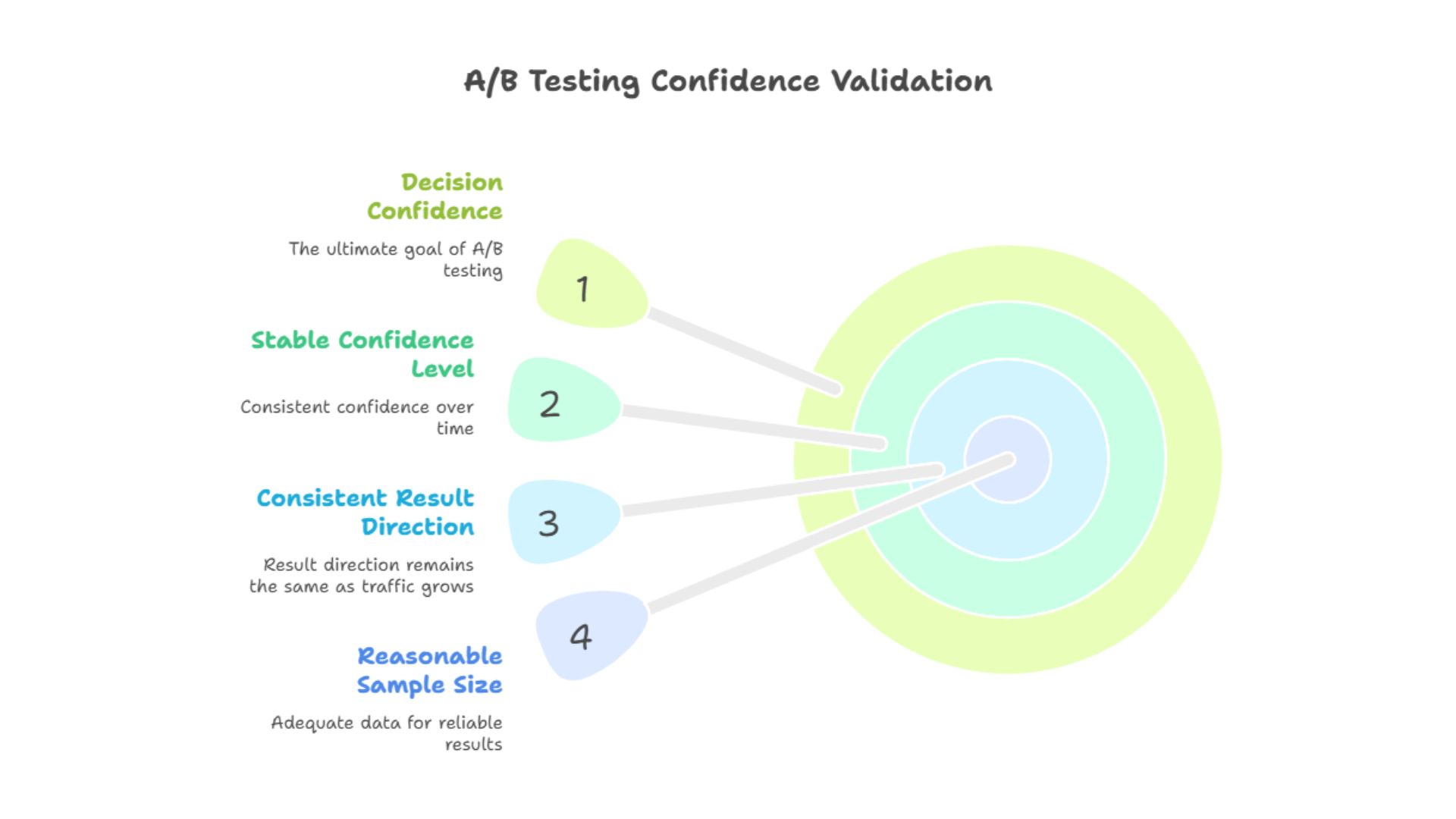
AB Testing Confidence Validation

Before scaling, check:

  • Did the test reach a reasonable sample size for your traffic level?

  • Is the confidence level stable rather than fluctuating wildly?

  • Does the direction of the result remain the same as traffic grows?

If confidence jumps from 70 percent to 95 percent and back again, the test may not be stable. If it steadily improves as data accumulates, that is a healthier signal.

Modern A/B Testing Platforms simplify this by presenting confidence in a readable way rather than raw statistical jargon. The goal is not academic precision. The goal is decision confidence.

Step Four: Look for Segment-Specific Effects

One of the biggest reasons tests fail after scaling is that they only worked for part of the audience.

This is extremely common in ecommerce.

For example:

  • A variant works well on desktop but hurts mobile

  • Paid traffic responds positively, organic traffic does not

  • New visitors convert better, returning customers convert worse

  • One region shows a strong lift, others show none

When you roll out globally without checking segmentation, you flatten these differences and lose the benefit.

Before scaling, break down results by:

  • Device type

  • Traffic source

  • New versus returning users

  • Geography if relevant

If Variant B is a clear winner for a specific segment but neutral or negative for others, the right move may not be full rollout. The smarter move may be personalization.

This is where tools like CustomFit.ai become especially useful, because they allow teams to turn a segment-specific win into a targeted experience instead of forcing it on everyone.

Step Five: Check Downstream Metrics for Hidden Damage

A/B tests rarely affect only one part of the funnel.

A change that increases add to cart might reduce checkout completion. A design that feels urgent might increase purchases but also increase returns or cancellations.

Before scaling, review downstream metrics carefully.

Ask:

  • Did checkout completion remain stable or improve?

  • Did average order value change?

  • Did refund or cancellation rates shift?

  • Did page load or engagement metrics degrade?

These effects often show up quietly. If you scale too fast, you may only notice weeks later when revenue quality drops.

A responsible A/B Testing process treats conversion rate as part of a system, not an isolated number.

Step Six: Re-Run or Extend the Test When the Stakes Are High

Some changes are low risk. Others are not.

If your test affects:

  • Pricing

  • Checkout flow

  • Subscription logic

  • Shipping visibility

  • Core navigation

It is worth validating twice.

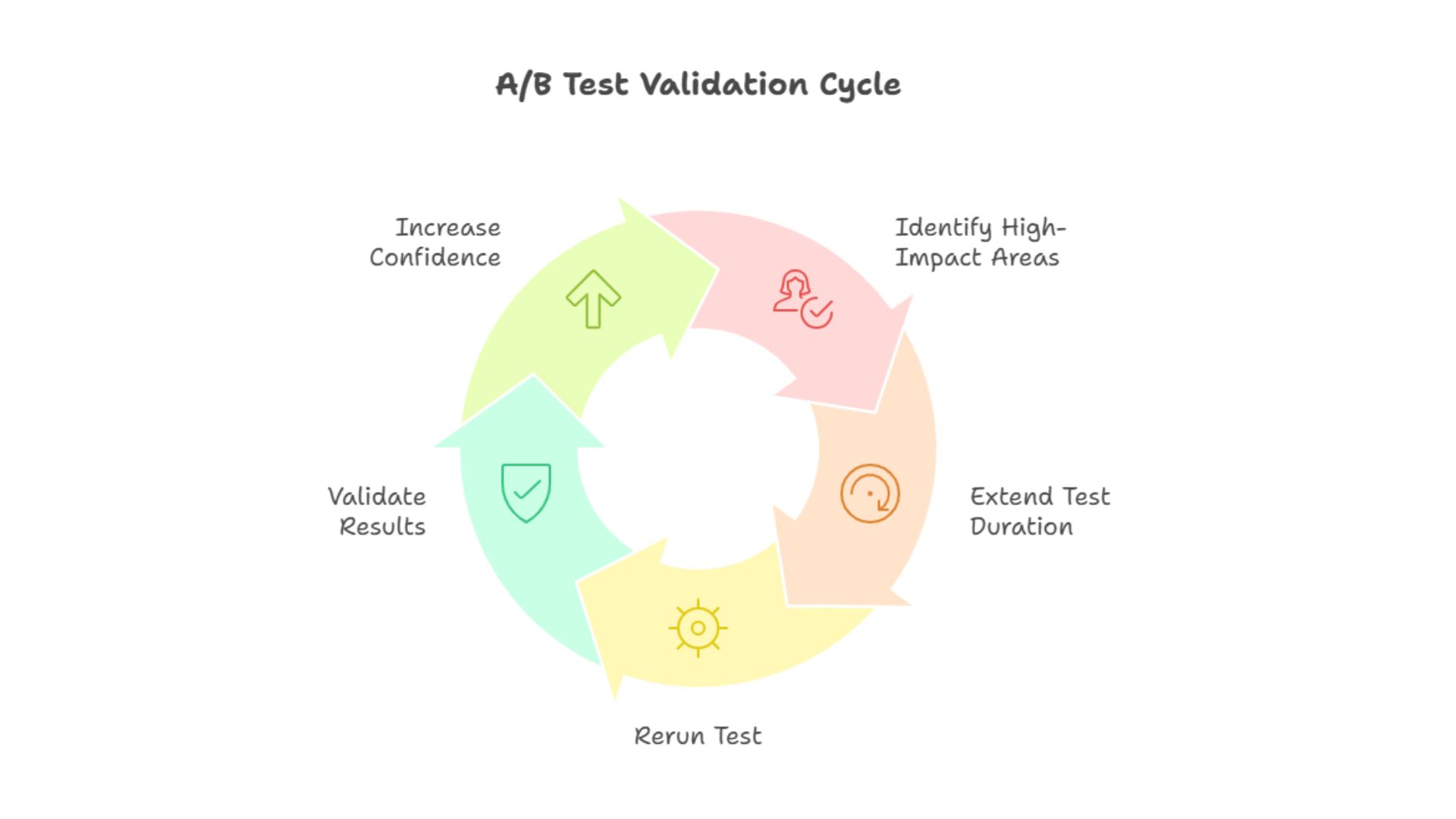
This does not mean starting from scratch every time. Sometimes extending the test for another cycle or rerunning it during a different traffic mix is enough.

AB Test Validation Cycle

For example:

  • Re-run the test during a non-sale period

  • Validate performance during a weekday-only window

  • Test the same change on a different high-traffic page

If the result repeats, confidence increases dramatically.

Conversion rate optimization companies often encourage this discipline because it prevents high-impact mistakes that are expensive to reverse.

Step Seven: Ask Whether the Result Makes Behavioral Sense

Data is powerful, but logic still matters.

Before scaling, ask a simple question.

Does this result make sense given how users behave?

If a tiny copy change produced a massive lift, be cautious. If removing important information somehow increased conversion dramatically, dig deeper.

True winners usually align with behavioral intuition:

  • Reduced friction

  • Increased clarity

  • Improved trust

  • Better alignment with intent

If the result feels too good to be true, it often is.

This does not mean dismissing surprising wins. It means understanding them before acting.

Step Eight: Decide How to Scale Carefully

Scaling does not have to be all or nothing.

Instead of instantly rolling out to 100 percent of traffic, consider phased scaling.

  • Roll out to 50 percent and monitor

  • Apply only to high-performing segments first

  • Launch on a subset of pages

  • Keep monitoring key metrics post-rollout

A good A/B Testing Platform makes it easy to control exposure and rollback if needed.

This approach reduces risk while still capturing upside.

Common Mistakes Teams Make When Declaring a Winner

Before moving on, it is worth calling out a few recurring mistakes.

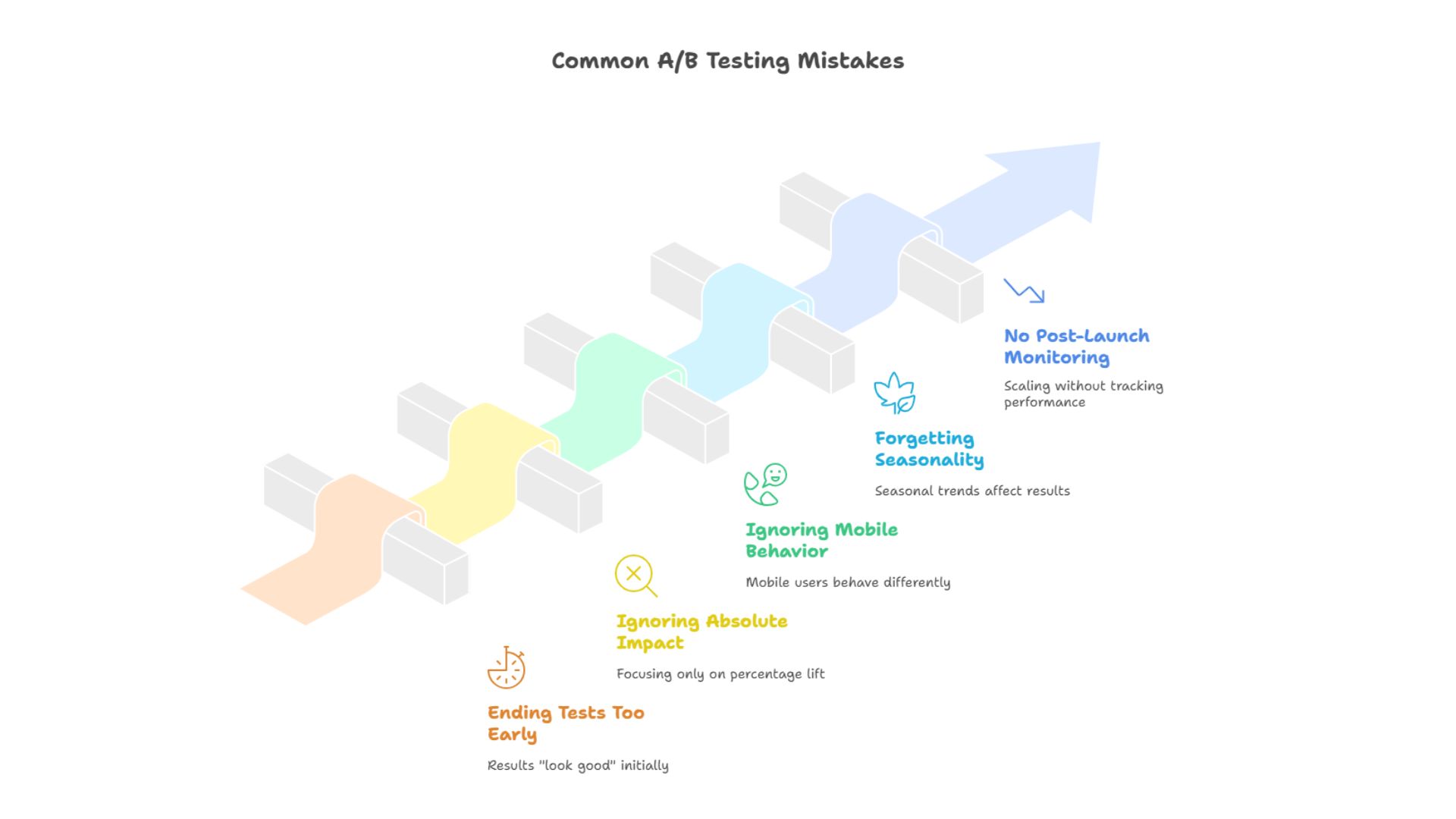
Common AB Testing Mistakes
  • Ending tests too early because results “look good”

  • Focusing only on percentage lift without looking at absolute impact

  • Ignoring mobile behavior

  • Forgetting seasonality and campaign effects

  • Scaling without monitoring post-launch performance

Avoiding these mistakes does not require advanced math. It requires patience and structure.

How CustomFit.ai Fits Into Responsible Scaling

CustomFit.ai is a conversion rate optimization company that helps ecommerce teams test, validate, and personalize website experiences without heavy development work.

While the platform simplifies running A/B tests, its real value shows up after the test ends.

Teams can:

  • Review segment-level performance easily

  • Turn segment-specific wins into personalized experiences

  • Control rollout exposure instead of forcing global changes

  • Monitor performance post-deployment

This makes scaling safer and more intentional, especially for D2C brands operating under high traffic pressure.

The tool does not decide for you. It gives you the clarity to decide well.

Turning A/B Testing Into a Long-Term Advantage

The goal of A/B Testing is not to chase wins. It is to build confidence in decisions.

When teams validate properly before scaling, they:

  • Avoid reversals

  • Build trust in experimentation

  • Improve long-term conversion rate

  • Reduce internal debates

  • Create repeatable optimization habits

Over time, this discipline compounds. The ecommerce store becomes more stable, more predictable, and more resilient under pressure.

A test that survives validation is far more valuable than a test that simply “won” once.

Conclusion: A Real Winner Holds Up After Scrutiny

Seeing a positive A/B test result is exciting. Scaling it responsibly is where the real work begins.

Before you roll out any test widely, pause and ask:

  • Did it improve the right metric?

  • Did it perform consistently over time?

  • Does it hold across segments?

  • Did it avoid harming downstream behavior?

  • Does it make sense behaviorally?

If the answer is yes across these questions, you are likely looking at a true winner.

A/B Testing is not just about finding changes that work. It is about finding changes that keep working.

That is how you turn experiments into sustainable growth.

FAQs: Is Your A/B Test Really a Winner?

What does it mean for an A/B test to be a real winner?

A real A/B test winner is one that consistently improves a meaningful business metric such as conversion rate or revenue, holds up across time and segments, and does not harm other parts of the funnel after scaling.

Why do some A/B test winners fail after rollout?

Many tests appear to win due to short-term behavior, campaign effects, or specific segments. When rolled out globally, those conditions disappear, and performance drops.

How long should I run an A/B test before declaring a winner?

There is no fixed duration, but tests should run long enough to capture different traffic patterns such as weekdays and weekends. Stability over time matters more than speed.

Is statistical significance enough to scale an A/B test?

Statistical confidence is important, but it is not enough on its own. Teams should also review segment performance, downstream metrics, and behavioral logic before scaling.

How does segmentation help validate A/B tests?

Segment analysis reveals whether a test worked broadly or only for certain users. This insight helps decide whether to roll out globally or use personalization instead.

Can AB testing for SEO be affected by scaling too fast?

Yes. Poorly validated changes can harm engagement metrics that indirectly affect SEO. Responsible AB Testing for SEO focuses on improving clarity and user experience, not just short-term clicks.

What metrics should I check before scaling an A/B test?

Focus on conversion rate, checkout completion, revenue per visitor, and any downstream signals such as refunds or cancellations.

Should I rerun important A/B tests?

For high-impact changes, rerunning or extending tests can confirm reliability and reduce risk. This is especially important for pricing, checkout, or navigation changes.

How can an A/B Testing Platform help avoid false winners?

A good A/B Testing Platform provides clear reporting, segment breakdowns, controlled rollouts, and post-launch monitoring so teams can validate results before scaling.

How does CustomFit.ai support safe scaling of A/B tests?

CustomFit.ai helps ecommerce teams analyze test performance deeply, personalize winning experiences for specific segments, and roll out changes gradually while monitoring impact. This reduces risk and improves long-term conversion rate outcomes.

Sapna Johar
CRO Engineer at Customfit.ai

You finally see it in your dashboard.

Variant B is outperforming Variant A. The conversion rate is up. Revenue looks higher. Someone on the team says, “This is a winner. Let’s roll it out everywhere.”

This moment feels good. After weeks of planning, building, and waiting, it feels like proof that the work paid off.

But here is the uncomfortable truth many ecommerce and D2C brands learn the hard way.

Not every A/B test winner is a real winner.

Some “winning” tests quietly fail after rollout. Some perform well for a short window and then regress. Others lift one metric while hurting another that matters more. And some wins are simply statistical noise that looked convincing because traffic spiked or behavior shifted temporarily.

Before you scale any A/B test across your ecommerce store, especially during high-traffic periods or campaigns, you need to slow down and double-check what you are seeing.

This guide walks through how to validate whether your A/B test is truly a winner before scaling. We will cover behavioral signals, statistical checks, segmentation traps, and practical validation steps. We will also touch on how teams using an A/B Testing Platform like CustomFit.ai approach this process in a structured way without turning it into overanalysis.

This is not about doubting experimentation. It is about respecting it.

The Sweet Spot of Valid AB Test Winners

Why False Winners Are More Common Than You Think

A/B Testing is powerful, but it is also easy to misinterpret.

Most ecommerce teams run tests under real-world conditions. Traffic is uneven. Campaigns start and stop. Discounts overlap. Behavior shifts by device, region, and time of day.

In this environment, it is surprisingly easy for a test to appear successful without being truly reliable.

Here are a few reasons false winners show up so often.

  • Short test durations that capture unusual traffic patterns

  • Results driven by a single segment rather than the whole audience

  • A focus on one metric while ignoring downstream effects

  • Seasonal or campaign-driven behavior skewing results

  • Changes that increase clicks but reduce purchase intent

When teams rush to scale without validating these factors, they often end up rolling out changes that do not actually increase conversion rate over time.

Step One: Confirm You Tested the Right Goal

The first question to ask is deceptively simple.

What exactly did this test optimize for?

Many A/B tests are set up around convenient metrics instead of meaningful ones. For example:

  • Clicks on a button

  • Engagement with a banner

  • Scroll depth

  • Time on page

These metrics are not useless, but they are often proxies. During the holidays or high-intent periods, proxies can mislead.

Before scaling, ask:

Did this test improve the metric that actually drives revenue?

For an ecommerce store, the most reliable primary metrics usually include:

  • Add to cart rate

  • Checkout initiation

  • Completed purchases

  • Revenue per visitor

If your test “won” on clicks but did not move add to cart or checkout completion, you need to pause. That does not automatically make it a bad test, but it does mean it is not ready to be scaled globally.

Teams using a structured A/B Testing Platform typically define a single primary metric upfront and treat other metrics as secondary signals. This clarity makes post-test validation much easier.

Step Two: Check Whether the Lift Is Consistent Over Time

One of the most common traps in AB testing is early excitement.

You launch a test. After a few days, Variant B looks clearly ahead. The numbers feel convincing. But early results are often unstable.

Behavior changes throughout the week. Weekends behave differently than weekdays. Campaign launches can temporarily inflate intent.

Before calling a test a winner, review performance across time slices.

  • Did Variant B outperform consistently across multiple days?

  • Did it hold up during both high-traffic and low-traffic periods?

  • Did performance spike early and then flatten or reverse?

A true winner usually shows steady improvement rather than sharp peaks.

This is especially important for ecommerce brands running paid traffic. A short-term surge from ads can make a variant look stronger than it really is.

If you are using a platform like CustomFit.ai, reviewing performance trends over time rather than a single aggregate number helps avoid scaling on shaky ground.

Step Three: Validate Statistical Confidence Without Obsessing Over It

Statistics matter, but they should guide decisions, not paralyze them.

Many teams either ignore statistical confidence entirely or get stuck chasing perfect significance that never arrives.

The practical approach sits in the middle.

AB Testing Confidence Validation

Before scaling, check:

  • Did the test reach a reasonable sample size for your traffic level?

  • Is the confidence level stable rather than fluctuating wildly?

  • Does the direction of the result remain the same as traffic grows?

If confidence jumps from 70 percent to 95 percent and back again, the test may not be stable. If it steadily improves as data accumulates, that is a healthier signal.

Modern A/B Testing Platforms simplify this by presenting confidence in a readable way rather than raw statistical jargon. The goal is not academic precision. The goal is decision confidence.

Step Four: Look for Segment-Specific Effects

One of the biggest reasons tests fail after scaling is that they only worked for part of the audience.

This is extremely common in ecommerce.

For example:

  • A variant works well on desktop but hurts mobile

  • Paid traffic responds positively, organic traffic does not

  • New visitors convert better, returning customers convert worse

  • One region shows a strong lift, others show none

When you roll out globally without checking segmentation, you flatten these differences and lose the benefit.

Before scaling, break down results by:

  • Device type

  • Traffic source

  • New versus returning users

  • Geography if relevant

If Variant B is a clear winner for a specific segment but neutral or negative for others, the right move may not be full rollout. The smarter move may be personalization.

This is where tools like CustomFit.ai become especially useful, because they allow teams to turn a segment-specific win into a targeted experience instead of forcing it on everyone.

Step Five: Check Downstream Metrics for Hidden Damage

A/B tests rarely affect only one part of the funnel.

A change that increases add to cart might reduce checkout completion. A design that feels urgent might increase purchases but also increase returns or cancellations.

Before scaling, review downstream metrics carefully.

Ask:

  • Did checkout completion remain stable or improve?

  • Did average order value change?

  • Did refund or cancellation rates shift?

  • Did page load or engagement metrics degrade?

These effects often show up quietly. If you scale too fast, you may only notice weeks later when revenue quality drops.

A responsible A/B Testing process treats conversion rate as part of a system, not an isolated number.

Step Six: Re-Run or Extend the Test When the Stakes Are High

Some changes are low risk. Others are not.

If your test affects:

  • Pricing

  • Checkout flow

  • Subscription logic

  • Shipping visibility

  • Core navigation

It is worth validating twice.

This does not mean starting from scratch every time. Sometimes extending the test for another cycle or rerunning it during a different traffic mix is enough.

AB Test Validation Cycle

For example:

  • Re-run the test during a non-sale period

  • Validate performance during a weekday-only window

  • Test the same change on a different high-traffic page

If the result repeats, confidence increases dramatically.

Conversion rate optimization companies often encourage this discipline because it prevents high-impact mistakes that are expensive to reverse.

Step Seven: Ask Whether the Result Makes Behavioral Sense

Data is powerful, but logic still matters.

Before scaling, ask a simple question.

Does this result make sense given how users behave?

If a tiny copy change produced a massive lift, be cautious. If removing important information somehow increased conversion dramatically, dig deeper.

True winners usually align with behavioral intuition:

  • Reduced friction

  • Increased clarity

  • Improved trust

  • Better alignment with intent

If the result feels too good to be true, it often is.

This does not mean dismissing surprising wins. It means understanding them before acting.

Step Eight: Decide How to Scale Carefully

Scaling does not have to be all or nothing.

Instead of instantly rolling out to 100 percent of traffic, consider phased scaling.

  • Roll out to 50 percent and monitor

  • Apply only to high-performing segments first

  • Launch on a subset of pages

  • Keep monitoring key metrics post-rollout

A good A/B Testing Platform makes it easy to control exposure and rollback if needed.

This approach reduces risk while still capturing upside.

Common Mistakes Teams Make When Declaring a Winner

Before moving on, it is worth calling out a few recurring mistakes.

Common AB Testing Mistakes
  • Ending tests too early because results “look good”

  • Focusing only on percentage lift without looking at absolute impact

  • Ignoring mobile behavior

  • Forgetting seasonality and campaign effects

  • Scaling without monitoring post-launch performance

Avoiding these mistakes does not require advanced math. It requires patience and structure.

How CustomFit.ai Fits Into Responsible Scaling

CustomFit.ai is a conversion rate optimization company that helps ecommerce teams test, validate, and personalize website experiences without heavy development work.

While the platform simplifies running A/B tests, its real value shows up after the test ends.

Teams can:

  • Review segment-level performance easily

  • Turn segment-specific wins into personalized experiences

  • Control rollout exposure instead of forcing global changes

  • Monitor performance post-deployment

This makes scaling safer and more intentional, especially for D2C brands operating under high traffic pressure.

The tool does not decide for you. It gives you the clarity to decide well.

Turning A/B Testing Into a Long-Term Advantage

The goal of A/B Testing is not to chase wins. It is to build confidence in decisions.

When teams validate properly before scaling, they:

  • Avoid reversals

  • Build trust in experimentation

  • Improve long-term conversion rate

  • Reduce internal debates

  • Create repeatable optimization habits

Over time, this discipline compounds. The ecommerce store becomes more stable, more predictable, and more resilient under pressure.

A test that survives validation is far more valuable than a test that simply “won” once.

Conclusion: A Real Winner Holds Up After Scrutiny

Seeing a positive A/B test result is exciting. Scaling it responsibly is where the real work begins.

Before you roll out any test widely, pause and ask:

  • Did it improve the right metric?

  • Did it perform consistently over time?

  • Does it hold across segments?

  • Did it avoid harming downstream behavior?

  • Does it make sense behaviorally?

If the answer is yes across these questions, you are likely looking at a true winner.

A/B Testing is not just about finding changes that work. It is about finding changes that keep working.

That is how you turn experiments into sustainable growth.

FAQs: Is Your A/B Test Really a Winner?

What does it mean for an A/B test to be a real winner?

A real A/B test winner is one that consistently improves a meaningful business metric such as conversion rate or revenue, holds up across time and segments, and does not harm other parts of the funnel after scaling.

Why do some A/B test winners fail after rollout?

Many tests appear to win due to short-term behavior, campaign effects, or specific segments. When rolled out globally, those conditions disappear, and performance drops.

How long should I run an A/B test before declaring a winner?

There is no fixed duration, but tests should run long enough to capture different traffic patterns such as weekdays and weekends. Stability over time matters more than speed.

Is statistical significance enough to scale an A/B test?

Statistical confidence is important, but it is not enough on its own. Teams should also review segment performance, downstream metrics, and behavioral logic before scaling.

How does segmentation help validate A/B tests?

Segment analysis reveals whether a test worked broadly or only for certain users. This insight helps decide whether to roll out globally or use personalization instead.

Can AB testing for SEO be affected by scaling too fast?

Yes. Poorly validated changes can harm engagement metrics that indirectly affect SEO. Responsible AB Testing for SEO focuses on improving clarity and user experience, not just short-term clicks.

What metrics should I check before scaling an A/B test?

Focus on conversion rate, checkout completion, revenue per visitor, and any downstream signals such as refunds or cancellations.

Should I rerun important A/B tests?

For high-impact changes, rerunning or extending tests can confirm reliability and reduce risk. This is especially important for pricing, checkout, or navigation changes.

How can an A/B Testing Platform help avoid false winners?

A good A/B Testing Platform provides clear reporting, segment breakdowns, controlled rollouts, and post-launch monitoring so teams can validate results before scaling.

How does CustomFit.ai support safe scaling of A/B tests?

CustomFit.ai helps ecommerce teams analyze test performance deeply, personalize winning experiences for specific segments, and roll out changes gradually while monitoring impact. This reduces risk and improves long-term conversion rate outcomes.