From the conversion glossary
Concepts referenced in this article, defined.
Learn how to run A/B tests on PrestaShop using CustomFit.ai. A practical 2025 guide for ecommerce brands to improve conversion rates, UX, and on-site performance.
Concepts referenced in this article, defined.
Run rigorous A/B tests and personalize every visit on Shopify or any storefront — no engineers required.
Running a D2C brand in 2025 means your website is never really "done." Your PrestaShop store is live around the clock, orders keep coming in, ads are running non-stop, and customers expect a smooth shopping experience at all times. Yet you also know parts of the site could perform better. Maybe your product pages feel cluttered, your home page isn't telling the right story, or your checkout flow has one step too many.
You can't pause your store to fix everything. You also can't keep guessing.
This is where A/B testing shifts from a nice-to-have idea to a practical necessity for ecommerce brands. PrestaShop already gives you a solid foundation for catalog management, payments, and checkout. The real question is: how do you turn that foundation into a store that steadily improves its conversion rate month after month?
This guide walks through how to run A/B testing on PrestaShop using CustomFit.ai in 2025. The focus is practical: the "why" alongside the "how," with steps that ecommerce teams can actually execute.
CustomFit.ai plays a supporting role here. Think of it as a way to bring A/B testing and personalization into your PrestaShop workflow without constantly editing theme files.
By the end of this guide, you'll understand:
If you've been running your PrestaShop store for a while, you've likely gone through this pattern:
This is an expensive and unpredictable way to run a store. Every redesign, every banner update, and every copy change is a bet. If you're running ads, every unclear decision costs real money.
A/B testing brings structure to the chaos.
Instead of asking "Is my product page good?" you ask:
On PrestaShop, this matters even more because most stores use similar templates or modules. The stores that scale faster are often not the ones with the most features. They're the ones that test small improvements consistently and let data guide them.
Your products might be strong. Traffic may be healthy. Payment systems may be trustworthy. Yet sales still fall short.
The leak usually hides in places like:
These aren't technical bugs. They're friction points, and friction is expensive.
A/B testing pays attention to these micro-moments. It treats your PrestaShop site as something that can be improved continuously, not as a static storefront.
A/B testing means comparing two versions of something to see which one works better.
You don't show everyone the new version. Instead, you split visitors:
In ecommerce, this could mean:
An A/B testing platform like CustomFit.ai handles the traffic split and performance tracking. You focus on what to test and why.
The payoff:
This turns design debates into clear numbers: "This variation increased checkout completion by 7.4 percent over 14 days."
PrestaShop is flexible. You can customize themes, add modules, and adapt flows. But flexibility carries risk if you make changes without knowing their impact.
A/B testing sits on top of that flexibility and answers questions like:
For D2C brands where brand trust, repeat purchases, and margins matter, small improvements compound into real revenue.
CustomFit.ai lets you run these experiments without requiring theme rewrites. Marketing teams can test new ideas while developers focus on long-term improvements.
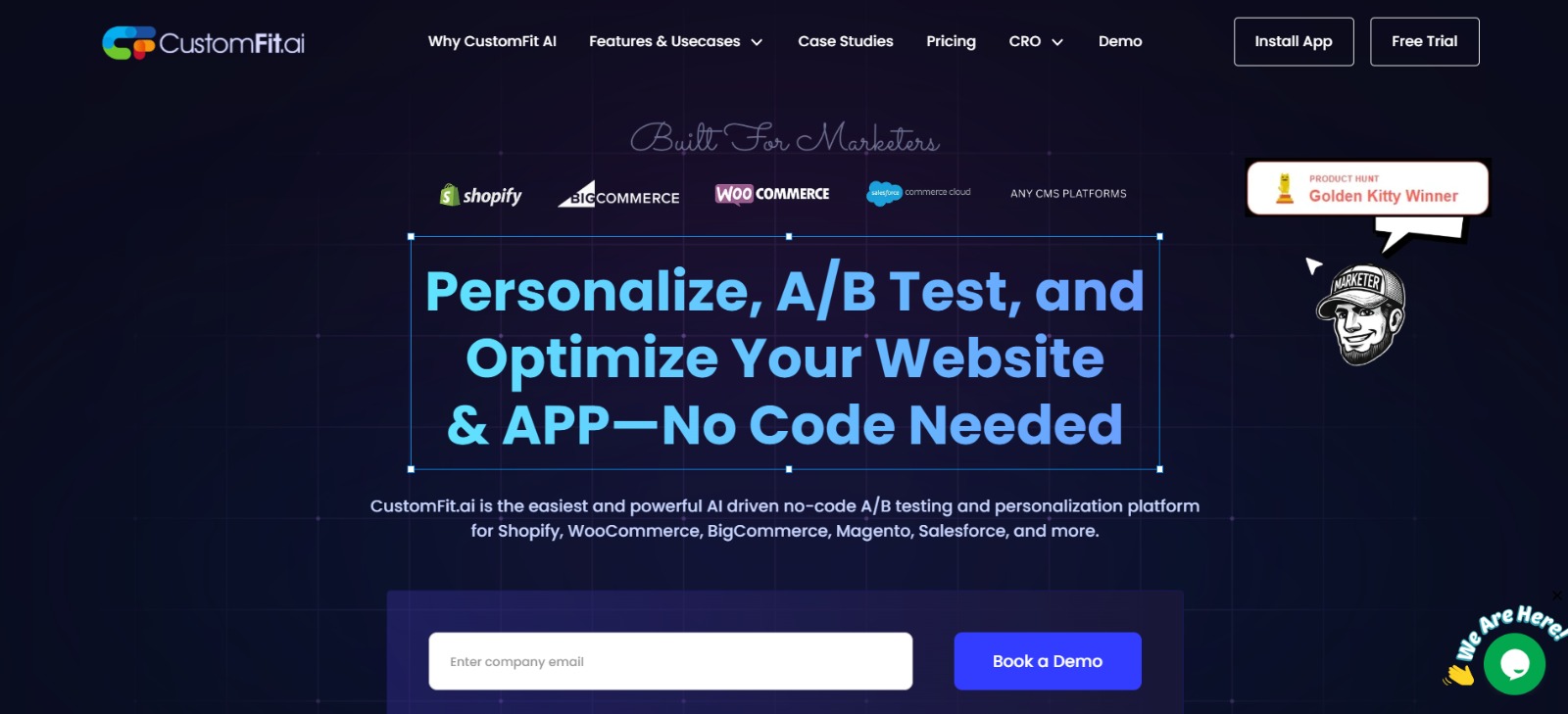
CustomFit.ai is a conversion rate optimization platform that lets ecommerce brands personalize their website and run A/B tests without heavy engineering. On PrestaShop, it works as an experimentation layer on top of your existing store.
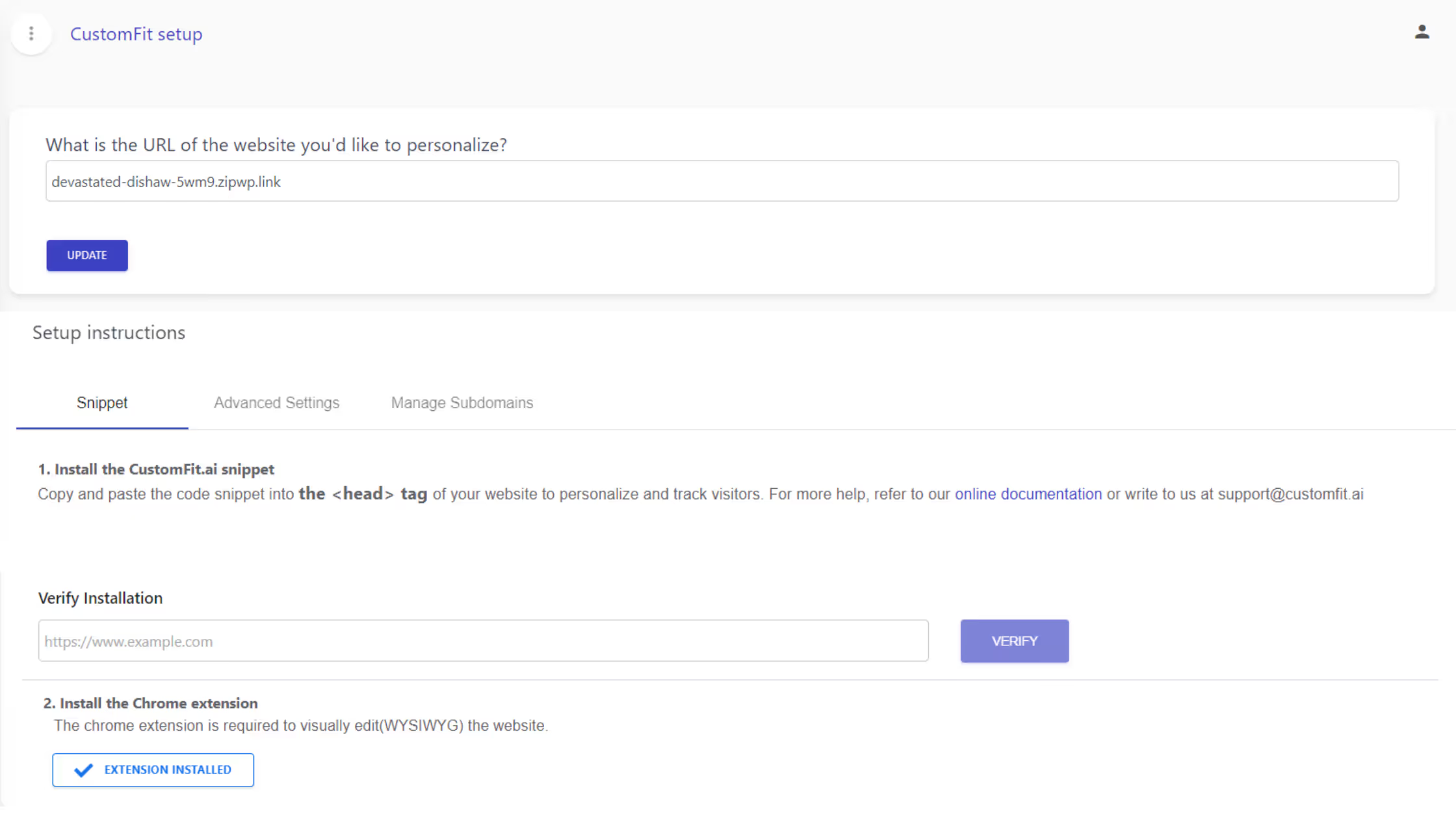
In practice:
PrestaShop remains your store's engine. CustomFit.ai becomes your experimentation layer.
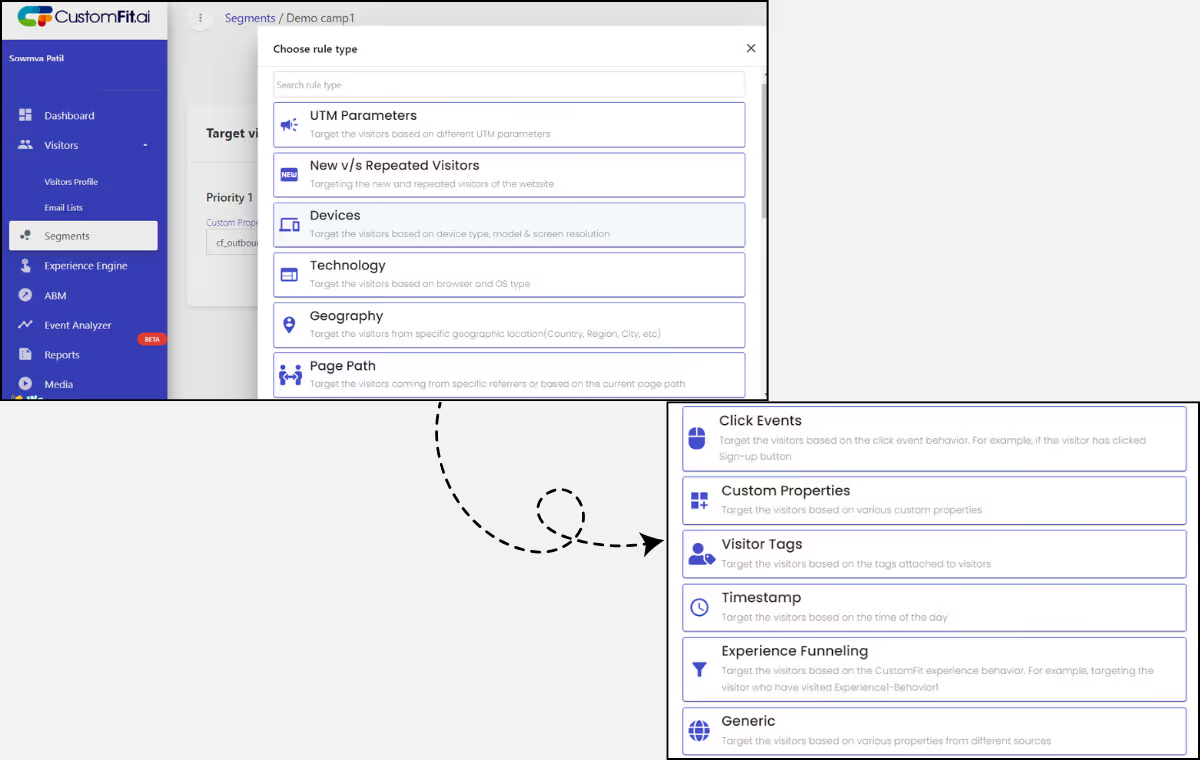
Once you've learned what works broadly through A/B testing, you can use personalization to show different experiences to new visitors, returning customers, or traffic from specific campaigns.
Here's the workflow, explained practically.
A/B testing works only when you know what you're trying to answer.
Examples of strong questions:
A weak question: "What if we change everything and see what happens?"
Testing requires direction.
Start with pages closest to your revenue:
This is where testing produces meaningful results, not vanity metrics.
Examples:
Choose one goal per test:
Without a clear metric, results become confusing.
This is where the testing platform does its work.
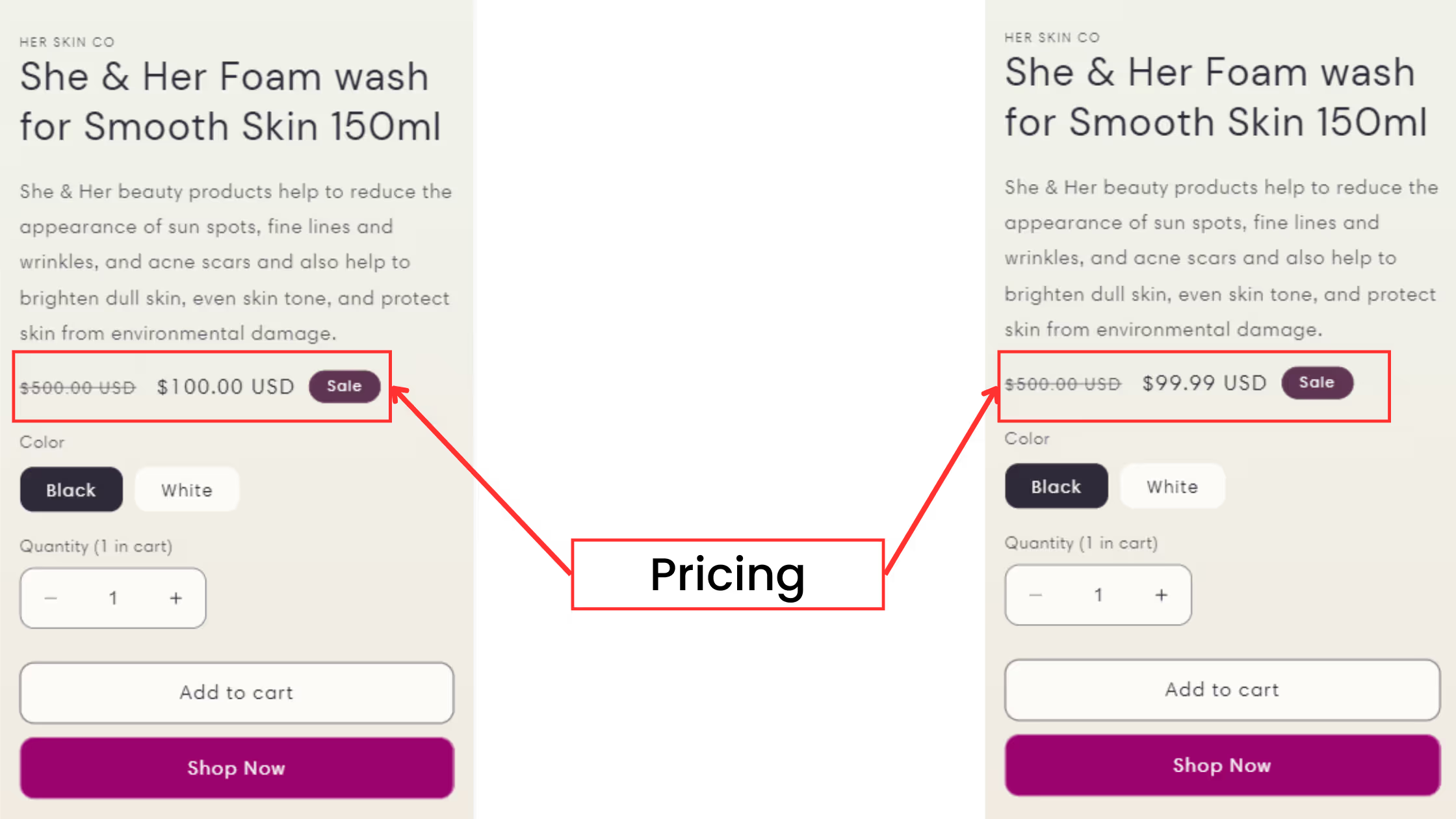
For example:
Variation A (control): standard product page layout.
Variation B (test): reviews moved higher, shipping note added near price.
Or:
Variation A: checkout with default headline. Variation B: checkout with reassurance copy.
CustomFit.ai lets you set these variations visually, so you don't need to edit PrestaShop templates each time.
Basic rules:
CustomFit.ai tracks which version leads to more conversions.
When the test completes, study:
This is how learning happens. If Variant B wins, roll it out permanently on your PrestaShop store. If results are inconclusive, refine and retest.
Here are real examples that PrestaShop merchants can adapt.
Test ideas:
Small trust cues can noticeably influence conversions.
Test ideas:
Category pages often make or break product discovery.
Test ideas:
Even small checkout changes can raise revenue per visitor.
Test ideas:
Offers should be tested, not assumed.
Avoid these to save time and traffic.
If everything changes, you learn nothing. Start small.
Let the test run long enough to smooth out randomness.
Mobile shoppers behave differently. Test with them in mind.
"We believe X will increase Y because Z." This gives your test purpose.
Once you know what works broadly, personalization lets you tailor content to:
CustomFit.ai supports both A/B testing and personalization, making it easier to evolve from simple experiments to tailored on-site experiences. This is where stores begin to see compounding improvements over time.
Concern about SEO is common. The reality:
Better user experiences produce better SEO signals: lower bounce rate, higher engagement, and more page exploration. A/B testing for SEO is practical and effective when done with a clean implementation.
Tools matter, but habits make the real difference.
A solid testing culture looks like:
This turns your PrestaShop store into a system that improves with every iteration.
If you're evaluating tools, start simple:
This approach builds improvement through evidence rather than guessing.
A/B testing on PrestaShop means creating two or more versions of a page or element and showing them to different visitor groups. With an A/B testing platform like CustomFit.ai, you can run these experiments without coding or modifying templates repeatedly.
A/B testing helps identify what layout, messaging, or structure actually improves conversions. Instead of assuming why customers drop off, you measure what works and increase conversion rate through evidence.
Yes. CustomFit.ai connects with PrestaShop and lets you visually create A/B tests and personalized experiences without rewriting theme files. It makes experimentation more accessible for ecommerce and D2C brands.
No. When implemented correctly, A/B testing does not hurt SEO. Google supports A/B testing as long as you don't cloak or show different content to bots. Better user experience often improves search performance indirectly.
Start with high-impact areas:
These tests often produce measurable improvements.
Yes. A practical approach is to begin with A/B testing, learn what works for most of your audience, and then personalize for specific segments. CustomFit.ai supports both on the same platform.
Not necessarily. Even smaller stores can benefit from well-designed tests focused on their highest-traffic pages. A few high-quality tests can reveal useful insights.
A realistic pace is one good test a month. Over a year, that's 12 measurable improvements. Over time, these small wins build toward large conversion gains.
Manual edits apply changes to everyone. If the change hurts conversions, you lose revenue. A/B testing with CustomFit.ai lets you safely compare versions and only roll out variations that are proven to perform better.
Each test removes friction, clarifies information, improves trust, or simplifies decisions. Over time, your PrestaShop store becomes easier to use and more aligned with what customers need, which leads to stable, long-term growth in conversions and revenue.