Avoid These 7 Holiday Conversion Killers: What Most Ecommerce Brands Miss on Their Website

Every holiday season, ecommerce stores pour money into traffic. Ads get more expensive, inboxes get louder, and shoppers bounce between tabs with a credit card in one hand and a deadline in the other.

From the brand side, it feels like this:

You have your offers live, your holiday creatives ready, and your warehouse on alert. Analytics shows traffic is higher than ever. But the orders do not match the effort.

Some people browse and leave. Others add to cart, then disappear. A few get all the way to checkout and still do not complete the purchase.

It is tempting to blame the market, your competition, or your product. But very often, the real problem is quieter and sits right inside the website experience.

This is where holiday conversion killers show up. Small UX decisions, unclear copy, or missing context that push people away at the very moment they are ready to buy.
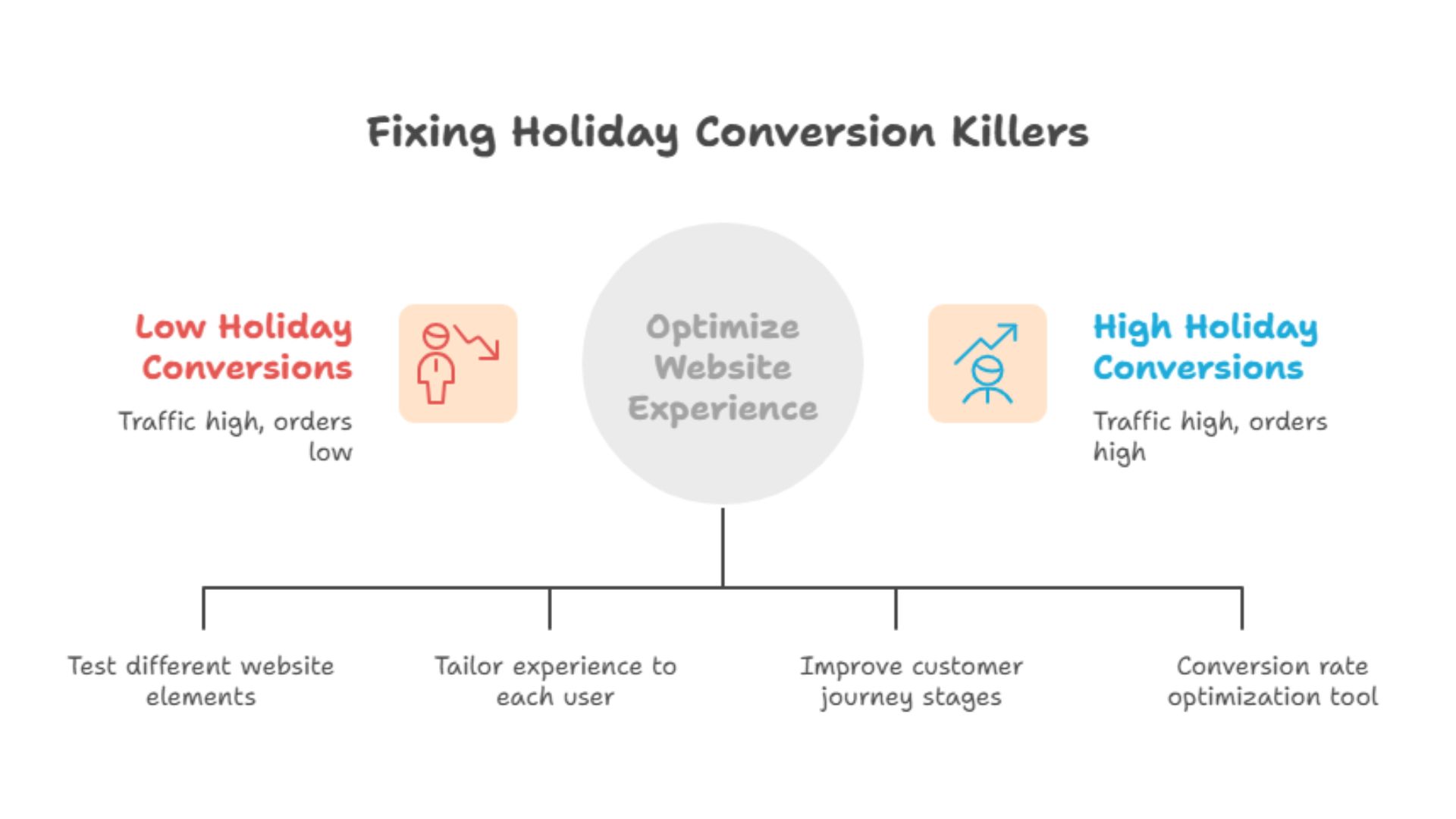
Fixing Holiday Conversion Killers

In this guide, we will walk through 7 holiday conversion killers that most ecommerce brands overlook, and how to fix them in a practical, testable way. We will talk about A/B Testing, personalization, Pre and post purchase experiences, and how a tool like CustomFit.ai, a conversion rate optimization company, can help your ecommerce store increase conversion rate without turning the season into chaos.

No hype, just very real problems and fixes you can apply.

Why Holidays Expose Every Weakness In Your Ecommerce Store

During most of the year, a small friction on your site is annoying but survivable. During holidays, it is expensive.

Holiday traffic is different because:

  • People are shopping with deadlines

  • Many orders are gifts, which adds emotional pressure

  • Shoppers are not loyal to tabs; they are comparing multiple sites at once

  • They are more sensitive to shipping dates, return policies, and trust signals

In that environment, every unnecessary step, every moment of confusion, and every slow page acts like a leak.

The good news: these leaks are fixable. An A/B Testing Platform, clear observation of your funnel, and simple design changes can rescue a lot of lost revenue.

Let us go through the 7 biggest holiday conversion killers and how to handle each one.

Conversion Killer 1: Slow, Unstable, And Overloaded Pages

Nothing kills intent faster than a page that hesitates.

During the holidays, your ecommerce store may experience traffic that it was not tested for. Suddenly:
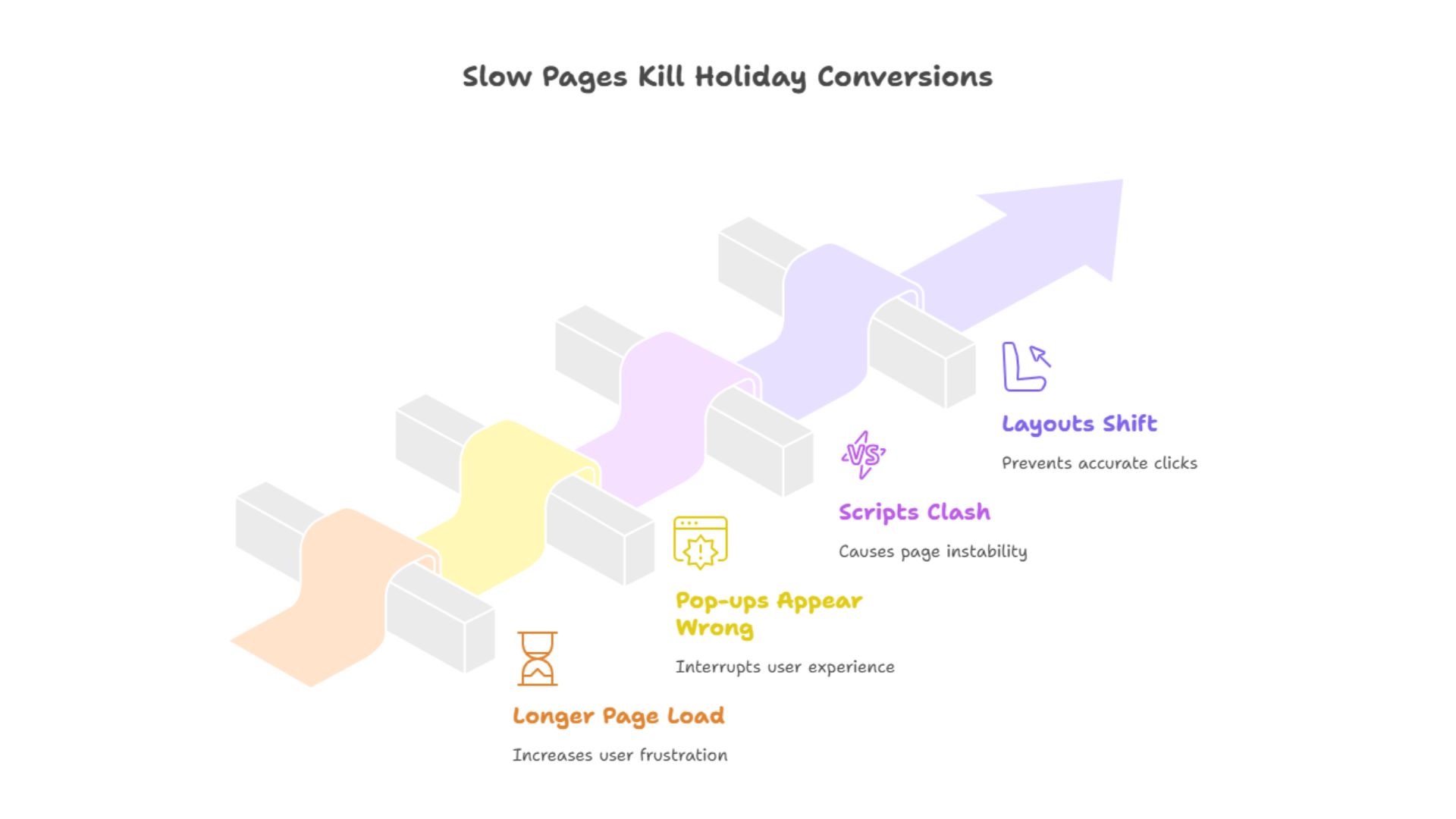
  • Pages take longer to load

  • Pop-ups appear at the wrong time

  • Scripts clash with each other

  • Layouts shift while the user is trying to click

Slow Pages Kill Holiday Conversions

If someone is already stressed about finding the right gift, a slow or unstable page feels like a sign to leave. They have plenty of other tabs waiting.

What this looks like in real life

  • The home page takes 5 seconds to load on mobile

  • The hero banner flickers while A/B Testing scripts load

  • The Add to Cart button moves because of delayed content

  • A pop-up blocks the screen before the user even sees the product

Some of this comes from unoptimized assets. Some of it comes from how you run A/B testing. If the scripts are not set to be flicker-free, users see one version, and then another appears over it.

What to do about it

  • Audit site speed before the holiday rush, especially on mobile

  • Compress large images and remove unused apps or scripts

  • Use an A/B Testing Platform that supports flicker-free tests

  • Avoid stacking multiple pop-ups, chat widgets, and banners all at once

  • Run a simple ab test on page speed optimizations and track conversion lift

Handled well, you can turn speed into a competitive advantage. Handled poorly, it becomes your first and biggest holiday conversion killer.

Conversion Killer 2: Generic Homepages That Ignore Intent

Many e-commerce brands treat the homepage like a poster instead of a decision-making tool.

During holidays, that hurts more. Shoppers do not have time to figure out where to go. They want clear paths:
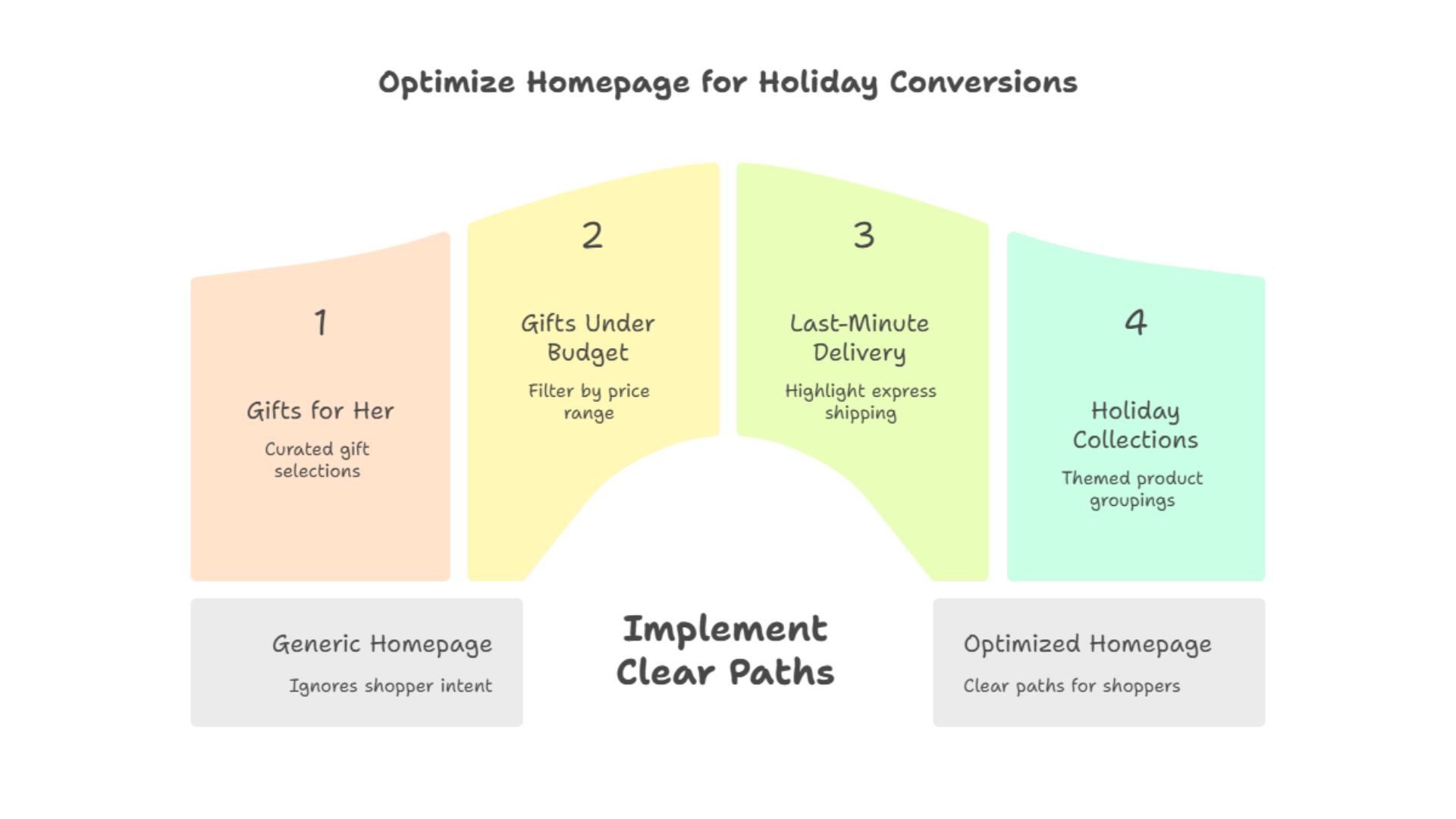
  • Gifts for her

  • Gifts under a certain budget

  • Last-minute delivery options

  • Holiday-specific collections

Optimize Homepage for Holiday Conversions

If your homepage looks the same as it did in August, you are forcing people to do extra mental work. Some will do it. Many will not.

Common signs of this problem

  • Your hero banner is still talking about “new arrivals” instead of holiday needs

  • There is no clear way to shop by budget or recipient

  • Visitors from ad campaigns land on a generic page that does not continue the ad message

  • Returning visitors see the exact same experience as first-timers.

This is where personalization and A/B testing work well together.

How to fix it

  • Create holiday-specific navigation paths (for example, “Gifts under 50,” “For parents,” “For coworkers”)

  • Use A/B Testing to try different hero messages, such as urgency vs curation

  • Set up simple personalizations with tools like CustomFit.ai so that campaign visitors see content that matches the ad they clicked

  • Make sure your homepage clearly answers “Who is this for?” and “What should I click next?” in under a few seconds

A homepage that respects holiday intent will quietly increase conversion rate without needing extra traffic.

Conversion Killer 3: Confusing Offers, Coupons, And Fine Print

Holiday shoppers are not just looking for discounts. They are looking for clarity.

Many stores accidentally create confusion instead of motivation. Here is how:
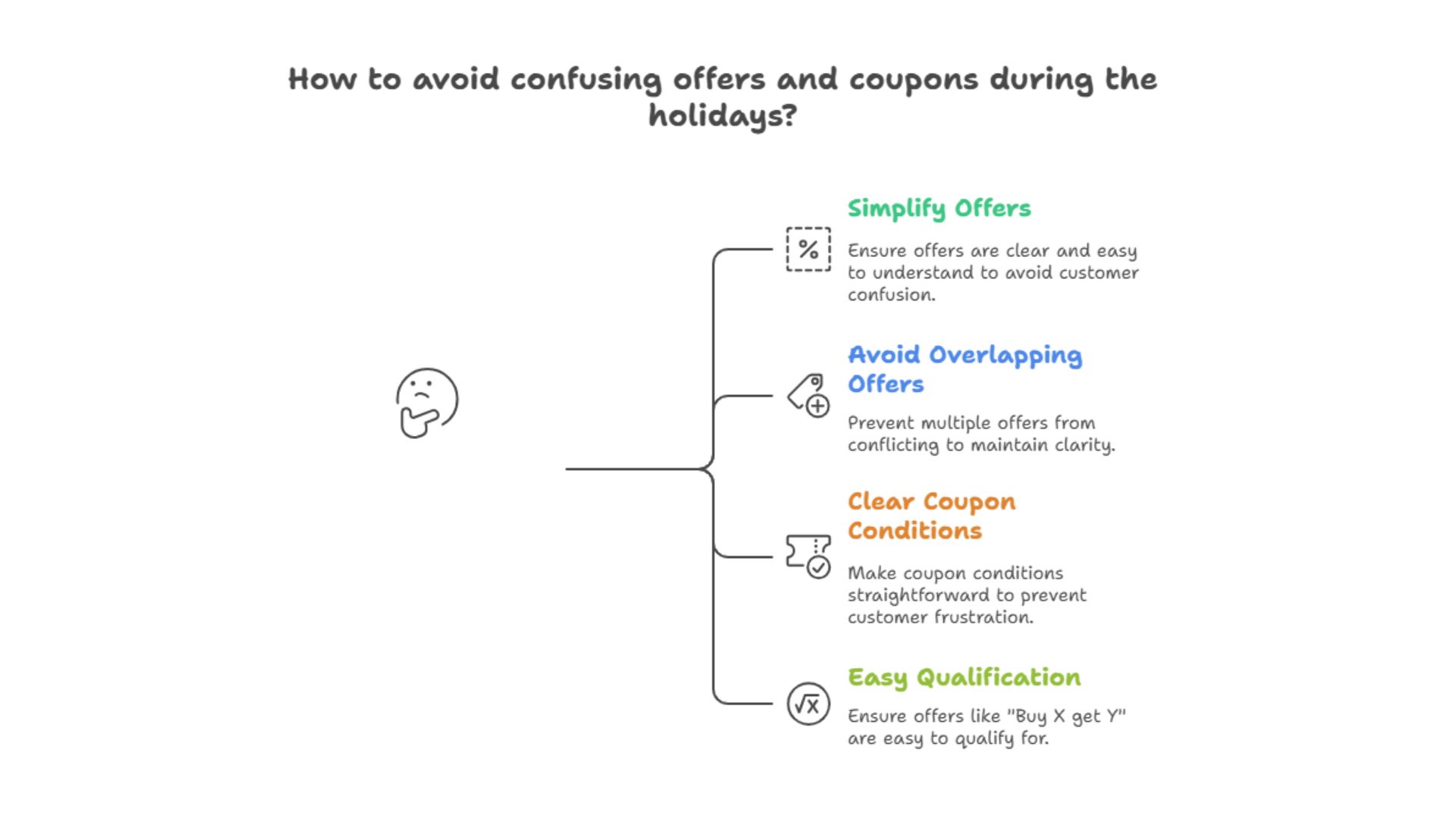
  • Multiple overlapping offers that do not work together

  • Coupon codes that only apply to specific products

  • Hidden conditions like “valid only on prepaid orders”

  • “Buy X get Y” offers that are hard to qualify for

How to avoid confusing offers and coupons during the holidays

When people feel tricked, they leave. They will not spend time decoding your rules, especially if other ecommerce stores make it simpler.

What confusion looks like in behavior

  • Shoppers add items to their cart and then remove them when the discount does not apply

  • People reach checkout and realize shipping or conditions have changed

  • Support channels fill up with “Why is my coupon not working?” questions

How to clean this up

  • Decide on one main holiday offer for each period instead of five competing ones

  • Make the offer text incredibly clear: what is included, what is excluded, and what the shopper needs to do

  • Show final prices early in the journey, not only in the last checkout step

  • Use A/B Testing to compare different ways of presenting the same offer

  • Test “no code needed” automatic discounts against coupon code versions

If you use a platform like CustomFit.ai, you can quickly set up an ab test for banner copy, cart messages, and promotion placement without rewriting your theme.

The goal is simple: no surprises. Clear offers build trust and reduce friction.

Conversion Killer 4: Weak Mobile Experience During Peak Season

Holiday shopping is heavily mobile, especially for D2C brands. Many customers browse on a phone, often in “in between” moments: on the couch, in a cab, between meetings.

If your ecommerce store feels even slightly clumsy on mobile, they will not fight it. They will move on.
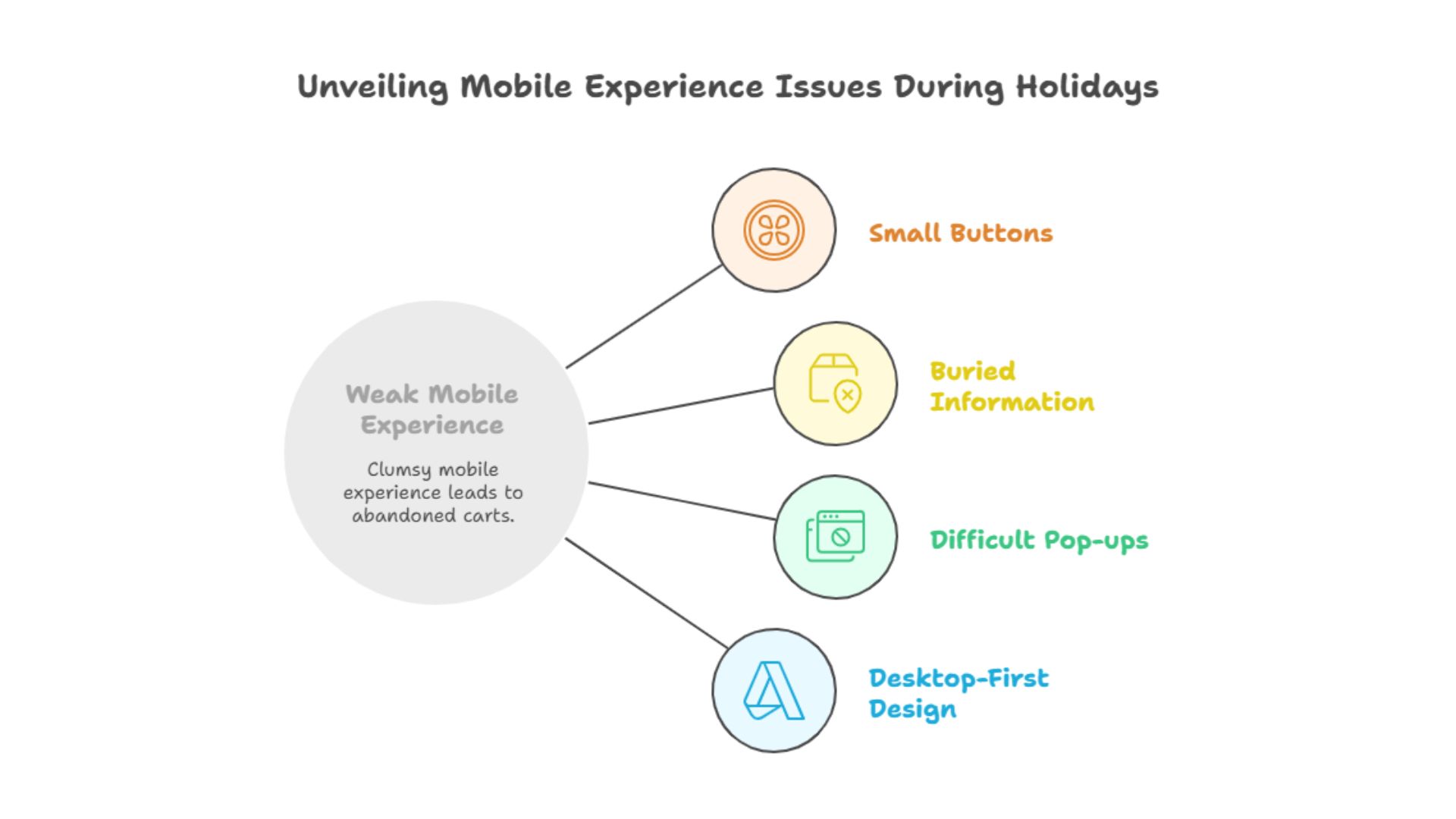
Typical mobile issues that show up more during holidays

  • Buttons too small or too close together

  • Important information like shipping dates buried below multiple scrolls

  • Pop ups difficult to close on smaller screens

  • Pages designed for desktop first, then “made responsive” as an afterthought

Unveiling Mobile Experience Issues During Holidays

Under normal traffic, you may get away with some of this. Under holiday pressure, you pay for it with abandoned carts.

How to fix holiday mobile friction

  • Test your entire funnel on a real phone, not just a responsive preview

  • Move critical information higher: last order date, shipping timelines, return policies

  • Simplify menus so people can reach key categories in one or two taps

  • Use an A/B Testing Platform to try different mobile layouts or button sizes

  • Track mobile and desktop separately in your ab testing results

A small mobile focused test, like making the Add to Cart button stickier or simplifying forms, can bring a noticeable increase in conversion rate when traffic spikes.

Conversion Killer 5: Forgetting Returning Visitors And Past Customers

Holiday marketing often behaves as if every visitor is brand new. But many of the people visiting your ecommerce store in November and December have seen you before. Some have even bought from you.

Treating them the same as first time visitors is a missed opportunity.

What most brands miss

  • No acknowledgment when a logged in customer returns

  • No personalized recommendations based on past browsing or orders

  • No reminders of loyalty points or benefits

  • Same generic banners and product blocks for everyone

This is where personalization can quietly outperform any new traffic campaign.

Practical ways to respect returning visitors

  • Show “Welcome back” messaging when someone returns, especially close to holidays

  • Highlight products related to their past purchases (like refills, upgrades, related categories)

  • Use CustomFit.ai or a similar tool to create segments such as “existing customers,” “high intent visitors,” or “cart abandoners,” then tailor messages to them

  • Test a returning customer specific offer versus a generic homepage experience

When a customer feels remembered rather than treated like a stranger, the chance of them buying again during the holidays increases significantly.

Conversion Killer 6: Missing Trust Signals For Gift Buyers

Holiday shopping involves risk. People are buying things for others, sometimes without knowing exactly what will be liked. They worry about:
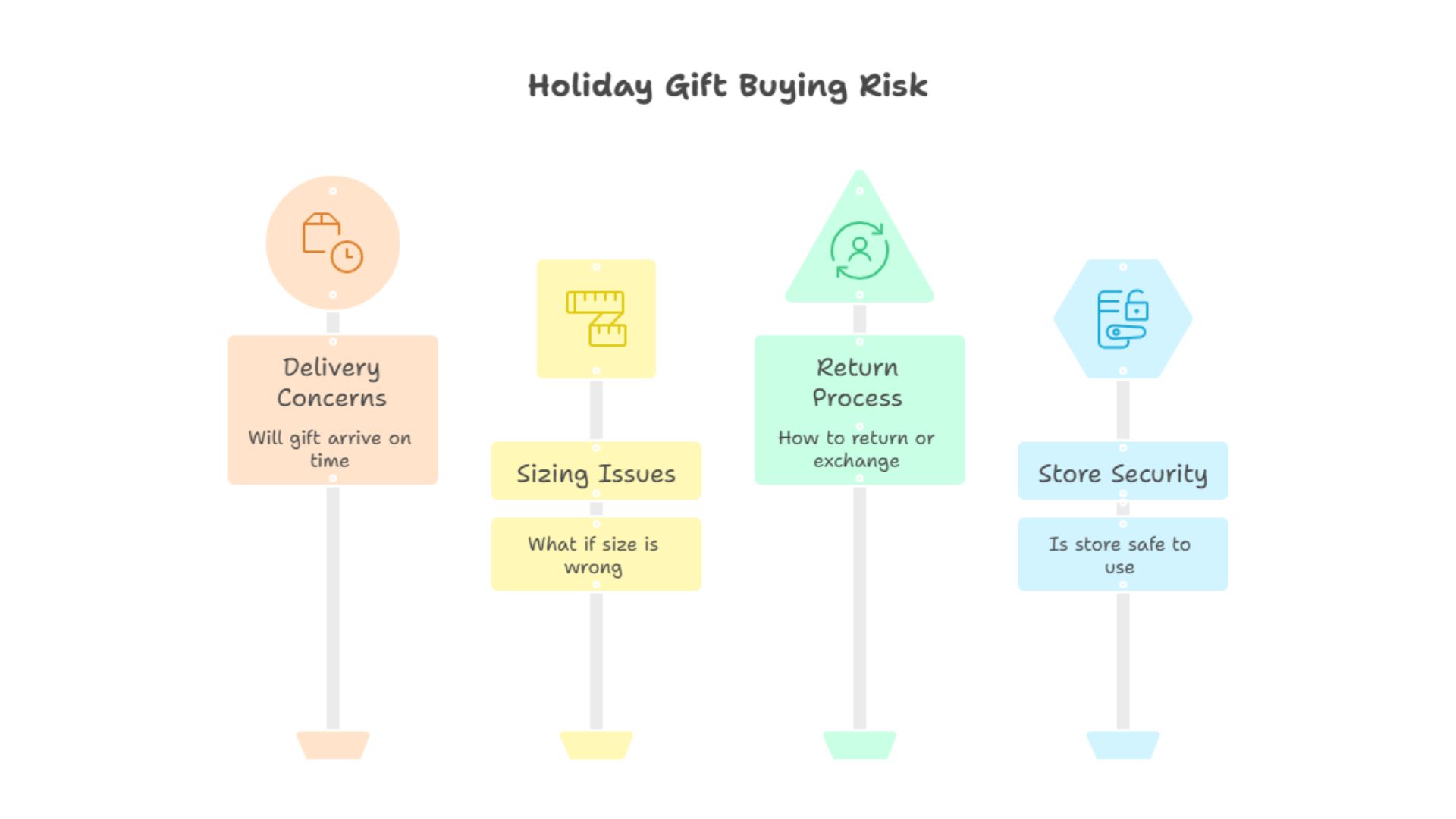
  • Will the gift arrive on time

  • What if the size is wrong

  • How to return or exchange

  • Whether the store is safe to use

Holiday Gift Buying Risk

Many ecommerce sites underplay these concerns. They either bury policies in the footer or talk about them in dry legal language.

Where trust gaps show up

  • No clear “Order by X date to get it by Christmas” type timelines

  • No visible returns and exchange policy near key CTAs

  • No trust badges or social proof on high intent pages

  • Gifting options like gift wrapping or notes hard to find

How to close these gaps

  • Make shipping timelines and cutoff dates extremely visible on product and cart pages

  • Bring your returns policy into a simple line near the price or Add to Cart button

  • Showcase reviews, ratings, and user photos for relevant products

  • Use A/B Testing to compare different placements for trust content and measure impact on completed orders

Trust is not only about security logos. It is about making the customer feel safe enough to buy, especially when the purchase is a gift.

Conversion Killer 7: Flying Blind Without Testing Or Measurement

The last and often biggest holiday conversion killer is not a specific UX issue. It is the habit of making big changes without measurement.

Common patterns:
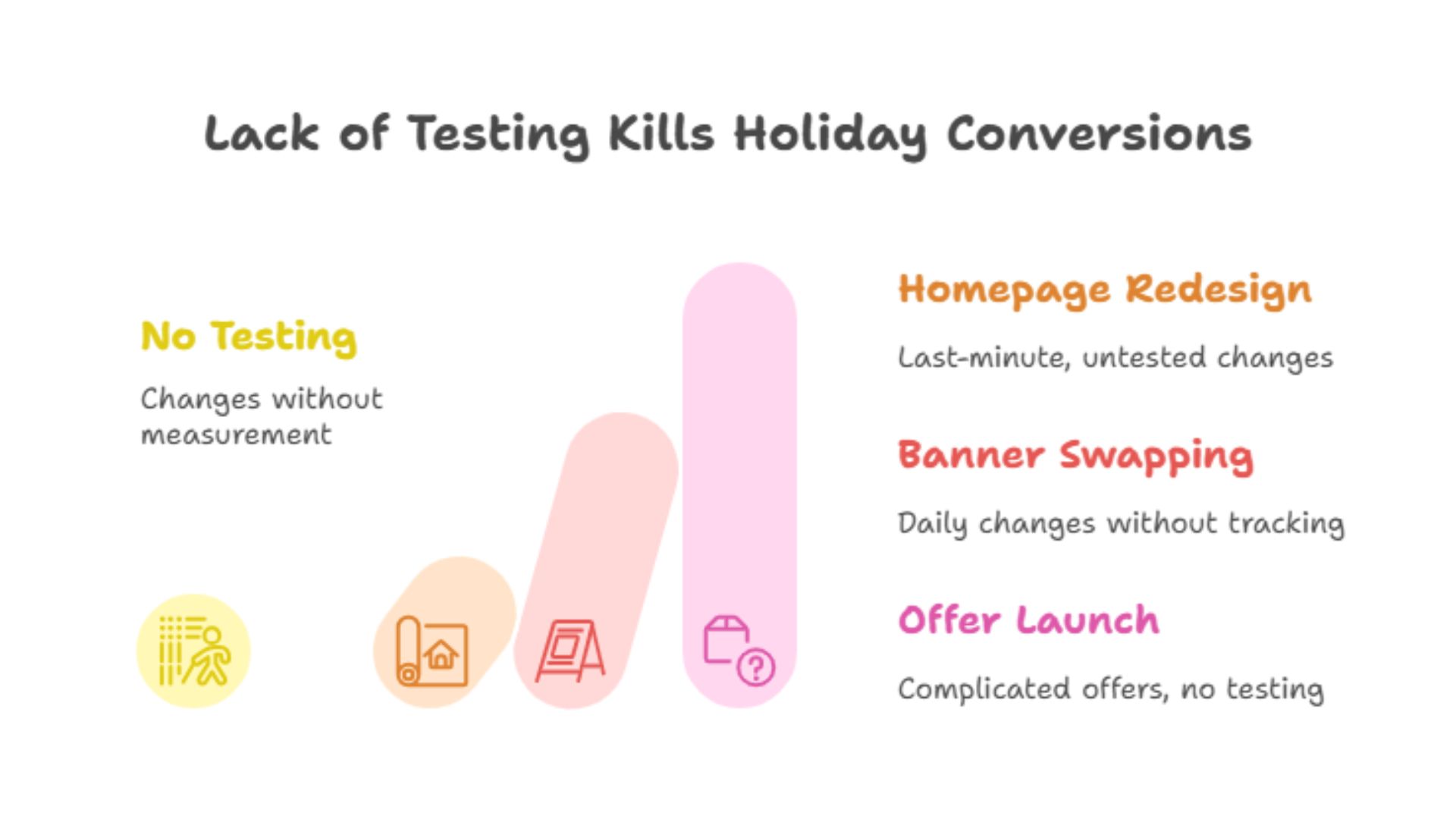
  • Completely redesigning the homepage the week before a sale

  • Swapping hero banners daily without tracking impact

  • Launching complicated offers without testing their effect on actual orders

Lack of Testing Kills Holiday Conversions

Without A/B Testing or solid analytics, you are guessing. Holiday season is not a good time for guesswork.

What a healthier approach looks like

  • Use A/B Testing to trial key ideas before the peak days

  • Focus on a few high impact experiments instead of constant reactive changes

  • Set up simple dashboards to monitor add to cart rate, checkout completion, and revenue per session during the season

  • Use AB Testing for SEO related elements too, such as how you present content on key landing pages, to improve engagement from organic visitors

Tools like CustomFit.ai make it easier to set up tests quickly, run them with a stable script, and roll winning versions out without constant developer involvement. That makes it more realistic to run experiments even when the calendar is packed.

The holiday period will always feel intense. The question is whether you let that intensity turn into chaos, or whether you build a system where decisions are grounded in behavior instead of guesswork.

Turning Holiday Traffic Into A Conversion System

If you strip away the seasonal graphics and colors, holiday optimization still comes down to the basics:

  • Respect people’s time

  • Reduce friction

  • Be honest and clear about offers

  • Make it easy to trust you

  • Learn from every change you make

The 7 holiday conversion killers we walked through sit exactly at these points. Slow pages, generic pages, confusing offers, weak mobile experiences, ignoring returning visitors, missing trust, and no testing - all of these are avoidable.

The most effective brands treat their ecommerce store like a live, learning system. They use A/B Testing to explore, personalization to respond, and clear content to support decisions.

A platform like CustomFit.ai can simplify that work by giving you a single place to run A/B Tests, set up personalizations, and measure results. But the mindset shift is what really matters: moving from “launch and hope” to “test, learn, and adapt.”

Holiday traffic is expensive. Letting those visitors slip away because of small, fixable issues is not.

FAQs: Holiday Conversion Killers And How To Fix Them

Below are some questions and answers you can use as an extended resource section. They include relevant keywords like holiday conversion killers, A/B Testing Platform, A/B Testing, AB Testing for SEO, ecommerce store, and increase conversion rate in a natural way.

Q1. What are the most common holiday conversion killers on an ecommerce website?

Holiday conversion killers are issues on your website that cause shoppers to drop off during peak season. The most common ones include slow or unstable pages, generic homepages that ignore holiday intent, confusing offers and coupon rules, weak mobile experiences, ignoring returning visitors, missing trust signals for gift buyers, and making big changes without A/B Testing or measurement.

Addressing these problems can significantly increase conversion rate during the holidays without requiring more ad spend.

Q2. How can an A/B Testing Platform help avoid holiday conversion killers?

An A/B Testing Platform lets you test different versions of pages, offers, and layouts on your ecommerce store before rolling them out to everyone. Instead of guessing whether a new banner, layout, or checkout copy will perform better, you run an A/B Test and measure results.

This is especially important during holidays, when traffic is expensive and behavior shifts. Testing key elements like hero messages, offer placements, and trust content can help you avoid changes that hurt performance and double down on the ones that improve conversions.

Q3. Does AB Testing for SEO make sense during the holidays?

Yes, AB Testing for SEO can be helpful during the holidays as long as it is implemented correctly. You can test how you structure content on key landing pages, how you present information for organic visitors, and how different layouts impact engagement metrics like bounce rate and time on site.

Search engines allow A/B Testing as long as you are not cloaking or serving one thing to bots and another to users. Holiday shoppers who land from search are in a hurry. If your tests help them find what they need more easily, both your conversions and your SEO performance benefit.

Q4. How can I make my homepage more effective during the holiday season?

To make your homepage more effective during holidays, focus on clarity and intent.

Practical steps:

  • Add clear paths for common holiday needs, such as “Gifts under $50” or “Last minute gifts”

  • Show deadline information like “Order by December X for guaranteed delivery”

  • Use A/B Testing to compare different hero messages and holiday layouts

  • Tailor content for campaign visitors with personalization tools such as CustomFit.ai

Your homepage should feel like a helpful guide, not a generic poster.

Q5. How important is mobile optimization for holiday conversions?

Mobile optimization is critical for holiday conversions. Many D2C and ecommerce shoppers browse and buy from their phones, often in rushed environments. If your mobile site is slow, cluttered, or confusing, they will abandon it quickly.

Use A/B Testing to try different mobile layouts, button sizes, and information placement. Make sure critical details like shipping, returns, and key offers are easy to see without endless scrolling. A small improvement in the mobile experience can have a large impact because of the volume of mobile traffic during the holidays.

Q6. How can I build more trust for gift buyers on my ecommerce store?

Gift buyers worry about delivery time, fit, quality, and returns. To build trust:

  • Make delivery cutoff dates extremely visible

  • Put your returns policy in simple language near key actions

  • Highlight reviews and real customer photos

  • Show trust signals near pricing and buy buttons

You can also use A/B Testing to see where trust messages work best. Tools like CustomFit.ai help you adjust placement and copy without heavy development work.

Q7. Do I need to personalize my website for holiday shoppers?

You do not need complex personalization to see benefits, but even basic personalization helps. For example, showing different content to returning customers, acknowledging past purchases, or adjusting banners based on traffic source can improve holiday performance.

Personalization becomes very effective when combined with A/B Testing. You can use A/B Tests to find what works for most people, then personalize for specific segments. A platform such as CustomFit.ai supports both, so your ecommerce store can move gradually from static experiences to responsive, tailored ones.

Q8. How often should I change my website during the holiday season?

You should not constantly change everything during the holidays. Instead, you should:

  • Prepare early and test key changes in advance using A/B Testing

  • Make a few high confidence updates based on test results

  • Avoid drastic last minute redesigns without data

The goal is stability with intelligent adjustments, not constant experimentation.

Q9. Can smaller ecommerce brands benefit from A/B Testing during holidays?

Yes. You do not need massive traffic to benefit from A/B Testing. Even smaller brands can run focused tests on their highest traffic pages, such as best selling product pages, cart, and checkout.

Small improvements, like adjusting offer copy or moving trust content, can bring noticeable lifts in conversions. Over time, these small wins stack up.

Q10. How does CustomFit.ai support holiday optimization?

CustomFit.ai helps ecommerce brands run A/B Testing and personalization on their websites without heavy coding. During holidays, this means you can:

  • Quickly test different banners, layouts, and offers

  • Personalize experiences for different visitor segments

  • Monitor the impact of changes on conversion rate in real time

Sapna Johar
CRO Engineer at Customfit.ai

Every holiday season, ecommerce stores pour money into traffic. Ads get more expensive, inboxes get louder, and shoppers bounce between tabs with a credit card in one hand and a deadline in the other.

From the brand side, it feels like this:

You have your offers live, your holiday creatives ready, and your warehouse on alert. Analytics shows traffic is higher than ever. But the orders do not match the effort.

Some people browse and leave. Others add to cart, then disappear. A few get all the way to checkout and still do not complete the purchase.

It is tempting to blame the market, your competition, or your product. But very often, the real problem is quieter and sits right inside the website experience.

This is where holiday conversion killers show up. Small UX decisions, unclear copy, or missing context that push people away at the very moment they are ready to buy.

Fixing Holiday Conversion Killers

In this guide, we will walk through 7 holiday conversion killers that most ecommerce brands overlook, and how to fix them in a practical, testable way. We will talk about A/B Testing, personalization, Pre and post purchase experiences, and how a tool like CustomFit.ai, a conversion rate optimization company, can help your ecommerce store increase conversion rate without turning the season into chaos.

No hype, just very real problems and fixes you can apply.

Why Holidays Expose Every Weakness In Your Ecommerce Store

During most of the year, a small friction on your site is annoying but survivable. During holidays, it is expensive.

Holiday traffic is different because:

  • People are shopping with deadlines

  • Many orders are gifts, which adds emotional pressure

  • Shoppers are not loyal to tabs; they are comparing multiple sites at once

  • They are more sensitive to shipping dates, return policies, and trust signals

In that environment, every unnecessary step, every moment of confusion, and every slow page acts like a leak.

The good news: these leaks are fixable. An A/B Testing Platform, clear observation of your funnel, and simple design changes can rescue a lot of lost revenue.

Let us go through the 7 biggest holiday conversion killers and how to handle each one.

Conversion Killer 1: Slow, Unstable, And Overloaded Pages

Nothing kills intent faster than a page that hesitates.

During the holidays, your ecommerce store may experience traffic that it was not tested for. Suddenly:

  • Pages take longer to load

  • Pop-ups appear at the wrong time

  • Scripts clash with each other

  • Layouts shift while the user is trying to click

Slow Pages Kill Holiday Conversions

If someone is already stressed about finding the right gift, a slow or unstable page feels like a sign to leave. They have plenty of other tabs waiting.

What this looks like in real life

  • The home page takes 5 seconds to load on mobile

  • The hero banner flickers while A/B Testing scripts load

  • The Add to Cart button moves because of delayed content

  • A pop-up blocks the screen before the user even sees the product

Some of this comes from unoptimized assets. Some of it comes from how you run A/B testing. If the scripts are not set to be flicker-free, users see one version, and then another appears over it.

What to do about it

  • Audit site speed before the holiday rush, especially on mobile

  • Compress large images and remove unused apps or scripts

  • Use an A/B Testing Platform that supports flicker-free tests

  • Avoid stacking multiple pop-ups, chat widgets, and banners all at once

  • Run a simple ab test on page speed optimizations and track conversion lift

Handled well, you can turn speed into a competitive advantage. Handled poorly, it becomes your first and biggest holiday conversion killer.

Conversion Killer 2: Generic Homepages That Ignore Intent

Many e-commerce brands treat the homepage like a poster instead of a decision-making tool.

During holidays, that hurts more. Shoppers do not have time to figure out where to go. They want clear paths:

  • Gifts for her

  • Gifts under a certain budget

  • Last-minute delivery options

  • Holiday-specific collections

Optimize Homepage for Holiday Conversions

If your homepage looks the same as it did in August, you are forcing people to do extra mental work. Some will do it. Many will not.

Common signs of this problem

  • Your hero banner is still talking about “new arrivals” instead of holiday needs

  • There is no clear way to shop by budget or recipient

  • Visitors from ad campaigns land on a generic page that does not continue the ad message

  • Returning visitors see the exact same experience as first-timers.

This is where personalization and A/B testing work well together.

How to fix it

  • Create holiday-specific navigation paths (for example, “Gifts under 50,” “For parents,” “For coworkers”)

  • Use A/B Testing to try different hero messages, such as urgency vs curation

  • Set up simple personalizations with tools like CustomFit.ai so that campaign visitors see content that matches the ad they clicked

  • Make sure your homepage clearly answers “Who is this for?” and “What should I click next?” in under a few seconds

A homepage that respects holiday intent will quietly increase conversion rate without needing extra traffic.

Conversion Killer 3: Confusing Offers, Coupons, And Fine Print

Holiday shoppers are not just looking for discounts. They are looking for clarity.

Many stores accidentally create confusion instead of motivation. Here is how:

  • Multiple overlapping offers that do not work together

  • Coupon codes that only apply to specific products

  • Hidden conditions like “valid only on prepaid orders”

  • “Buy X get Y” offers that are hard to qualify for

How to avoid confusing offers and coupons during the holidays

When people feel tricked, they leave. They will not spend time decoding your rules, especially if other ecommerce stores make it simpler.

What confusion looks like in behavior

  • Shoppers add items to their cart and then remove them when the discount does not apply

  • People reach checkout and realize shipping or conditions have changed

  • Support channels fill up with “Why is my coupon not working?” questions

How to clean this up

  • Decide on one main holiday offer for each period instead of five competing ones

  • Make the offer text incredibly clear: what is included, what is excluded, and what the shopper needs to do

  • Show final prices early in the journey, not only in the last checkout step

  • Use A/B Testing to compare different ways of presenting the same offer

  • Test “no code needed” automatic discounts against coupon code versions

If you use a platform like CustomFit.ai, you can quickly set up an ab test for banner copy, cart messages, and promotion placement without rewriting your theme.

The goal is simple: no surprises. Clear offers build trust and reduce friction.

Conversion Killer 4: Weak Mobile Experience During Peak Season

Holiday shopping is heavily mobile, especially for D2C brands. Many customers browse on a phone, often in “in between” moments: on the couch, in a cab, between meetings.

If your ecommerce store feels even slightly clumsy on mobile, they will not fight it. They will move on.

Typical mobile issues that show up more during holidays

  • Buttons too small or too close together

  • Important information like shipping dates buried below multiple scrolls

  • Pop ups difficult to close on smaller screens

  • Pages designed for desktop first, then “made responsive” as an afterthought

Unveiling Mobile Experience Issues During Holidays

Under normal traffic, you may get away with some of this. Under holiday pressure, you pay for it with abandoned carts.

How to fix holiday mobile friction

  • Test your entire funnel on a real phone, not just a responsive preview

  • Move critical information higher: last order date, shipping timelines, return policies

  • Simplify menus so people can reach key categories in one or two taps

  • Use an A/B Testing Platform to try different mobile layouts or button sizes

  • Track mobile and desktop separately in your ab testing results

A small mobile focused test, like making the Add to Cart button stickier or simplifying forms, can bring a noticeable increase in conversion rate when traffic spikes.

Conversion Killer 5: Forgetting Returning Visitors And Past Customers

Holiday marketing often behaves as if every visitor is brand new. But many of the people visiting your ecommerce store in November and December have seen you before. Some have even bought from you.

Treating them the same as first time visitors is a missed opportunity.

What most brands miss

  • No acknowledgment when a logged in customer returns

  • No personalized recommendations based on past browsing or orders

  • No reminders of loyalty points or benefits

  • Same generic banners and product blocks for everyone

This is where personalization can quietly outperform any new traffic campaign.

Practical ways to respect returning visitors

  • Show “Welcome back” messaging when someone returns, especially close to holidays

  • Highlight products related to their past purchases (like refills, upgrades, related categories)

  • Use CustomFit.ai or a similar tool to create segments such as “existing customers,” “high intent visitors,” or “cart abandoners,” then tailor messages to them

  • Test a returning customer specific offer versus a generic homepage experience

When a customer feels remembered rather than treated like a stranger, the chance of them buying again during the holidays increases significantly.

Conversion Killer 6: Missing Trust Signals For Gift Buyers

Holiday shopping involves risk. People are buying things for others, sometimes without knowing exactly what will be liked. They worry about:

  • Will the gift arrive on time

  • What if the size is wrong

  • How to return or exchange

  • Whether the store is safe to use

Holiday Gift Buying Risk

Many ecommerce sites underplay these concerns. They either bury policies in the footer or talk about them in dry legal language.

Where trust gaps show up

  • No clear “Order by X date to get it by Christmas” type timelines

  • No visible returns and exchange policy near key CTAs

  • No trust badges or social proof on high intent pages

  • Gifting options like gift wrapping or notes hard to find

How to close these gaps

  • Make shipping timelines and cutoff dates extremely visible on product and cart pages

  • Bring your returns policy into a simple line near the price or Add to Cart button

  • Showcase reviews, ratings, and user photos for relevant products

  • Use A/B Testing to compare different placements for trust content and measure impact on completed orders

Trust is not only about security logos. It is about making the customer feel safe enough to buy, especially when the purchase is a gift.

Conversion Killer 7: Flying Blind Without Testing Or Measurement

The last and often biggest holiday conversion killer is not a specific UX issue. It is the habit of making big changes without measurement.

Common patterns:

  • Completely redesigning the homepage the week before a sale

  • Swapping hero banners daily without tracking impact

  • Launching complicated offers without testing their effect on actual orders

Lack of Testing Kills Holiday Conversions

Without A/B Testing or solid analytics, you are guessing. Holiday season is not a good time for guesswork.

What a healthier approach looks like

  • Use A/B Testing to trial key ideas before the peak days

  • Focus on a few high impact experiments instead of constant reactive changes

  • Set up simple dashboards to monitor add to cart rate, checkout completion, and revenue per session during the season

  • Use AB Testing for SEO related elements too, such as how you present content on key landing pages, to improve engagement from organic visitors

Tools like CustomFit.ai make it easier to set up tests quickly, run them with a stable script, and roll winning versions out without constant developer involvement. That makes it more realistic to run experiments even when the calendar is packed.

The holiday period will always feel intense. The question is whether you let that intensity turn into chaos, or whether you build a system where decisions are grounded in behavior instead of guesswork.

Turning Holiday Traffic Into A Conversion System

If you strip away the seasonal graphics and colors, holiday optimization still comes down to the basics:

  • Respect people’s time

  • Reduce friction

  • Be honest and clear about offers

  • Make it easy to trust you

  • Learn from every change you make

The 7 holiday conversion killers we walked through sit exactly at these points. Slow pages, generic pages, confusing offers, weak mobile experiences, ignoring returning visitors, missing trust, and no testing - all of these are avoidable.

The most effective brands treat their ecommerce store like a live, learning system. They use A/B Testing to explore, personalization to respond, and clear content to support decisions.

A platform like CustomFit.ai can simplify that work by giving you a single place to run A/B Tests, set up personalizations, and measure results. But the mindset shift is what really matters: moving from “launch and hope” to “test, learn, and adapt.”

Holiday traffic is expensive. Letting those visitors slip away because of small, fixable issues is not.

FAQs: Holiday Conversion Killers And How To Fix Them

Below are some questions and answers you can use as an extended resource section. They include relevant keywords like holiday conversion killers, A/B Testing Platform, A/B Testing, AB Testing for SEO, ecommerce store, and increase conversion rate in a natural way.

Q1. What are the most common holiday conversion killers on an ecommerce website?

Holiday conversion killers are issues on your website that cause shoppers to drop off during peak season. The most common ones include slow or unstable pages, generic homepages that ignore holiday intent, confusing offers and coupon rules, weak mobile experiences, ignoring returning visitors, missing trust signals for gift buyers, and making big changes without A/B Testing or measurement.

Addressing these problems can significantly increase conversion rate during the holidays without requiring more ad spend.

Q2. How can an A/B Testing Platform help avoid holiday conversion killers?

An A/B Testing Platform lets you test different versions of pages, offers, and layouts on your ecommerce store before rolling them out to everyone. Instead of guessing whether a new banner, layout, or checkout copy will perform better, you run an A/B Test and measure results.

This is especially important during holidays, when traffic is expensive and behavior shifts. Testing key elements like hero messages, offer placements, and trust content can help you avoid changes that hurt performance and double down on the ones that improve conversions.

Q3. Does AB Testing for SEO make sense during the holidays?

Yes, AB Testing for SEO can be helpful during the holidays as long as it is implemented correctly. You can test how you structure content on key landing pages, how you present information for organic visitors, and how different layouts impact engagement metrics like bounce rate and time on site.

Search engines allow A/B Testing as long as you are not cloaking or serving one thing to bots and another to users. Holiday shoppers who land from search are in a hurry. If your tests help them find what they need more easily, both your conversions and your SEO performance benefit.

Q4. How can I make my homepage more effective during the holiday season?

To make your homepage more effective during holidays, focus on clarity and intent.

Practical steps:

  • Add clear paths for common holiday needs, such as “Gifts under $50” or “Last minute gifts”

  • Show deadline information like “Order by December X for guaranteed delivery”

  • Use A/B Testing to compare different hero messages and holiday layouts

  • Tailor content for campaign visitors with personalization tools such as CustomFit.ai

Your homepage should feel like a helpful guide, not a generic poster.

Q5. How important is mobile optimization for holiday conversions?

Mobile optimization is critical for holiday conversions. Many D2C and ecommerce shoppers browse and buy from their phones, often in rushed environments. If your mobile site is slow, cluttered, or confusing, they will abandon it quickly.

Use A/B Testing to try different mobile layouts, button sizes, and information placement. Make sure critical details like shipping, returns, and key offers are easy to see without endless scrolling. A small improvement in the mobile experience can have a large impact because of the volume of mobile traffic during the holidays.

Q6. How can I build more trust for gift buyers on my ecommerce store?

Gift buyers worry about delivery time, fit, quality, and returns. To build trust:

  • Make delivery cutoff dates extremely visible

  • Put your returns policy in simple language near key actions

  • Highlight reviews and real customer photos

  • Show trust signals near pricing and buy buttons

You can also use A/B Testing to see where trust messages work best. Tools like CustomFit.ai help you adjust placement and copy without heavy development work.

Q7. Do I need to personalize my website for holiday shoppers?

You do not need complex personalization to see benefits, but even basic personalization helps. For example, showing different content to returning customers, acknowledging past purchases, or adjusting banners based on traffic source can improve holiday performance.

Personalization becomes very effective when combined with A/B Testing. You can use A/B Tests to find what works for most people, then personalize for specific segments. A platform such as CustomFit.ai supports both, so your ecommerce store can move gradually from static experiences to responsive, tailored ones.

Q8. How often should I change my website during the holiday season?

You should not constantly change everything during the holidays. Instead, you should:

  • Prepare early and test key changes in advance using A/B Testing

  • Make a few high confidence updates based on test results

  • Avoid drastic last minute redesigns without data

The goal is stability with intelligent adjustments, not constant experimentation.

Q9. Can smaller ecommerce brands benefit from A/B Testing during holidays?

Yes. You do not need massive traffic to benefit from A/B Testing. Even smaller brands can run focused tests on their highest traffic pages, such as best selling product pages, cart, and checkout.

Small improvements, like adjusting offer copy or moving trust content, can bring noticeable lifts in conversions. Over time, these small wins stack up.

Q10. How does CustomFit.ai support holiday optimization?

CustomFit.ai helps ecommerce brands run A/B Testing and personalization on their websites without heavy coding. During holidays, this means you can:

  • Quickly test different banners, layouts, and offers

  • Personalize experiences for different visitor segments

  • Monitor the impact of changes on conversion rate in real time