Best Visually Alternative for Shopify A/B Testing: CustomFit.ai

Running a Shopify store today means you are constantly balancing two realities. On one hand, you need to deliver a polished, intuitive online shopping experience. On the other hand, you are expected to test, update, refine, and adjust your website without slowing down sales or involving a full engineering team every time.

This is exactly why so many Shopify brands look for visual A/B Testing tools. A visual editor allows marketers, founders, and growth teams to make changes on the page, test ideas quickly, and measure what works without writing code.

Visually.io has been one of the tools that attempted to solve this need. It offered a visual editor, personalization capabilities, and experiment management. But Shopify brands evolve, and so do the demands placed on their tools. Many ecommerce founders want something simpler, faster, flicker free, more focused on Shopify’s unique structure, and easier to operate without depending on developers.

This is where CustomFit.ai enters the conversation as a strong Visually alternative for Shopify A/B Testing. Not because it tries to do everything, but because it focuses on doing the most important things extremely well: A/B Testing, personalization, and real time content modification on Shopify stores. It is built to help ecommerce, especially d2c brands, increase conversion rate using experiments and tailored experiences that feel native to Shopify.

This blog will explore why Shopify brands are searching for an alternative to Visually.io, what limitations they face with visual experimentation tools, and how CustomFit.ai becomes a practical, clean, and powerful alternative without turning into a fully bloated platform.

We will cover real world scenarios, testing frameworks, examples of experiments, and how to use AB Testing for SEO, personalization, and revenue uplift in a way that feels natural to Shopify merchants.

This is not a pitch. It is a clear, honest breakdown of what a Shopify brand truly needs from an A/B Testing Platform in 2025, especially if they are replacing Visually.io.

Let us start with the fundamentals.

Why Shopify Brands Look for Visual A/B Testing Tools

A visual editor changes the pace of optimization. When someone on your team can enter a page, click on an element, modify text or layout, and launch an ab test instantly, the entire velocity of experimentation changes.

Without a visual editor, every small change becomes a ticket in your engineering backlog. That means:

  • Tests take too long to set up

  • Small improvements get deprioritized

  • Teams stop experimenting

  • Optimizations become reactive instead of strategic

Shopify merchants in particular rely heavily on visual editors because Shopify themes can be rigid. You do not always want to dive into Liquid files. You want a safer, simpler way to test changes before committing them to your live theme.

Tools like Visually.io originally gained traction because they promised:

  • Drag and drop experiments

  • No code content editing

  • Visual personalization

  • Faster iteration

But as Shopify stores scaled and testing needs matured, limitations started to show. That is why many brands began exploring alternatives that felt more native to their workflows.

Where Visually.io Falls Short for Modern Shopify Stores

Visually.io has strengths, but several practical challenges keep appearing in conversations with Shopify brands. These are not dramatic failures. They are simply friction points that matter deeply when you depend on testing to drive revenue.
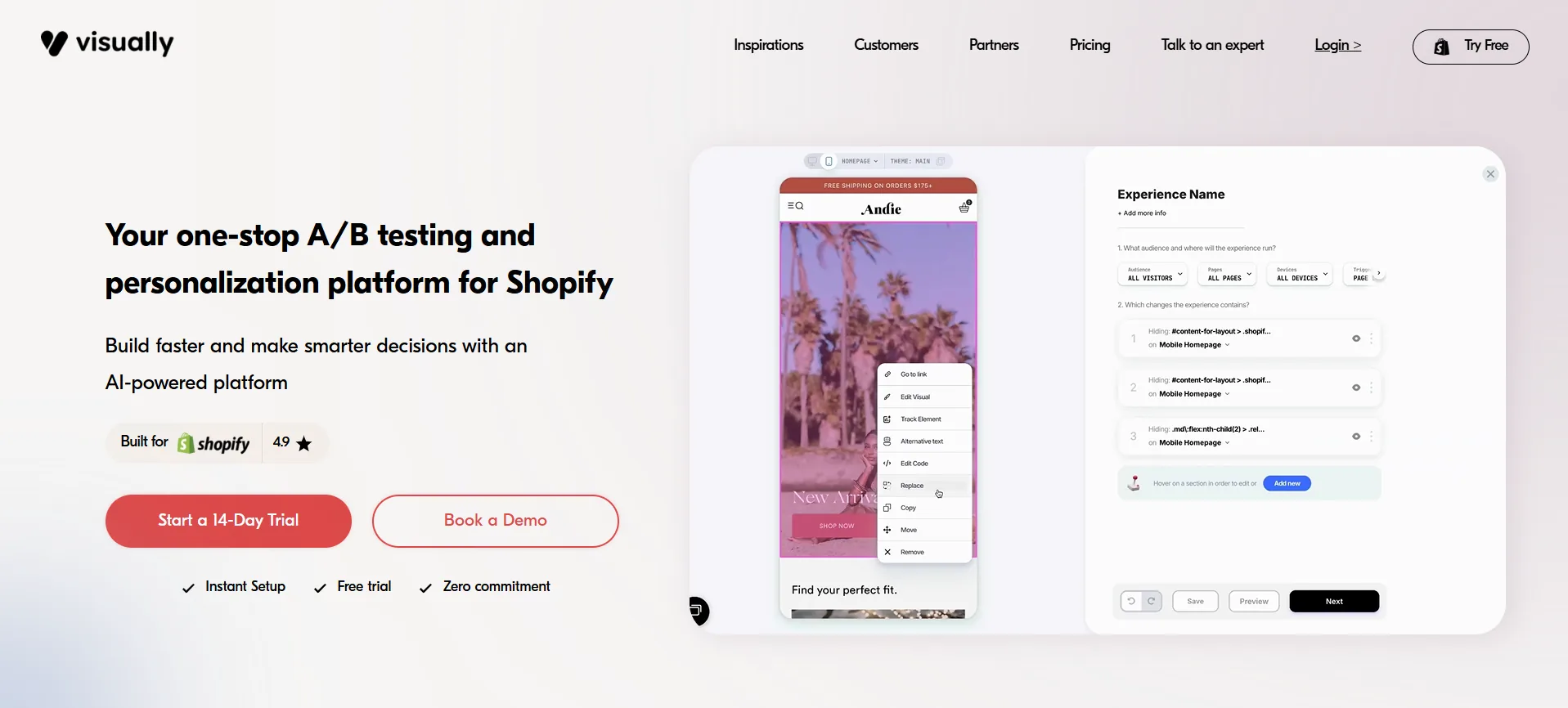
visually.io

1. Too many features, not enough focus

A Shopify brand does not need a platform overloaded with hundreds of options. They need a clean, reliable, flicker free A/B Testing Platform that runs fast on their store and does not add weight to page load.

Visually’s broad scope sometimes makes the experience feel heavier than necessary.

2. Shopify specific behavior needs Shopify specific solutions

Shopify themes, apps, dynamic sections, cart behaviors, and metafields are unique. An experimentation tool must understand these patterns deeply. Tools built for generic websites often struggle with:

  • Dynamic selectors

  • Theme editor updates

  • Script conflicts

  • Shopify app behaviors

3. Experiments must load without flicker

If a visitor sees your original version before the test version loads, the entire experiment becomes unreliable. It also hurts user trust and can impact engagement metrics that matter for SEO.

A flicker free experience is non negotiable for serious A/B Testing.

4. Many Shopify merchants want personalization built into the same platform

A pure A/B Testing tool is great, but when the holiday season arrives or when a new marketing campaign launches, brands want to instantly adjust content for:

  • New visitors

  • Returning customers

  • High intent users

  • Geo based traffic

  • Campaign traffic

  • Offer audiences

This is easier when A/B Testing and personalization sit in one place.

These gaps created an opportunity for a more streamlined, ecommerce focused platform that feels like a natural part of Shopify instead of a heavy add on.

That alternative is CustomFit.ai.
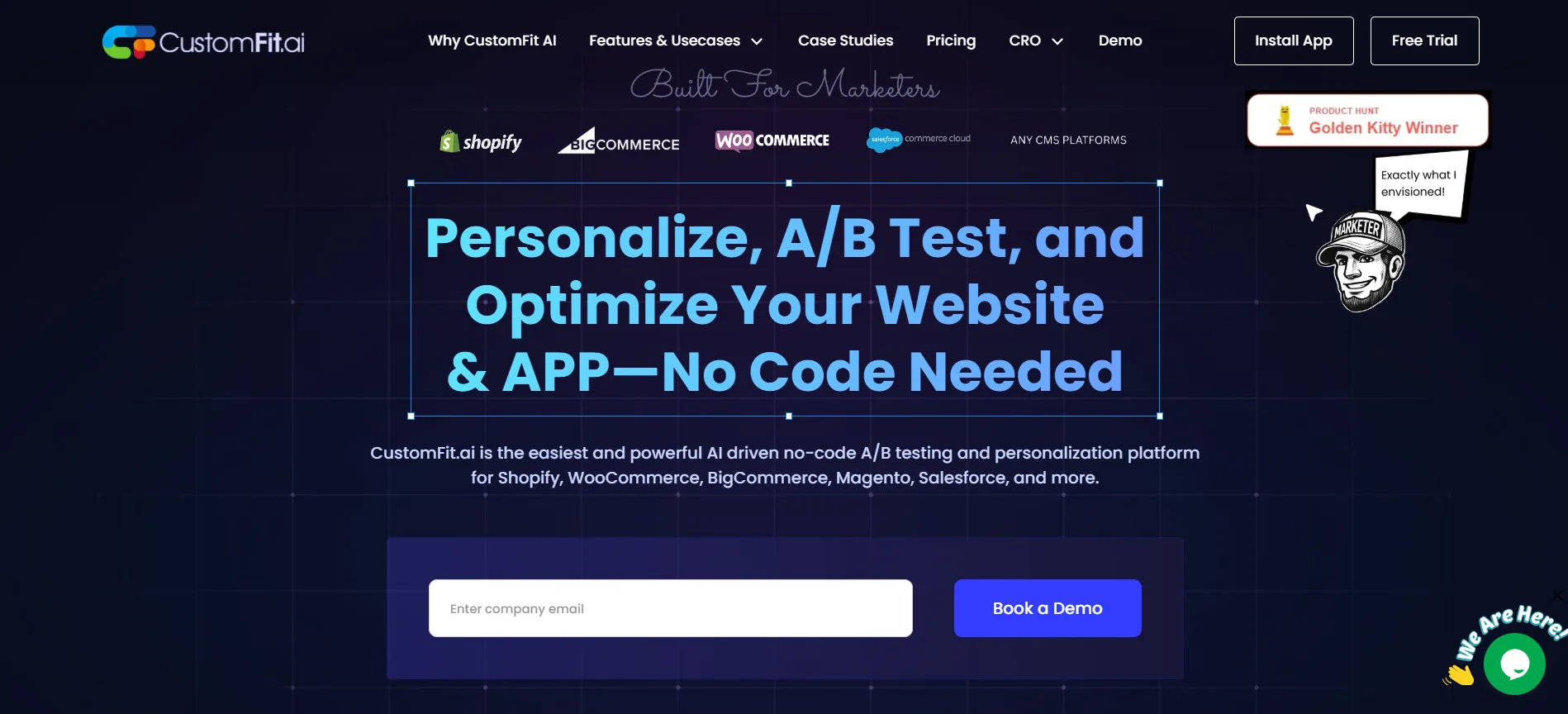
What Makes CustomFit.ai a Strong Alternative to Visually.io for Shopify A/B Testing

customfit.ai

CustomFit.ai is not a clone of Visually. It is not trying to replicate everything. Instead, it focuses on the parts that matter most to Shopify merchants:

  • Visual editing

  • A/B Testing

  • Personalization

  • Flicker free content changes

  • Fast load times

  • Shopify native integrations

And all of this without making the platform feel overwhelming.
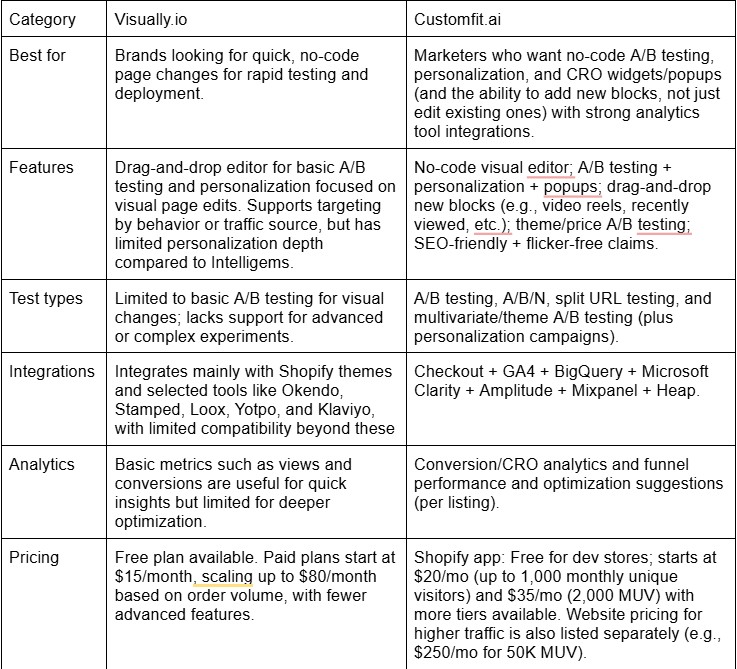
1. A Visual Editor Designed for Shopify Behavior

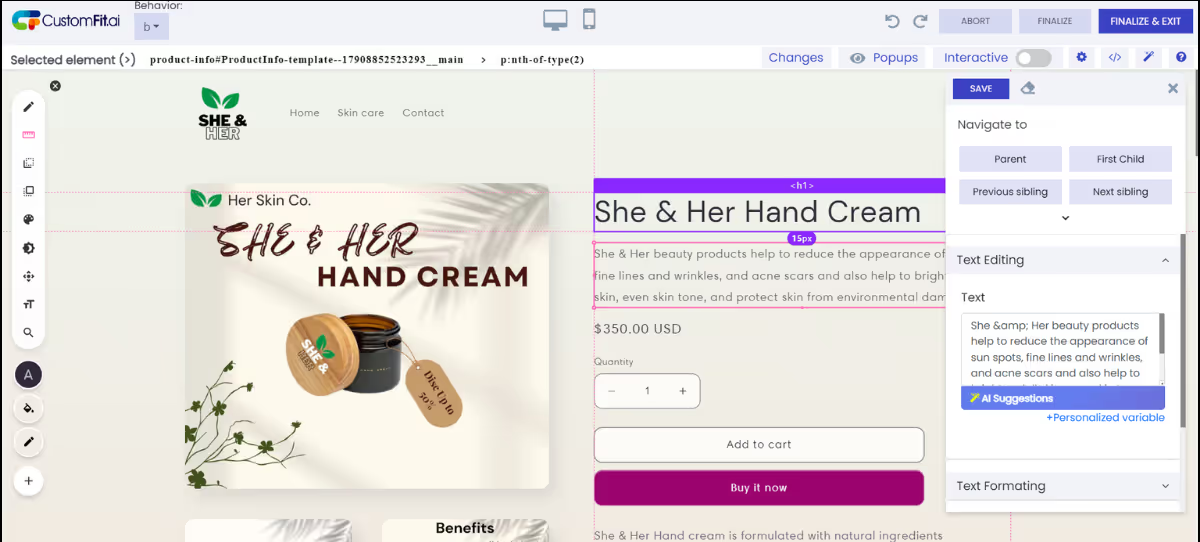
The editor works with dynamic Shopify structures, including:
  • Sections

  • Blocks

  • Product pages

  • Collection layouts

  • Cart snippets

  • Announcement bars

customfit Visual Editor

This means your tests apply cleanly without breaking your theme.

2. Lightweight script optimized for performance

A testing tool should never hurt your site speed. CustomFit.ai’s script is intentionally small, optimized to load early, and designed to prevent flicker.

For Shopify stores that rely heavily on paid traffic, this matters because a slow experience lowers conversion rate.

3. A/B Testing and personalization in the same place

You can run tests on elements, offers, banners, layouts, and messaging, and then use personalization rules to deliver the right version to the right user group.

Modern d2c brands want personalization because not every visitor behaves the same way.

4. No code setup

Marketers and founders can run experiments. Engineers do not need to touch Liquid files every time.
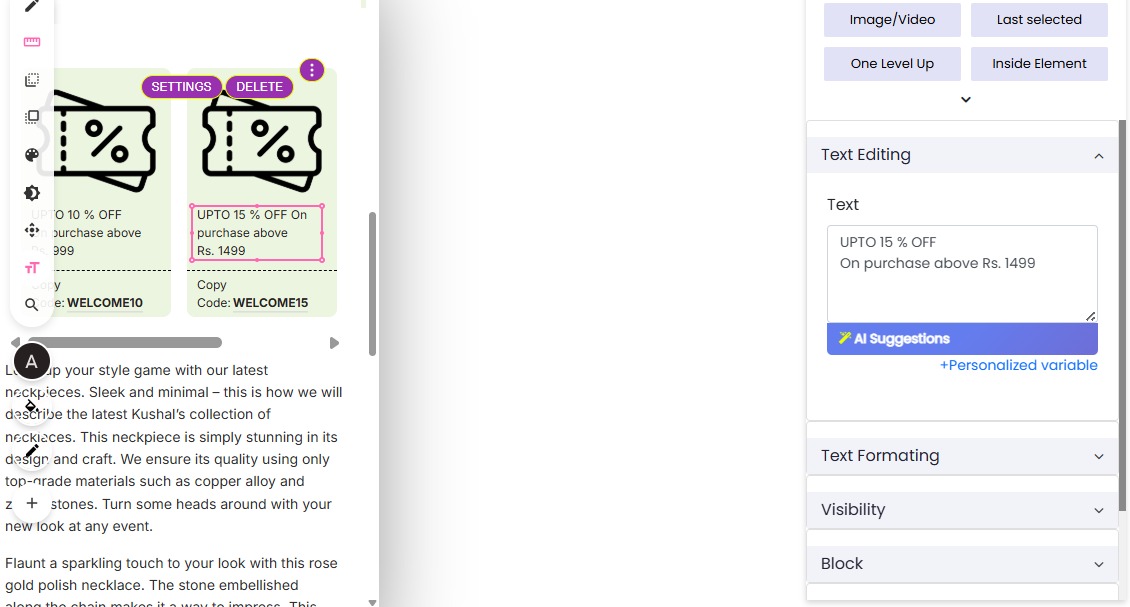
 No code setup customfit.ai

5. Built with actual ecommerce workflows in mind

CustomFit.ai understands how Shopify brands think. Testing is not academic. It is practical. It is about:

  • Increasing add to cart

  • Reducing cart abandonment

  • Improving checkout completion

  • Testing shipping messages

  • Experimenting with price anchoring

  • Highlighting social proof

  • Optimizing hero banners

Tools must speak the language of ecommerce, not generic experimentation logic.

CustomFit enables seamless A/B testing and personalised optimisation.

Download the CustomFit A/B Testing App from Shopify today!

What a Shopify Brand Actually Needs from a Visually Alternative

Let us break this down into real checkboxes that teams look for.

You need:

  • A visual editor that works with Shopify’s ever changing front end

  • A/B Testing that loads instantly

  • The ability to test without breaking your theme

  • A way to track Shopify specific metrics

  • A tool that someone non technical can use

  • Personalization for different audience segments

  • A safe layer so experiments never disrupt live revenue

  • Testing that improves SEO, not hurts it

If a platform cannot satisfy these, the brand eventually looks elsewhere.

CustomFit.ai satisfies these requirements without feeling bloated or intimidating.

Real Shopify A/B Testing Examples You Can Run with CustomFit.ai

Replacing Visually.io with CustomFit.ai only makes sense if the tool helps you run practical experiments quickly. Here are real experiments you can run on a Shopify store to increase conversion rate.

1. Homepage Hero Test

Version A: Standard product focused hero
Version B: Clean value proposition with holiday shipping deadline

Success metric: Click through into collections

2. Collection Page Layout Test

Version A: Three column grid
Version B: Two column layout with larger images

Success metric: Product page views per session

3. Add to Cart Button Test

Version A: Add to Cart
Version B: Add to Bag or Buy Now

Success metric: Add to cart rate

4. Trust Badge Placement Test

Version A: Trust badges below the fold
Version B: Trust badges near the price and CTA

Success metric: Checkout initiation

5. Shipping Message Experiment

Version A: Free shipping over 50
Version B: Order before Friday to get it by Christmas

Success metric: Checkout completion

6. Social Proof Highlight Test

Version A: Reviews at bottom
Version B: Reviews directly under title

Success metric: Add to cart or scroll depth

7. Offer Banner Test

Version A: Code required
Version B: Auto applied discount

Success metric: Sales per session

These types of tests are simple to launch, easy to understand, and directly linked to revenue outcomes.

A tool like CustomFit.ai allows you to move from idea to experiment without waiting weeks for development support.

How CustomFit.ai Supports SEO Friendly A/B Testing

Many merchants worry that A/B Testing might hurt SEO. This concern is valid because flicker, slow scripts, or content mismatches can cause issues.

Google is fine with A/B Testing as long as:

  • You do not cloak

  • You do not hide content from bots

  • Experiments run cleanly and consistently

CustomFit.ai is built with AB Testing for SEO in mind. The script loads early and prevents layout shifts. This means:

  • Your LCP stays healthy

  • Your CLS remains stable

  • Your mobile experience remains intact

A/B Testing should improve SEO by improving user behavior signals, not harm it.

Personalization: The Missing Half of Most Testing Tools

Visual experiments are powerful. But ecommerce behavior is rarely one size fits all.

A returning customer should not see the same homepage as someone visiting from Instagram for the first time. A high intent user who viewed a product three times should not see the same content as a user casually browsing.

Visually.io attempts personalization, but Shopify brands often want something simpler and focused on ecommerce goals.

CustomFit.ai addresses this by offering personalization rules such as:

  • First time vs returning

  • Cart abandoners

  • Visitors from Meta ads

  • Visitors from TikTok

  • High engagement visitors

  • Geo based shoppers

  • Product browsing patterns

This allows you to build experiences that adapt to each visitor, without heavy setup or a complex decision engine.

Personalization becomes especially helpful during major shopping seasons like Black Friday, Cyber Monday, and Christmas, where intent varies widely.

Why CustomFit.ai Feels More “Shopify Native” Than Visually.io

When Shopify merchants test CustomFit.ai, they often describe it as a tool that feels closer to the Shopify mindset. It focuses on what matters to ecommerce brands, rather than being an all purpose editor trying to please every type of website.

Shopify is unique. A Shopify A/B Testing Platform must understand:

  • How themes update

  • How apps inject scripts

  • How carts behave

  • How dynamic blocks render

  • How variants load

  • How the checkout is managed externally

This understanding makes experiments smoother and more stable.

CustomFit.ai was built with these constraints in mind, making it a practical Visually alternative that works with Shopify, not against it.

The Real Value: Velocity of Experiments

A/B Testing works only when you can run many experiments over time. One test will not change your business. Twenty will. Fifty will. One hundred will.

Visual editors increase that velocity.

But only if they are fast and intuitive.
Only if they do not require engineering every time.
Only if they do not slow down your site.

CustomFit.ai’s workflow helps Shopify brands:

  • Launch experiments faster

  • Iterate based on results

  • Personalize for segments

  • Roll out winning changes instantly

  • Keep everything flicker free and fast

When the tool disappears into your workflow, you know it is working well.

The Transactional Side: Why Shopify Stores Prefer CustomFit.ai’s Model

Shopify merchants are practical. They want:

  • Transparent pricing

  • Predictable performance

  • Minimal developer involvement

  • Fast onboarding

  • Simple integration

CustomFit.ai keeps installation simple:

  • Add the script

  • Verify store

  • Start testing

There are no heavy modules, no complicated theme rewrites, and no long integration timelines. It lets Shopify merchants start with one test, see results, and expand naturally.

This lowers the barrier to experimentation and helps merchants increase conversion rate without stress.
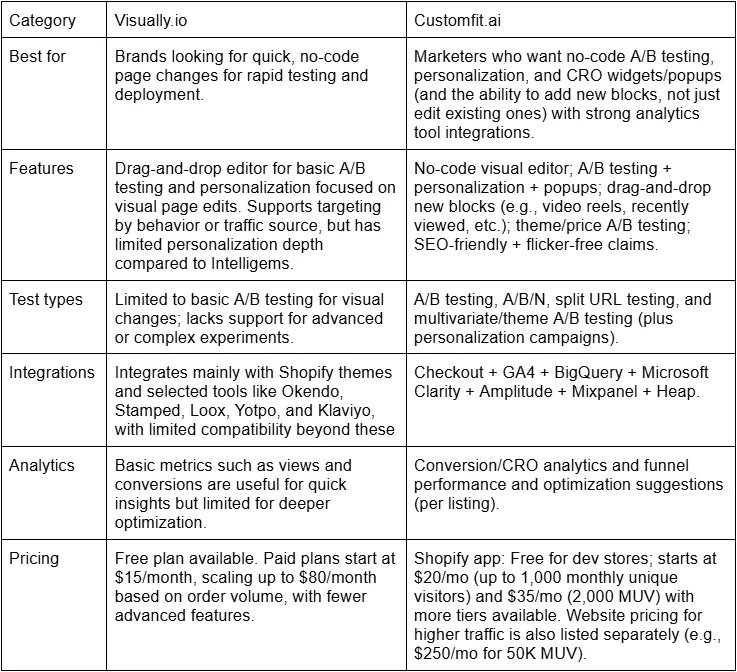
Conclusion: A Practical, Human Reason to Choose CustomFit.ai Over Visually.io

Visual testing tools matter. Shopify brands rely on A/B Testing and personalization to understand behavior and improve their store experience.

Visually.io helped create awareness around visual editing, but Shopify merchants today need something more focused, more lightweight, and more ecommerce oriented.

CustomFit.ai steps into that role with a clean, Shopify aware system that supports:

  • Visual A/B Testing

  • Ecommerce personalization

  • Flicker free changes

  • Fast load times

  • Real world ecommerce experiments

  • SEO friendly testing behavior

It becomes not just a Visually alternative, but a more intuitive layer of control over your Shopify store.

Testing stops feeling like a technical inconvenience. It becomes a natural part of growth.

For a Shopify brand, that shift is often worth more than any specific feature.

FAQs: Best Visually Alternative for Shopify A/B Testing

Q1. What is the best Visually alternative for Shopify A/B Testing?

CustomFit.ai is one of the strongest Visually.io alternatives for Shopify stores because it offers a visual editor, A/B Testing Platform capabilities, personalization, fast script performance, and Shopify native behavior. Merchants can run experiments without coding and improve their ecommerce store through evidence based changes.

Q2. Why should I switch from Visually.io to CustomFit.ai?

Shopify stores need a tool that understands Shopify’s dynamic structure, loads without flicker, supports fast A/B Testing, and allows non technical teams to experiment. CustomFit.ai is lightweight, intuitive, and built specifically for ecommerce optimization.

Q3. Does CustomFit.ai offer a visual A/B Testing Platform like Visually.io?

Yes. CustomFit.ai allows Shopify merchants to visually edit pages, create variations, publish ab tests, and track performance. It works with Shopify sections and blocks, making testing smooth and stable.

Q4. Is A/B Testing safe for SEO on Shopify?

Yes. AB Testing for SEO is safe when implemented correctly. Google supports A/B Testing as long as you avoid cloaking and keep user experiences consistent. CustomFit.ai is built to be SEO friendly and prevents layout shifts that harm Core Web Vitals.

Q5. What experiments can I run on Shopify using CustomFit.ai?

You can test hero banners, CTA buttons, product page layouts, collection sorting, shipping messages, trust badges, offer banners, social proof placement, and more. The platform lets you launch experiments without touching Liquid code.

Q6. Can I use personalization and A/B Testing together?

Yes. CustomFit.ai supports both. You can run a test to find what works best overall, then personalize for returning customers, high intent users, or campaign specific visitors.

Q7. Do I need a developer to run A/B Tests with CustomFit.ai?

No. The visual editor allows non technical users to set up tests. Developers are needed only for deeper custom implementations if required.

Q8. How does CustomFit.ai help increase conversion rate on Shopify?

By making experiments simpler to execute, faster to deploy, and easier to understand. The platform turns optimization into a continuous process instead of occasional redesigns.

Q9. Does CustomFit.ai load experiments without flicker?

Yes. The script is built for fast execution and stable rendering. That means visitors see the correct variation immediately, improving both conversion and user trust.

Q10. Can CustomFit.ai replace Visually.io entirely?

For most Shopify stores, yes. It provides visual editing, A/B Testing, personalization, stable performance, and an ecommerce focused workflow that fits seamlessly with Shopify.

Sapna Johar
CRO Engineer at Customfit.ai

Running a Shopify store today means you are constantly balancing two realities. On one hand, you need to deliver a polished, intuitive online shopping experience. On the other hand, you are expected to test, update, refine, and adjust your website without slowing down sales or involving a full engineering team every time.

This is exactly why so many Shopify brands look for visual A/B Testing tools. A visual editor allows marketers, founders, and growth teams to make changes on the page, test ideas quickly, and measure what works without writing code.

Visually.io has been one of the tools that attempted to solve this need. It offered a visual editor, personalization capabilities, and experiment management. But Shopify brands evolve, and so do the demands placed on their tools. Many ecommerce founders want something simpler, faster, flicker free, more focused on Shopify’s unique structure, and easier to operate without depending on developers.

This is where CustomFit.ai enters the conversation as a strong Visually alternative for Shopify A/B Testing. Not because it tries to do everything, but because it focuses on doing the most important things extremely well: A/B Testing, personalization, and real time content modification on Shopify stores. It is built to help ecommerce, especially d2c brands, increase conversion rate using experiments and tailored experiences that feel native to Shopify.

This blog will explore why Shopify brands are searching for an alternative to Visually.io, what limitations they face with visual experimentation tools, and how CustomFit.ai becomes a practical, clean, and powerful alternative without turning into a fully bloated platform.

We will cover real world scenarios, testing frameworks, examples of experiments, and how to use AB Testing for SEO, personalization, and revenue uplift in a way that feels natural to Shopify merchants.

This is not a pitch. It is a clear, honest breakdown of what a Shopify brand truly needs from an A/B Testing Platform in 2025, especially if they are replacing Visually.io.

Let us start with the fundamentals.

Why Shopify Brands Look for Visual A/B Testing Tools

A visual editor changes the pace of optimization. When someone on your team can enter a page, click on an element, modify text or layout, and launch an ab test instantly, the entire velocity of experimentation changes.

Without a visual editor, every small change becomes a ticket in your engineering backlog. That means:

  • Tests take too long to set up

  • Small improvements get deprioritized

  • Teams stop experimenting

  • Optimizations become reactive instead of strategic

Shopify merchants in particular rely heavily on visual editors because Shopify themes can be rigid. You do not always want to dive into Liquid files. You want a safer, simpler way to test changes before committing them to your live theme.

Tools like Visually.io originally gained traction because they promised:

  • Drag and drop experiments

  • No code content editing

  • Visual personalization

  • Faster iteration

But as Shopify stores scaled and testing needs matured, limitations started to show. That is why many brands began exploring alternatives that felt more native to their workflows.

Where Visually.io Falls Short for Modern Shopify Stores

Visually.io has strengths, but several practical challenges keep appearing in conversations with Shopify brands. These are not dramatic failures. They are simply friction points that matter deeply when you depend on testing to drive revenue.

visually.io

1. Too many features, not enough focus

A Shopify brand does not need a platform overloaded with hundreds of options. They need a clean, reliable, flicker free A/B Testing Platform that runs fast on their store and does not add weight to page load.

Visually’s broad scope sometimes makes the experience feel heavier than necessary.

2. Shopify specific behavior needs Shopify specific solutions

Shopify themes, apps, dynamic sections, cart behaviors, and metafields are unique. An experimentation tool must understand these patterns deeply. Tools built for generic websites often struggle with:

  • Dynamic selectors

  • Theme editor updates

  • Script conflicts

  • Shopify app behaviors

3. Experiments must load without flicker

If a visitor sees your original version before the test version loads, the entire experiment becomes unreliable. It also hurts user trust and can impact engagement metrics that matter for SEO.

A flicker free experience is non negotiable for serious A/B Testing.

4. Many Shopify merchants want personalization built into the same platform

A pure A/B Testing tool is great, but when the holiday season arrives or when a new marketing campaign launches, brands want to instantly adjust content for:

  • New visitors

  • Returning customers

  • High intent users

  • Geo based traffic

  • Campaign traffic

  • Offer audiences

This is easier when A/B Testing and personalization sit in one place.

These gaps created an opportunity for a more streamlined, ecommerce focused platform that feels like a natural part of Shopify instead of a heavy add on.

That alternative is CustomFit.ai.

What Makes CustomFit.ai a Strong Alternative to Visually.io for Shopify A/B Testing

customfit.ai

CustomFit.ai is not a clone of Visually. It is not trying to replicate everything. Instead, it focuses on the parts that matter most to Shopify merchants:

  • Visual editing

  • A/B Testing

  • Personalization

  • Flicker free content changes

  • Fast load times

  • Shopify native integrations

And all of this without making the platform feel overwhelming.

1. A Visual Editor Designed for Shopify Behavior

The editor works with dynamic Shopify structures, including:

  • Sections

  • Blocks

  • Product pages

  • Collection layouts

  • Cart snippets

  • Announcement bars

customfit Visual Editor

This means your tests apply cleanly without breaking your theme.

2. Lightweight script optimized for performance

A testing tool should never hurt your site speed. CustomFit.ai’s script is intentionally small, optimized to load early, and designed to prevent flicker.

For Shopify stores that rely heavily on paid traffic, this matters because a slow experience lowers conversion rate.

3. A/B Testing and personalization in the same place

You can run tests on elements, offers, banners, layouts, and messaging, and then use personalization rules to deliver the right version to the right user group.

Modern d2c brands want personalization because not every visitor behaves the same way.

4. No code setup

Marketers and founders can run experiments. Engineers do not need to touch Liquid files every time.

 No code setup customfit.ai

5. Built with actual ecommerce workflows in mind

CustomFit.ai understands how Shopify brands think. Testing is not academic. It is practical. It is about:

  • Increasing add to cart

  • Reducing cart abandonment

  • Improving checkout completion

  • Testing shipping messages

  • Experimenting with price anchoring

  • Highlighting social proof

  • Optimizing hero banners

Tools must speak the language of ecommerce, not generic experimentation logic.

CustomFit enables seamless A/B testing and personalised optimisation.

Download the CustomFit A/B Testing App from Shopify today!

What a Shopify Brand Actually Needs from a Visually Alternative

Let us break this down into real checkboxes that teams look for.

You need:

  • A visual editor that works with Shopify’s ever changing front end

  • A/B Testing that loads instantly

  • The ability to test without breaking your theme

  • A way to track Shopify specific metrics

  • A tool that someone non technical can use

  • Personalization for different audience segments

  • A safe layer so experiments never disrupt live revenue

  • Testing that improves SEO, not hurts it

If a platform cannot satisfy these, the brand eventually looks elsewhere.

CustomFit.ai satisfies these requirements without feeling bloated or intimidating.

Real Shopify A/B Testing Examples You Can Run with CustomFit.ai

Replacing Visually.io with CustomFit.ai only makes sense if the tool helps you run practical experiments quickly. Here are real experiments you can run on a Shopify store to increase conversion rate.

1. Homepage Hero Test

Version A: Standard product focused hero
Version B: Clean value proposition with holiday shipping deadline

Success metric: Click through into collections

2. Collection Page Layout Test

Version A: Three column grid
Version B: Two column layout with larger images

Success metric: Product page views per session

3. Add to Cart Button Test

Version A: Add to Cart
Version B: Add to Bag or Buy Now

Success metric: Add to cart rate

4. Trust Badge Placement Test

Version A: Trust badges below the fold
Version B: Trust badges near the price and CTA

Success metric: Checkout initiation

5. Shipping Message Experiment

Version A: Free shipping over 50
Version B: Order before Friday to get it by Christmas

Success metric: Checkout completion

6. Social Proof Highlight Test

Version A: Reviews at bottom
Version B: Reviews directly under title

Success metric: Add to cart or scroll depth

7. Offer Banner Test

Version A: Code required
Version B: Auto applied discount

Success metric: Sales per session

These types of tests are simple to launch, easy to understand, and directly linked to revenue outcomes.

A tool like CustomFit.ai allows you to move from idea to experiment without waiting weeks for development support.

How CustomFit.ai Supports SEO Friendly A/B Testing

Many merchants worry that A/B Testing might hurt SEO. This concern is valid because flicker, slow scripts, or content mismatches can cause issues.

Google is fine with A/B Testing as long as:

  • You do not cloak

  • You do not hide content from bots

  • Experiments run cleanly and consistently

CustomFit.ai is built with AB Testing for SEO in mind. The script loads early and prevents layout shifts. This means:

  • Your LCP stays healthy

  • Your CLS remains stable

  • Your mobile experience remains intact

A/B Testing should improve SEO by improving user behavior signals, not harm it.

Personalization: The Missing Half of Most Testing Tools

Visual experiments are powerful. But ecommerce behavior is rarely one size fits all.

A returning customer should not see the same homepage as someone visiting from Instagram for the first time. A high intent user who viewed a product three times should not see the same content as a user casually browsing.

Visually.io attempts personalization, but Shopify brands often want something simpler and focused on ecommerce goals.

CustomFit.ai addresses this by offering personalization rules such as:

  • First time vs returning

  • Cart abandoners

  • Visitors from Meta ads

  • Visitors from TikTok

  • High engagement visitors

  • Geo based shoppers

  • Product browsing patterns

This allows you to build experiences that adapt to each visitor, without heavy setup or a complex decision engine.

Personalization becomes especially helpful during major shopping seasons like Black Friday, Cyber Monday, and Christmas, where intent varies widely.

Why CustomFit.ai Feels More “Shopify Native” Than Visually.io

When Shopify merchants test CustomFit.ai, they often describe it as a tool that feels closer to the Shopify mindset. It focuses on what matters to ecommerce brands, rather than being an all purpose editor trying to please every type of website.

Shopify is unique. A Shopify A/B Testing Platform must understand:

  • How themes update

  • How apps inject scripts

  • How carts behave

  • How dynamic blocks render

  • How variants load

  • How the checkout is managed externally

This understanding makes experiments smoother and more stable.

CustomFit.ai was built with these constraints in mind, making it a practical Visually alternative that works with Shopify, not against it.

The Real Value: Velocity of Experiments

A/B Testing works only when you can run many experiments over time. One test will not change your business. Twenty will. Fifty will. One hundred will.

Visual editors increase that velocity.

But only if they are fast and intuitive.
Only if they do not require engineering every time.
Only if they do not slow down your site.

CustomFit.ai’s workflow helps Shopify brands:

  • Launch experiments faster

  • Iterate based on results

  • Personalize for segments

  • Roll out winning changes instantly

  • Keep everything flicker free and fast

When the tool disappears into your workflow, you know it is working well.

The Transactional Side: Why Shopify Stores Prefer CustomFit.ai’s Model

Shopify merchants are practical. They want:

  • Transparent pricing

  • Predictable performance

  • Minimal developer involvement

  • Fast onboarding

  • Simple integration

CustomFit.ai keeps installation simple:

  • Add the script

  • Verify store

  • Start testing

There are no heavy modules, no complicated theme rewrites, and no long integration timelines. It lets Shopify merchants start with one test, see results, and expand naturally.

This lowers the barrier to experimentation and helps merchants increase conversion rate without stress.

Conclusion: A Practical, Human Reason to Choose CustomFit.ai Over Visually.io

Visual testing tools matter. Shopify brands rely on A/B Testing and personalization to understand behavior and improve their store experience.

Visually.io helped create awareness around visual editing, but Shopify merchants today need something more focused, more lightweight, and more ecommerce oriented.

CustomFit.ai steps into that role with a clean, Shopify aware system that supports:

  • Visual A/B Testing

  • Ecommerce personalization

  • Flicker free changes

  • Fast load times

  • Real world ecommerce experiments

  • SEO friendly testing behavior

It becomes not just a Visually alternative, but a more intuitive layer of control over your Shopify store.

Testing stops feeling like a technical inconvenience. It becomes a natural part of growth.

For a Shopify brand, that shift is often worth more than any specific feature.

FAQs: Best Visually Alternative for Shopify A/B Testing

Q1. What is the best Visually alternative for Shopify A/B Testing?

CustomFit.ai is one of the strongest Visually.io alternatives for Shopify stores because it offers a visual editor, A/B Testing Platform capabilities, personalization, fast script performance, and Shopify native behavior. Merchants can run experiments without coding and improve their ecommerce store through evidence based changes.

Q2. Why should I switch from Visually.io to CustomFit.ai?

Shopify stores need a tool that understands Shopify’s dynamic structure, loads without flicker, supports fast A/B Testing, and allows non technical teams to experiment. CustomFit.ai is lightweight, intuitive, and built specifically for ecommerce optimization.

Q3. Does CustomFit.ai offer a visual A/B Testing Platform like Visually.io?

Yes. CustomFit.ai allows Shopify merchants to visually edit pages, create variations, publish ab tests, and track performance. It works with Shopify sections and blocks, making testing smooth and stable.

Q4. Is A/B Testing safe for SEO on Shopify?

Yes. AB Testing for SEO is safe when implemented correctly. Google supports A/B Testing as long as you avoid cloaking and keep user experiences consistent. CustomFit.ai is built to be SEO friendly and prevents layout shifts that harm Core Web Vitals.

Q5. What experiments can I run on Shopify using CustomFit.ai?

You can test hero banners, CTA buttons, product page layouts, collection sorting, shipping messages, trust badges, offer banners, social proof placement, and more. The platform lets you launch experiments without touching Liquid code.

Q6. Can I use personalization and A/B Testing together?

Yes. CustomFit.ai supports both. You can run a test to find what works best overall, then personalize for returning customers, high intent users, or campaign specific visitors.

Q7. Do I need a developer to run A/B Tests with CustomFit.ai?

No. The visual editor allows non technical users to set up tests. Developers are needed only for deeper custom implementations if required.

Q8. How does CustomFit.ai help increase conversion rate on Shopify?

By making experiments simpler to execute, faster to deploy, and easier to understand. The platform turns optimization into a continuous process instead of occasional redesigns.

Q9. Does CustomFit.ai load experiments without flicker?

Yes. The script is built for fast execution and stable rendering. That means visitors see the correct variation immediately, improving both conversion and user trust.

Q10. Can CustomFit.ai replace Visually.io entirely?

For most Shopify stores, yes. It provides visual editing, A/B Testing, personalization, stable performance, and an ecommerce focused workflow that fits seamlessly with Shopify.