From the conversion glossary
Concepts referenced in this article, defined.
Concepts referenced in this article, defined.
Run rigorous A/B tests and personalize every visit on Shopify or any storefront — no engineers required.
Cart abandonment rate averages 75% for Indian D2C brands. That means 3 out of 4 customers who added your product to their cart and started checkout — people who showed real purchase intent — left without buying. A well-structured cart abandonment sequence can recover 8–15% of those lost purchases. For a brand doing ₹10 lakh in monthly revenue, that is ₹80,000–150,000 in recovered revenue from one automated sequence. Here are the templates, timing, and tactics that work.
Before writing recovery emails, understand why customers abandon:
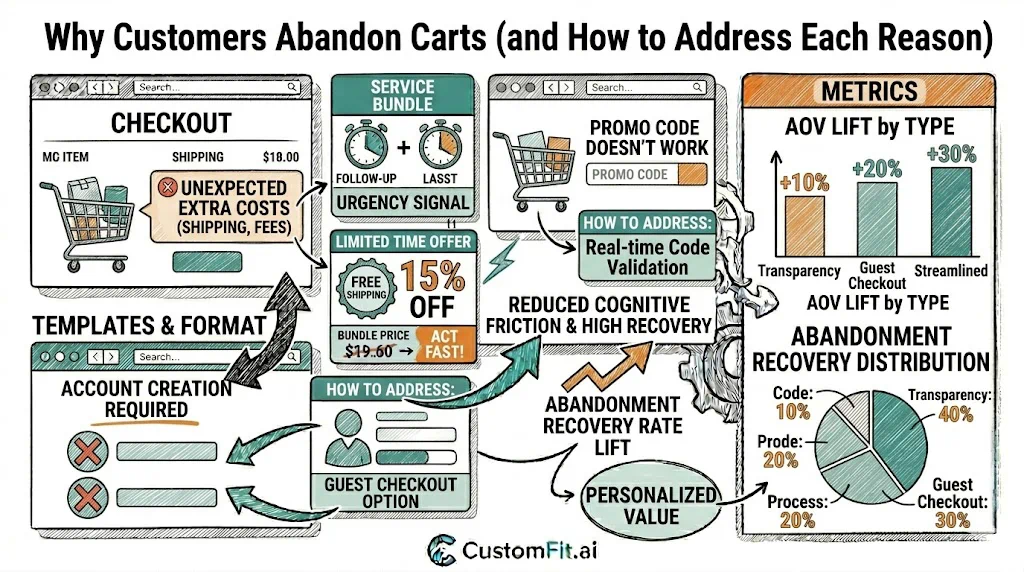
| Reason | % of Abandonment | Recovery Approach |
|---|---|---|
| Just browsing / not ready | 34% | Reminder + social proof |
| Shipping cost too high | 22% | Free shipping offer or threshold reminder |
| Forced account creation | 14% | Guest checkout reminder |
| Payment issues | 8% | Alternative payment options |
| General distraction | 12% | Simple reminder |
| Price concern | 10% | Value reinforcement or small offer |
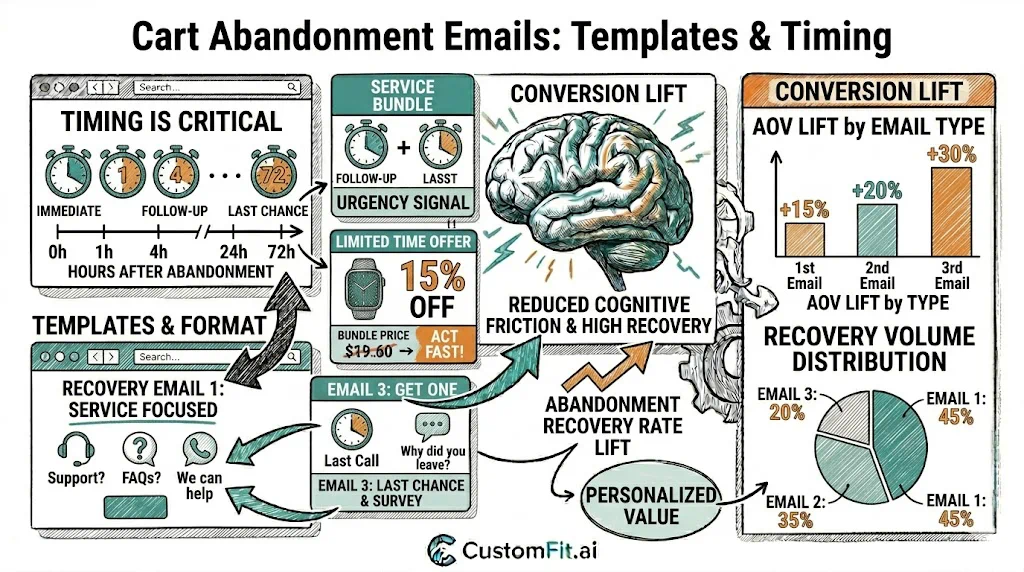
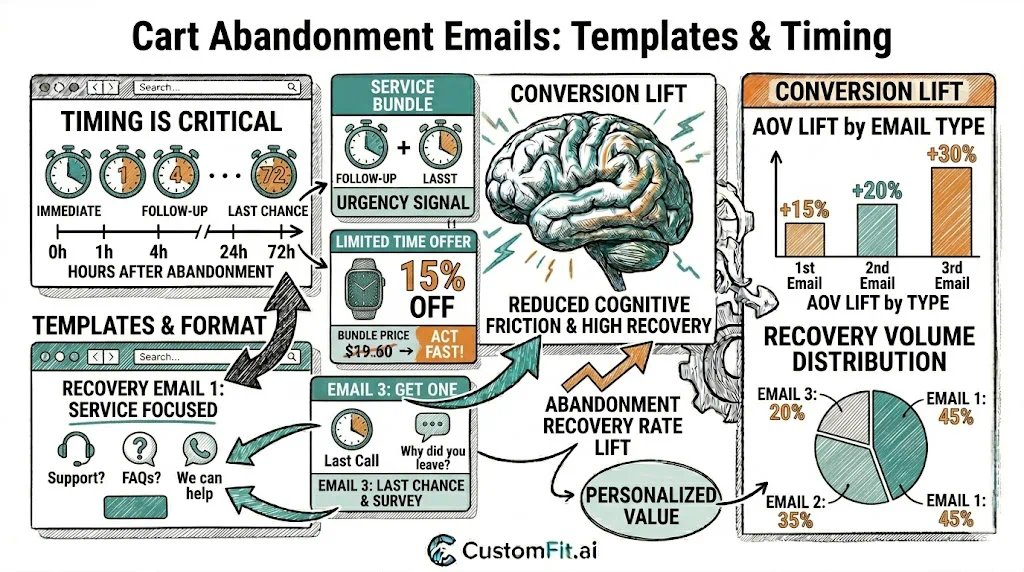
Your recovery sequence should address these reasons across its emails. Email 1 handles distraction and browsing. Email 2 handles social proof and price concern. Email 3 handles the final objection with an incentive.
Goal: Catch customers who were simply distracted — the largest segment of abandoners.
Timing: 1 hour after cart abandonment. Research shows this is when purchase intent is still high and the product is still in memory.
No discount in Email 1. Discounting here trains customers to abandon carts expecting a coupon.
Subject line options (A/B test these):
Email body template:
Hi [First Name],
You left something behind.
[Product Image]
[Product Name] — ₹[Price]
[Your brand's one-line product benefit, e.g., "The vitamin C serum 3,200+ customers swear by for clearer skin in 30 days."]
[CTA Button: Complete Your Purchase]
Questions? Reply to this email — our team responds within 2 hours.
[Signature]
Keep it short. Email 1 is a reminder, not a sales pitch. The product image, price, and one-line benefit are all the content needed.
Goal: Address the "am I sure about this?" hesitation with third-party validation.
Subject line options:
Email body template:
Hi [First Name],
Still considering [Product Name]? Here's what changed our customers' minds:
⭐⭐⭐⭐⭐ "[Quote from your best review — specific, relatable, handles a common objection]" — [Reviewer name and relevant attribute, e.g., "Priya S., oily skin, 32"]
⭐⭐⭐⭐⭐ "[Second review quote — different benefit angle]" — [Reviewer name and attribute]
[Product Image]
[Product Name] — In stock, ships today if you order before 5 PM
[CTA Button: Yes, I Want This]
P.S. We only guarantee [X] units. Stock can go fast, especially around the weekend.
Notes on Email 2:
Goal: Convert the remaining hesitant customers with a small incentive.
Timing: 72 hours (3 days) after abandonment. By this point, customers who wanted to buy have either bought or need an extra push.
Subject line options:
Email body template:
Hi [First Name],
We noticed you were interested in [Product Name] but didn't complete your order.
As a thank-you for considering us, here's an exclusive offer:
10% off your order — use code: COMEBACK10 Valid for 48 hours only.
[Product Image]
[Product Name] — ₹[Original Price] → ₹[Discounted Price] with your code
[CTA Button: Claim Your 10% Off]
This offer expires [date/time]. After that, it's back to regular price.
If something stopped you from completing your order, let us know — we're here to help. [Reply to this email or WhatsApp us: +91 XXXXXXXXXX]
Notes on Email 3:
For Indian audiences, WhatsApp recovery sequences outperform email significantly:
Run WhatsApp and email in parallel — they reach different customers. Some customers ignore marketing emails but respond to WhatsApp. Some prefer email. Cover both.
WhatsApp Message 1 (2 hours after abandonment):
Hi [First Name]! 👋 Looks like you left [Product Name] in your cart. Still interested? Complete your order here: [short link] Any questions? Just reply here.
WhatsApp Message 2 (48 hours after abandonment, if no purchase):
Hi [First Name], just checking in. [Product Name] is still available, but stock is limited. Here's what other customers are saying: "[brief review quote]" [Link to complete purchase]
WhatsApp Message 3 (96 hours after abandonment, if no purchase):
Hi [First Name], one last note. We'd love to have you try [Product Name]. Here's 10% off, just for you: BACK10 Valid until [date]. Complete your order: [link]
Important: Obtain WhatsApp communication consent explicitly during checkout ("I agree to receive order updates and offers on WhatsApp"). Unsolicited WhatsApp messages violate Meta's Business API policies.
Not all abandoned carts deserve the same treatment. Segment for better results:
By cart value:
By customer status:
By product category:
By abandonment point:
CustomFit.ai's targeting capabilities can personalize your website for returning abandoners — showing a different homepage banner or product page offer to customers who have an active abandoned cart.
Subject lines determine open rates, which determine recovery rate. Test these variables:
Personalization vs. generic: "[First Name], your cart is waiting" vs. "You left something behind"
Direct vs. indirect: "Complete your order" vs. "Something caught your eye..."
Urgency vs. low-pressure: "Don't miss out" vs. "Still thinking it over?"
Emoji vs. no emoji: "🛒 Your cart is waiting" vs. "Your cart is waiting"
For Indian D2C audiences, data generally shows:
Track these metrics for your recovery sequence:
| Metric | How to Calculate | Target |
|---|---|---|
| Recovery rate | Recovered orders / Abandoned carts | 8–15% |
| Email 1 open rate | Opens / Sends | 40–55% |
| Email 2 open rate | Opens / Sends | 25–35% |
| Email 3 open rate | Opens / Sends | 15–25% |
| Email 1 recovery | Orders from Email 1 / Sends | 4–8% |
| WhatsApp click rate | Clicks / Sends | 15–25% |
If your recovery rate is below 5%, look at:
Never discount in Email 1. Train customers with patience for a coupon and you train cart abandonment as a strategy.
Use real urgency. "Only 3 left in stock" when you have 300 units is eventually noticed and destroys trust. Real urgency (genuine low stock, genuine offer expiry) converts without the trust cost.
Make the CTA one click to the pre-populated cart. Do not make customers search for their product again. Link directly to a pre-populated cart.
A/B test subject lines continuously. Open rate is the first conversion in your recovery sequence. A 5% improvement in open rate means 5% more recovery opportunities.
Monitor unsubscribes per email. If Email 3 is driving high unsubscribes, consider making the incentive more compelling or the tone less pushy.
Test WhatsApp + email timing relative to each other. Sending WhatsApp and email within the same hour can feel like double-bombardment. Stagger them by 2–4 hours.
Cart abandonment recovery is one of the highest-ROI activities in D2C marketing. The customers in your abandoned carts have shown intent — they added a product. Getting them back across the finish line costs a fraction of acquiring a new customer with the same level of intent.