Describe the website experience. Copilot builds it.
Your AI co-worker for ecommerce. Turn growth ideas into live storefront changes, personalized experiences, and A/B tests — without writing a dev ticket.

Most AI tools guess. CustomFit Copilot studies every detail of your page — your copy, your brand guidelines, your product care & ingredient details — before it writes a single word. Then its ML engine (CustomFeds) generates the change and self-iterates until the output is genuinely right.
Parses your full page structure, copy, layout, and every content block you've published — in and out.
Absorbs your brand guidelines, tone, product care details, and ingredient stories so output sounds like you.
Our ML engine builds exactly the change you asked for — on-brand, on-page, in context.
Runs multiple internal passes to refine and verify — so what you get back is right, fast.
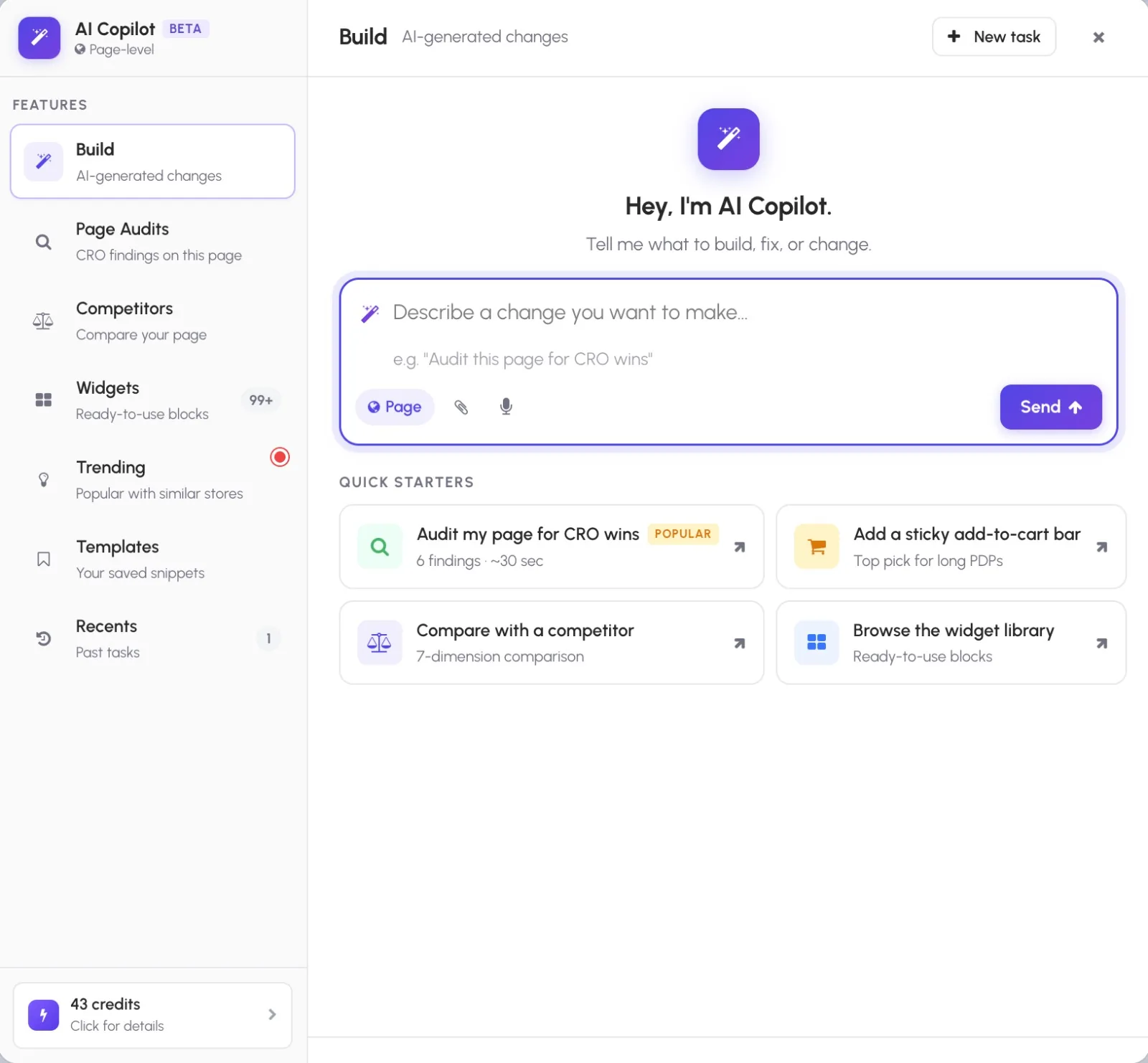
Build, audit, benchmark competitors, browse 99+ widgets, ride trends, and save templates — all from one prompt bar.

Copilot is page-aware: it can edit CSS, JavaScript & animations on the exact page you're viewing, and every output respects your brand and product details.
Describe any change in plain English — "make the PDP hero benefit-led", "add a free-shipping bar", "rewrite this for first-time visitors" — and Copilot scaffolds it on the page. Attach a screenshot or reference, dictate by voice, or start from a quick-starter. Every task is metered transparently with credits.
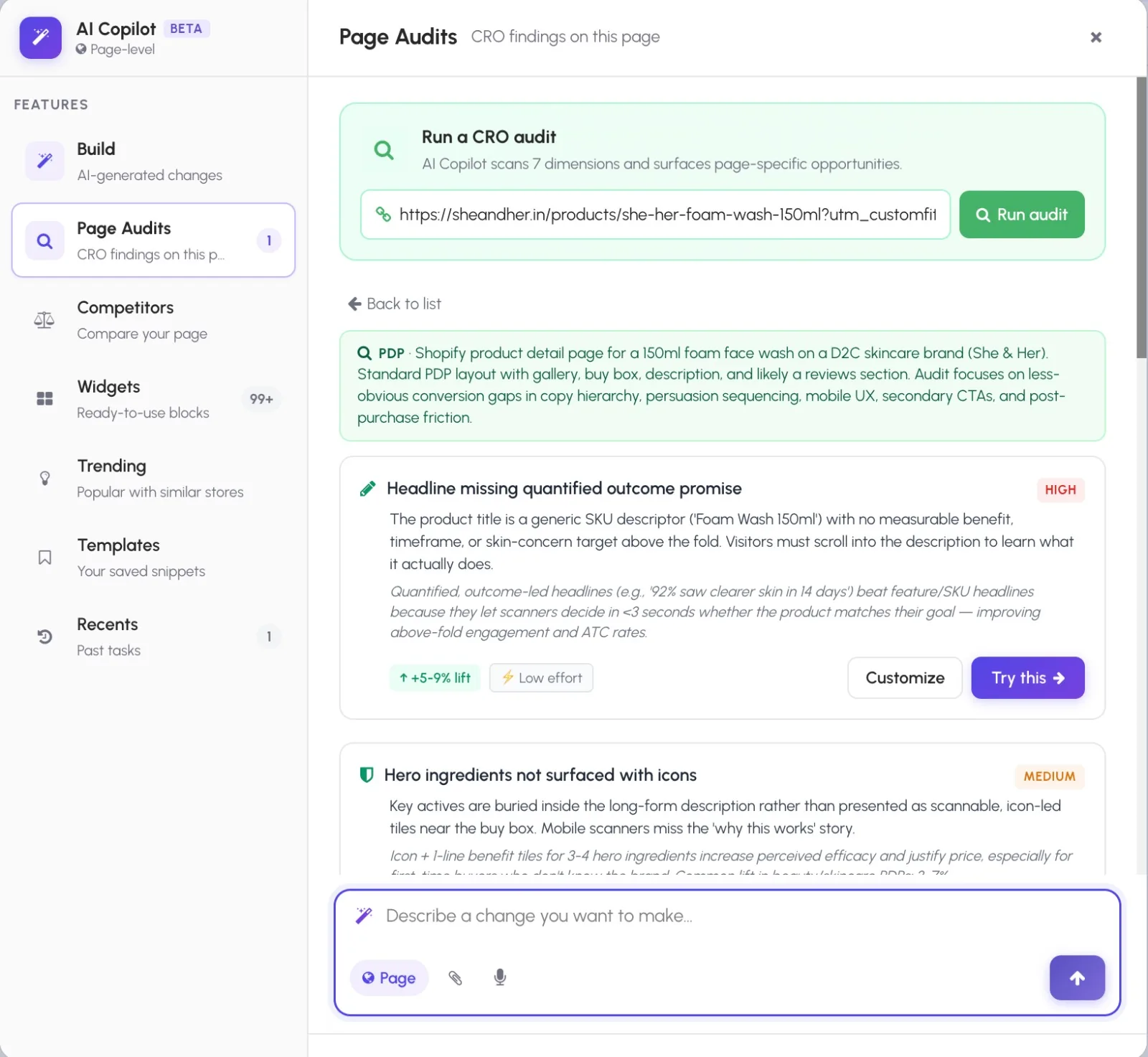
Point Copilot at a PDP, PLP, or homepage and it reviews copy hierarchy, persuasion sequencing, mobile UX, secondary CTAs, post-purchase friction, and more. It returns prioritized findings with severity, effort, and reasoning, then prepares a proposed change for review.
Drop in a competitor's product page and Copilot audits 7 dimensions side by side — bundles, social proof, trust signals, pricing presentation, layout — telling you exactly where you're ahead and where they win. Each gap comes with a COMPETITOR vs YOU breakdown, a lift estimate, and an actionable change for your team to review before testing.
A library of 99+ conversion blocks organized by goal — CRO, Style, Behavior, Homepage, PLP, PDP and Checkout. Tap any widget and Copilot drops its prompt into the composer and scaffolds it for your page: trust badges, urgency countdowns, sticky add-to-cart, social-proof toasts, exit-intent popups, discount nudges, announcement bars, spin-the-wheel, delivery estimates, flash-sale banners and more.
See the blocks converting right now for stores like yours — tagged by intent (Upsell, Behavior, Trust, Promo) — like Frequently-Bought-Together cross-sell cards, auto-rotating testimonial carousels, and spin-the-wheel discount popups. Try any one in a single click.
Save any change Copilot makes as a reusable template — with its description and date — then customize and apply it across pages and stores in seconds. Recents keeps a running history of every task so nothing is lost.
Marketing and growth teams ship most CRO ideas with Copilot — no developer dependency for repetitive website changes.
Test more campaigns, faster.
Hands-on with the storefront, no dev ticket.
Go from idea to A/B test in minutes.
Match landing pages to every ad campaign.
If you can describe the change in plain English, Copilot can help you create, personalize, and test it.
CustomFit Copilot is an AI CRO page audit tool that reviews a live PDP, PLP or homepage for conversion friction. Submit a URL and it evaluates areas such as copy hierarchy, persuasion sequencing, mobile UX, secondary calls to action and post-purchase friction. It returns prioritized findings with severity, effort and reasoning, then prepares a proposed change for your team to review and test. It does not independently publish audit recommendations to production.
Submit a live PDP, PLP, or homepage URL and select the page goal.
Review hierarchy, persuasion, mobile UX, calls to action, trust, and friction.
Return prioritized evidence, severity, effort, reasoning, and a proposed change.
A person reviews the draft, defines the test, and approves any production release.
Anonymized audit example: A beauty brand submits a mobile product page. Copilot finds that the primary call to action sits below the first screen, delivery information appears only in an accordion, and review proof is separated from the product title. It proposes a reviewable experiment that adds a sticky mobile call to action and moves delivery and review context closer to the purchase decision. The brand team checks the draft, chooses add-to-cart rate as the primary metric, adds revenue per visitor as a guardrail, and decides whether to launch the test.
As a prompt to website change tool, Copilot can turn an approved finding into an editable draft. Review and controlled testing still come before any production release.
Paste a competitor's product page URL and Copilot compares it to yours side-by-side, then hands back a scored report with prioritized, reviewable change proposals.
CustomFit Copilot works as an automated website competitor audit tool for ecommerce pages. Provide your page and a competitor URL, and it compares conversion-focused elements including pricing presentation, bundles, social proof, trust signals and layout. It explains where each page is stronger and converts identified gaps into proposed tests for human review.
| Element | Competitor observation | Your-page observation | Evidence | Recommendation | Validation method |
|---|---|---|---|---|---|
| Pricing and bundles | Bundle saving is visible beside the price. | Only the single-item price appears above the fold. | Rendered price block and offer copy on both PDPs. | Draft a separate bundle-card test variant. | Controlled test using revenue per visitor and margin guardrails. |
| Social proof | Rating, review count, and customer proof sit near the title. | Reviews appear below the product details. | Relative placement and visible proof in the first viewport. | Test a compact review summary near the purchase decision. | Measure add-to-cart rate with returns and revenue guardrails. |
| Trust signals | Delivery, returns, and payment reassurance sit below the CTA. | The same information is available only in a lower-page FAQ. | CTA-adjacent content and policy visibility on both pages. | Draft an inline trust row for team review. | Test checkout progression and monitor support and refund rates. |
Impact label: Impact estimates are directional until tested in a controlled experiment with a defined primary metric and guardrails.
Anonymized input-to-output example: A skincare brand submits its product page and a competitor product-page URL. Copilot finds that the competitor places verified reviews, delivery information and a bundle saving above the fold, while the brand page leads with product copy and shows those signals later. The output is a reviewable test proposal to move review proof and delivery clarity closer to the primary call to action, with the bundle presented as a separate variant.
Validation note: Any estimated impact is directional until the proposed change is validated through a controlled test with a defined primary metric and guardrails.
One controlled editor environment for every step from idea to live experiment.
Move from idea to live website change in minutes, not sprints.
No dev tickets for CTA colors, banners, sticky bars, or copy tweaks.
Because execution is faster, your team tests more ideas every quarter.
Every Meta, Google, or email visitor gets messaging that matches the ad.
Changes happen inside a controlled editor — review, edit, then publish.
Create, personalize, A/B test, and measure — all inside CustomFit.ai.
Pick the path that fits where you are. Sandbox playground, guided live demo with our team, or jump straight into a free trial.
Other ways teams lift conversions with CustomFit.
Start your 14-day free trial. Ship your first personalized experience this afternoon.