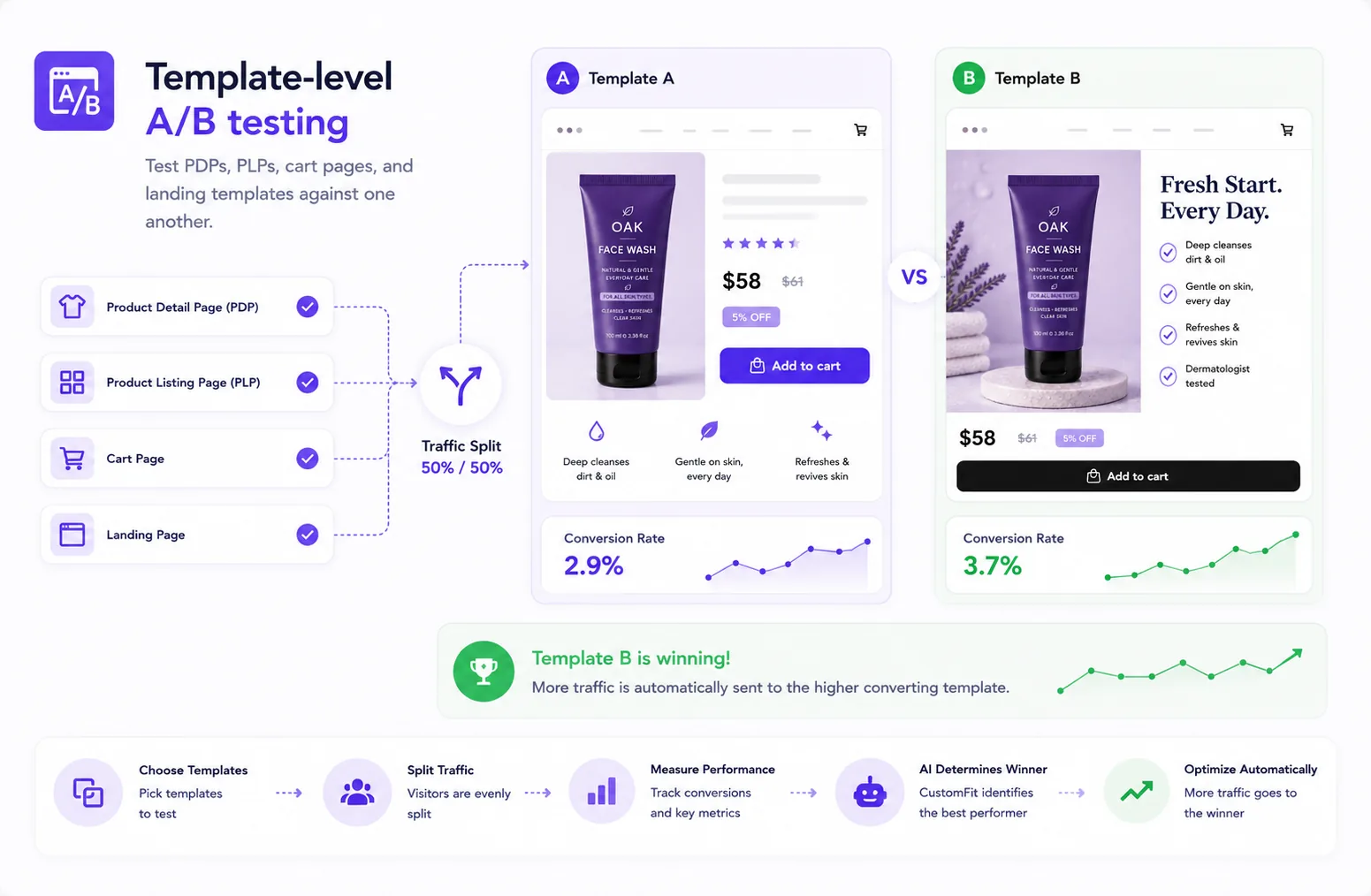
Some wins only show up at the layout level. CustomFit lets you A/B an entire template — your PDP, collection page, cart, or landing layout — then roll the winning version out across every product or collection at once.

Edit a template once and the variant applies to every product or collection that uses it — test at the layout level, ship at catalog scale.
A/B any template type: product detail, collection listing, cart, or campaign landing — each measured on its own goal.
When a template wins, promote it across the whole catalog in a click — no per-page rebuild, no developer queue.
Swapping a button tells you about a button. But the bigger gains — gallery position, buy-box stickiness, the order of sections — only surface when you test the whole template. CustomFit makes the entire layout the unit of the experiment.
The point of testing a template is that it governs hundreds of pages. When a template wins, CustomFit promotes it across every page bound to it in one action — so a single experiment lifts your entire catalog, not one URL.
We tested three PDP templates, not three buttons. The winning layout went live across 1,200 products in an afternoon — that's a lift we'd never have found one element at a time.
From a layout idea to a catalog-wide winner — no code.
Fork your live PDP, PLP, cart, or landing template in the visual editor.
Reorder sections, move the buy box, restyle — no theme edits.
Send traffic across templates; we report ATC and revenue per visitor.
Promote the winning template across every page bound to it in one click.
Template-level A/B testing compares entire page layouts — a whole PDP, collection page, cart, or landing template — rather than a single element. Because one template governs many pages, the winning version can be rolled out across your entire catalog at once, making it one of the highest-leverage tests a D2C store can run.
A template governs hundreds of pages, so a single win compounds across your whole store.
Section order and buy-box placement move conversion in ways element tests never reveal.
Build and promote templates in a no-code editor — no developer queue.
Test PDP and collection layouts that sell the catalog harder.
Run layout-level experiments with revenue-per-visitor verdicts.
Drop into custom CSS/JS when a template needs it — otherwise no-code.
Template-level A/B testing compares entire page layouts instead of single elements. Where a classic A/B test might swap a headline or a button, a template test pits a whole PDP, collection page, cart, or landing layout against an alternative — gallery position, buy-box behavior, section order, and copy all changing together.
This matters because a template governs many pages at once. A PDP template might render 1,200 products; a collection template might drive every category page. When you find a winning layout, CustomFit promotes it across every page bound to that template in a single action — so one experiment lifts the whole catalog rather than a single URL.
Everything is built in the no-code visual editor and applied as a render-time layer, so your live theme is never edited and a winning template can be rolled out — or rolled back — instantly. Results are measured on add-to-cart and revenue per visitor, not vanity metrics, so you only scale layouts that genuinely earn more.
Element testing changes one thing — a headline, a button. Template testing changes the whole layout (gallery, buy box, section order) and applies the winner across every page that uses the template.
Product detail (PDP), collection/listing (PLP), cart, and landing-page templates. Each is measured on its own goal, like add-to-cart or revenue per visitor.
No. Variants apply as a layer at render time, so your theme files are never touched and you can roll a winner out or revert it instantly.
Yes. Because the template governs many pages, promoting the winner updates every page bound to it in one click — no per-page rebuild.
No. Marketers build and test templates in a no-code visual editor; developers can use the API and SDKs when they want deeper control.
Run your first template test this week — no theme edits, free to start.