Home / A/B Testing / Split URL
Split-URL testing

Split-URL testing for your biggest changes.

When a change is too big for an in-page tweak — a full redesign, a headless template, a separately built landing page — split-URL testing sends part of your traffic to the new URL, keeps SEO clean, and tells you which version actually earns more. AI handles the stats and surfaces the winner automatically.

Edge-split, no flicker SEO-safe canonicals Works headless
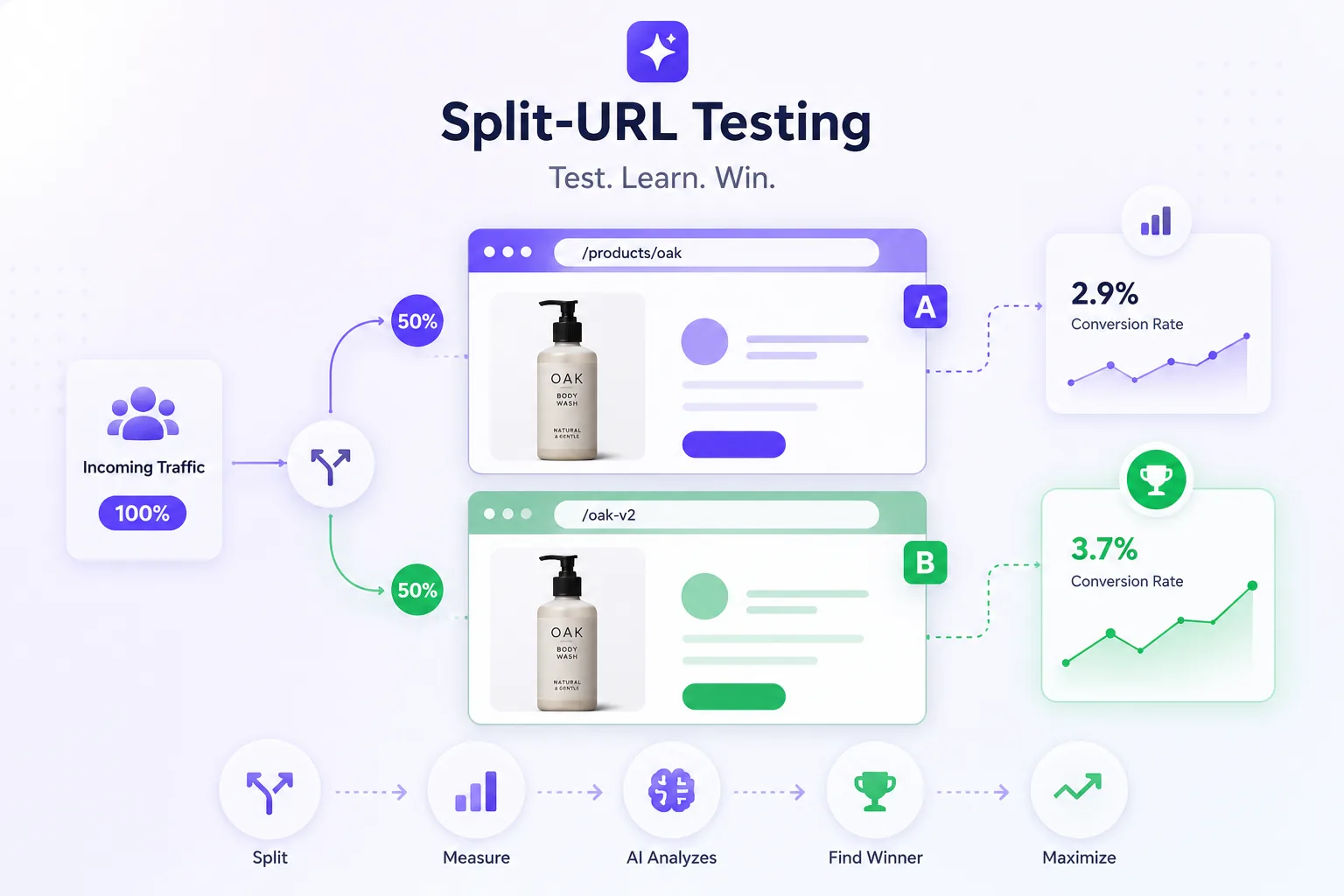
CustomFit split-URL testing: 100% incoming traffic is split 50/50 between /products/oak (variation A, 2.9% conversion rate) and /oak-v2 (variation B, 3.7% conversion rate, winner) — then the flow runs split, measure, AI analyzes, find winner and maximize.
🔀

Test radically different pages

Compare two entirely separate URLs — ideal for redesigns, new page builders, or headless templates that can't be a single in-page variant.

🔎

SEO handled for you

Automatic canonical tags and 302 redirects keep search engines indexing your primary URL — no duplicate-content or ranking risk.

Decided at the edge

The split happens before the page loads, so visitors land on their version directly — no visible redirect bounce, no flicker.

When to reach for it

Some changes are too big for one page.

In-page A/B testing is perfect for swapping a headline or a button. But when you've rebuilt the PDP in a new framework, launched a campaign microsite, or are migrating to headless, the challenger lives at its own URL — and split-URL is the only honest way to compare them.

  • Full redesigns & replatform pilots
  • Separately hosted campaign & landing pages
  • Headless / different-stack page builders
Compare with in-page A/B →
In-page vs. split-URL
Swap a headline / buttonIn-page
Restyle a sectionIn-page
Full PDP redesignSplit-URL
New headless templateSplit-URL
SEO safeguards · automatic
Canonical tag → primary URL
302 temporary redirects (not 301)
Consistent variant per visitor
Bots always see the canonical
🔎 You don't touch a line of redirect config — CustomFit sets it all at the edge.
SEO-safe by default

Split traffic without splitting your rankings.

Done wrong, split tests create duplicate content and leak link equity. CustomFit handles canonicals and temporary redirects automatically, keeps each visitor on a stable variant, and always serves crawlers the canonical page — so your SEO is never the price of a test.

  • Automatic canonical + 302 handling
  • Sticky assignment across sessions
  • Revenue-per-visitor verdict, segment-aware
Auto-roll out the winner →
We piloted our headless PDP rebuild as a split test on 30% of traffic. It won, we migrated with data in hand instead of a leap of faith.
AN
Anirudh Shridharan
Growth Marketer · Chargebee
+27%
CVR on the new headless PDP
0
Ranking drops during the test
30%
Traffic piloted before migrating
Launch in minutes

A split-URL test in four steps

From two URLs to a live, SEO-safe experiment — no redirect config, no engineering.

1

Add both URLs

Point CustomFit at your control URL and the challenger URL.

2

Set the split

Choose the traffic share — start at 10% and scale as it proves out.

3

We handle SEO

Canonicals and 302 redirects are applied automatically at the edge.

4

Read the verdict

Revenue-per-visitor and segment results tell you when to promote.

The fundamentals

What is split-URL testing?

Split-URL testing (also called redirect testing) splits traffic between two or more separate URLs — ideal when a change is too large for an in-page variant, like a full redesign, a headless template, or a separately built landing page. CustomFit handles canonicals and temporary redirects so your SEO is never the price of a test.

Quick facts

Compares entirely separate page versions or URLs
Edge-decided split — no visible redirect flicker
Automatic canonical tags and 302 redirects keep SEO safe
Works across different tech stacks, including headless
Why it matters

Why split-URL testing matters for D2C

🔀

Test the big swing

Some changes are too large for an in-page tweak — split-URL is the honest way to compare.

🔎

Keep your rankings

Done wrong, split tests leak SEO; CustomFit handles it automatically.

🧪

Pilot with data

Migrate to a redesign or headless build only once it proves it wins.

Who it's for

Built for your whole growth team

🎨

Teams redesigning

A/B a full new page against the original.

🧑‍💻

Headless builds

Compare a new stack page to your current one.

📣

Performance marketers

Test radically different campaign landing pages.

The complete guide

Understanding split URL testing

Split URL testing (redirect testing) splits traffic between two or more separate URLs — ideal when a change is too large for an in-page variant, like a full redesign, a headless template, or a separately built landing page. CustomFit handles canonicals and 302 redirects so your SEO is never the price of a test.

When you've rebuilt a PDP in a new framework or launched a campaign microsite, the challenger lives at its own URL, and split-URL is the only honest way to compare it. The split decision happens at the edge before the page loads, so visitors land on their assigned version with no visible redirect bounce.

Done wrong, split tests create duplicate content and leak link equity; CustomFit applies canonical tags pointing variants at the original, keeps each visitor on a sticky variant, and always serves crawlers the canonical page — then reports the winner on revenue per visitor.

When should I use split-URL testing instead of in-page A/B?

Use split-URL when the change is too big for an in-page variant — a full redesign, a different page builder, a headless template, or a separately hosted landing page.

Does split testing hurt SEO?

No, when set up correctly. CustomFit applies canonical tags and 302 redirects automatically so search engines keep indexing your primary URL.

Is the redirect slow?

No. The split is decided at the edge before the page loads, so the visitor lands on their assigned version directly with no flicker.

When should I use split-URL instead of in-page A/B?

When the change is too large for an in-page variant — a full redesign, a different page builder, a headless template, or a separately hosted landing page. The variant lives at its own URL and traffic is split to it.

Will split testing hurt my SEO?

No, when set up correctly. CustomFit applies canonical tags pointing the variant at the original and uses 302 (temporary) redirects so search engines keep indexing your primary URL — handled automatically.

Is the redirect slow or flickery?

No. The split decision is made at the edge before the page loads, so the visitor lands on their assigned version directly — no visible bounce between URLs.

Can the two URLs be on different tech stacks?

Yes. The control can be your Shopify theme and the challenger a headless or separately hosted build — split-URL doesn't care what renders each page.

Do I need a developer to use CustomFit.ai?

No. Marketers build experiments and personalized experiences in a no-code visual editor; developers can use the API and SDKs when they want deeper control.

Pilot the big change before you commit.

Run your first split-URL test this week — SEO handled, free to start.

Built for every D2C category

🧴
Skincare
💄
Beauty
🌿
Wellness
F&B
👟
Apparel
💍
Jewelry
🛋️
Home
🍼
Baby
Live · Right now
Mamaearthfree-shipping band +12.4% AOVGIVAfestive collection page +34% revenueBellavitaPDP CTA test +27.4% CVRKapivaQuiz-driven recs +9.48% CTRThe Sleep Colanding personalized 2× capturesPlumReturning shopper swap +18.2% CVRMamaearthfree-shipping band +12.4% AOVGIVAfestive collection page +34% revenueBellavitaPDP CTA test +27.4% CVRKapivaQuiz-driven recs +9.48% CTRThe Sleep Colanding personalized 2× capturesPlumReturning shopper swap +18.2% CVR