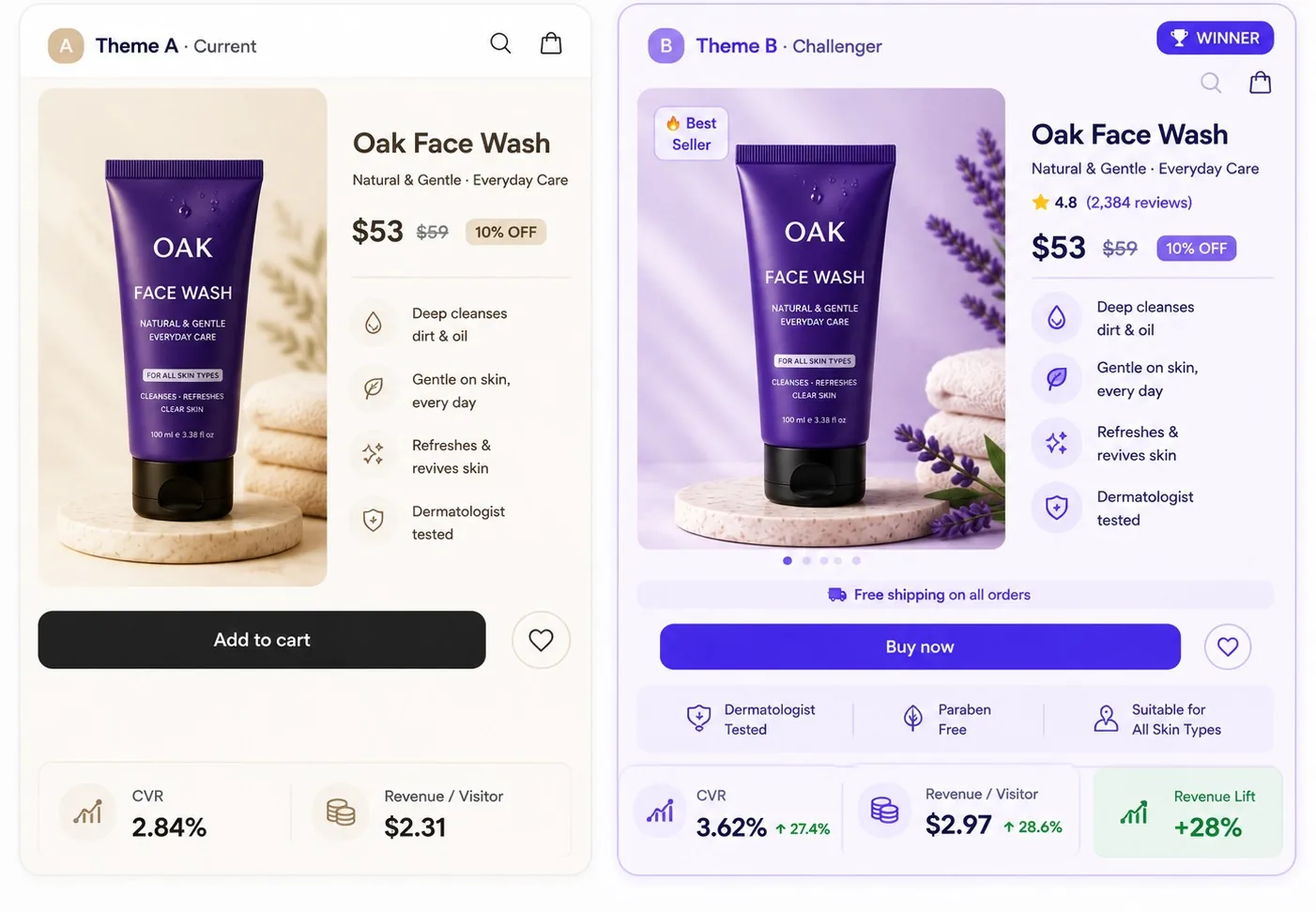
A new theme is the biggest bet your store makes all year — and most brands ship it on a gut feeling. CustomFit runs your challenger theme live against the current one, on real traffic, and tells you what it does to revenue before you commit. AI calls the winning theme on revenue, not guesswork.

The challenger theme wins on revenue per visitor — AI calls it, you roll it out.
Serve an entire alternate theme — layout, navigation, PDP, cart — to a cohort and compare the full experience, not a single element.
Winners are decided on revenue per visitor and AOV — a prettier theme that quietly drops basket size is a loss, and we'll catch it.
Nothing is republished until you promote the winner. If the challenger loses, your live theme was never touched.
Most replatforms and redesigns go live everywhere at once, and teams cross their fingers. With theme testing you expose the new design to a slice of traffic, watch real purchase behavior, and only roll forward when the numbers say so.
Run a festive theme for Diwali, a minimalist theme for a launch, or a campaign theme for a big sale — test it against your evergreen design, schedule it to flip on and off by date, and never touch code on a Friday night again.
We were about to relaunch on a gut feeling. Testing the new theme first showed it lifted CVR but dropped AOV — we fixed the PDP before going live.
Theme tests are judged on the metrics that actually matter to the business — with guardrails that catch a redesign that looks great but sells worse.
The headline metric — the true measure of a theme.
Catches designs that convert more but sell cheaper.
Guardrail — a flashy theme that scares people off loses.
Guardrail — Core Web Vitals must stay green.
Theme A/B testing serves an entire alternate theme or template to a slice of your traffic and compares it against your current design on live shoppers — judged on revenue per visitor and AOV, not just clicks. It lets you prove a redesign lifts revenue before you roll it out to everyone.
Don’t bet the store on a gut-feel relaunch — prove it on real traffic first.
A prettier theme that lowers AOV is a loss; theme tests catch it.
If the challenger dips, your live theme was never touched.
Validate a new look before going wide.
A/B festive and campaign themes, then auto-revert.
Pilot replatforms on a cohort with data in hand.
Theme A/B testing serves an entire alternate theme or template to a slice of your traffic and compares it against the current design on live shoppers — judged on revenue per visitor and AOV, not just clicks. It lets you prove a redesign lifts revenue before rolling it out to everyone.
A new theme is the biggest bet a store makes all year, and most brands ship it on a gut feeling. With theme testing you expose the challenger to a controlled cohort, watch real purchase behavior, and scale only when the numbers say so — with instant rollback if engagement dips.
The same mechanism powers seasonal and campaign themes: run a festive theme for a sale, A/B it against your evergreen design, and schedule it to flip on and off by date with automatic revert. No redeploys, no late-night theme surgery.
No. The challenger theme is served through CustomFit to its cohort without replacing your published theme, so there is nothing to roll back if it loses.
Revenue per visitor and AOV, not just click-through — with bounce and page speed as guardrails — because a prettier theme that lowers basket size is a loss.
Yes. CustomFit serves an entire alternate theme or template set to a randomized cohort while everyone else sees the current one — both live at once, compared on the same traffic and seasonality.
No. Themes resolve at the edge before first paint, so the cohort gets the challenger with no flicker and no Core Web Vitals hit.
No. Marketers build experiments and personalized experiences in a no-code visual editor; developers can use the API and SDKs when they want deeper control.
Test your next theme against the current one — free to start, live in minutes.