From the conversion glossary
Concepts referenced in this article, defined.
Concepts referenced in this article, defined.
Run rigorous A/B tests and personalize every visit on Shopify or any storefront — no engineers required.
Dynamic pricing allows ecommerce brands to move beyond fixed prices and respond to demand, inventory, competition, and customer behavior in real time. Done well, it increases revenue per visitor and improves sell-through rates. Done poorly, it creates customer distrust and can undermine brand value. This guide walks through what dynamic pricing actually means for D2C brands, how to implement it at different levels of sophistication, and how A/B price testing gives you data before committing to any pricing change.
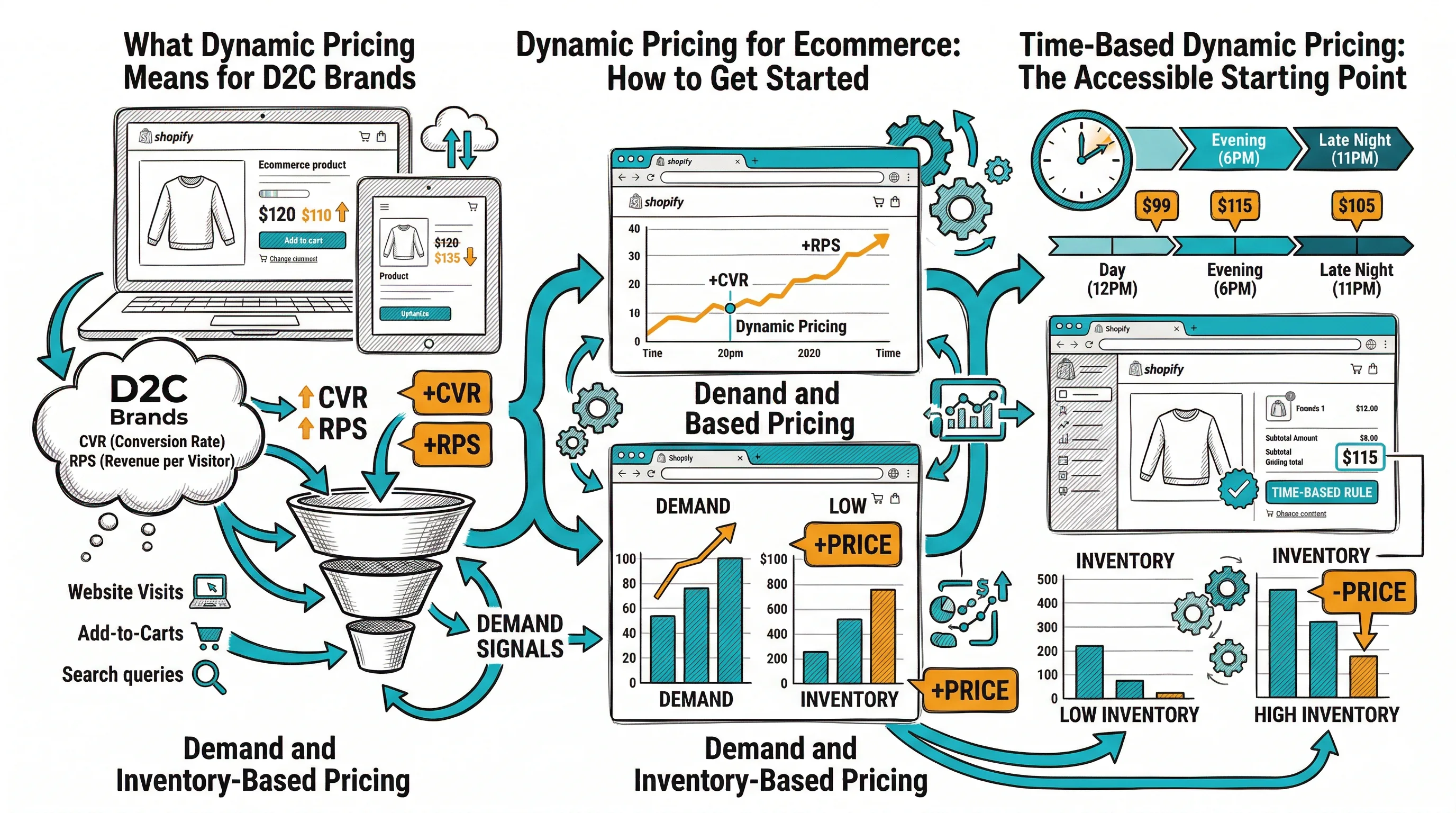
The term "dynamic pricing" gets applied to a wide range of tactics—from sophisticated algorithmic pricing (adjusting thousands of SKU prices in real time based on competitor data) to simple time-based discounting during festive season.
For most Indian D2C brands, the practical application falls into three categories:
1. Time-based dynamic pricing: Prices that change based on a calendar or countdown. Flash sales, early bird pricing, festive offers, clearance season. This is the most common and most accessible form.
2. Demand/inventory-based pricing: Prices that adjust based on stock levels or demand signals. As inventory runs low, prices may hold firm or increase slightly. As overstocked items need clearing, prices come down. This is mid-complexity and can be implemented via Shopify apps.
3. Segment-based pricing: Different prices for different customer groups. Loyalty member pricing, repeat customer discounts, referral-exclusive offers. This requires customer segmentation and a tool to serve different prices by segment.
Full algorithmic dynamic pricing (tracking competitor prices in real time and adjusting every 30 minutes) is primarily relevant for marketplace sellers and large catalog brands. For most D2C brands, the first two or three forms above generate meaningful revenue improvement with manageable complexity.
Festive season pricing is the most natural entry point for dynamic pricing in Indian ecommerce.
Diwali / Navratri / Holi pricing strategy:
During festive periods, consumer willingness-to-pay for gift-worthy products typically increases—buyers are in purchase mode and the emotional occasion justifies spending. This creates the opportunity to hold prices firm on premium products (rather than discounting them) while offering bundled value.
However, festive periods also bring intense competition. If competitors are discounting heavily, holding prices firm on identical or comparable products can hurt conversion. The right approach is category-specific:
Countdown urgency pricing:
"This price ends in 4 hours" is a time-based dynamic pricing element. When the countdown is real (the price genuinely reverts), it creates honest urgency. When it's fake (the countdown resets), it's manipulative and increasingly recognized as such by Indian consumers.
The Indian e-commerce market has grown sophisticated. Manufactured urgency that's been overused has a diminishing return—and risks trust damage when customers notice the "limited time" offer has been running for three months.
Early bird pricing:
For new product launches, pre-orders at a lower price point reward early commitment and generate revenue before the product is in hand. Effective for brands with engaged communities (email list, WhatsApp group) that can create real early-bird demand.
Adjusting prices based on demand and stock levels is the next layer of dynamic pricing sophistication.
Low-stock signaling: Showing "Only 5 left in stock" (when true) creates urgency without price change. This is the softest form of demand-based pricing psychology. The honesty requirement is critical—fake low-stock signals have been overused and create cynicism.
Clearance pricing: As inventory of a particular SKU or season ages, systematic markdown schedules prevent the buildup of dead stock. A markdown schedule might be: 10% off at 60 days unsold, 25% off at 90 days, 40% off at 120 days. Automated via Shopify apps.
Surge pricing (cautious application): During genuine peak demand—say, a product featured by a major influencer—holding prices firm while demand is high is a form of demand-based pricing. Actually increasing prices during demand spikes is risky for D2C brands because it can create viral negative sentiment ("they raised prices when they knew the product was popular").
Showing different prices to different customer segments is powerful but requires careful implementation.
Loyalty/VIP pricing: Logged-in loyalty members see member pricing, which may be 5–15% below the listed price. This is widely accepted and builds retention—customers have a tangible reason to be in your loyalty program.
Repeat customer discounts: Using a Shopify tool or CustomFit.ai, you can identify returning customers and show them an exclusive offer. "Welcome back—here's 10% off your next order" is segment pricing that feels like a reward rather than discrimination.
New visitor vs. returning visitor: Showing a first-order incentive exclusively to new visitors (not returning customers who don't need the incentive to convert) is efficient spending—you're not discounting to customers who would have bought anyway.
What to avoid: Showing different prices for the same product to similar customers based on data like device type or geographic location (without clear rationale) can create trust issues when discovered and may face regulatory scrutiny under evolving Indian consumer protection rules.
Before committing to dynamic pricing infrastructure, A/B price testing helps you understand how price changes affect demand.
The basic price test:
Version A: Current price (₹999) Version B: Test price (₹899 or ₹1,099) Measure: Conversion rate AND revenue per visitor (not just CVR—a lower price may convert more but generate less revenue)
The goal isn't the highest conversion rate—it's the highest revenue per visitor (RPV). A 10% CVR increase that comes with a 15% price decrease results in lower total revenue.
Running price tests ethically:
Customers in a price A/B test see different prices for the same product. This is legal and standard practice. The test should run long enough for statistical significance (typically 2–4 weeks depending on traffic). Don't run price tests during anomalous periods (festivals, major promotions) that would contaminate results.
CustomFit.ai supports price testing on Shopify as part of its A/B testing functionality—no developer needed. Create variants with different price displays, split traffic, and analyze RPV and CVR together.
What price tests reveal:
Dynamic pricing doesn't operate in a vacuum—it works alongside psychological pricing principles that affect how prices are perceived.
Charm pricing: Prices ending in 9 or 7 (₹499, ₹1,997) are perceived as lower than round numbers. This is still effective, though increasingly understood by consumers.
Price anchoring: Showing a higher original price alongside a sale price ("₹1,499 ₹999") creates the perception of value even if ₹999 has been the price for months. The FTC (US) and ASI (India) have guidelines on what constitutes deceptive pricing—anchoring against a genuine original price is fine; fabricating an MRP solely to create a "discount" is not.
Bundle pricing vs. per-unit pricing: A bundle of 3 items priced at ₹999 ("just ₹333 each") creates a different price perception than three items at ₹333 each. Bundle pricing often allows higher total prices while maintaining perceived value.
Free shipping thresholds: "Free shipping above ₹499" creates a dynamic where customers add items to reach the threshold. This is a form of demand-based price interaction that can be A/B tested with different thresholds.
Most Indian D2C brands don't need enterprise dynamic pricing software. Here's a practical tiered approach:
Level 1 (Start here):
Level 2:
Level 3:
Links: Price Testing | A/B Testing | Conversion Rate | Pricing Strategy Pillar | Bundle Pricing Strategies | Shipping Rate A/B Testing