From the conversion glossary
Concepts referenced in this article, defined.
Concepts referenced in this article, defined.
Run rigorous A/B tests and personalize every visit on Shopify or any storefront — no engineers required.
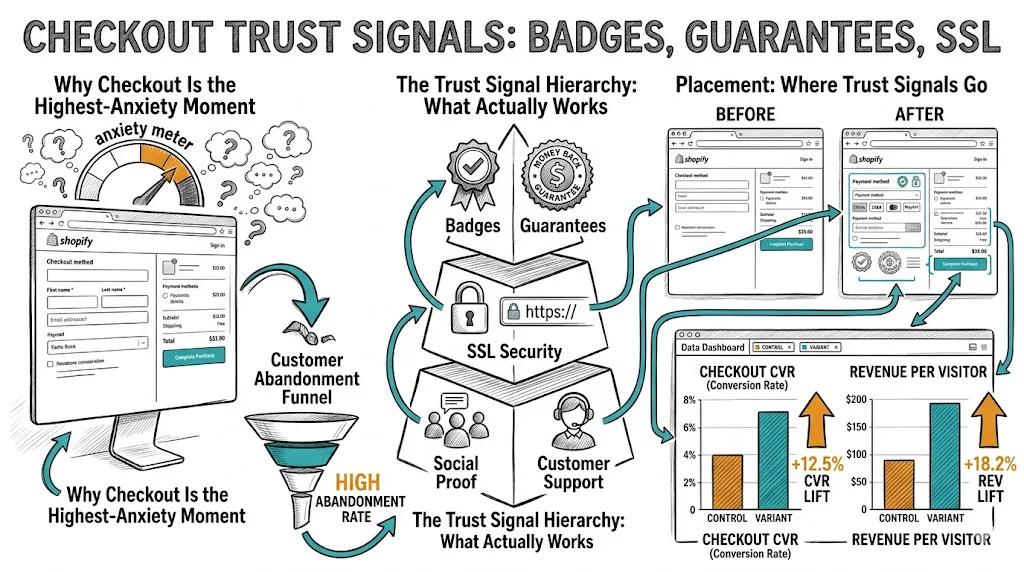
The checkout page is where purchase anxiety peaks. A customer who has selected a product and started the checkout process is already interested—but their reservations about the brand, payment security, and product quality haven't disappeared. They've just been deferred to this final step. Trust signals at checkout address these lingering hesitations directly, reducing abandonment at the moment it matters most. Getting trust signal placement right can lift checkout CVR by 5–20% without changing any other element of the purchase flow.
At checkout, customers face a trifecta of anxiety:
Financial commitment anxiety: "I'm about to give this brand my money (or have it delivered COD)."
Payment security anxiety: "Is my card/UPI information safe? Could this site be fraudulent?"
Product uncertainty anxiety: "What if the product isn't what I expected? What happens if I want to return it?"
For first-time buyers at a D2C brand, all three anxieties are active simultaneously. This is why checkout abandonment rates are high even after a customer has clearly expressed purchase intent. The abandonment isn't necessarily about the product or price—it's about unresolved trust concerns.
Trust signals address each anxiety type directly:
Not all trust signals are equally effective. Here's the evidence-backed hierarchy:
Tier 1: High Trust Impact
Recognized payment logos: Visa, Mastercard, RuPay, UPI, Razorpay, PayU. When a customer sees logos of payment systems they already trust, the brand inherits that trust by association. These are the most effective checkout trust signals available.
SSL/HTTPS indicator: The padlock icon in the browser URL bar is the most recognized security signal. Make sure your checkout runs on HTTPS (all Shopify stores do by default) and draw attention to it if needed ("This checkout is 256-bit encrypted").
Money-back guarantee badge: "30-Day Money-Back Guarantee" as a visual badge (not just text) near the payment section or Order button. The specificity matters—"30 days" outperforms "satisfaction guaranteed."
Returns policy visibility: A clear, plain-language returns policy statement at checkout. Not a link to the policy (most people won't click it)—a brief statement: "Free returns within 14 days. No questions asked."
Tier 2: Moderate Trust Impact
Generic security seals: "McAfee Secure," "Norton Secured," "Trustwave." These have some effect, particularly on older demographics, but their impact is declining as customers become more sophisticated. Less effective than recognized payment logos.
Star rating / review count: "Join 90,000+ happy customers" or "4.8/5 from 12,000 reviews" near the checkout CTA. Social proof at checkout reinforces the decision already made by others.
Brand trust badges: "As seen in Forbes / Vogue India / YourStory"—for brands with genuine press coverage, this is useful. Fabricated or obscure press badges have no effect.
Tier 3: Low Trust Impact (Alone)
"Secure Checkout" text without associated badges: Generic text with no visual support doesn't move the needle. The claim needs to be backed by recognizable visuals.
Customer service contact: Visible phone number or chat icon at checkout tells customers they can reach someone if something goes wrong—modest but positive effect.
The placement of trust signals within the checkout flow determines their effectiveness.
High-impact placement zones:
1. Near the payment method selection: When a customer is choosing UPI, card, or COD—and about to enter payment details—payment logos and security badges immediately below or adjacent to the payment section are at their most effective. This is the moment of peak payment anxiety.
2. Near the "Place Order" / CTA button: The final click to confirm the order is the last abandonment point. A small trust strip ("🔒 Secure checkout · Free returns · 90,000+ customers served") immediately above or below the Place Order button addresses last-second hesitation.
3. Order summary sidebar: Most checkout pages have an order summary sidebar showing what's being purchased. Adding a compact trust strip at the bottom of this sidebar (returns policy, free shipping, security) is a low-friction placement that catches natural eye movement.
4. Checkout page header/footer: Secondary placement. Customers who are actively scanning for trust signals will look in headers and footers if not found closer to the action.
Low-impact placement:
COD availability as a trust signal:
In the Indian D2C context, "Cash on Delivery Available" is itself a significant trust signal for many customer segments. COD means "if you don't like it, you don't have to pay." Even if a customer ultimately pays UPI, knowing COD is an option reduces the perceived risk.
Display "COD Available" as part of your trust strip, particularly if your target audience includes first-time buyers or Tier-2/3 market segments.
BIS/FSSAI/Ayush certifications:
For health, beauty, and food D2C brands, regulatory certifications (FSSAI for food, Ayush for herbal, BIS for certain product categories) are powerful trust signals—more so than generic "premium quality" claims. Display these near the payment step for relevant categories.
Authenticity guarantee for beauty and supplements:
The Indian market has a significant problem with counterfeit personal care and supplement products. An explicit "100% Authentic—Genuine Manufacturer" guarantee at checkout addresses a specific trust concern that is more acute in India than in western markets.
Indian payment gateway logos:
Razorpay and PayU are recognized and trusted by Indian ecommerce shoppers. Their logos at checkout provide more trust signal in the Indian context than generic international security seals.
Most D2C brands have a returns policy. Most checkout pages hide it behind a link. This is a significant missed opportunity.
An explicit, plain-language returns policy statement at checkout—not a link, but an actual brief statement—meaningfully reduces abandonment.
Effective returns statement at checkout:
"Change your mind? Return within 14 days for a full refund. No questions asked. Free reverse pickup."
This statement:
Compare this to the typical: a small "Returns Policy" link in the footer that few customers click.
Money-back guarantee specifics:
For health, beauty, and supplement categories where efficacy is a purchase concern, a results-based guarantee is even more powerful: "See results in 30 days or get your money back." This removes the "what if it doesn't work" hesitation that is a significant conversion barrier in these categories.
Trust signal effectiveness varies by audience, category, and brand. Test rather than assume.
Tests worth running:
Money-back guarantee badge vs. no badge: Does adding a 30-day guarantee badge near the order CTA improve checkout completion rate?
Returns policy statement vs. returns link: Does a visible plain-language policy statement at checkout reduce abandonment vs. a footer link?
Payment logo count: Do more payment logos improve trust, or does a cluttered logo strip reduce clarity?
Guarantee language: "30-Day Money-Back" vs. "100% Satisfaction Guarantee" vs. "Love It or Return It Free."
COD trust signal: Does explicitly displaying "COD Available" in the checkout trust strip lift CVR for your audience?
CustomFit.ai enables A/B testing on pre-checkout pages (product pages, cart) where trust signals can be tested before the customer even reaches checkout.
Trust signals are most effective for first-time buyers. Repeat customers who already trust your brand don't need them as much—but they still help.
The deeper trust-building happens through order fulfillment: fast delivery, product quality that matches expectations, a smooth returns experience if needed. These fulfill the promises your trust signals made.
A brand that displays "Easy Returns" and then makes returns difficult has destroyed trust more effectively than if it had never made the claim. Trust signals are commitments—they work when honored, and backfire when they're not.
Building trust signal credibility:
When execution consistently matches what trust signals promise, repeat purchase rates increase and word-of-mouth amplifies the trust signals organically.
Links: Checkout Optimization | Conversion Rate | Social Proof | Checkout Optimization Pillar | Guest Checkout vs Account Creation | Payment Methods Conversion Rate