From the conversion glossary
Concepts referenced in this article, defined.
Concepts referenced in this article, defined.
Run rigorous A/B tests and personalize every visit on Shopify or any storefront — no engineers required.
Should you require account creation before purchase? The conversion data says no. Forcing account creation at checkout is one of the most consistently documented causes of cart abandonment, and brands that removed mandatory registration have seen immediate CVR improvements. That doesn't mean guest checkout requires you to abandon retention. It means rethinking where and how you earn customer relationships.
The evidence against mandatory account creation is about as clear as ecommerce research gets:
The psychology makes sense. A first-time buyer at your store has already accepted the risk of trying an unknown brand. Asking them to also create an account (which implies signing up for marketing, sharing more data, and choosing a password) before they can buy adds a second barrier on top of the first.
Every barrier is a potential exit. Checkout should be about removing barriers, not adding them.
By default, Shopify allows both guest checkout and account login. Merchants can configure whether account creation is required, optional before purchase, or prompted after purchase.
The configuration that works for most D2C brands on Shopify:
This setup sacrifices nothing in conversion, since guest checkout completes at higher rates, while still leaving room to build account-based relationships with buyers who want them.
The most common objection to guest checkout is that if shoppers don't create an account, you can't market to them or build retention.
That's wrong for two reasons.
First, you always capture email in guest checkout. Order confirmation requires an email address, so every guest checkout customer gives you their email. You can send post-purchase sequences, review requests, replenishment reminders, and new product announcements to these customers without an account. Email marketing doesn't depend on an account. It depends on an email address, which you get from every order regardless.
Second, the account you'd have created during forced registration tends to hold low-quality data. Customers who create accounts reluctantly, under pressure, to complete a purchase often provide the minimum required information: sometimes a throwaway email, a name typo, no birthdate, no preferences. Accounts created willingly post-purchase carry better data quality because the customer chose to create them.
Guest checkout still leaves you with plenty of retention tools.
A post-purchase email sequence starts from the address captured at order confirmation. Open with delivery tracking (day 1), then value-add content (day 5), then a review request (day 10), then a replenishment or related product recommendation (day 30-45). This retention loop needs nothing beyond the email you already have.
A post-purchase account creation invite comes right after order confirmation: "Create an account to track your order, earn loyalty points, and check out faster next time. Takes 10 seconds." With a clear benefit stated, post-purchase account creation rates run significantly higher than pre-purchase rates, and the data quality is better.
SMS and WhatsApp marketing round out the mix. In India, WhatsApp-based order updates and post-purchase communication are increasingly standard. A phone number collected at checkout (which most D2C brands ask for delivery purposes) enables WhatsApp retention sequences.
Cookie-based recognition covers returning visitors who checked out as guest. A browser cookie can recognize them for personalization, showing "Welcome back" messaging and surfacing products relevant to their previous purchase, without a formal account.
There are scenarios where actively encouraging account creation, though never forcing it, is high-value.
For subscription products, account creation is necessary and rational. A customer subscribing to a supplement, skincare, or food subscription needs it to manage subscription settings.
For high-AOV or complex products, customers who buy jewelry, electronics, or custom products get real value from account access, whether for warranty registration, repair tracking, or customization history.
For loyalty programs that require an account (points accumulation, tier tracking), make the loyalty benefit the primary reason to create one: "Join our rewards program, earn ₹50 in points on this order."
For B2B or repeat business customers, business buyers who reorder regularly have strong practical reasons to keep an account: order history, recurring orders, team access.
Shopify's ecosystem includes Shop Pay, which saves payment details across all Shopify stores. A customer who used Shop Pay at any Shopify store can check out at your store in 2 taps, without creating an account and without re-entering payment details.
Shop Pay adoption has grown significantly in India. For Shopify brands, enabling Shop Pay covers a key benefit of account creation, fast repeat checkout, without the conversion friction of forced registration.
UPI as a payment method in India works the same way. It's fast and requires no stored payment details, since the customer authenticates from their UPI app in seconds. That reduces the "save payment details for next time" value proposition of account creation.
When you offer both guest checkout and account login, the UX presentation matters.
Avoid visual equality. If guest checkout and account login carry equal visual weight, customers get confused about which to choose. Many default to reading the account login section and then feel like they need to create one. Guest checkout should be the visually dominant, default option.
Keep framing clear. "Continue as Guest" or "No account needed" reads clearly. "Checkout" without clarification leaves ambiguity. "Create account or guest checkout?" presents both as equal and confusing.
Handle returning customer recognition gently. On the checkout page, if the customer's email address is recognized from a previous order, offer them the option to log in with a one-click prompt, but don't require it.
Add a post-purchase prompt. After order confirmation, a simple line ("Save time next time, create your account in 30 seconds") with a one-click option captures account creation from willing buyers at the moment of highest satisfaction.
For Indian D2C brands, COD orders add a layer to this conversation. COD orders typically:
For COD orders specifically, guest checkout matters even more. A customer uncertain enough about your brand to prefer COD is unlikely to feel comfortable creating an account before completing the purchase.
Account creation prompts sent after successful COD delivery (via SMS or WhatsApp) work better for this segment.
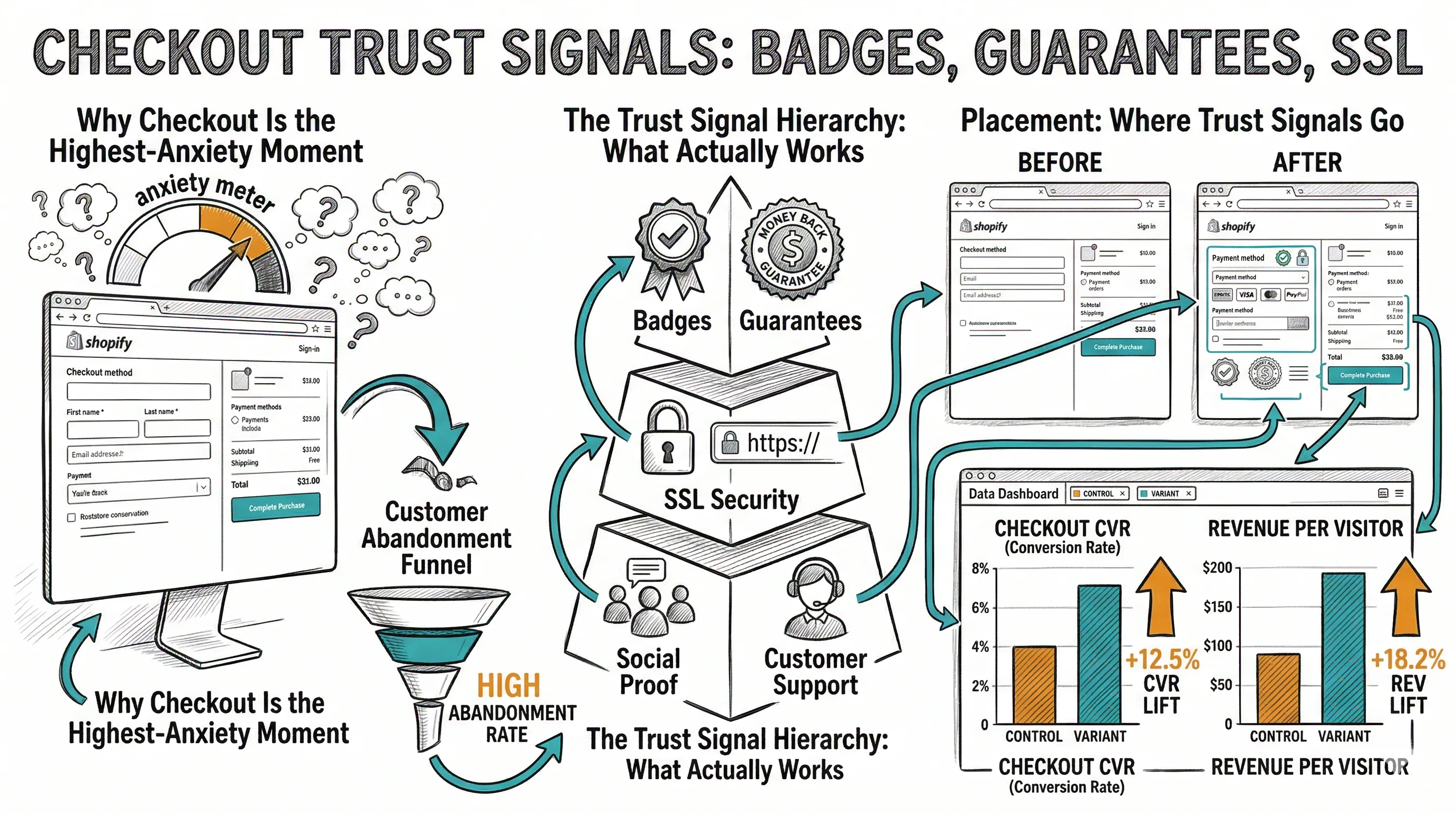
Links: Checkout Optimization | Cart Abandonment | Conversion Rate | Checkout Optimization Pillar | Payment Methods Conversion Rate | Checkout Trust Signals