From the conversion glossary
Concepts referenced in this article, defined.
Concepts referenced in this article, defined.
Run rigorous A/B tests and personalize every visit on Shopify or any storefront — no engineers required.
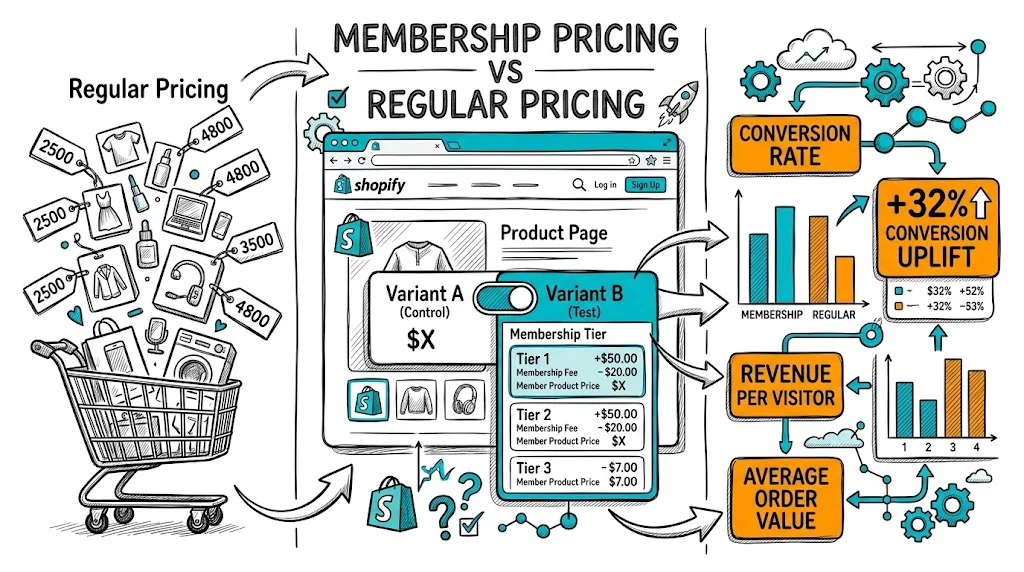
Membership pricing offers your loyal shoppers a permanently lower price in exchange for signing up (and often paying) for a membership. Regular pricing is the standard approach: everyone pays the same listed price, with discounts applied via promotions. Which model you pick, or whether you combine them, comes down to your purchase frequency, customer lifetime value, and brand positioning.
A membership (or loyalty price) program has these components:
Examples from Indian D2C and ecommerce:
Regular pricing is straightforward: one listed price for everyone. Discounts are tactical (seasonal sales, promo codes, first-purchase offers) rather than structural.
Most D2C brands in India start with regular pricing because it is simple to manage and does not require membership infrastructure. The trade-off is that every acquisition cost has to be recovered in the first purchase or two, because nothing structural is pushing the customer toward a third or fourth order.
High repeat-purchase frequency. If your average customer reorders every 30 to 45 days (supplements, skincare routine products, pet food, coffee), membership pricing gives them a structural reason to stay loyal. The discount is not enough to pull someone back for a one-time purchase, but it is enough reason to not switch brands mid-routine.
High customer acquisition cost. In categories where CAC is ₹500 to ₹1,000 or more, any mechanism that increases LTV matters. A membership that increases order frequency by 30% and average order value by 15% can double the effective return on acquisition spend.
Premium brand positioning. Members feel exclusive. Being part of a "members only" community signals that a brand has earned a loyal following. Brands like Pilgrim and The Minimalist (both targeting conscious beauty consumers) could use membership pricing to reinforce the "insider" identity.
Low repeat frequency. Furniture, mattresses, and most apparel categories have purchase cycles measured in years, not months. A membership model gives no retention benefit when customers are unlikely to return regardless.
Price-sensitive acquisition channels. If most of your traffic comes from price-comparison ads or discount aggregators, a membership model confuses the value proposition. Shoppers who found you because of a deal are not the right membership audience.
Early-stage brands. Building a membership program before you have product-market fit adds operational complexity. Most Indian D2C founders should focus on regular pricing until they have 10,000+ repeat customers to build a membership base from.
The most involved approach shows both prices at once: "Member price: ₹359 | Regular price: ₹499" with a "Join for free" or "Join for ₹199/year" CTA. This does three things:
Chargebee (B2B SaaS, not D2C) showed that structuring pricing tiers with a clear "committed" tier drove 40% AOV increases. The same psychology applies to D2C membership vs regular tiers.
Shopify has limited native membership pricing support. Your options:
For Indian brands, pricing the membership at ₹99 to ₹299 per year (not per month) keeps the sign-up friction low enough to convert without making the ongoing commitment feel burdensome.
Before committing to a full membership program, test membership interest:
Related reading: