CustomFit.ai — Website personalization, A/B testing and CRO for Shopify and D2C
Product
Features
✱
Website Personalization
Adapt to each visitor's behavior & intent
⧖
A/B & Multivariate Testing
Rigorous experimentation
✨
AI CopilotNEW
Personalize with a prompt
🤖
AI WingmanNEW
Auto-optimize toward winners
🎯
AI Conversion OptimizerNEW
GPT-grade test ideas
✎
No-Code Visual Editor
Drag-and-drop edit any element
▦
Product Recommendations
Personalized recs that lift AOV
⚑
Feature Flags
Ship safely with kill-switches
◧
Chrome Extension
Edit your store in the browser
⧉
Shopify, WooCommerce & more
All platform integrations
View all features →
Use Cases
$
Price A/B Testing
Test price points to maximize revenue
▦
Theme A/B Testing
Compare whole layouts & designs
🗂
Template A/B Testing
Test whole PDP/PLP templates
🏷
Discount A/B Testing
Find the offer that converts
🚚
Shipping A/B Testing
Thresholds, speed & copy
✍
Content A/B Testing
Copy, images & reviews
💳
Checkout Gateway A/B
Payments & one-click
⌖
Geo-Based Personalization
Per-location content & offers
⚡
Buyer-Intent Nudges
Exit-intent & retargeting
↔
Split-URL / Redirection
Full-page redirect tests
View all use cases →
Solutions & Guides
⤢
Conversion Rate Optimization
The complete CRO guide
⧖
A/B Testing Software
Buyer's guide for D2C
🛒
Cart Abandonment Recovery
Win back lost carts
📰
Landing Page Optimization
Convert more paid traffic
S
Shopify A/B Testing
Test your store, no code
S
Shopify Personalization
Tailor the store per shopper
◔
First-Time Visitor Offers
Convert new shoppers with trust & offers
★
Repeat-Customer Experiences
Reward and re-engage loyal buyers
◎
Campaign-Matched Pages
Match the landing page to the ad
⌖
Location-Based Experiences
Currency, language & regional offers
Explore CRO →
Customer stories
GIVA
+32%
conversion via personalized recs
GIVA
Mamaearth
+18%
revenue lift from PDP A/B tests
ME
The Sleep Company
+24%
AOV from product recommendations
TSC
Read customer stories →
Integrations
SWsfGA+15
✦
Not sure where to start?
Let AI Copilot pick your first tests

“We wake up to evidence-backed tests ready to deploy — not a backlog of maybe ideas.”

AN
Anirudh S.
Growth · Chargebee
★★★★★4.8on G2 · 2,400+ brands
Talk to our team →
Widgets
Integrations
Ecommerce & Checkout
Shopify
Shopline
Shoplazza
GoKwik
ShopFlo
Razorpay Magic Checkout
Breeze
Shiprocket
View all integrations →
Analytics & Behavior
Google Analytics 4
Microsoft Clarity
Hotjar
Mixpanel
Amplitude
Heap
Adobe Analytics
Segment (CDP)
View all integrations →
Engagement, CRM & More
Klaviyo
MoEngage
CleverTap
WebEngage
HubSpot
Salesforce
Slack
Meta Ads
View all integrations →
CustomersPricing
Resources
CRO
▤
Playbooks
Proven strategies to boost conversions
🎙
Interviews
D2C leaders & marketing experts
▶
Webinars
Live deep dives & product sessions
Learn
✎
Blog
Tips, experiments & best practices
📕
Free E-Books
Mastering personalization
📖
Conversion Glossary
Every CRO term, defined
✦AI CopilotNEWLog inBook a demo
Start free trial
Select your platform — Install in 2 minsWe'll tailor the setup
⚡ Risk-free 14-day trial · No credit card · Cancel anytime
S
Shopify
Install from Shopify App Store
›
W
WooCommerce
Install the WooCommerce plugin
›
B
BigCommerce
Install from BigCommerce App Marketplace
›
SL
Shopline
Install from Shopline App Store
›
M
Salesforce / Magento
Install from the marketplace
›
SZ
Shoplazza
Install from Shoplazza App Store
›
WP
WordPress / Webflow
Install plugin or paste the script
›
◧
Others
Custom-built on React, Next.js, etc.
›
Tip: pick your platform — we handle the restBook a demo →
Product
Website PersonalizationA/B & Multivariate TestingAI CopilotAI WingmanAI Conversion OptimizerNo-Code Visual EditorProduct RecommendationsFeature FlagsView all features →
Use Cases
Price A/B TestingTheme A/B TestingTemplate A/B TestingDiscount A/B TestingShipping A/B TestingContent A/B TestingCheckout Gateway A/BGeo-Based PersonalizationBuyer-Intent NudgesSplit-URL / Redirection
Solutions & Guides
Conversion Rate OptimizationA/B Testing SoftwareCart Abandonment RecoveryLanding Page OptimizationShopify A/B TestingShopify Personalization
Explore
WidgetsIntegrationsCustomersPricing
Resources
BlogPlaybooksWebinarsInterviewsE-BooksConversion Glossary
Platforms
ShopifyShoplineShoplazzaChrome ExtensionAll integrations
Start free trialBook a demo
Home›Blog›checkout pricing›Psychological Pricing Strategies That Work

Psychological Pricing Strategies That Work

SJSapna JoharHead of Growth & CRO, CustomFit.aiJanuary 15, 20259 min read
On this page
  1. Why Price Presentation Matters as Much as Price
  2. Strategy 1: Charm Pricing and Left-Digit Anchoring
  3. Strategy 2: Price Anchoring
  4. Strategy 3: Bundle Pricing and the Decoy Effect
  5. Strategy 4: Free Shipping Thresholds as Price Anchors
  6. Strategy 5: BNPL and EMI Presentation
  7. Strategy 6: [Dynamic Pricing](/conversion-glossary/dynamic-pricing) and Time-Based Price Psychology
  8. Strategy 7: Price-Quality Signaling
  9. Tips and Best Practices
  10. Key Takeaways
0%
Psychological Pricing Strategies That Work

From the conversion glossary

Concepts referenced in this article, defined.

Definition
What Is Bundle? Definition & Guide
Definition
What Is Psychological Pricing? Definition & Guide
Definition
What Is Free Shipping Threshold? Definition & Guide
Definition
What Is Dynamic Pricing? Definition & Guide
Definition
What Is Subscription? Definition & Guide
← Back to Checkout Pricing guide
Try CustomFit.ai

Run A/B tests and personalize your store without code. 14-day free trial, no credit card.

Start free trial →
Share
XLinkedInEmail

Related articles

checkout pricing

Volume Discount Strategy for Ecommerce

Sapna Johar· 5 min read
checkout pricing

UPI & COD Optimization for Indian Ecommerce

Sapna Johar· 9 min read
checkout pricing

Tiered Pricing for D2C Products

Sapna Johar· 5 min read

Start lifting conversions today.

Run rigorous A/B tests and personalize every visit on Shopify or any storefront — no engineers required.

Start free trialBook a demo

Built for every D2C category

🧴
Skincare
💄
Beauty
🌿
Wellness
☕
F&B
👟
Apparel
💍
Jewelry
🛋️
Home
🍼
Baby
Live · Right now
Mamaearth — free-shipping band +12.4% AOVGIVA — festive collection page +34% revenueBellavita — PDP CTA test +27.4% CVRKapiva — Quiz-driven recs +9.48% CTRThe Sleep Co — landing personalized 2× capturesPlum — Returning shopper swap +18.2% CVRMamaearth — free-shipping band +12.4% AOVGIVA — festive collection page +34% revenueBellavita — PDP CTA test +27.4% CVRKapiva — Quiz-driven recs +9.48% CTRThe Sleep Co — landing personalized 2× capturesPlum — Returning shopper swap +18.2% CVR
Get in touch

Tell us about your store.

We reply within an hour during business hours. No sales pitch, no spam — just answers from someone who's seen 2,400+ D2C stores.

✓ Reply within 1 hour✓ No spam, ever✓ Free demo & setup help
✓ Thanks! We'll be in touch shortly.
CustomFit.ai

The all-in-one website personalization, A/B testing & CRO platform for high-growth D2C brands. Made by marketers, fueled by coffee.

in𝕏◎▶f
Product
  • Features
  • A/B Testing
  • Personalization
  • AI Copilot
  • AI Wingman
  • AI Conversion Optimizer
  • Feature Flags
  • Widgets
  • Integrations
  • ROI Calculator
Platforms
  • Shopify
  • Shopline
  • Shoplazza
  • Salesforce
  • Chrome Extension
  • All Integrations
Resources
  • Blog
  • Playbooks
  • Webinars
  • GrowthFit Interviews
  • Free E-Books
  • Conversion Glossary
  • Case Studies
Compare
  • vs VWO
  • vs Optimizely
  • vs Google Optimize
  • vs Mutiny
  • vs Intelligems
  • vs Shoplift
  • vs AB Tasty
  • vs Convert
  • vs Kameleoon
Company
  • About Us
  • Partners
  • CustomFit Awards
  • Recognition
  • Contact
  • Privacy Policy
  • Terms & Conditions
© 2026 CustomFit.ai · Valley Monks Pvt Ltd · Made by marketers, fueled by coffee, and obsessed with conversions.
SOC 2 Type II · GDPR · CCPA · ISO 27001

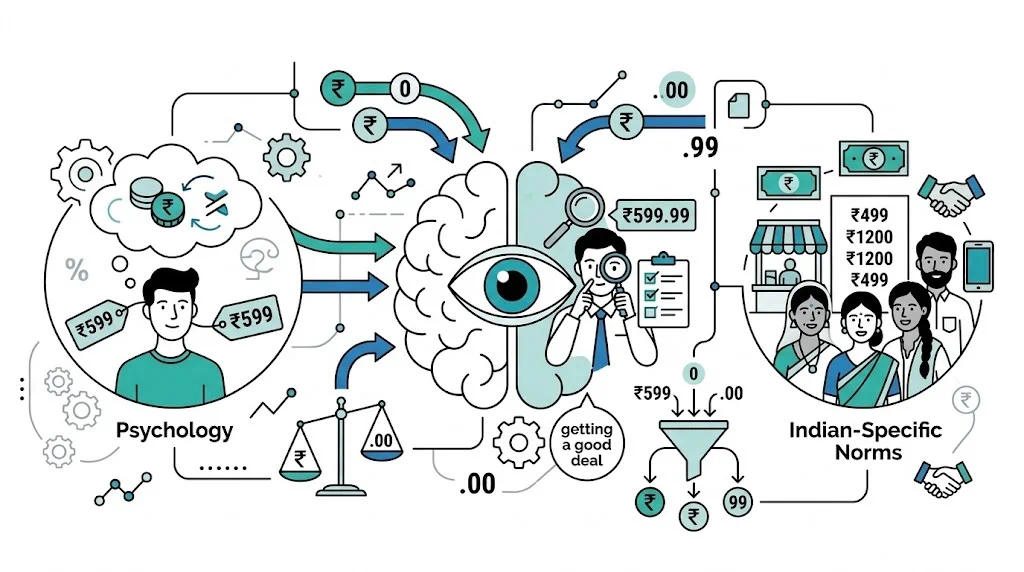
The price of your product is fixed — but how you display that price dramatically affects whether customers buy. Psychological pricing is not manipulation; it is understanding how human brains process price information and presenting your prices in the way that most accurately communicates value. The difference between ₹999 and ₹1,000 is ₹1. The difference in conversion rate can be 12%. Here are the psychological pricing strategies that work for Indian D2C brands, with guidance on how to test each.

Why Price Presentation Matters as Much as Price

Customers do not evaluate prices in a vacuum. They compare prices to:

  • Reference prices (what they expect to pay based on past experience)
  • Anchor prices (the first price they see, which shapes all subsequent judgments)
  • Competitor prices (what they know alternatives cost)
  • Perceived value (how much they believe the product is worth)

Psychological pricing works by shaping each of these reference points to present your price as more attractive without changing the actual number.

Strategy 1: Charm Pricing and Left-Digit Anchoring

Charm pricing — ending prices in 9, 99, or 995 — is the most widely used psychological pricing technique because it exploits a specific cognitive bias: we read numbers left to right, so the leftmost digit anchors our impression.

₹999 feels closer to ₹900 than to ₹1,000. ₹499 feels dramatically less than ₹500. This "left-digit effect" is consistent across cultures and income levels.

For Indian D2C, effective charm price points:

  • ₹149, ₹199, ₹249 (entry-level products)
  • ₹499, ₹599, ₹799 (mid-range)
  • ₹999, ₹1,499, ₹1,999 (premium)
  • ₹2,499, ₹4,999 (high-end)

When not to use charm pricing: For luxury-positioned brands, round numbers (₹1,000, ₹2,000, ₹5,000) actually signal premium quality. Luxury psychology differs from mass market. Charm pricing on a ₹15,000 watch feels tacky; a clean ₹15,000 feels appropriate.

How to test: Run an A/B test comparing your current price (say ₹500) with ₹499 on your product page. CustomFit.ai can serve the two versions to equal traffic segments and measure conversion rate difference.

Strategy 2: Price Anchoring

Anchoring is the practice of showing a reference price alongside your selling price to make the selling price feel like a better deal.

In Indian ecommerce, this manifests as:

  • MRP vs. selling price: Showing ₹899 MRP crossed out next to ₹599 selling price. This is standard practice and highly effective.
  • "Was" pricing: "Was ₹1,200, Now ₹799" — communicates a discount without requiring a percentage calculation.
  • Comparative pricing: "Similar products cost ₹2,000–3,000. Ours: ₹1,299."
  • Per-unit anchoring: "₹1,499 for 3 months supply = just ₹499/month" for subscription-style products.

Critical rule: Anchors must be real. False MRP inflation is illegal under Indian consumer protection regulations and is increasingly detected by consumers. If your product's actual MRP is ₹599, do not show ₹999 as MRP.

For supplements and beauty: Per-day pricing is powerful. "Just ₹33/day for healthier skin" makes ₹999 feel trivial.

For Chargebee's B2B pricing, a similar principle applies: showing the cost in context of the value generated (a 40% AOV increase) makes the subscription fee feel modest. The same logic applies to D2C products — contextualize your price against the alternative cost or value delivered.

Strategy 3: Bundle Pricing and the Decoy Effect

Bundles increase average order value while making individual product prices feel more attractive through comparison.

The three-option structure (Good/Better/Best) uses the decoy effect:

OptionContentsPricePer Item
Starter1 product₹499₹499
Value Bundle3 products₹1,199₹400 (20% off)
Complete Kit5 products₹1,799₹360 (28% off)

In this structure, the Value Bundle (middle option) is usually your target purchase. The Complete Kit makes it look like a steal. The Starter makes the Value Bundle feel like better value. This architecture — tested across thousands of D2C stores — consistently drives the most customers to the middle option.

How Kapiva uses bundles: Kapiva offers daily wellness bundles (Immunity Pack, Gut Health Pack, Weight Management Pack) that group 3 complementary products at 20% off individual prices. These bundles drive 30–40% higher AOV than individual product sales.

Bundle naming matters: "Starter Kit" implies beginning. "Complete Routine" implies comprehensiveness. "30-Day Challenge Bundle" implies a commitment with a benefit. Test your bundle names — the framing changes purchase behavior.

Strategy 4: Free Shipping Thresholds as Price Anchors

The free shipping threshold is a psychological pricing tool disguised as a logistics policy. When you set free shipping at ₹699 and a customer's cart is at ₹550, the "Add ₹149 for free shipping" prompt almost always results in an additional item added.

This is not manipulation — it is giving customers a clear value proposition: spend a bit more and get real monetary value (shipping savings of ₹60–100).

Threshold optimization:

  • Set your threshold 15–25% above your median order value
  • If median order value is ₹550, set threshold at ₹649–699
  • Display the threshold prominently in the cart ("₹149 away from free shipping")
  • Suggest specific products to add to reach the threshold

Test different threshold amounts using A/B testing. A threshold that is too high feels unachievable; too low gives away shipping revenue without driving meaningful AOV lift.

See our full guide on free shipping threshold optimization for the complete methodology.

Strategy 5: BNPL and EMI Presentation

Buy Now Pay Later (BNPL) and EMI options function as psychological pricing tools by breaking large prices into palatable installments.

For Indian D2C:

  • Simpl and LazyPay for BNPL (split into 3 payments)
  • Bajaj Finserv and ZestMoney for EMI
  • Credit card EMI (Razorpay supports this)

The framing that converts:

  • "Or 3 installments of ₹333 with Simpl" — show this below the main price
  • "0% EMI from ₹XXX/month" — for AOVs above ₹1,500
  • "Pay in 3 — no cost" — emphasize zero additional cost

For products in the ₹1,000–3,000 range, showing BNPL options increases conversion by 8–15% for price-sensitive segments, particularly for Tier 2 audiences and younger demographics.

Strategy 6: Dynamic Pricing and Time-Based Price Psychology

Dynamic pricing — adjusting prices based on demand, time, or customer behavior — is advanced but increasingly accessible for D2C brands.

Practical applications:

Festive pricing with visible countdown: "Diwali Special — ₹799 (regular ₹1,099) — ends in 48 hours" with a real countdown timer. The time limit adds urgency to the price anchor.

First-order discount framing: "15% off your first order" vs. "₹150 off your first order" — test both. Dollar-amount discounts often outperform percentage discounts for lower-priced products; percentages outperform for higher-priced products.

Loyalty tier pricing: Showing loyalty members a different (better) price than non-members creates visible reward for loyal behavior and incentivizes program sign-up.

Exit-intent price offers: When a customer shows exit behavior, showing a time-limited offer ("Wait — here's 10% off valid for the next 15 minutes") captures some of the departing traffic. Use sparingly — overuse devalues your pricing.

Strategy 7: Price-Quality Signaling

Sometimes, pricing too low kills conversion. Customers use price as a proxy for quality, especially for categories with high quality uncertainty (skincare, supplements, personal care).

If you are converting poorly and your price is significantly below market, test a price increase. Counter-intuitive but documented: a serum priced at ₹399 sometimes converts worse than the same serum at ₹599 because customers suspect something is wrong with a "cheap" skincare product.

The price-quality balance for Indian D2C:

  • Personal care: ₹199–599 is accessible; ₹600–1,200 is premium but credible; above ₹1,500 requires strong brand justification
  • Supplements: ₹499–1,199 for monthly supply feels fair; below ₹399 raises quality questions
  • Fashion: Depends heavily on category — ethnic wear at ₹1,500–4,000 is mid-market; below ₹800 is mass market

If you are repositioning a product upward in price, use anchoring and certification prominently to justify the new price point.

Tips and Best Practices

  1. Test one variable at a time. When A/B testing pricing, change only the price display element — not the page layout simultaneously. Isolate the variable you are measuring.

  2. Anchoring works only with credible anchors. False MRP inflation is increasingly detected by Indian consumers and creates distrust. Use honest anchors.

  3. Bundle savings must feel meaningful. "Save ₹30 on a ₹1,499 bundle" is not compelling. "Save ₹450 (23% off)" is. The absolute saving must be significant relative to the bundle price.

  4. Show price per day or per use for high-frequency products. "₹16/day for healthy skin" converts better than "₹499/month" for most skincare and supplement categories.

  5. Test free shipping threshold quarterly. As your product mix and AOV evolve, the optimal threshold changes.

  6. Track revenue per visitor, not just conversion rate. A pricing change that reduces conversion slightly but increases AOV significantly can be a net win.

Key Takeaways

  • How you display prices affects conversion as much as the price itself — invest in price presentation.
  • Charm pricing (₹999 not ₹1,000) consistently improves conversion through left-digit anchoring.
  • Bundle the three-option structure (Good/Better/Best) to drive customers to your target purchase using the decoy effect.
  • Free shipping thresholds set 15–25% above median AOV drive meaningful basket size increases.
  • BNPL and EMI framing makes ₹1,000–3,000 products accessible for price-sensitive segments.
  • Test every pricing display element using A/B testing — your audience's price psychology may differ from generalizations.

Psychological pricing is not about tricking customers — it is about presenting genuine value in a way that human psychology processes as compelling. When honest, it is a win for both sides: customers feel they got value, and your conversion rate and average order value improve together.