From the conversion glossary
Concepts referenced in this article, defined.
Concepts referenced in this article, defined.
Run rigorous A/B tests and personalize every visit on Shopify or any storefront — no engineers required.
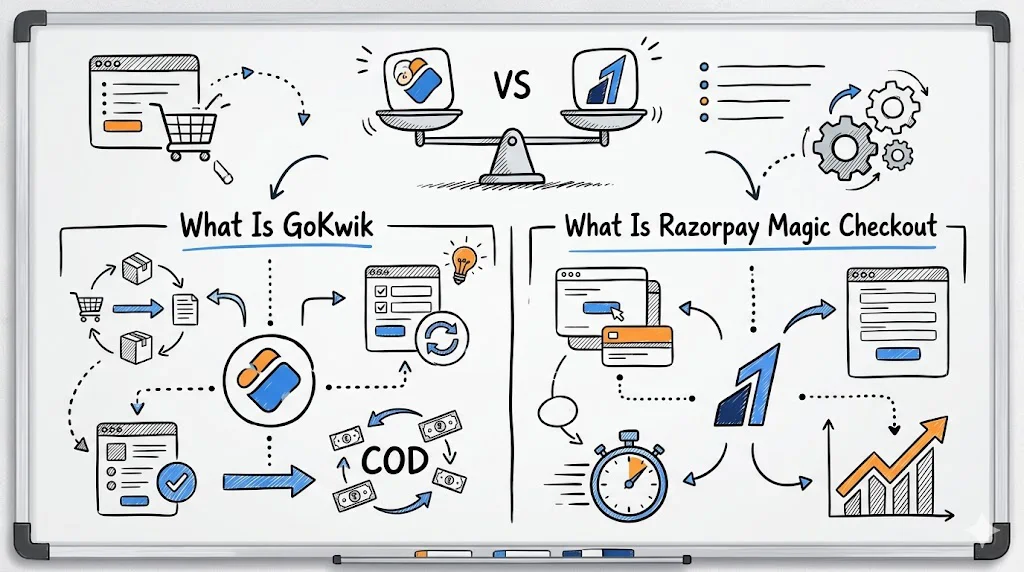
Both GoKwik and Razorpay Magic Checkout address the same core problem in Indian D2C: a high-friction checkout that drives cart abandonment, excessive COD orders, and post-delivery returns. GoKwik is the more specialized of the two. It focuses on COD risk intelligence, prepaid conversion, and return rate reduction. Razorpay Magic Checkout uses Razorpay's large payment network to pre-fill checkout details for returning customers. For brands with a significant COD challenge and high return rates, GoKwik's intelligence layer is more targeted. For brands that mainly want faster checkout and prepaid conversion across a broad audience, Razorpay Magic Checkout's network effect makes a strong case.
GoKwik is an Indian checkout optimization and COD intelligence platform. It helps D2C brands identify high-risk COD orders (the ones likely to be returned or not delivered), nudge shoppers toward prepaid payments, and offer a one-click checkout for returning customers. GoKwik keeps a network of shopper data across its brand partners and uses that network intelligence to verify addresses, assess return risk, and personalize the checkout flow. Brands like Mamaearth, Noise, and Lenskart have used GoKwik.
Razorpay Magic Checkout is a one-click checkout solution built on Razorpay's payment infrastructure. Because Razorpay processes payments for a large portion of Indian ecommerce, it already holds saved payment details and addresses for millions of Indian shoppers. Magic Checkout pre-fills this data at checkout, which cuts friction sharply for returning Razorpay customers. It supports all major Indian payment methods: UPI, credit/debit cards, net banking, and COD.
| Feature | GoKwik | Razorpay Magic Checkout |
|---|---|---|
| One-click checkout (returning users) | Yes | Yes (via Razorpay network) |
| COD risk intelligence | Yes (core feature) | Limited |
| Prepaid nudging | Yes (intelligent) | Basic |
| Return rate reduction tools | Yes | No |
| Address verification | Yes | Via pincode database |
| UPI support | Yes | Yes |
| EMI options | Yes | Yes |
| Network size | GoKwik merchant network | Razorpay's full payment network |
| Platform compatibility | Custom + Shopify | Shopify + WooCommerce + custom |
| Pricing model | Revenue share / custom | Transaction fee |
| Free plan | No | No |
Indian D2C brands face a specific challenge: a large portion of orders are placed as cash on delivery, which means the sale isn't confirmed until delivery. COD orders have higher return rates and non-delivery rates than prepaid orders. A typical D2C brand might see 30% to 50% COD return rates in high-COD categories like fashion and electronics accessories.
Both GoKwik and Razorpay Magic Checkout try to solve this, but in different ways.
GoKwik's approach is intelligence-first. It uses network data to predict which COD orders are likely to be returned, then intervenes: showing a "prepaid discount" nudge specifically to high-risk COD customers, or blocking COD for addresses with a history of non-delivery. This targeted risk management lowers return rates and improves cash flow.
Razorpay's approach is friction-first. By pre-filling checkout details for the large share of shoppers who have previously paid via Razorpay, it reduces abandonment at checkout. Fewer steps mean more completions, which mean more prepaid conversions by default, since prepaid checkout is faster when details are already filled in.
Both approaches are valid. They address different root causes of the same problem.
Razorpay's key advantage is scale. Razorpay processes payments for a very large share of Indian ecommerce, so its Magic Checkout recognizes a significant proportion of your shoppers and can pre-fill their details. The network effect is real: the more brands that use Razorpay as their payment gateway, the more shoppers benefit from one-click checkout.
GoKwik's network is smaller but more targeted to D2C brands. The intelligence it offers (COD risk scores, return prediction) is specific to the types of brands GoKwik works with: direct-to-consumer, fashion, wellness, electronics accessories. This focus can make GoKwik's risk models more accurate for D2C categories.
Both platforms offer ways to nudge COD shoppers toward prepaid, but GoKwik's nudging is more sophisticated. GoKwik can adjust the prepaid incentive based on the shopper's risk score, offering a ₹50 discount to a borderline shopper but a ₹100 discount to a high-risk COD customer. This dynamic incentive keeps the cost of prepaid conversion in check.
Razorpay Magic Checkout's prepaid conversion benefit comes mainly from reducing checkout friction. Faster checkout for prepaid means more prepaid completions. It's a passive conversion lever, not an active one.
This is GoKwik's clearest differentiator. GoKwik explicitly models return risk and takes actions to reduce returns, not only through COD blocking but through COD fulfillment decisions (sometimes fulfilling a high-risk COD order with additional verification steps before dispatch). For brands where return costs are a meaningful P&L line, GoKwik's return rate intelligence has a direct financial impact.
Razorpay Magic Checkout does not have comparable return reduction features.
One-click checkout sounds simple, but the mechanism differs between platforms and affects which customers benefit.
Razorpay Magic Checkout achieves one-click by recognizing customers who have previously paid through any Razorpay-powered store. Since Razorpay processes payments for a large share of Indian ecommerce, the recognition rate is high, because a significant portion of Indian online shoppers have made at least one Razorpay transaction. For these shoppers, Magic Checkout pre-fills their name, address, email, and payment details, reducing checkout to a single confirmation step.
GoKwik achieves one-click checkout by recognizing customers within its own merchant network. A shopper who previously bought from a GoKwik-powered brand has their address and contact details stored in GoKwik's system, which enables pre-fill on later purchases at any GoKwik merchant. The recognition rate depends on how many brands in GoKwik's network a given shopper has transacted with.
For new customers (first-time buyers who haven't shopped on any GoKwik or Razorpay-connected store), neither platform removes manual data entry on the first purchase. The one-click benefit applies mainly to returning shoppers and cross-merchant shoppers within each network.
A major driver of non-delivery in Indian D2C is address quality: incomplete addresses, incorrect pincodes, or addresses in areas that third-party logistics (3PL) partners don't service. Both GoKwik and Razorpay Magic Checkout have ways to handle this.
GoKwik's address verification uses its network data and pincode database to flag problematic addresses at checkout, prompting the customer to correct or confirm before completing the order. For brands shipping to Tier-2 and Tier-3 cities where address completeness is more variable, this pre-emptive verification can meaningfully reduce non-delivery rates.
Razorpay Magic Checkout pre-fills address data from its payment network for known customers, which reduces manual entry errors. Pre-filled addresses are generally more reliable than manually typed ones, so this approach carries an indirect quality benefit.
For brands with a high Tier-2/3 order mix, GoKwik's explicit address verification is a more targeted solution. Razorpay's pre-fill approach helps but doesn't catch all the edge cases that GoKwik's network intelligence can identify.
Checkout optimization in India isn't only about which checkout platform you use. It's also about what happens before the checkout. Product page trust signals, shipping information, COD availability display, and return policy placement all influence whether a shopper clicks "Buy Now" at all.
CustomFit.ai lets Indian D2C brands A/B test the pre-checkout experience: testing where to display COD availability, how to show delivery timelines, whether a "100% return guarantee" badge above the fold improves add-to-cart rates, and how to present prepaid discount incentives. These page-level decisions affect the quality and quantity of shoppers who reach checkout, which is where GoKwik and Razorpay then do their work.
Pre-checkout optimization with CustomFit.ai and checkout optimization with GoKwik or Razorpay Magic Checkout address different parts of the same conversion funnel.
For Indian D2C brands, converting COD orders to prepaid is a significant financial lever. Consider the economics.
A COD order at ₹1,500 might have:
The same ₹1,500 prepaid order removes the COD charge, lowers return probability (prepaid customers return at lower rates), and reduces logistics complexity.
If offering a ₹50 prepaid discount converts 15% of COD orders to prepaid on orders averaging ₹1,500, the net economics are strongly positive, saving more in COD charges and avoided returns than the discount costs. Both GoKwik and Razorpay Magic Checkout help capture this economic benefit, but GoKwik's targeted approach (offering incentives specifically to high-risk COD customers) is more capital-efficient than offering prepaid discounts to all COD customers.
What is COD risk intelligence in GoKwik? GoKwik scores each COD order for the probability that it will be returned or not delivered. This score is based on network data from GoKwik's brand partners: address history, order behavior, pincode-level return rates, and more. High-risk orders can be offered prepaid incentives, routed to additional verification, or have COD blocked entirely.
Does Razorpay Magic Checkout support all Indian payment methods? Yes. Magic Checkout supports UPI (Google Pay, PhonePe, BHIM), credit and debit cards (Visa, Mastercard, RuPay), net banking, EMI options, and COD. UPI is increasingly the highest-volume payment method for Indian D2C brands.
How is GoKwik priced? GoKwik typically works on a revenue-sharing or per-order model with custom pricing for each brand. Pricing is not publicly listed and requires a sales conversation. Costs are usually justified by the reduction in returns and the improvement in prepaid conversion.
Can I use both GoKwik and Razorpay together? Some brands use GoKwik for COD intelligence while keeping Razorpay as their prepaid payment processor. GoKwik integrates with multiple payment gateways. That said, Razorpay Magic Checkout is most effective when Razorpay is also your primary payment gateway. The integration approach needs to be verified with both vendors.
What is a typical COD return rate for Indian D2C brands? Return rates vary a lot by category. Fashion can see 30% to 50% COD returns. Electronics accessories typically see 15% to 25%. Wellness and personal care tend to have lower return rates. Return rates also vary by geography, and Tier 1 cities generally have lower non-delivery rates than Tier 3+ cities.