From the conversion glossary
Concepts referenced in this article, defined.
Concepts referenced in this article, defined.
Run rigorous A/B tests and personalize every visit on Shopify or any storefront — no engineers required.
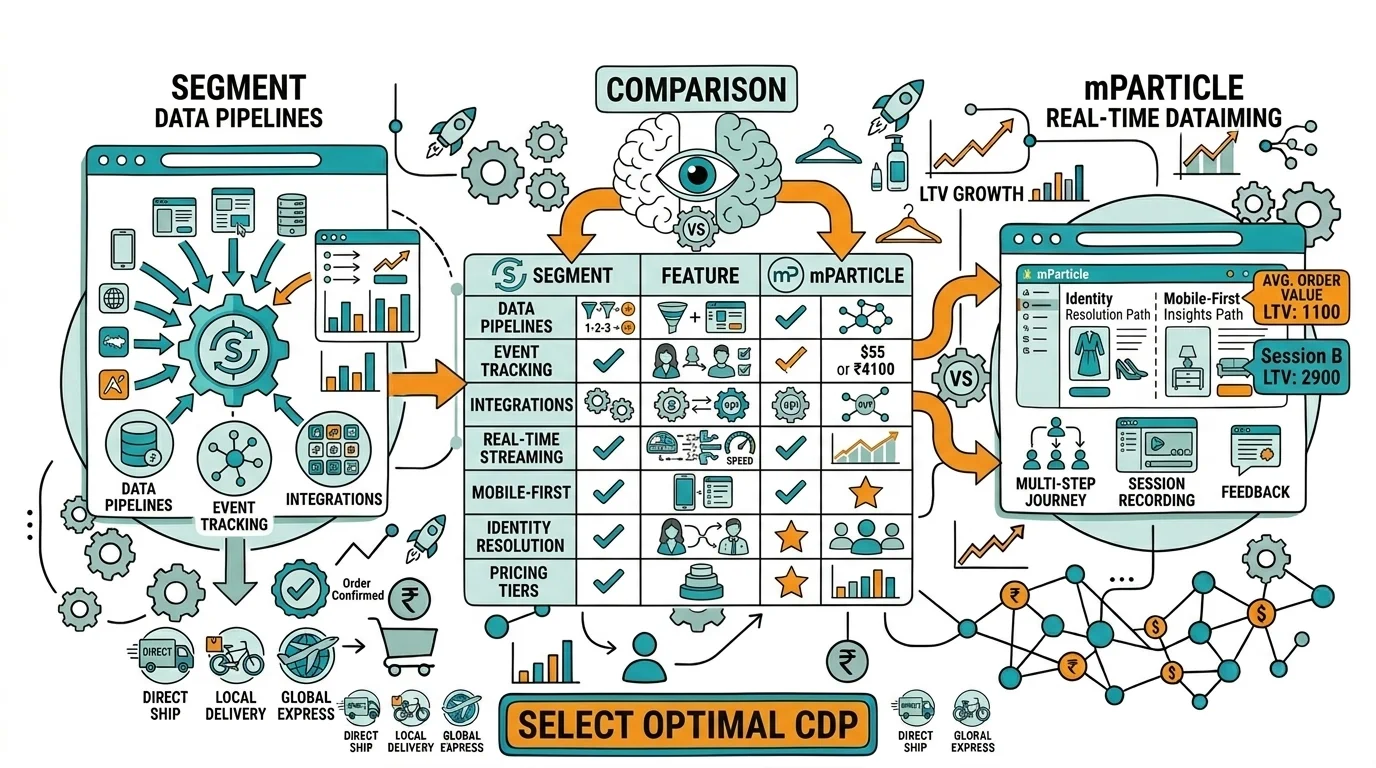
Segment is the more accessible customer data platform (CDP) for most D2C brands. It's faster to set up, has better documentation, offers a free tier, and its integration ecosystem covers virtually every marketing and analytics tool you'll need. mParticle is built for enterprise data infrastructure, with more sophisticated identity resolution and strict data governance features. If you're a D2C brand under $50M revenue looking to unify customer data and feed it into your marketing and analytics stack, Segment is the right choice in almost every case. mParticle's complexity and cost pay off only when your data infrastructure demands, and your budget, are genuinely enterprise-level.
Segment, now owned by Twilio, is a customer data platform that collects events from your website, app, and third-party tools and routes them to your marketing, analytics, and CRM stack. It sits between your data sources (your Shopify store, mobile app, email tool) and your destinations (Klaviyo, Google Ads, Amplitude, your data warehouse), acting as a centralized data layer. You instrument Segment once, and it keeps all your downstream tools in sync with the same event data. Thousands of ecommerce and SaaS companies use Segment, from early-stage startups to large enterprises.
mParticle is an enterprise CDP focused on mobile-first data infrastructure, real-time audience management, and data quality enforcement. It runs a rules-based data pipeline where you can validate, transform, and route event data with fine-grained control. You can block non-conformant events, rename properties on the fly, and route specific event types to specific destinations only. Large consumer apps and retailers with complex multi-platform data needs rely on it, in cases where data consistency across many engineering teams is a genuine operational challenge.
| Feature | Segment | mParticle |
|---|---|---|
| Web event tracking | Yes | Yes |
| Mobile SDK (iOS/Android) | Yes | Yes (stronger mobile focus) |
| Server-side tracking | Yes | Yes |
| Identity resolution | Yes (Unify module) | Advanced |
| Data transformation | Yes (Functions) | Yes (Rules Engine) |
| Data validation/governance | Protocols (paid add-on) | Built-in, extensive |
| Real-time audiences | Yes (Personas/Engage) | Yes |
| Warehouse sync | Yes (BigQuery, Snowflake, Redshift) | Yes |
| Pre-built integrations | 400+ | 300+ |
| Free tier | Yes (1,000 MTUs) | No |
| Ease of setup | High | Moderate |
| Shopify integration | Yes | Yes |
| Best for | SMB to mid-market | Enterprise |
Before comparing the platforms themselves, it helps to clarify what a CDP actually does, and why D2C brands need one.
When a shopper visits your Shopify store, several things happen at once. Google Analytics records a pageview, Klaviyo might record a product view if the shopper's email is known, your Shopify store records the session, and your Facebook Pixel fires. Each tool captures some data independently. The problem is that these tools don't know about each other, so you end up with fragmented customer profiles: different identifiers in different tools, events tracked differently, and no single source of truth about what each customer has done.
A CDP like Segment fixes this by acting as the single collection point. You instrument Segment once (install the snippet, define your events), and Segment routes the same event data to every tool in your stack. Instead of implementing a separate Klaviyo tracking script, a separate GA4 script, and a separate Amplitude script, you maintain one data layer in Segment and fan it out.
Both platforms collect events via JavaScript snippet (web) and native SDKs (iOS/Android). The main operational difference is how they handle data quality.
mParticle has a built-in data master. You define your event schema upfront, and mParticle enforces it. Any event that doesn't match the defined schema is flagged, blocked, or quarantined. This is genuinely valuable at enterprise scale, where dozens of engineers across multiple teams are sending events and data drift is a real problem: events named differently by different teams, properties inconsistently included. mParticle's governance prevents that drift.
Segment's Protocols feature provides similar schema enforcement, but only on higher-tier plans. On standard plans, Segment accepts any event without validation. For most D2C brands, this is fine. You control your own event tracking, you're not coordinating across a large engineering organization, and the productivity gain from quick, flexible event setup outweighs the governance gap.
Segment's 400+ integrations cover essentially every tool in the modern marketing stack: Klaviyo, Braze, Mixpanel, Amplitude, Google Ads, Meta Pixel, Snowflake, BigQuery, Redshift, Salesforce, HubSpot, and more. For D2C brands specifically, the Klaviyo integration is particularly useful. Segment can pass user traits (purchase history, product category affinity, loyalty status) to Klaviyo as custom properties, which opens up finer segmentation.
mParticle has around 300 integrations, with particular depth in mobile attribution platforms: Appsflyer, Adjust, Kochava, Firebase. If your D2C brand has a significant mobile app component alongside your web store, mParticle's mobile-first architecture and attribution integrations are worth considering. For web-only Shopify brands, Segment's broader integration library is more relevant.
Stitching together a shopper's mobile visit, web visit, and purchase history into a single unified profile is the central challenge in ecommerce customer data. A shopper who browses on mobile (anonymous), opens an email on desktop (identified), and purchases in-store (known) might appear as three separate users in a basic tracking setup. Identity resolution merges these into one profile.
mParticle's identity resolution is more mature and configurable. You define a priority of identity attributes (email takes precedence over device ID, which takes precedence over anonymous ID) and set rules for how profiles merge and split under different conditions. For enterprise retailers with complex cross-channel identities, this configurability matters.
Segment's identity resolution (in the Unify module) works well for most ecommerce use cases: basic cross-device identification using email and anonymous ID merging. It's less configurable than mParticle but covers the core use cases adequately.
Segment's free tier supports up to 1,000 Monthly Tracked Users (MTUs), which is enough to set up and validate your data infrastructure before committing to a paid plan. The Team plan starts around $120/month and scales by MTU count. For a D2C store with 10,000 monthly active users, the Team plan is typically sufficient for event collection, connections to core marketing tools, and basic audience building.
mParticle has no free plan. Pricing is custom and enterprise-level, typically starting at several thousand dollars per month. For a growing D2C brand, mParticle's pricing is generally prohibitive unless you're operating at significant scale with a dedicated data engineering team to manage it.
A CDP like Segment or mParticle collects and routes your customer data, but neither platform runs experiments. They tell you what customers are doing (how many people viewed a product page, at what rate they add to cart, how many complete purchase). What they can't do is systematically test different experiences to improve those rates.
This is where experimentation platforms complement CDPs. CustomFit.ai integrates with Segment. Segment passes user traits and behavioral events to CustomFit.ai, which lets you target A/B tests at specific audience segments. Here's an example. Segment identifies customers who have purchased three or more times (a high-LTV segment). CustomFit.ai shows that segment a different product page variant with a loyalty-focused message. You then measure whether conversion rate or average order value improves.
A workable stack for D2C brands looks like this: Segment for data collection and routing, Klaviyo for email and SMS, CustomFit.ai for on-site experimentation, and a data warehouse (BigQuery or Snowflake) for long-term analysis. Each tool does one job well, and they compound.
Does Segment work with Shopify? Yes. Segment has a native Shopify integration that captures standard ecommerce events: page viewed, product viewed, product added to cart, checkout started, order completed, and more. Customer profiles are automatically synced. For most D2C Shopify brands, Segment is the recommended way to build a clean event data layer that feeds all downstream tools.
Is mParticle better than Segment for mobile apps? mParticle has stronger mobile-native features, particularly around mobile attribution integrations (Appsflyer, Adjust) and mobile identity resolution. If your D2C brand derives significant revenue through a mobile app, mParticle's mobile-first architecture is worth evaluating seriously. For web-only Shopify brands, the mobile advantage is not relevant.
What's a Monthly Tracked User (MTU) in Segment? An MTU is any unique user who triggers at least one event in a calendar month, whether they're a known customer or an anonymous visitor. For Segment's pricing, this typically maps to your monthly active visitor or customer base. A store with 5,000 unique monthly visitors would need a plan supporting at least 5,000 MTUs.
Can Segment replace Google Analytics? No. Segment is a data pipeline that collects events and routes them to destination tools. It does not have a native analytics interface for exploring data. You'd use Segment to route data to GA4, Amplitude, or Mixpanel, then explore analytics in those tools. Segment and analytics platforms serve complementary roles.
Do I need a developer to set up Segment? Initial setup (installing the JavaScript snippet, configuring standard Shopify events) can be done by a technically capable marketer. More advanced configurations, such as server-side tracking, custom event schemas, and data warehouse sync, typically require developer involvement. Segment's documentation is thorough, and its Shopify integration handles many standard events automatically.