From the conversion glossary
Concepts referenced in this article, defined.
Concepts referenced in this article, defined.
Run rigorous A/B tests and personalize every visit on Shopify or any storefront — no engineers required.
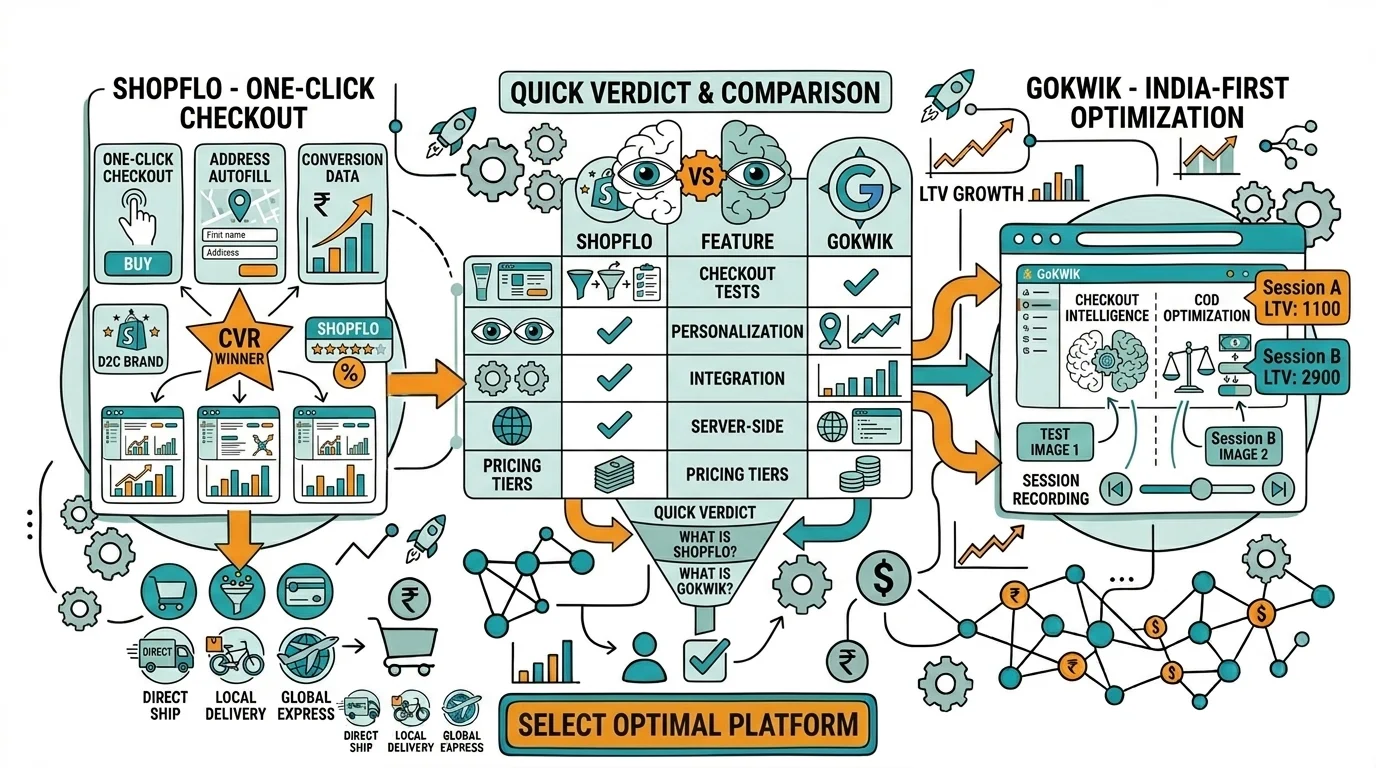
Both Shopflo and GoKwik are Indian checkout optimization platforms aimed at D2C brands, but they prioritize different problems. Shopflo focuses on checkout UX: a clean, fast, customizable checkout experience that reduces friction across all order types. GoKwik focuses on COD intelligence, using network data to identify risky COD orders, nudge prepaid conversion, and reduce return rates. If your main challenge is checkout UI friction and mobile UX, Shopflo's approach is more product-design-forward. If your main challenge is high COD return rates and you need risk scoring to make smart fulfillment decisions, GoKwik's intelligence layer is more targeted. Many large Indian D2C brands have evaluated both.
Shopflo is an Indian checkout platform built to replace the default Shopify (or WooCommerce) checkout with a faster, more customizable experience tuned for Indian shoppers. The checkout is designed for India-specific payment flows (UPI, COD, EMI) and includes one-click checkout for returning customers, trust signals built into the checkout flow, prepaid incentive display, and customizable checkout pages that brands can align with their visual identity. Shopflo was acquired by Razorpay in 2023.
GoKwik is a checkout and COD intelligence platform for Indian D2C brands. What sets it apart is network intelligence: GoKwik keeps a database of shopper behavior across its brand partners and uses that data to score each COD order for return risk, pre-fill checkout data for returning shoppers, and present prepaid incentives dynamically based on each shopper's risk profile. GoKwik works with a large number of Indian D2C brands across fashion, wellness, and electronics categories.
| Feature | Shopflo | GoKwik |
|---|---|---|
| Custom checkout UI | Yes (core feature) | Partial |
| One-click checkout | Yes | Yes |
| COD risk scoring | Basic | Yes (core feature) |
| Prepaid nudging | Yes (display-based) | Yes (dynamic, risk-based) |
| Return rate reduction | Basic | Yes (targeted) |
| Address verification | Yes | Yes |
| UPI support | Yes | Yes |
| EMI options | Yes | Yes |
| WhatsApp checkout integration | Limited | Some integrations |
| Checkout analytics | Yes | Yes |
| Platform support | Shopify + custom | Shopify + custom |
| Integration effort | Moderate | Moderate |
Shopflo's strength is the checkout experience itself. The interface is clean, mobile-first, and customizable. Brands can match it to their design language, add trust signals (secure payment badges, delivery guarantee messaging), and control the flow's steps and layout. For brands that want their checkout to feel like an extension of the brand rather than a generic Shopify or payment gateway page, Shopflo's customization depth matters.
GoKwik's checkout is functional but prioritizes intelligence over design customization. The interface is clean and fast, but checkout UI customization is not what sets GoKwik apart.
GoKwik's network intelligence is genuinely different. By processing COD orders across hundreds of D2C brands, GoKwik has built a model that predicts, at the time of checkout, how likely a specific address, shopper profile, and order combination is to result in a return or non-delivery.
That intelligence enables targeted intervention. It can show a ₹75 prepaid discount to a high-risk COD customer (worth it if their return probability is 40%) while withholding that discount from a low-risk COD customer who will pay COD anyway. That is more financially efficient than blanket prepaid incentives.
Shopflo offers prepaid nudging, but it's more static: a standard discount display rather than risk-adjusted dynamic incentives.
Indian D2C cart abandonment rate is driven by factors that differ from Western markets:
Shopflo addresses the friction and trust concerns through better UX. GoKwik addresses the COD-specific issues through risk intelligence. A brand that has already optimized checkout UX but still struggles with high COD return rates benefits more from GoKwik. A brand with a high-friction checkout and mobile abandonment problems benefits more from Shopflo's UX approach.
In India, over 80% of D2C ecommerce orders are placed on mobile devices. That makes mobile checkout UX a primary driver of conversion rate, not a secondary concern.
Shopflo's checkout is designed mobile-first. The field layout, button sizing, keyboard behavior (numeric keyboard for phone number fields, email keyboard for email fields), and auto-scroll to error messages are all tuned for mobile interaction. On a 6-inch screen with a thumb-based interaction model, checkout field design decisions matter more than on desktop.
GoKwik's checkout is also mobile-optimized, but its design priority is intelligence over UI polish. The COD/prepaid selection interface, the prepaid incentive display, and the address field all work on mobile, but they are built around GoKwik's risk-based flow rather than mobile UX aesthetics.
For brands where mobile abandonment is a specific pain point, visible in your checkout funnel analytics as higher drop-off on mobile than desktop, Shopflo's mobile-first UX focus is the more targeted solution.
Neither Shopflo nor GoKwik publishes pricing openly. Both typically work on a per-order fee or revenue-sharing model with custom pricing based on order volume and feature set. The absolute cost depends on your GMV and the specific configuration. Both require a sales conversation to get pricing.
Note: Shopflo's acquisition by Razorpay may lead to closer integration with Razorpay's payment infrastructure over time, which could affect pricing and the feature roadmap.
Both platforms provide checkout analytics: funnel drop-off rates, payment method distribution, prepaid vs. COD split, and conversion rates by device, city, and tier. This data helps you understand where your checkout loses customers.
GoKwik's analytics also include COD risk distribution and return rate data alongside the checkout funnel metrics, which gives a fuller picture of the post-checkout economics of each order type.
Indian D2C brands increasingly use WhatsApp as a checkout channel, letting customers complete purchases through WhatsApp messages, especially for repeat orders. Both Shopflo and GoKwik have considerations for WhatsApp integration.
GoKwik has integrations with WhatsApp Business API providers that can send checkout recovery messages via WhatsApp, reaching customers who abandoned checkout with a direct WhatsApp nudge rather than an email. Given WhatsApp's much higher open rates compared to email in India, this matters.
Shopflo's WhatsApp integration capability has grown as part of Razorpay's broader messaging infrastructure. Check the current state of both platforms' WhatsApp capabilities directly, since this area changes quickly.
For D2C brands using WhatsApp as an active sales and recovery channel (particularly in fashion and beauty categories, where WhatsApp commerce is mature), verify WhatsApp-specific checkout recovery features with both vendors before deciding.
A commonly overlooked part of checkout optimization is the post-purchase experience: the confirmation page, order status updates, and delivery tracking communication. Both platforms influence how orders are confirmed and communicated.
GoKwik's checkout confirmation flow can be customized to include post-purchase upsell offers, showing a relevant complementary product on the confirmation page with a one-click add-on mechanism. For brands working on average order value, confirmation page upsells can add 3 to 8% incremental revenue.
Shopflo also supports post-purchase page customization as part of its checkout flow. Given Shopify's native checkout limitations (non-Plus merchants have limited confirmation page customization), both platforms that extend checkout are worth evaluating for their post-purchase capabilities specifically.
Checkout tools like Shopflo and GoKwik optimize the checkout step. But a large part of conversion rate is decided before shoppers ever reach checkout: on the product page, in the cart, and in the trust signals shown throughout the browse experience.
CustomFit.ai helps Indian D2C brands optimize this pre-checkout experience through A/B testing. You can test how prominently to display COD availability, whether showing expected delivery dates on product pages increases add-to-cart rates, how to present prepaid discount offers on the product page, and whether specific trust badges (payment security, return guarantee) improve purchase confidence.
The combined approach uses CustomFit.ai for pre-checkout page optimization, then Shopflo or GoKwik for checkout itself. Both layers compound to improve overall purchase conversion.
Is Shopflo available after its Razorpay acquisition? Yes. Shopflo continues to operate as a product following Razorpay's acquisition. However, the product roadmap and go-to-market approach may evolve as integration with Razorpay deepens. Evaluate current availability and feature roadmap directly with the Shopflo/Razorpay team.
Does GoKwik work with WooCommerce? GoKwik's primary integration focus is Shopify and custom platforms. WooCommerce compatibility varies, so verify with GoKwik for your specific setup.
What percentage of Indian D2C orders are COD? COD share varies a lot by category and brand. Fashion and lifestyle brands often see 50 to 70% COD. Wellness and personal care brands typically see 30 to 50%. Premium brands with strong customer trust often have higher prepaid rates. Tier 2/3 city shoppers generally prefer COD more than metro shoppers.
How does GoKwik prevent COD fraud? GoKwik uses a combination of address verification (via pincode database and historical delivery data), shopper behavior patterns across its network, and phone number verification. High-risk orders can be flagged for additional verification before dispatch or have COD removed as an option entirely.
Can Shopflo handle multiple payment methods including UPI? Yes. Shopflo supports UPI (Google Pay, PhonePe, BHIM UPI), credit/debit cards, EMI, net banking, and COD. UPI-first checkout flows are a standard Shopflo configuration given UPI's dominant market share in Indian digital payments.