From the conversion glossary
Concepts referenced in this article, defined.
Concepts referenced in this article, defined.
 d2c ecommerce
Quick commerce conversion optimization for D2C brands selling on Blinkit, Zepto, and Instamart - how 10-minute delivery changes the CRO playbook.
 d2c ecommerce
 d2c ecommerce
Run rigorous A/B tests and personalize every visit on Shopify or any storefront — no engineers required.
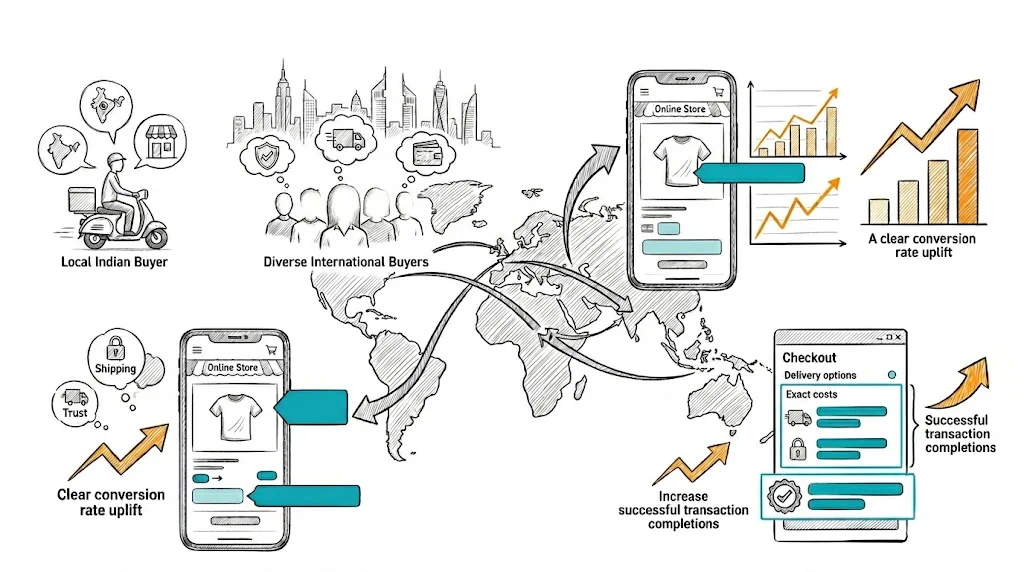
Indian D2C brands have a significant cross-border opportunity—particularly with the 30+ million-strong Indian diaspora in the US, UK, UAE, and Canada actively seeking authentic Indian products. But converting an international buyer is a different challenge from converting a domestic one. The friction points are different, the trust signals matter in different ways, and checkout expectations vary by market. This guide covers the CRO changes that drive the highest improvement in international conversion rates.
When an international visitor lands on your Indian D2C site, they face friction that domestic visitors do not:
Currency uncertainty: Prices in ₹ require mental math that creates friction. A visitor from the UK wondering whether ₹2,499 is £25 or £40 is less likely to complete purchase.
Shipping cost and timeline uncertainty: "We deliver across India" does not answer the question burning in their mind: how much does it cost to ship to Toronto and how long will it take?
Duty and customs uncertainty: "Will I be charged extra when this arrives?" is a major purchase barrier, especially for higher-value orders.
Payment method mismatch: Indian payment methods (UPI, COD, netbanking) are useless to an international buyer. They need card payment, PayPal, or familiar buy-now-pay-later options.
Trust signals calibrated for Indian context: Indian certifications, "free COD," and WhatsApp support are irrelevant or confusing to a buyer in Singapore. They need different reassurances.
Each of these friction points is a CRO opportunity—eliminating them directly improves international conversion rate.
Auto-detect and convert currency. Use Shopify Markets or a currency conversion app to automatically display prices in the visitor's local currency based on their IP location. This is the single highest-impact international CRO change for most brands.
Display the converted price as approximate: "$29.99 (approx.)" or show both: "$29.99 USD | ₹2,499". The latter builds transparency by showing the actual INR price alongside the conversion.
Avoid deceptive rounding. If ₹2,499 converts to $29.87, show $29.87 or $29.99—not $30 if that feels misleading given the actual conversion. International buyers are sensitive to perceived bait-and-switch on prices.
Be clear about what currency payment will be charged in. If your payment gateway charges in INR and converts via the card issuer, say so. If you charge in USD, say so. Surprise currency charges at the bank statement stage drive chargebacks.
Create a dedicated international shipping information page and link to it prominently from product pages and checkout:
On product pages, add an interactive shipping estimate: "Enter your country to see shipping cost and timeline." This eliminates uncertainty before checkout.
Free international shipping threshold: If your AOV supports it, offer free international shipping above a threshold. This is a proven checkout completion driver and increases AOV simultaneously.
The duty question is where many international carts are abandoned. Two approaches:
DDP (Delivered Duty Paid): You collect the estimated duty and taxes at checkout and handle payment to customs on the buyer's behalf. The buyer pays a single total; no surprise at delivery. Shopify Markets supports DDP with partner carriers. This is the premium experience and drives the highest international conversion.
DDU (Delivered Duty Unpaid): You ship; the buyer pays customs on delivery. This requires clear disclosure at checkout: "Import duties and taxes may be applicable on delivery in your country. We recommend checking your country's import rules." Hiding DDU status is a trust destroyer.
For most Indian D2C brands starting with cross-border, DDU with transparent disclosure is the starting point; DDP is worth investing in once international volume justifies the operational complexity.
Payment methods: At minimum, offer:
Remove COD, UPI, and netbanking from the checkout flow for international visitors—these are confusing and unused.
Address fields: International addresses have different formats. Enable auto-complete for international addresses (Google Places API supports this globally) and allow full international address formats, including postal codes and province/state dropdowns.
Phone number format: Use a country code dropdown (+44, +1, +971) rather than assuming Indian mobile formats.
Language: For diaspora markets (US, UK, UAE), English works well. If you are targeting non-English-speaking markets at scale, consider language localization—but this is typically later-stage investment.
Replace India-specific trust signals with internationally relevant ones:
Work globally:
Replace or remove:
CustomFit.ai can detect international visitors and show them a tailored homepage experience: international shipping highlighted, currency shown in their local denomination, and a "Shop Now — Ships to [Country]" CTA replacing domestic messaging. This kind of geo-personalization is high-impact and achievable without developer resources.
Related reading: Conversion Rate Optimization | Cart Abandonment | A/B Testing | Customer Journey | Multi-Channel Selling
See also: D2C & Ecommerce Growth Pillar | CRO Pillar