CustomFit.ai — Website personalization, A/B testing and CRO for Shopify and D2C
Product
Features
✱
Website Personalization
Adapt to each visitor's behavior & intent
⧖
A/B & Multivariate Testing
Rigorous experimentation
✨
AI CopilotNEW
Personalize with a prompt
🤖
AI WingmanNEW
Auto-optimize toward winners
🎯
AI Conversion OptimizerNEW
GPT-grade test ideas
✎
No-Code Visual Editor
Drag-and-drop edit any element
▦
Product Recommendations
Personalized recs that lift AOV
⚑
Feature Flags
Ship safely with kill-switches
◧
Chrome Extension
Edit your store in the browser
⧉
Shopify, WooCommerce & more
All platform integrations
View all features →
Use Cases
$
Price A/B Testing
Test price points to maximize revenue
▦
Theme A/B Testing
Compare whole layouts & designs
🗂
Template A/B Testing
Test whole PDP/PLP templates
🏷
Discount A/B Testing
Find the offer that converts
🚚
Shipping A/B Testing
Thresholds, speed & copy
✍
Content A/B Testing
Copy, images & reviews
💳
Checkout Gateway A/B
Payments & one-click
⌖
Geo-Based Personalization
Per-location content & offers
⚡
Buyer-Intent Nudges
Exit-intent & retargeting
↔
Split-URL / Redirection
Full-page redirect tests
View all use cases →
Solutions & Guides
⤢
Conversion Rate Optimization
The complete CRO guide
⧖
A/B Testing Software
Buyer's guide for D2C
🛒
Cart Abandonment Recovery
Win back lost carts
📰
Landing Page Optimization
Convert more paid traffic
S
Shopify A/B Testing
Test your store, no code
S
Shopify Personalization
Tailor the store per shopper
◔
First-Time Visitor Offers
Convert new shoppers with trust & offers
★
Repeat-Customer Experiences
Reward and re-engage loyal buyers
◎
Campaign-Matched Pages
Match the landing page to the ad
⌖
Location-Based Experiences
Currency, language & regional offers
Explore CRO →
Customer stories
GIVA
+32%
conversion via personalized recs
GIVA
Mamaearth
+18%
revenue lift from PDP A/B tests
ME
The Sleep Company
+24%
AOV from product recommendations
TSC
Read customer stories →
Integrations
SWsfGA+15
✦
Not sure where to start?
Let AI Copilot pick your first tests

“We wake up to evidence-backed tests ready to deploy — not a backlog of maybe ideas.”

AN
Anirudh S.
Growth · Chargebee
★★★★★4.8on G2 · 2,400+ brands
Talk to our team →
Widgets
Integrations
Ecommerce & Checkout
Shopify
Shopline
Shoplazza
GoKwik
ShopFlo
Razorpay Magic Checkout
Breeze
Shiprocket
View all integrations →
Analytics & Behavior
Google Analytics 4
Microsoft Clarity
Hotjar
Mixpanel
Amplitude
Heap
Adobe Analytics
Segment (CDP)
View all integrations →
Engagement, CRM & More
Klaviyo
MoEngage
CleverTap
WebEngage
HubSpot
Salesforce
Slack
Meta Ads
View all integrations →
CustomersPricing
Resources
CRO
▤
Playbooks
Proven strategies to boost conversions
🎙
Interviews
D2C leaders & marketing experts
▶
Webinars
Live deep dives & product sessions
Learn
✎
Blog
Tips, experiments & best practices
📕
Free E-Books
Mastering personalization
📖
Conversion Glossary
Every CRO term, defined
✦AI CopilotNEWLog inBook a demo
Start free trial
Select your platform — Install in 2 minsWe'll tailor the setup
⚡ Risk-free 14-day trial · No credit card · Cancel anytime
S
Shopify
Install from Shopify App Store
›
W
WooCommerce
Install the WooCommerce plugin
›
B
BigCommerce
Install from BigCommerce App Marketplace
›
SL
Shopline
Install from Shopline App Store
›
M
Salesforce / Magento
Install from the marketplace
›
SZ
Shoplazza
Install from Shoplazza App Store
›
WP
WordPress / Webflow
Install plugin or paste the script
›
◧
Others
Custom-built on React, Next.js, etc.
›
Tip: pick your platform — we handle the restBook a demo →
Product
Website PersonalizationA/B & Multivariate TestingAI CopilotAI WingmanAI Conversion OptimizerNo-Code Visual EditorProduct RecommendationsFeature FlagsView all features →
Use Cases
Price A/B TestingTheme A/B TestingTemplate A/B TestingDiscount A/B TestingShipping A/B TestingContent A/B TestingCheckout Gateway A/BGeo-Based PersonalizationBuyer-Intent NudgesSplit-URL / Redirection
Solutions & Guides
Conversion Rate OptimizationA/B Testing SoftwareCart Abandonment RecoveryLanding Page OptimizationShopify A/B TestingShopify Personalization
Explore
WidgetsIntegrationsCustomersPricing
Resources
BlogPlaybooksWebinarsInterviewsE-BooksConversion Glossary
Platforms
ShopifyShoplineShoplazzaChrome ExtensionAll integrations
Start free trialBook a demo
Home›Blog›d2c ecommerce›Seasonal Demand Planning for Ecommerce

Seasonal Demand Planning for Ecommerce

SJSapna JoharHead of Growth & CRO, CustomFit.aiJanuary 15, 20256 min read
On this page
  1. The Indian Ecommerce Seasonal Calendar
  2. Step 1: Demand Forecasting
  3. Use Multiple Data Sources
  4. Build a Demand Scenario Model
  5. Step 2: Inventory Planning and Pre-Positioning
  6. Calculate Safety Stock
  7. Pre-Position Inventory
  8. Plan for Reverse Logistics
  9. Step 3: Website and CRO Preparation
  10. Festive-Themed Experience
  11. Sale Page Architecture
  12. Speed and Load Testing
  13. Checkout Optimization for Peak
  14. Step 4: Marketing and Communication Preparation
  15. Build Demand Before the Season
  16. Festive Ad Strategy
  17. Tips / Best Practices
  18. Key Takeaways
0%
Seasonal Demand Planning for Ecommerce

From the conversion glossary

Concepts referenced in this article, defined.

Definition
What Is Pixel? Definition & Guide
← Back to D2c Ecommerce guide
Try CustomFit.ai

Run A/B tests and personalize your store without code. 14-day free trial, no credit card.

Start free trial →
Share
XLinkedInEmail

Related articles

d2c ecommerce

Wishlist Feature: Impact on Conversions & Retargeting

Sapna Johar· 7 min read
d2c ecommerce

User-Generated Content Strategy for D2C

Sapna Johar· 9 min read
d2c ecommerce

How to Scale an Ecommerce Business in 2026

Sapna Johar· 8 min read

Start lifting conversions today.

Run rigorous A/B tests and personalize every visit on Shopify or any storefront — no engineers required.

Start free trialBook a demo

Built for every D2C category

🧴
Skincare
💄
Beauty
🌿
Wellness
☕
F&B
👟
Apparel
💍
Jewelry
🛋️
Home
🍼
Baby
Live · Right now
Mamaearth — free-shipping band +12.4% AOVGIVA — festive collection page +34% revenueBellavita — PDP CTA test +27.4% CVRKapiva — Quiz-driven recs +9.48% CTRThe Sleep Co — landing personalized 2× capturesPlum — Returning shopper swap +18.2% CVRMamaearth — free-shipping band +12.4% AOVGIVA — festive collection page +34% revenueBellavita — PDP CTA test +27.4% CVRKapiva — Quiz-driven recs +9.48% CTRThe Sleep Co — landing personalized 2× capturesPlum — Returning shopper swap +18.2% CVR
Get in touch

Tell us about your store.

We reply within an hour during business hours. No sales pitch, no spam — just answers from someone who's seen 2,400+ D2C stores.

✓ Reply within 1 hour✓ No spam, ever✓ Free demo & setup help
✓ Thanks! We'll be in touch shortly.
CustomFit.ai

The all-in-one website personalization, A/B testing & CRO platform for high-growth D2C brands. Made by marketers, fueled by coffee.

in𝕏◎▶f
Product
  • Features
  • A/B Testing
  • Personalization
  • AI Copilot
  • AI Wingman
  • AI Conversion Optimizer
  • Feature Flags
  • Widgets
  • Integrations
  • ROI Calculator
Platforms
  • Shopify
  • Shopline
  • Shoplazza
  • Salesforce
  • Chrome Extension
  • All Integrations
Resources
  • Blog
  • Playbooks
  • Webinars
  • GrowthFit Interviews
  • Free E-Books
  • Conversion Glossary
  • Case Studies
Compare
  • vs VWO
  • vs Optimizely
  • vs Google Optimize
  • vs Mutiny
  • vs Intelligems
  • vs Shoplift
  • vs AB Tasty
  • vs Convert
  • vs Kameleoon
Company
  • About Us
  • Partners
  • CustomFit Awards
  • Recognition
  • Contact
  • Privacy Policy
  • Terms & Conditions
© 2026 CustomFit.ai · Valley Monks Pvt Ltd · Made by marketers, fueled by coffee, and obsessed with conversions.
SOC 2 Type II · GDPR · CCPA · ISO 27001

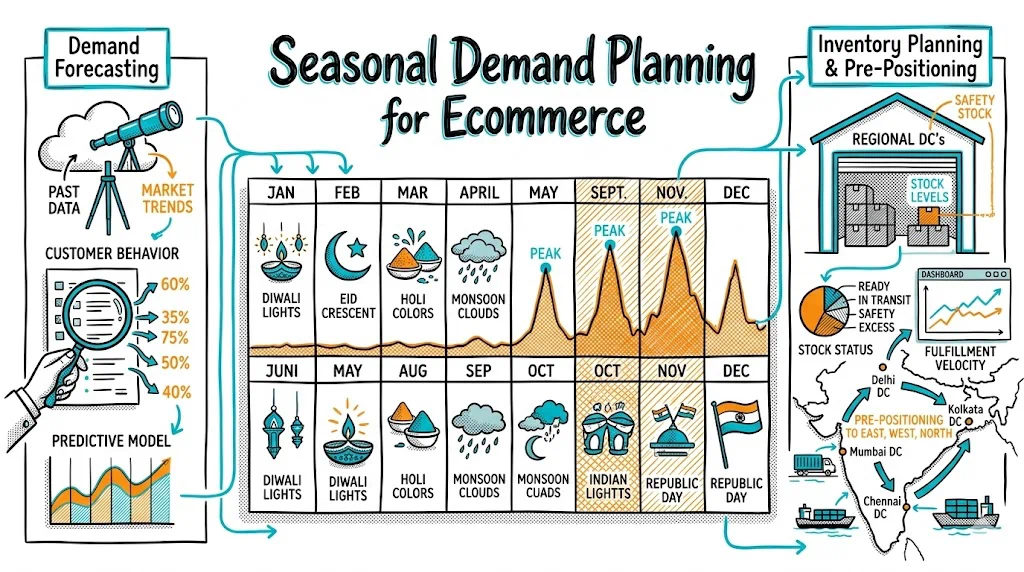
For Indian D2C brands, three to four weeks of the year—Diwali, Christmas/New Year, and the Big Billion Days/Great Indian Festival windows—can generate 30–40% of annual revenue. Brands that plan for these peaks execute them profitably; those that scramble run out of stock, make expensive last-minute ad buys, and disappoint customers. Seasonal demand planning is the difference between a festive season that funds your next year and one that creates financial stress.

The Indian Ecommerce Seasonal Calendar

Understanding the demand calendar helps you sequence preparation:

October–November (Navratri to Diwali): The biggest ecommerce window in India. Categories that spike: apparel, footwear, electronics, home decor, gifting, beauty, and dry fruits/sweets. Marketplace sale events (Big Billion Days, Great Indian Festival) fall in this window.

December–January (Christmas/New Year and Republic Day sales): Strong for electronics, fitness, fashion, and lifestyle. "New Year, new me" drives health and wellness.

February–March (Valentine's Day, Holi): Strong for gifting, personal care, and color cosmetics. Valentine's week creates a concentrated demand spike for beauty, fragrance, and accessories.

April–May (Summer prep): Skincare, sunscreen, cooling products, summer apparel.

June–July (Monsoon onset, mid-year sale): Amazon Prime Day and Flipkart's Big Savings Day typically fall here. Good for electronics, home, and kitchen.

Map your product catalog to this calendar and identify your top two or three demand windows—those are where planning investment pays off most.

Step 1: Demand Forecasting

Use Multiple Data Sources

Your own historical data (if available): Last year's daily/weekly order rate with a growth factor applied. If you grew 40% year-over-year, apply a 40–50% uplift to last year's peak.

Category benchmarks: Logistics partners and marketplace account managers share category-level demand multipliers. "Fashion grows 3.5x during Diwali" is a useful starting point if you have no history.

Google Trends: Trend your primary product keywords over 12 months to see the magnitude and timing of seasonal spikes in your category.

Notify-me and wishlist data: The size of your back-in-stock list and wishlist adds for specific products is a leading indicator of pent-up demand.

Build a Demand Scenario Model

Create three scenarios:

  • Base case: 2x normal weekly run rate
  • Target case: 3x normal weekly run rate
  • Stretch case: 4–5x with aggressive marketing

Plan inventory for the target case, have supplier commitments in place for the stretch case, and define your "pause ads" trigger point if you approach stockout in base case.

Step 2: Inventory Planning and Pre-Positioning

Calculate Safety Stock

Safety stock = (Peak daily demand forecast × Lead time days) + (Standard deviation of demand × Lead time factor)

For a simpler approach: if your peak daily demand estimate is 50 units and your supplier takes 12 days to replenish, keep at minimum 600 units on hand when the season starts, plus a 20% buffer (720 units).

Pre-Position Inventory

Logistics speed matters during peak season when everyone's network is strained. If 40% of your orders go to Maharashtra and 30% to Delhi-NCR, pre-position inventory at fulfillment centers in Mumbai and Delhi before the sale window opens. This cuts delivery times by 1–2 days and reduces "expected delivery: 7–10 days" which hurts conversion.

Plan for Reverse Logistics

Festive seasons bring higher return rates—customers buy impulsively and change their mind. Plan your reverse logistics capacity: returns processing, refund timelines, and inventory reinspection. Set customer expectations clearly on your returns page about festive season return timelines.

Step 3: Website and CRO Preparation

Festive-Themed Experience

Update your website 1–2 weeks before the sale window:

  • Festive homepage banner (Diwali lights motif, Holi colors, etc.)
  • "Gift Guide" or "Festive Collection" landing page
  • Limited-edition packaging callouts on product pages
  • Gift wrapping option at checkout (high AOV driver)

CustomFit.ai lets you schedule these changes without code and A/B test which festive banners drive more add-to-cart.

Sale Page Architecture

For major sale events:

  • Create a dedicated /festive-sale or /diwali-offers landing page (good for SEO and paid landing)
  • Category-level sale pages: /diwali-skincare-offers, /diwali-apparel-deals
  • Countdown timer on the homepage and sale pages showing sale end time

Speed and Load Testing

Test your website's ability to handle 5–10x normal traffic before the sale starts. If you are on Shopify, check your theme's performance scores and reduce unoptimized image sizes. Talk to your Shopify plan provider about traffic expectations.

Checkout Optimization for Peak

During peak seasons, even small checkout frictions multiply across high volume. Ensure:

  • UPI and top payment methods are displayed prominently
  • Address auto-fill is working
  • All error states are handled clearly (failed payment, OOS during checkout, etc.)
  • Mobile checkout is fully tested on actual devices

Step 4: Marketing and Communication Preparation

Build Demand Before the Season

Start email/WhatsApp warm-up 2–3 weeks before the sale:

  • "Sneak peek" of festive products
  • Early access signup (creates list of high-intent buyers)
  • "Save to wishlist" campaign for featured products

Festive Ad Strategy

Festive season CPMs on Meta and Google spike 40–100% as all brands advertise simultaneously. To compete efficiently:

  • Pre-load your retargeting audiences before the season (pixel all relevant pages)
  • Allocate 60–70% of festive ad budget to retargeting (lower CPM, higher CVR)
  • Launch campaigns 5–7 days before the marketplace sale windows open to capture pre-sale research traffic
  • Use festive creative that clearly communicates the offer and deadline

Tips / Best Practices

  • Do not wait for the sale to update your website. Festive content live 1–2 weeks before the sale captures early researchers who come back to buy when the sale starts.
  • Monitor inventory in real time during the sale. Set alerts when any SKU drops below 20% of initial stock.
  • Plan your post-festive recovery. After Diwali, many brands see a January dip. Have a "year-end" campaign ready for December to bridge the gap.
  • Review competitor pricing during the festive window at least daily. Staying aware helps you adjust offers quickly.
  • Capture post-sale customer data. Festive season buyers who did not exist in your database are a valuable new cohort—start nurturing them immediately for repeat purchase.

Key Takeaways

  • Festive seasons drive 30–40% of annual D2C revenue; planning 8–10 weeks ahead is the minimum for market-leading brands.
  • Demand forecasting requires multiple data sources—your own history, category benchmarks, and early demand signals like wishlists.
  • Pre-positioning inventory at regional fulfillment centers improves delivery speed and conversion during peak demand.
  • Website preparation—festive themes, sale pages, checkout optimization—should be ready at least one week before the sale window opens.
  • Post-festive customer nurturing turns one-time sale buyers into repeat customers who improve your LTV economics.

Related reading: Conversion Rate Optimization | Average Order Value | Cart Abandonment | A/B Testing | Ecommerce Loyalty vs Acquisition

See also: D2C & Ecommerce Growth Pillar