From the conversion glossary
Concepts referenced in this article, defined.
Concepts referenced in this article, defined.
 d2c ecommerce
Quick commerce conversion optimization for D2C brands selling on Blinkit, Zepto, and Instamart - how 10-minute delivery changes the CRO playbook.
 d2c ecommerce
 d2c ecommerce
Run rigorous A/B tests and personalize every visit on Shopify or any storefront — no engineers required.
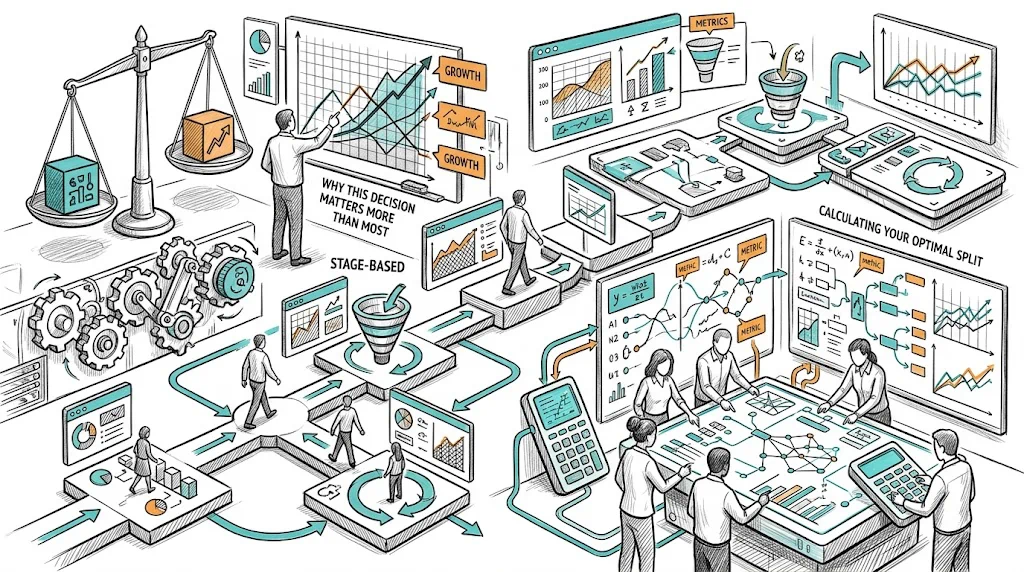
Every ₹1 in your marketing budget is a choice: bring in a new customer or deepen your relationship with an existing one. Get this split wrong and you either hit a growth ceiling (too much loyalty, not enough acquisition) or a profitability problem (too much acquisition, not enough retention). The right balance depends on your stage, category, and unit economics, and it shifts as your business evolves.
The economics of ecommerce loyalty vs. acquisition are stark.
Customer acquisition cost (CAC) for Indian D2C brands typically runs ₹300 to ₹1,500+ depending on category and channel. Beauty and personal care tend toward ₹400 to ₹800; electronics and high-consideration categories can exceed ₹2,000.
The repeat purchase probability for a customer who has bought twice is 60 to 70%, far higher than the 5 to 20% probability of converting a cold prospect.
Revenue per repeat customer usually grows with each order as customers discover more of your catalog and trust your brand. A customer's third order often has 30 to 40% higher AOV than their first.
When these numbers are plugged into a model, most brands find that improving repeat purchase rate from 20% to 30% is worth more to long-term profitability than reducing CAC by 15%. Yet most brands spend the majority of their budget chasing CAC reduction.
At this stage, you do not have enough customers to sustain a meaningful loyalty program, and your most important task is proving product-market fit through customer volume.
Recommended split: 75 to 80% acquisition, 20 to 25% loyalty.
Loyalty investment at this stage means:
Heavy loyalty infrastructure (points programs, tiers, dedicated loyalty platforms) is premature. The CAC of managing these outweighs the benefit until you have a large enough active customer base.
At this stage, you have data on what makes customers come back and can start investing in retention infrastructure.
Recommended split: 60% acquisition, 40% loyalty.
Loyalty investment now includes:
CustomFit.ai's personalization engine lets you show different website experiences to first-time vs. returning customers without any development work. It is a high-ROI loyalty investment that most growing D2C brands overlook.
At scale, acquisition costs are high because competition is intense for the same audiences, and you have a large enough customer base that even small improvements in repeat purchase rate generate significant revenue.
Recommended split: 50% acquisition, 50% loyalty (or loyalty-weighted).
Loyalty investment at scale:
Rather than using benchmarks, calculate your optimal split from your own unit economics.
Step 1: Calculate current LTV. LTV = Average order value × Average orders per year × Average customer lifespan in years × Gross margin %
Example: ₹800 AOV × 3.5 orders/year × 2.5 years × 55% gross margin = ₹3,850 LTV
Step 2: Calculate your LTV:CAC ratio. Target LTV:CAC is 3:1 at minimum, and 5:1 or better for healthy D2C economics.
If your CAC is ₹1,500 and LTV is ₹3,850, your ratio is 2.57:1, which is below healthy. You need to either reduce CAC or improve LTV (i.e., invest more in loyalty).
Step 3: Model the impact of loyalty investment. If increasing loyalty spend by ₹10 lakh/month improves repeat purchase rate from 25% to 32%, calculate the LTV impact:
If that incremental revenue exceeds ₹10 lakh/month in contribution margin, the loyalty investment pays for itself.
Loyalty spend breaks down into a few categories.
Communication (email, WhatsApp, SMS) is usually the highest ROI loyalty channel. A well-crafted 10-email post-purchase sequence can generate a 15 to 25% repeat purchase rate from customers who would otherwise not return. Cost is minimal, typically ₹2 to ₹5 per customer per month in platform fees.
Offers and discounts for retention cover targeted offers to lapsing customers ("we miss you, here is ₹100 off") or loyalty rewards for hitting order milestones. These have direct cost but generate measurable revenue lift.
Experience investment includes faster delivery, better packaging, free samples, and personalized notes. These build brand love and word-of-mouth, which is harder to attribute but powerful over time.
Loyalty program infrastructure means points platforms (LoyaltyLion, Yotpo, etc.), which cost ₹5,000 to ₹30,000/month. This is justifiable only at sufficient customer volume, typically 500+ active monthly purchasers.
Related reading: Conversion Rate Optimization | Average Order Value | Customer Journey | Reduce Customer Acquisition Cost | Ecommerce Personalization Maturity Model
See also: D2C & Ecommerce Growth Pillar