CustomFit.ai — Website personalization, A/B testing and CRO for Shopify and D2C
Product
Features
✱
Website Personalization
Adapt to each visitor's behavior & intent
⧖
A/B & Multivariate Testing
Rigorous experimentation
✨
AI CopilotNEW
Personalize with a prompt
🤖
AI WingmanNEW
Auto-optimize toward winners
🎯
AI Conversion OptimizerNEW
GPT-grade test ideas
✎
No-Code Visual Editor
Drag-and-drop edit any element
▦
Product Recommendations
Personalized recs that lift AOV
⚑
Feature Flags
Ship safely with kill-switches
◧
Chrome Extension
Edit your store in the browser
⧉
Shopify, WooCommerce & more
All platform integrations
View all features →
Use Cases
$
Price A/B Testing
Test price points to maximize revenue
▦
Theme A/B Testing
Compare whole layouts & designs
🗂
Template A/B Testing
Test whole PDP/PLP templates
🏷
Discount A/B Testing
Find the offer that converts
🚚
Shipping A/B Testing
Thresholds, speed & copy
✍
Content A/B Testing
Copy, images & reviews
💳
Checkout Gateway A/B
Payments & one-click
⌖
Geo-Based Personalization
Per-location content & offers
⚡
Buyer-Intent Nudges
Exit-intent & retargeting
↔
Split-URL / Redirection
Full-page redirect tests
View all use cases →
Solutions & Guides
⤢
Conversion Rate Optimization
The complete CRO guide
⧖
A/B Testing Software
Buyer's guide for D2C
🛒
Cart Abandonment Recovery
Win back lost carts
📰
Landing Page Optimization
Convert more paid traffic
S
Shopify A/B Testing
Test your store, no code
S
Shopify Personalization
Tailor the store per shopper
◔
First-Time Visitor Offers
Convert new shoppers with trust & offers
★
Repeat-Customer Experiences
Reward and re-engage loyal buyers
◎
Campaign-Matched Pages
Match the landing page to the ad
⌖
Location-Based Experiences
Currency, language & regional offers
Explore CRO →
Customer stories
GIVA
+32%
conversion via personalized recs
GIVA
Mamaearth
+18%
revenue lift from PDP A/B tests
ME
The Sleep Company
+24%
AOV from product recommendations
TSC
Read customer stories →
Integrations
SWsfGA+15
✦
Not sure where to start?
Let AI Copilot pick your first tests

“We wake up to evidence-backed tests ready to deploy — not a backlog of maybe ideas.”

AN
Anirudh S.
Growth · Chargebee
★★★★★4.8on G2 · 2,400+ brands
Talk to our team →
Widgets
Integrations
Ecommerce & Checkout
Shopify
Shopline
Shoplazza
GoKwik
ShopFlo
Razorpay Magic Checkout
Breeze
Shiprocket
View all integrations →
Analytics & Behavior
Google Analytics 4
Microsoft Clarity
Hotjar
Mixpanel
Amplitude
Heap
Adobe Analytics
Segment (CDP)
View all integrations →
Engagement, CRM & More
Klaviyo
MoEngage
CleverTap
WebEngage
HubSpot
Salesforce
Slack
Meta Ads
View all integrations →
CustomersPricing
Resources
CRO
▤
Playbooks
Proven strategies to boost conversions
🎙
Interviews
D2C leaders & marketing experts
▶
Webinars
Live deep dives & product sessions
Learn
✎
Blog
Tips, experiments & best practices
📕
Free E-Books
Mastering personalization
📖
Conversion Glossary
Every CRO term, defined
✦AI CopilotNEWLog inBook a demo
Start free trial
Select your platform — Install in 2 minsWe'll tailor the setup
⚡ Risk-free 14-day trial · No credit card · Cancel anytime
S
Shopify
Install from Shopify App Store
›
W
WooCommerce
Install the WooCommerce plugin
›
B
BigCommerce
Install from BigCommerce App Marketplace
›
SL
Shopline
Install from Shopline App Store
›
M
Salesforce / Magento
Install from the marketplace
›
SZ
Shoplazza
Install from Shoplazza App Store
›
WP
WordPress / Webflow
Install plugin or paste the script
›
◧
Others
Custom-built on React, Next.js, etc.
›
Tip: pick your platform — we handle the restBook a demo →
Product
Website PersonalizationA/B & Multivariate TestingAI CopilotAI WingmanAI Conversion OptimizerNo-Code Visual EditorProduct RecommendationsFeature FlagsView all features →
Use Cases
Price A/B TestingTheme A/B TestingTemplate A/B TestingDiscount A/B TestingShipping A/B TestingContent A/B TestingCheckout Gateway A/BGeo-Based PersonalizationBuyer-Intent NudgesSplit-URL / Redirection
Solutions & Guides
Conversion Rate OptimizationA/B Testing SoftwareCart Abandonment RecoveryLanding Page OptimizationShopify A/B TestingShopify Personalization
Explore
WidgetsIntegrationsCustomersPricing
Resources
BlogPlaybooksWebinarsInterviewsE-BooksConversion Glossary
Platforms
ShopifyShoplineShoplazzaChrome ExtensionAll integrations
Start free trialBook a demo
Home›Blog›d2c ecommerce›D2C Brand Storytelling for Higher Conversions

D2C Brand Storytelling for Higher Conversions

SJSapna JoharHead of Growth & CRO, CustomFit.aiJanuary 15, 20258 min read
On this page
  1. Why Storytelling Is a Conversion Tool, Not Just a Marketing Nice-to-Have
  2. The Four Story Types That Convert
  3. 1. The Founder's Problem Story
  4. 2. The Ingredient/Source Origin Story
  5. 3. The Customer Transformation Story
  6. 4. The Production Process Story
  7. Where to Deploy Brand Stories on Your Shopify Store
  8. Homepage
  9. Product Pages
  10. Email Welcome Series
  11. Instagram and YouTube
  12. A/B Testing Your Brand Storytelling
  13. India-Specific Brand Storytelling Notes
  14. Tips / Best Practices
  15. Key Takeaways
0%
D2C Brand Storytelling for Higher Conversions

From the conversion glossary

Concepts referenced in this article, defined.

Definition
What Is Engagement Rate? Definition, Formula & Guide
Definition
What Is Variant? Definition, Formula & Guide
← Back to D2c Ecommerce guide
Try CustomFit.ai

Run A/B tests and personalize your store without code. 14-day free trial, no credit card.

Start free trial →
Share
XLinkedInEmail

Related articles

d2c ecommerce

Wishlist Feature: Impact on Conversions & Retargeting

Sapna Johar· 7 min read
d2c ecommerce

User-Generated Content Strategy for D2C

Sapna Johar· 9 min read
d2c ecommerce

Seasonal Demand Planning for Ecommerce

Sapna Johar· 6 min read

Start lifting conversions today.

Run rigorous A/B tests and personalize every visit on Shopify or any storefront — no engineers required.

Start free trialBook a demo

Built for every D2C category

🧴
Skincare
💄
Beauty
🌿
Wellness
☕
F&B
👟
Apparel
💍
Jewelry
🛋️
Home
🍼
Baby
Live · Right now
Mamaearth — free-shipping band +12.4% AOVGIVA — festive collection page +34% revenueBellavita — PDP CTA test +27.4% CVRKapiva — Quiz-driven recs +9.48% CTRThe Sleep Co — landing personalized 2× capturesPlum — Returning shopper swap +18.2% CVRMamaearth — free-shipping band +12.4% AOVGIVA — festive collection page +34% revenueBellavita — PDP CTA test +27.4% CVRKapiva — Quiz-driven recs +9.48% CTRThe Sleep Co — landing personalized 2× capturesPlum — Returning shopper swap +18.2% CVR
Get in touch

Tell us about your store.

We reply within an hour during business hours. No sales pitch, no spam — just answers from someone who's seen 2,400+ D2C stores.

✓ Reply within 1 hour✓ No spam, ever✓ Free demo & setup help
✓ Thanks! We'll be in touch shortly.
CustomFit.ai

The all-in-one website personalization, A/B testing & CRO platform for high-growth D2C brands. Made by marketers, fueled by coffee.

in𝕏◎▶f
Product
  • Features
  • A/B Testing
  • Personalization
  • AI Copilot
  • AI Wingman
  • AI Conversion Optimizer
  • Feature Flags
  • Widgets
  • Integrations
  • ROI Calculator
Platforms
  • Shopify
  • Shopline
  • Shoplazza
  • Salesforce
  • Chrome Extension
  • All Integrations
Resources
  • Blog
  • Playbooks
  • Webinars
  • GrowthFit Interviews
  • Free E-Books
  • Conversion Glossary
  • Case Studies
Compare
  • vs VWO
  • vs Optimizely
  • vs Google Optimize
  • vs Mutiny
  • vs Intelligems
  • vs Shoplift
  • vs AB Tasty
  • vs Convert
  • vs Kameleoon
Company
  • About Us
  • Partners
  • CustomFit Awards
  • Recognition
  • Contact
  • Privacy Policy
  • Terms & Conditions
© 2026 CustomFit.ai · Valley Monks Pvt Ltd · Made by marketers, fueled by coffee, and obsessed with conversions.
SOC 2 Type II · GDPR · CCPA · ISO 27001

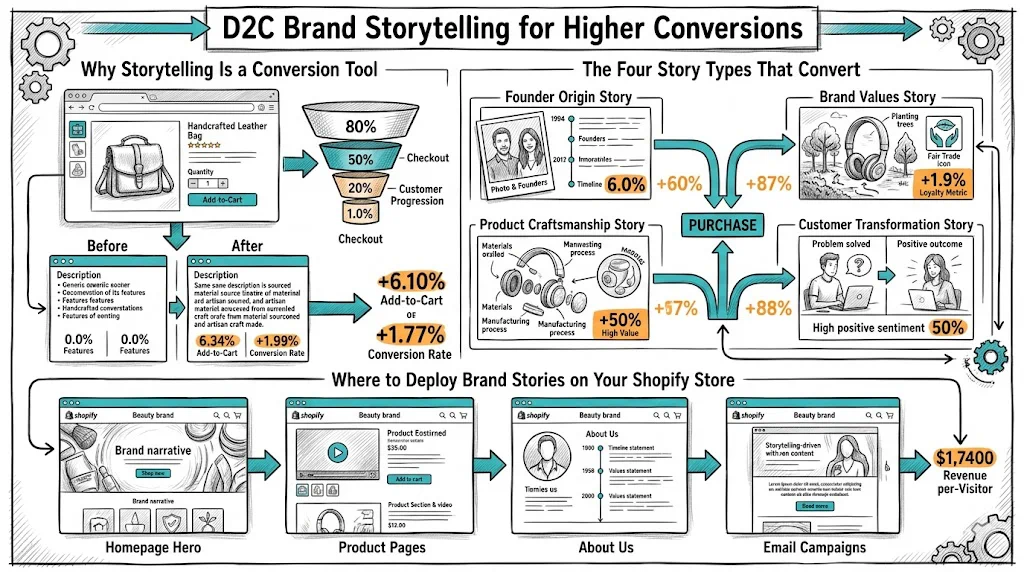
D2C brand storytelling is the art of translating your brand's origin, values, and product development into narratives that make potential customers feel connected to your brand before they've touched your product—and feel confident buying when they have. The brands that dominate Indian D2C categories don't just have better products; they have better stories that reduce purchase hesitation, justify price premiums, and create the emotional investment that drives repeat purchase and word-of-mouth. This guide connects storytelling directly to conversion rate improvement, where the impact is measurable.

Why Storytelling Is a Conversion Tool, Not Just a Marketing Nice-to-Have

Storytelling affects conversion through a specific psychological mechanism: it reduces uncertainty. When a first-time visitor lands on a D2C product page, they're confronted with uncertainty on multiple dimensions—will this product work? Is this brand trustworthy? Is the price worth it?

Brand storytelling answers these questions through narrative rather than facts. Cognitive science research consistently shows that information embedded in a story is remembered more accurately, trusted more readily, and acted upon more quickly than the same information presented as data or bullet points.

For Indian D2C brands, this matters even more because the trust gap between consumers and unfamiliar online brands is significant. A compelling story that demonstrates authenticity, expertise, and genuine care for the customer's problem can bridge that gap in 90 seconds of reading. A product page with bullet-pointed features cannot.

The measurable impact: product pages with brand story elements (founder context, origin narrative, specific ingredient story) consistently show 15–30% higher add-to-cart rates than pages with purely functional copy—across beauty, health, food, and fashion categories.

The Four Story Types That Convert

1. The Founder's Problem Story

The most persuasive D2C story is the founder who had the exact same problem as the target customer and couldn't find a solution that worked.

Framework: "I struggled with [specific problem] for [timeframe]. I tried [specific alternatives]. None of them worked because [specific insight about why]. So I spent [timeframe] building [specific solution]."

What makes it work: the target customer sees themselves in the founder's experience. The struggle validates that the problem is real, the alternatives tested validates that the solution is genuinely different, and the investment of time signals commitment.

What makes it fail: vague language ("struggled," "tried everything") that any brand could claim. The cure is specificity—name the brands tried, the timeline, the specific failure point.

2. The Ingredient/Source Origin Story

For beauty, health, food, and supplement brands, the story of where and how a key ingredient is sourced can be as persuasive as the founder story.

Framework: "Most [ingredient] brands source [ingredient] from [generic industrial source] processed with [method]. Ours comes from [specific origin] where [specific farming or production practice]. The difference shows up in [specific outcome]."

Brands like Forest Essentials, Kama Ayurveda, and The Whole Truth have built significant brand equity on ingredient origin stories because they're inherently difficult to replicate and easy for customers to feel.

3. The Customer Transformation Story

Real customer stories, told with specificity and context, are often more persuasive than anything the brand itself can write. The reason: customers distrust brand claims but trust peer experiences.

Framework: "[Customer name], a [specific descriptor—working mother, marathon runner, student], struggled with [specific problem] for [timeframe]. After [X weeks/months] of using [product], [specific, measurable outcome]."

Collect these stories through your review request flow (ask customers to describe their before and after). The best transformation stories contain numbers ("I lost 4 kg in 8 weeks," "My skin cleared up completely within 6 weeks"), names, and unprompted emotional language ("I finally feel like myself again").

4. The Production Process Story

For brands whose quality advantage is in how their product is made, a production story builds credibility that claims alone cannot.

Framework: "While most [category] brands [common shortcut], we [specific practice] because [specific reason]. This means [specific benefit to the customer]."

Example: "While most protein supplements add flavouring after manufacturing to cut costs, we blend ours at the source with real cocoa powder from Coorg. This means you get chocolate flavour that doesn't fade or turn chemical-tasting after an hour in your shaker."

Where to Deploy Brand Stories on Your Shopify Store

Homepage

The homepage brand story should answer "what is this brand and why does it matter" in 60–100 words. Position it as a visual element—a founder photo with a pull-quote, or a short brand value statement supported by three specific proof points (certifications, customer count, media mentions).

Product Pages

Each product should have its own origin story—how was this specific product developed, what problem does it solve, what makes this formulation or design different? Keep product stories to 80–150 words, placed just below the product features and before the reviews.

Brands that add product origin copy to their Shopify product pages consistently see higher conversion rates than those that use purely functional copy. The story gives the customer a reason to choose this product rather than the generic alternative.

Email Welcome Series

The welcome series is the highest-engagement email sequence you'll ever send—new subscribers are at peak interest. Use 5–7 emails to tell the brand story in chapters:

  • Email 1: Why we started (founder problem story)
  • Email 2: How we make our products differently (process/ingredient story)
  • Email 3: Our customers' results (transformation story)
  • Email 4: What we stand for (brand values with proof)
  • Email 5: Welcome to the community (belonging and invitation)

Each email should have one clear call to action. The cumulative effect is a customer who feels they know the brand before their first purchase—and converts significantly more readily.

Instagram and YouTube

Short-form video storytelling (60–90 second Reels, 3–5 minute YouTube videos) is the most shareable brand story format. Founder talking directly to camera, behind-the-scenes manufacturing footage, ingredient sourcing trips, and customer testimonial compilations each translate the written brand story into a format suited to social discovery.

A/B Testing Your Brand Storytelling

Not all stories work equally for all audiences. Run structured tests to find what resonates:

Test 1: Emotional vs. functional homepage hero copy Emotional: "Born out of [founder name]'s decade-long struggle with Indian skin" vs. Functional: "Dermatologist-grade skincare formulated for Indian skin tones"

Measure: 7-day add-to-cart rate for new visitors. Emotional copy typically wins for discovery traffic; functional copy wins for branded search traffic.

Test 2: Founder video vs. founder photo + text on About page Measure: About page engagement rate and CVR for visitors who view the About page. Video typically wins by 15–25% but requires content investment.

Test 3: Specific vs. general transformation claims "Helped 50,000 customers" vs. "Helped Priya from Bangalore clear 5 years of acne in 8 weeks"—specific customer stories typically outperform aggregate claims for high-consideration categories.

Use CustomFit.ai to run these story-testing experiments directly on your Shopify store, measuring impact on conversion rate and average order value for each variant.

India-Specific Brand Storytelling Notes

Connect to Indian identity: Stories that reference recognisable Indian contexts—discovering Ayurveda in a grandmother's kitchen, training for a marathon in Bengaluru's monsoon, growing up without skincare that worked for dark skin—resonate with Indian buyers in a way that generic global brand stories do not.

Speak to the value consciousness: Indian buyers are sophisticated value assessors. A story that acknowledges "yes, we cost more than [competitor]—here's exactly why" is more effective than ignoring the price gap. Transparency about pricing signals confidence in product quality.

Use regional specificity: Mentioning specific Indian cities, festivals, ingredients, or cultural contexts adds authenticity. "Tested on Indian skin in our Mumbai lab by Dr. [name]" is more credible than "dermatologically tested."

Hindi and regional language story elements: For brands targeting non-metro markets, weaving Hindi phrases or regional cultural references into the brand story signals belonging. "Apna brand" is a different emotional register than "our brand."

Tips / Best Practices

  • Write like you talk: Brand stories that sound like legal disclaimers or marketing press releases don't connect. Read your copy aloud—if it sounds unnatural, rewrite it.
  • Update your stories with new evidence: A transformation story from 2022 should be supplemented with 2024 stories. Stories stay credible when they grow alongside the brand.
  • Never fabricate: Invented customer stories and exaggerated outcomes erode trust catastrophically when exposed. Indian social media is highly effective at calling out inauthenticity.
  • Feature real customer names and faces (with permission): Named, photographed customers convert more sceptics than anonymous quotes.
  • Measure story performance as a CVR metric: Attribution is imperfect, but comparing CVR on product pages before and after adding story copy gives directional evidence.

Key Takeaways

  • Brand stories reduce purchase uncertainty by making abstract claims concrete and emotional—this is why they increase conversion rate
  • Four high-converting story types: founder problem story, ingredient origin story, customer transformation story, production process story
  • Deploy stories across homepage (60–100 words), product pages (80–150 words), and email welcome series (5 chapters)
  • Specificity is the difference between credible and generic: names, dates, failures, and specific outcomes
  • A/B test emotional vs. functional homepage copy and founder video vs. photo
  • India-specific: connect to Indian identity, acknowledge value consciousness, use regional specificity