From the conversion glossary
Concepts referenced in this article, defined.
Concepts referenced in this article, defined.
 d2c ecommerce
Quick commerce conversion optimization for D2C brands selling on Blinkit, Zepto, and Instamart - how 10-minute delivery changes the CRO playbook.
 d2c ecommerce
 d2c ecommerce
Run rigorous A/B tests and personalize every visit on Shopify or any storefront — no engineers required.
A D2C branding strategy is the system that makes your brand recognisable, trustworthy, and worth paying a premium for before a potential customer has ever touched your product. For new brands entering India's crowded D2C market in 2025, where categories like personal care, nutrition, and home goods have dozens of Shopify-native competitors, brand is what determines whether a potential customer gives you 30 seconds or scrolls past. Getting this right from the start prevents the expensive rebrand that most growing brands face at the two-year mark.
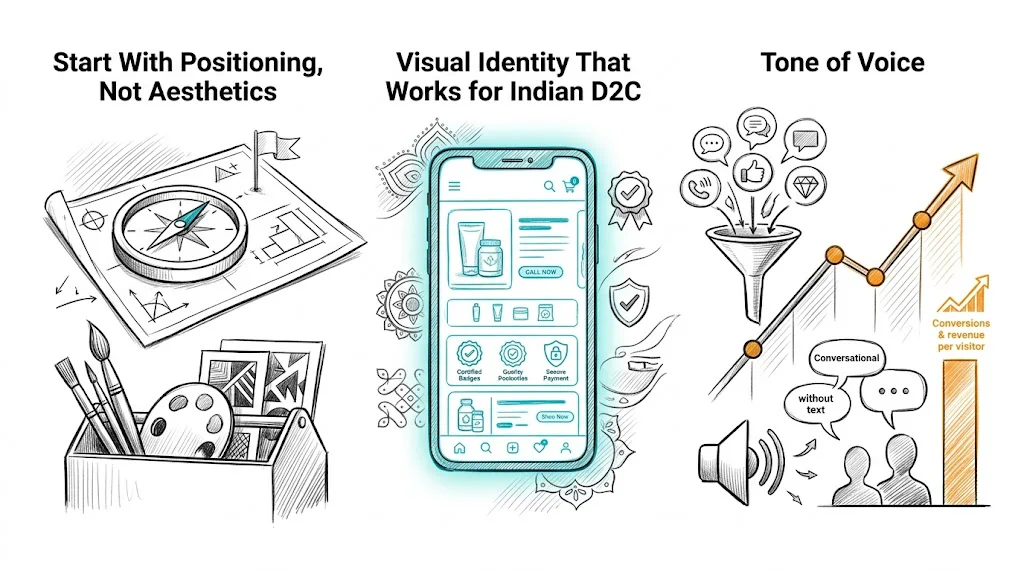
Most new D2C founders start branding by choosing colours and a logo. That's the wrong order. The sequence that works:
1. Define your target customer with specificity
"Urban millennials interested in wellness" is not a target customer. "Women aged 25 to 35 in Tier-1 cities who have tried multiple skincare brands, are frustrated by imported products not working on Indian skin tones, and follow at least 3 dermatologist accounts on Instagram" is.
The more specific your target customer, the more your branding can be written for them rather than at everyone.
2. Name the specific problem you solve
A positioning statement template: "For [specific customer], [Brand Name] is the [category] that [specific benefit] because [reason to believe]."
Example: "For working women in metros who want effective skincare without 12-step routines, Minimalist is the skincare brand that delivers results with just 2 products because every formula is backed by published dermatology research."
3. Map your competition honestly
For every competitor in your category, identify what they're known for and where they fall short. Your positioning should occupy the gap that the largest number of your target customers wish was filled.
This analysis tells you what to emphasise in your brand story, not just your product specs.
Colour carries cultural meaning that global branding guides miss:
Your colour palette should pass two tests: does it feel right for your category, and does it look distinctive on a mobile screen next to your category's top competitors?
Choose fonts that are readable at small sizes on mobile screens. Most Indian D2C shoppers discover brands on mobile Instagram or YouTube, so decorative scripts that look beautiful in a logo often become illegible as a favicon or WhatsApp sticker.
Your logo should work in three contexts: full colour on your website, one-colour on packaging, and as a circular avatar on Instagram and WhatsApp. Test all three before finalising.
For Indian D2C, the unboxing experience is a customer acquisition tool. A well-designed box or mailer gets shared on Instagram reels and YouTube unboxing videos more reliably than almost any paid content. Budget ₹5 to ₹15 per order for branded packaging inserts: a thank-you card with the founder's signature, a QR code to an exclusive community, or a hand-written note for first-time orders.
Brands like Nua and Mamaearth turned packaging into earned media before they had marketing budgets. The packaging tells the brand story at the moment of highest customer satisfaction, right after the product arrives.
Your brand's written voice is often the first brand touchpoint for new visitors: Instagram captions, ad copy, website headlines, email subject lines. Defining it explicitly prevents the inconsistency that makes young brands feel untrustworthy.
A simple tone of voice framework:
| What we are | What we are not |
|---|---|
| Direct | Preachy |
| Warm | Sycophantic |
| Knowledgeable | Jargon-heavy |
| Indian | Trying to sound global |
Test your tone against this framework on every piece of copy. "Our scientifically validated formulations optimise epidermal hydration" is jargon-heavy. "Our formula keeps your skin hydrated for 24 hours, proven in clinical tests" is direct and knowledgeable.
For Indian D2C brands, mixing Hindi and English (Hinglish) in the right contexts signals authenticity to mass-market audiences. "Ab skin glow karega" in an Instagram caption can outperform any amount of technical copy for personal care brands targeting non-metro markets.
The homepage is your brand's primary pitch. It should answer in 5 seconds: who this brand is for, what makes it different, and why I should trust it. Conversion rate for visitors who stay past 5 seconds is 4 to 6x higher than those who bounce immediately. Brand clarity is what keeps them.
Pick one or two platforms and do them consistently rather than spreading thin across five. For most Indian D2C brands:
Consistency means posting cadence, visual style, and tone are recognisable regardless of channel. A customer who sees your Instagram ad and then visits your website should feel the same brand.
Your email and WhatsApp marketing should feel like a brand extension, not a broadcast. That means branded headers with your logo and colour palette, copy written in your defined tone of voice, and subject lines that sound like a person sent them.
Brand is not a soft metric. It shows up directly in your conversion funnel numbers:
New visitor CVR: A brand that looks credible converts new visitors at 1.5 to 3% in competitive categories. A brand that looks generic or unpolished converts at 0.3 to 0.8%.
Returning visitor CVR: Once someone trusts your brand, returning visitor CVR should be 3 to 5x your new visitor CVR. If the gap is smaller, your brand is not building enough loyalty.
Word-of-mouth and referral rate: Strong brands generate organic referrals. Track what percentage of new customer acquisitions come from referral codes, organic search for brand terms, or direct type-in traffic. Growing brand equity shows up as rising organic share over 12 to 18 months.
Use CustomFit.ai to A/B test brand messaging on your homepage and product pages. Which brand story variant drives higher add-to-cart rates, which value proposition framing converts new visitors, which trust signals move the needle for your specific audience.