From the conversion glossary
Concepts referenced in this article, defined.
Concepts referenced in this article, defined.
 d2c ecommerce
Quick commerce conversion optimization for D2C brands selling on Blinkit, Zepto, and Instamart - how 10-minute delivery changes the CRO playbook.
 d2c ecommerce
 d2c ecommerce
Run rigorous A/B tests and personalize every visit on Shopify or any storefront — no engineers required.
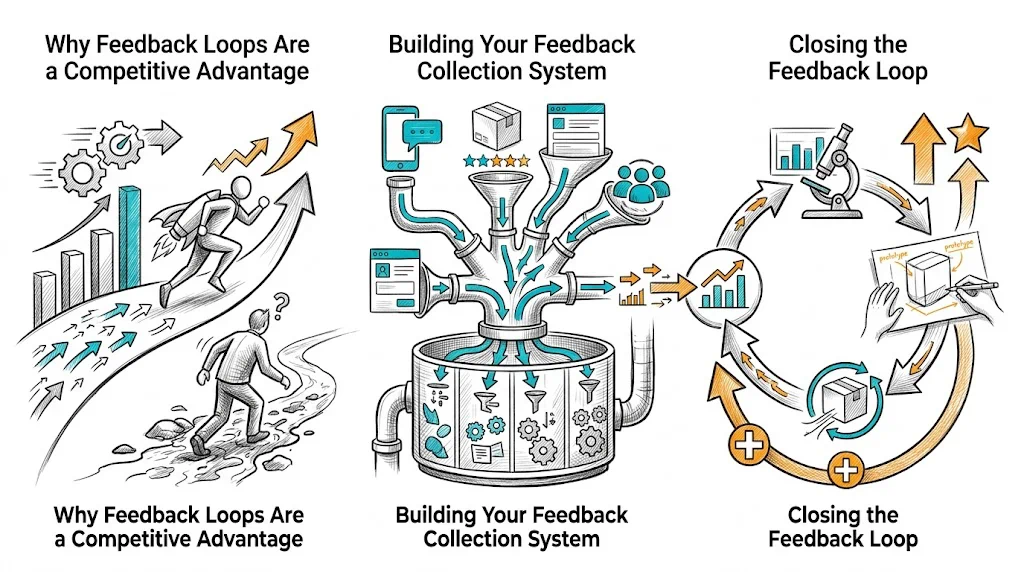
A D2C customer feedback loop is the system that turns what your customers say—in reviews, WhatsApp messages, support tickets, community posts, and survey responses—into better products, higher-converting store pages, and lower return rates. The brands that grow fastest in India's D2C market are not those with the best gut instincts; they're those that have built the closest possible feedback relationships with their customers and act on what they hear faster than competitors. This guide covers how to build, manage, and close that loop.
In a market where most D2C brands share the same advertising platforms, similar price points, and accessible manufacturing, the feedback loop is one of the few genuine competitive moats. A brand that hears customer feedback in week 1 and ships a product improvement in week 8 will outpace a brand that relies on annual brand studies.
The advantages are measurable across three dimensions:
Product development: Customer feedback identifies formulation issues, packaging problems, and feature gaps before they become widespread complaints. Brands that act on feedback within 60 days reduce return rates and negative review accumulation.
Marketing and conversion: Customer language in reviews and feedback contains the exact phrases that potential buyers use to search for products and evaluate alternatives. Using this language in product descriptions, ad copy, and email subject lines directly improves conversion rate.
Retention: Customers who see their feedback acknowledged and acted upon are significantly more likely to repurchase and refer. "We heard you and changed [X]" emails to relevant customers generate some of the highest open and click rates in the D2C email playbook.
The foundation of any feedback system. Set up automated review requests at two time points:
Day 7 post-delivery: "How was your unboxing and delivery experience?" (Rate 1–5 stars + optional comment). This captures shipping and packaging experience while the memory is fresh.
Day 30 post-delivery: "How has [Product Name] worked for you?" (Rate 1–5 stars + structured feedback questions). This captures product performance feedback after meaningful use.
Use WhatsApp for review requests, not just email. WhatsApp review request open rates are 3–4x email in India, and customers are more likely to leave detailed, casual feedback via WhatsApp than through formal email forms.
Tools for Shopify: Judge.me, Loox, Stamped.io—all support automated review request sequences.
A single question—"How likely are you to recommend [Brand] to a friend or colleague? (0–10)"—asked 30 days post-purchase and quarterly thereafter. NPS is not just a metric; it's a conversation starter.
For every Detractor (score 0–6), follow up personally: "We're sorry you weren't completely satisfied. Can you tell us what went wrong?" This turns detractors into intelligence sources and occasionally into loyal customers.
For every Promoter (score 9–10), ask: "We're glad you love it. Would you be willing to share a photo or review?" This converts promoters into UGC generators.
Target NPS for Indian D2C brands: above +30 is competitive, above +50 is excellent.
Your WhatsApp community, Instagram comments, and support tickets contain real-time feedback that no survey can capture. Build a weekly practice of:
Assign someone to tag feedback by type: packaging, product formula, delivery, pricing, customer service. Monthly review of tags reveals trends before they become crises.
Quantitative feedback (ratings, NPS) tells you what; qualitative interviews tell you why. Schedule 4–6 customer interviews per quarter:
45-minute interviews via Google Meet or phone. Record with permission. These sessions are worth more per insight than almost any quantitative research you can conduct.
The most overlooked part of any feedback system is closing the loop—telling customers what changed because of their input. Without this step, you have data but not trust.
When customer feedback drives a product change, communicate it:
Email subject: "You asked. We listened. [Product Name] v2 is here." WhatsApp community message: "Quick update—14% of you mentioned the scent was too strong. Our reformulated version (lighter scent, same efficacy) ships from next week. Existing subscribers get priority dispatch."
This is the brand-building ROI of feedback loops. Customers who see their input visibly acted on become the most loyal segment in your database.
Some brands publish quarterly "what we changed based on your feedback" updates on their blog or social media. This is a trust signal and a retention content piece simultaneously. Mamaearth's transparency reports, The Whole Truth's ingredient policy updates, and similar brand communications are examples of this in the Indian market.
Customer feedback is a goldmine for conversion optimisation:
Review language in product descriptions: Scan your best reviews for phrases that appear repeatedly. "I finally found a protein powder that doesn't make me feel bloated" is a customer's natural language for "digestive comfort." Using that phrase in your product description makes it 2–3x more relevant to other buyers searching with the same concern.
FAQ from support tickets: The top 10 questions your support team receives every week are exactly the questions your product page should answer. Add them to your FAQ section or product description to reduce pre-purchase doubt.
Before/after story from review content: A 4-star review that says "Was skeptical at first because I'd tried 3 other supplements. Gave this 90 days and my energy levels are genuinely different" is more persuasive than any ad copy. Feature these stories (with permission) on product pages.
Use CustomFit.ai to A/B test product page variants that incorporate specific customer language against the original copy. Measuring the impact on conversion rate directly validates which feedback-driven changes are worth keeping.
For brands with significant non-metro Indian audience, solicit feedback in Hindi or regional languages. WhatsApp makes this natural—customers respond in whatever language they're comfortable in, and most responses are more detailed and honest in the customer's native language.
Use bilingual survey forms (English + Hindi) for maximum response rates in Tier-2 and Tier-3 markets.
COD buyers have a specific set of feedback topics: delivery experience, whether the product matched the website photos, and whether the delivery partner was professional. Track COD feedback separately from prepaid feedback—COD buyers are often first-time customers and their feedback reflects the first-impression experience.
Post-festive period (after Diwali, Raksha Bandhan) often produces a spike in negative reviews and returns. Analyse this feedback separately to distinguish festive-specific issues (gifting mismatches, delayed delivery during high-volume periods) from ongoing product or service problems.
Review request response rate: Target 15–25% of customers leaving a review. Below 5% signals your request timing or channel is off.
Average rating trend: Monthly average star rating. Declining trends signal an unresolved product or service issue.
Negative review resolution rate: What percentage of 1- and 2-star reviews receive a brand response within 24 hours? Target 100%.
Feedback-to-action cycle time: How many days between identifying a recurring feedback theme and implementing a change? Target under 60 days for product changes, under 14 days for messaging/copy changes.
NPS trend: Quarter-over-quarter NPS movement. Increasing NPS correlates with long-term retention and referral growth.