From the conversion glossary
Concepts referenced in this article, defined.
Concepts referenced in this article, defined.
 d2c ecommerce
Quick commerce conversion optimization for D2C brands selling on Blinkit, Zepto, and Instamart - how 10-minute delivery changes the CRO playbook.
 d2c ecommerce
 d2c ecommerce
Run rigorous A/B tests and personalize every visit on Shopify or any storefront — no engineers required.
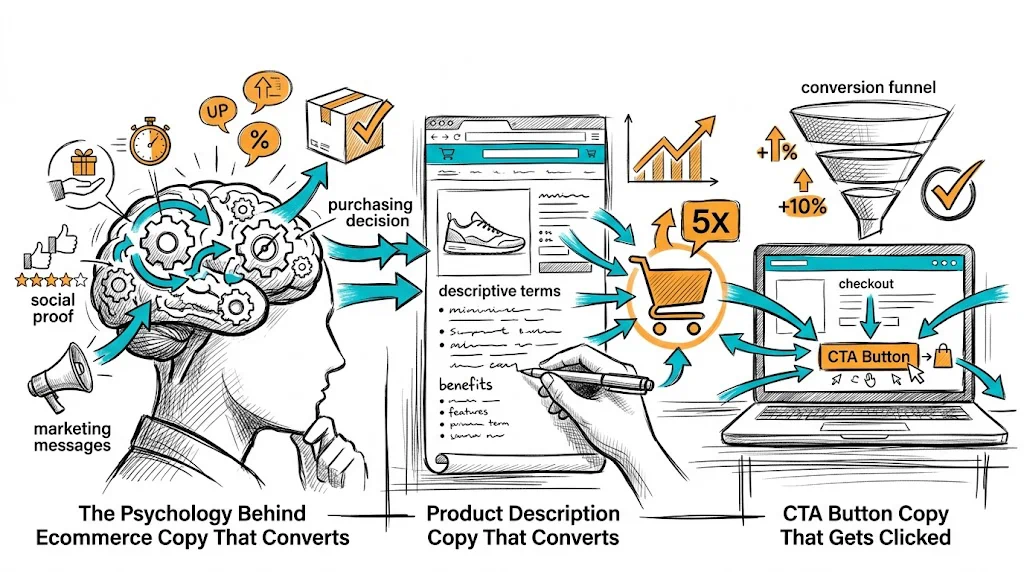
Ecommerce copywriting is the skill of arranging words on a screen so that a stranger who has never touched your product decides to hand over their money. Every element of your Shopify store—product descriptions, headline copy, CTA button text, email subject lines, and cart page messaging—either moves a visitor toward purchase or pushes them away. For Indian D2C brands competing in crowded categories, the quality of the copy is often the deciding factor between a ₹2,000 conversion and an abandoned cart. This guide breaks down the elements that move the needle most.
Buyers visiting a D2C product page are having a conversation with themselves. The questions running through their head, in roughly this order:
Your copy's only job is to answer these six questions clearly before the visitor leaves. Every copywriting principle—specificity, social proof, objection handling, urgency—is just a technique for answering one of these questions faster and more convincingly.
Hook (1–2 sentences): Speak to the specific reader, identify their problem, or make a bold claim. "If you've tried every protein powder on the market and they all taste like chalk, this is the one that finally doesn't."
Desire paragraph (2–3 sentences): Paint the outcome, not the product. Not "Contains 25g protein per serving" but "You'll get through a double-session training week without the muscle soreness that used to bench you for a day."
Features bullet list (3–5 points): Now the features make sense because the reader already wants the outcome. Use benefit framing: "25g whey protein per serving — builds and repairs muscle faster" beats "25g protein."
Reassurance (1–2 sentences): Handle the biggest objection briefly. "If it's not your new favourite protein by week 3, we'll refund you—no questions, no return shipping."
Action (1 sentence max): "Add to cart" is often enough here because you've done the work above. For high-hesitation products: "Join 50,000 customers who made this their first morning ritual."
Every time you write an enthusiastic but vague claim, replace it with a specific fact:
| Vague | Specific |
|---|---|
| Amazing results | 87% of users saw visible improvement in 4 weeks (user survey, n=1,240) |
| Premium quality | Cold-pressed within 24 hours of harvest at our Coorg estate |
| Trusted by thousands | 1.2 lakh orders delivered across India |
| All-natural | 100% natural—no parabens, sulfates, or synthetic fragrances |
| Fast delivery | Delivered in 2–4 days with Delhivery and Xpressbees |
Specificity signals that you know your product deeply. Vagueness signals that you're hiding something.
Button copy is the most A/B tested element in ecommerce, and for good reason—a word change can shift click-through rates by 10–30%.
High-converting CTA frameworks:
Words to avoid in CTAs: "Submit," "Continue," "Click here," "Proceed"—these are process words, not action words. They describe the interface, not the value.
Test your CTAs regularly. "Add to cart" vs. "Get yours now" vs. "Try it free for 14 days" can show 10–20% differences in click-through rate for the same product. Use CustomFit.ai to run these tests directly on your Shopify store without any developer changes.
The homepage headline is read by 100% of your traffic. The product page headline is read by 100% of purchase intent traffic. Both need to clear the "is this for me?" question in under 5 seconds.
Homepage headline formula: Audience + Benefit + Differentiator "For Indian skin that's oily in summer and dry in winter — skincare that actually adapts."
Product page headline: What it is + Why it matters "Post-Workout Protein (Chocolate) — 25g whey, no artificial flavours, absorbs in under 30 minutes"
What kills headlines:
Email open rates in D2C email marketing average 20–35% for Indian brands. Subject lines that consistently outperform:
Curiosity gap: "The one thing you're doing wrong after your workout" Specificity: "Your [product] reorder is due in 7 days" Social proof: "50,000 customers. Here's what they said." Personalisation: "[First name], your skin type deserves this" Urgency: "Diwali sale ends tonight — 30% off, no code needed"
Subject line length: Under 50 characters for best mobile preview display. The first 30–35 characters are visible on most mobile screens without unlocking.
Preview text: The 40–80 characters after the subject line are almost as important. They should extend the subject line's hook, not repeat it. Subject: "50,000 customers. Here's what they said." Preview: "Real results from real users. No filters, no edits."
The cart page is the highest-intent page in your store—these are buyers with products already selected. Copy here should remove final friction:
Cart page trust signals:
Upsell copy: "Customers who bought [Product A] also love [Product B] — add it for just ₹X more."
Checkout button: "Secure checkout" consistently outperforms plain "Checkout" because the word "secure" addresses payment anxiety.
COD-specific copy: Near the checkout button, add: "COD available — confirm at checkout." This visible assurance prevents COD customers from abandoning because they weren't sure COD was available.
Festive season copy should carry specific urgency: "Order by 14 October for Diwali delivery" is more effective than "Order now for festive delivery."
Gift copy matters in festive season: "Premium Diwali gifting—includes gift box and personalised message card (add at checkout)." Not all buyers are buying for themselves; gift packaging availability and messaging should be explicitly stated.
Add COD reassurance wherever cart abandonment is highest:
First-time buyers have higher hesitation than returners. Surface trust-building copy prominently:
Copy testing is the highest-ROI experimentation category for D2C stores. The variables worth testing:
Run each test with CustomFit.ai for a minimum of 2 weeks and sufficient sample size (200+ add-to-cart events per variant) before declaring a winner.