From the conversion glossary
Concepts referenced in this article, defined.
Concepts referenced in this article, defined.
 d2c ecommerce
Quick commerce conversion optimization for D2C brands selling on Blinkit, Zepto, and Instamart - how 10-minute delivery changes the CRO playbook.
 d2c ecommerce
 d2c ecommerce
Run rigorous A/B tests and personalize every visit on Shopify or any storefront — no engineers required.
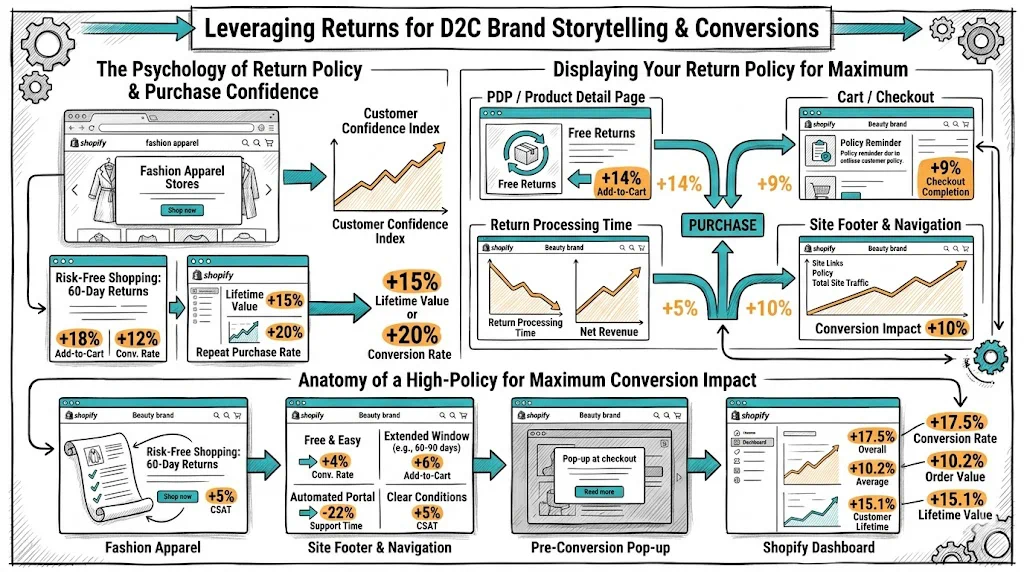
Your return policy is one of the most underused conversion tools in your Shopify store. Most D2C brands treat it as legal documentation rather than marketing copy. A clear, generous, and prominently displayed return policy removes the single biggest non-price barrier for new customers: the fear of being stuck with something that does not work. Brands that have rewritten their return policy as a customer promise rather than a legal disclaimer consistently see measurable conversion rate lifts from this single change.
New visitors to a D2C store are taking a risk. They have never touched the product, they do not know the brand, and they are being asked to hand over ₹500 to ₹5,000 with no guarantee that what arrives will match their expectations. Every unfamiliar buyer runs a mental calculation: "What is my downside if this does not work?"
A well-written return policy answers that question directly: your downside is zero. When a buyer knows they can return easily and get their money back, the mental calculus shifts from "what if I'm stuck with this" to "I might as well try it." This is why the strongest return policies function as customer acquisition strategies, not just operational policies.
The data is consistent across categories: clear return policies shown near the purchase decision point increase conversion rates by 15 to 40% for new visitors. The effect is largest for:
A return policy is a brand promise. Write it in the tone of a promise, not a contract:
Low-trust policy: "Returns accepted within 30 days of purchase for unused, undamaged items in original packaging, subject to inspection. Refund processing takes 7 to 10 business days. Shipping charges not refundable."
High-trust policy: "Not 100% happy? We'll make it right. Return any item within 30 days, unused or opened, and we'll arrange a free pickup. Refund hits your account within 5 working days. No forms, no questions."
The second version describes the same policy. Only the copy differs. The conversion impact is measurably different.
Return window: State the number of days clearly. 30 days is the Indian D2C benchmark.
Condition requirement: For consumable products (supplements, skincare), clarify whether opened items are returnable. "Opened items accepted if you've tried it and it didn't work" removes the biggest hesitation for supplements and skincare buyers.
Return process: Step by step, not just "contact us." "WhatsApp us at +91-XXXXXXXXXX with your order number. We'll arrange pickup within 48 hours" is a process.
Refund method and timeline: "Refund to original payment method within 5 working days" or "Store credit within 24 hours." For COD orders: "Bank transfer to the account you provide, within 7 working days."
Exceptions: What is NOT returnable (hygiene products, customised items, items showing use beyond a trial). Be specific and honest. Hiding exceptions in fine print destroys trust.
Shifting from legalistic to conversational return policy copy is one of the highest-ROI copywriting changes available to D2C brands. Compare:
Before: "All returns must be initiated within thirty (30) days of the delivery date. The Company reserves the right to refuse returns that do not meet return eligibility criteria."
After: "Changed your mind? That's fine. You've got 30 days to decide, and we'll handle the pickup. We just ask that you haven't used it more than a few times, give it an honest try first."
The second version reads like a confident brand that stands behind its product. The first reads like a brand that expects returns to be problematic.
This is the highest-impact placement. A 1-line return policy summary directly below or beside the "Add to cart" button removes the last pre-purchase barrier at the exact decision moment.
Copy options:
Show 2 to 3 trust icons (return arrow icon, lock icon, star rating) alongside this line for visual reinforcement.
Buyers who have added to cart but have not purchased are at their highest point of hesitation. Showing the return policy in the cart drawer and at checkout removes the "what if" that causes abandonment.
Placement: a small strip at the bottom of the cart total section, or a collapsible "Purchase Protection" element that expands to show the full policy.
Post-purchase is when buyer's remorse peaks, especially for higher-value items. Including "You have 30 days to return if you're not satisfied, here's how: [link]" in the order confirmation email reduces post-purchase anxiety and pre-emptive cancellation requests.
A detailed return policy page, properly formatted with FAQ schema markup, can rank for searches like "does [brand] accept returns" or "[brand] refund policy." These are high-intent queries from buyers on the consideration/decision boundary. A reassuring policy page in search results is a pre-purchase trust signal that improves cold traffic conversion rates.
COD orders require a specific refund process: the customer paid cash at delivery, so the refund must go to their bank account. Clarify:
Being explicit about this prevents the confusion and support tickets that arise when COD buyers do not know how they will receive their refund.
Health and personal care brands must address the hygiene return question directly: can I return an opened skincare or supplement product? For most Indian D2C brands with confident products, the answer is yes, with reasonable use. "We want you to try it before you're committed. If after 2 weeks it's not working, WhatsApp us for a return."
This policy is a competitive differentiator. Most Indian D2C brands have stricter policies. A brand that accepts opened-product returns for a 2-week trial is making a statement of confidence that few are willing to make, and it converts at measurably higher rates.
Festive season gifts (Diwali, Raksha Bandhan) have higher return rates because recipients may not want what they received. A seasonal policy extension, such as "Gifts purchased between 1 Oct, 15 Nov can be returned through 30 Nov," removes gifting purchase hesitation and drives more gifting sales.
State this explicitly on your gifting pages during the festive season.
Test 1: Return policy placement near add-to-cart button Add a 1-line return guarantee below the add-to-cart button vs. current (no guarantee near button). Measure new visitor conversion rate. Expected impact: 10 to 25% lift for first-time buyers.
Test 2: Policy copy tone Legal/formal tone vs. conversational brand voice. Measure click-through to policy page from product pages and downstream add-to-cart rate. Conversational copy almost always outperforms legal copy.
Test 3: "Free returns" vs. "30-day returns" The word "free" in return policy language typically outperforms the time period alone. "Free returns within 30 days" vs. "Returns within 30 days", a small word change with potentially significant conversion impact.
Run these with CustomFit.ai on your Shopify product pages, targeting new visitors specifically (returning visitors already have prior purchase trust).
Generous return policies do not necessarily increase return rates. Confident buyers make more deliberate purchase decisions and are less likely to be disappointed when the product arrives.
What actually drives return rates:
Invest in these upstream improvements before restricting your return window. The goal is fewer disappointments, not fewer returns. Fewer disappointments come from setting accurate expectations, not from trapping buyers with tight return windows.