An annual CRO plan turns experimentation from an ad hoc activity into a systematic program with predictable results. Without an annual plan, teams test opportunistically, skip tests during busy periods, and can't show compounding progress because there's no baseline or roadmap. With an annual plan, you have goals to hit, a seasonal calendar to work within, and a framework for reporting progress to leadership throughout the year. This template and process applies to any D2C brand running or building a CRO program.
Why Annual CRO Planning Matters
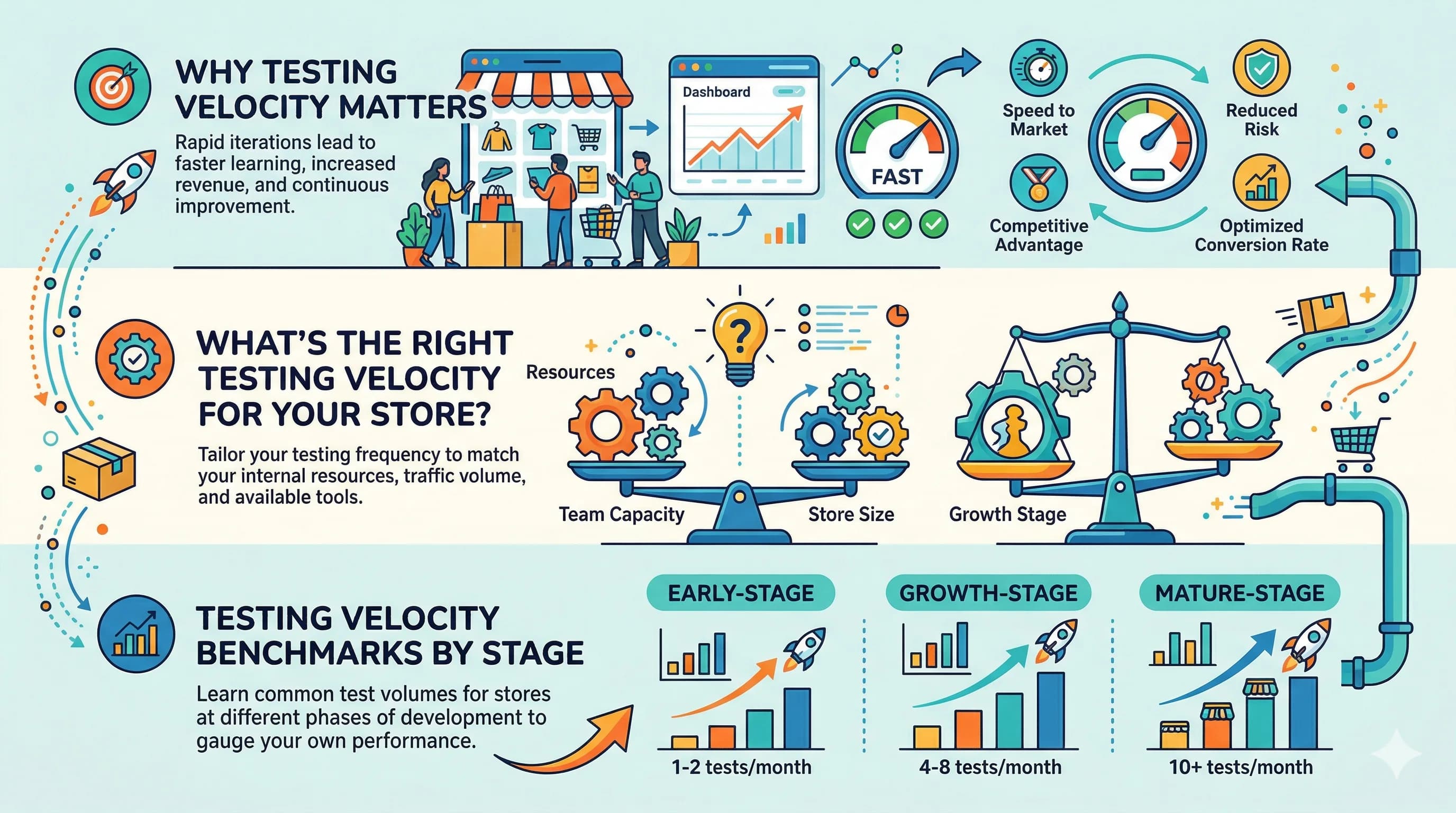
CRO compounds. A brand that runs 80 tests per year, with a 30% win rate and average 5% CVR lift per winner, generates approximately 10–15% annual CVR improvement through accumulated incremental wins. That compounding only happens if testing velocity is maintained through all 12 months — including the months when "we're too busy" or "we're in a big campaign push."
Annual planning creates the structure that maintains velocity:
- Goals align CRO with business targets
- Seasonal calendars prevent testing voids during busy periods
- Upfront resource allocation prevents mid-year "we don't have dev time for this" situations
- Quarterly milestones create accountability checkpoints
The Annual CRO Planning Process
Step 1: Baseline Audit (December / Before Planning)
Before setting goals, know where you're starting from. Document:
Current conversion metrics:
- Overall store CVR (site-wide)
- Mobile CVR vs. desktop CVR
- CVR by traffic source (organic, paid, email, direct)
- CVR by funnel stage: Landing → Category → PDP → Cart → Checkout → Purchase
- Bounce rate by page type
- Cart abandonment rate
- Checkout abandonment rate
- Average order value
Current testing program status:
- Tests run last year
- Win rate (% of tests producing statistically significant improvements)
- Average CVR lift from winning tests
- Test velocity (tests/month)
- Estimated revenue impact from shipped winners
This baseline tells you where the biggest opportunities are and sets realistic annual goals.
Step 2: Set Annual Goals
Goals should be specific, measurable, and tied to revenue.
Framework for setting goals:
- Identify your highest-priority funnel stage (where drop-off is greatest relative to potential)
- Set a realistic improvement target (based on your win rate and industry benchmarks)
- Calculate the revenue impact of achieving that target
Example goals:
- "Increase mobile CVR from 1.4% to 1.9% by December 31" (36% relative improvement)
- "Reduce cart abandonment rate from 72% to 65% by Q3"
- "Increase average order value from ₹1,200 to ₹1,450 through personalization and cross-sell optimization"
- "Run 60 tests by year-end with 25+ producing statistically significant results"
Revenue impact calculation:
- Current monthly revenue: ₹50 lakh
- Target CVR improvement: 0.5 percentage points (from 2.0% to 2.5%)
- Relative improvement: 25%
- Estimated annual revenue impact: ₹50 lakh × 25% × 12 = ₹1.5 crore
This calculation makes the annual CRO investment (tool costs + team time) look very different.
Step 3: Build Your Annual Testing Calendar
The testing calendar maps test themes to time periods. It ensures:
- Testing continues year-round (no voids)
- Test themes align with business priorities each period
- Festive season is accounted for correctly
Annual calendar template for Indian D2C brands:
January–February: Post-Festive Recovery and Baseline Tests
- Test themes: Cart abandonment, checkout optimization, return visitor re-engagement
- Context: Traffic is moderate, no major promotions competing. Good time for foundational tests.
- Target velocity: High (4–6 tests/month)
March–April: New Collection and Spring
- Test themes: Category page optimization, product discovery, new product launch pages
- Context: New collection launches; test how to best merchandise new arrivals
- Target velocity: Moderate (3–4 tests/month)
May–June: Summer Campaigns
- Test themes: Landing page optimization for summer campaigns, email capture
- Context: Summer sale planning; pre-test landing pages before major summer push
- Target velocity: Moderate (3–4 tests/month)
July–August: Festive Preparation
- Test themes: Festive imagery (Raksha Bandhan, Ganesh Chaturthi), gifting messaging, bundle offers
- Context: Begin testing festive concepts before peak season; find winners before Diwali budget peaks
- Target velocity: High (4–6 tests/month)
September–October: Pre-Diwali
- Test themes: Urgency messaging, gifting landing pages, trust signals for new visitors
- Context: Traffic builds toward Diwali; test conversion elements under real festive traffic
- Target velocity: Moderate (3–4 tests/month) — prioritize stable experience for peak
November: Diwali / Peak Season
- Test themes: Minimal — focus on executing known winners, not new experiments
- Context: Peak traffic and revenue. Not the time for major site changes. If you must test, use small-scale, low-risk tests.
- Target velocity: Low (1–2 tests/month maximum)
December: Post-Diwali + Christmas
- Test themes: Christmas/year-end gifting, winter product messaging, loyalty and retention
- Context: Second wave of festive traffic from Christmas; test retention and repeat purchase drivers
- Target velocity: Moderate (3–4 tests/month)
Step 4: Identify Your Top 20 Test Hypotheses
At the start of the year, generate your initial hypothesis backlog from:
- Baseline audit findings (which pages have highest drop-off?)
- Customer research (support tickets, post-purchase surveys)
- Previous year's test learnings (what inconclusive or losing tests warrant follow-up?)
- Industry research (Baymard Institute ecommerce UX findings)
Document these in your hypothesis library with PIE scores. These 20 hypotheses are your year-one starting backlog — not a complete list, because new hypotheses will emerge from test results throughout the year.
Step 5: Resource Planning
Define upfront what resources the program requires:
Tool costs:
- A/B testing and personalization platform: CustomFit.ai at $99/mo = ~₹1 lakh/year
- Analytics tools (Clarity is free; Hotjar paid tier ~₹20,000/year)
- Total tools budget: ₹1.2–2 lakh/year
Human resources:
- CRO program owner: 0.5–1 FTE (can be a marketer who owns CRO alongside other responsibilities)
- Design support: 2–4 hours/test (for variant creation) — can be in-house designer or freelancer
- Development support: Should be near-zero if using CustomFit.ai no-code testing
Total investment estimate for a mid-size D2C brand:
- Tools: ₹2 lakh
- Human resources: ₹5–10 lakh (portion of salaries attributed to CRO)
- Total: ₹7–12 lakh/year
Against a revenue impact of ₹1+ crore from a successful program, this ROI is compelling.
Step 6: Define Quarterly Milestones
Break the annual plan into quarterly checkpoints:
Q1 Milestone: Program infrastructure in place (tools set up, analytics configured, hypothesis backlog populated); first 10 tests launched; baseline metrics documented
Q2 Milestone: First 20 tests complete with documented results; test velocity at 4/month; 5+ winners shipped; Q2 CVR vs. Q1 baseline tracked
Q3 Milestone: Festive season preparation complete; top festive-period tests identified and winning variants ready for October deployment; program cumulative CVR impact measured
Q4 Milestone: Annual goal progress assessed; next year's plan drafted; annual results report prepared
The Annual CRO Plan Template
Use this template to document your plan:
ANNUAL CRO PLAN [YEAR]

BASELINE (as of January 1):
- Overall CVR: X%
- Mobile CVR: X%
- Cart abandonment rate: X%
- Checkout abandonment rate: X%
- AOV: ₹X

ANNUAL GOALS:
- Primary: [metric] from [X] to [Y] by December 31
- Secondary: [metric] from [X] to [Y]
- Test velocity: [N] tests/year

QUARTERLY MILESTONES:
- Q1: [specific milestones]
- Q2: [specific milestones]
- Q3: [specific milestones]
- Q4: [specific milestones]

RESOURCES:
- Program owner: [name], [% time]
- Design support: [hours/month]
- Tools budget: ₹[X]

TOP 20 HYPOTHESES:
[Link to hypothesis library]

TESTING CALENDAR:
[Month-by-month themes as above]

REPORTING CADENCE:
- Weekly: Test status update (who's running, what's the early trend)
- Monthly: Results summary (wins shipped, revenue impact)
- Quarterly: Milestone review vs. plan
Connecting Annual Planning to Quarterly Reviews
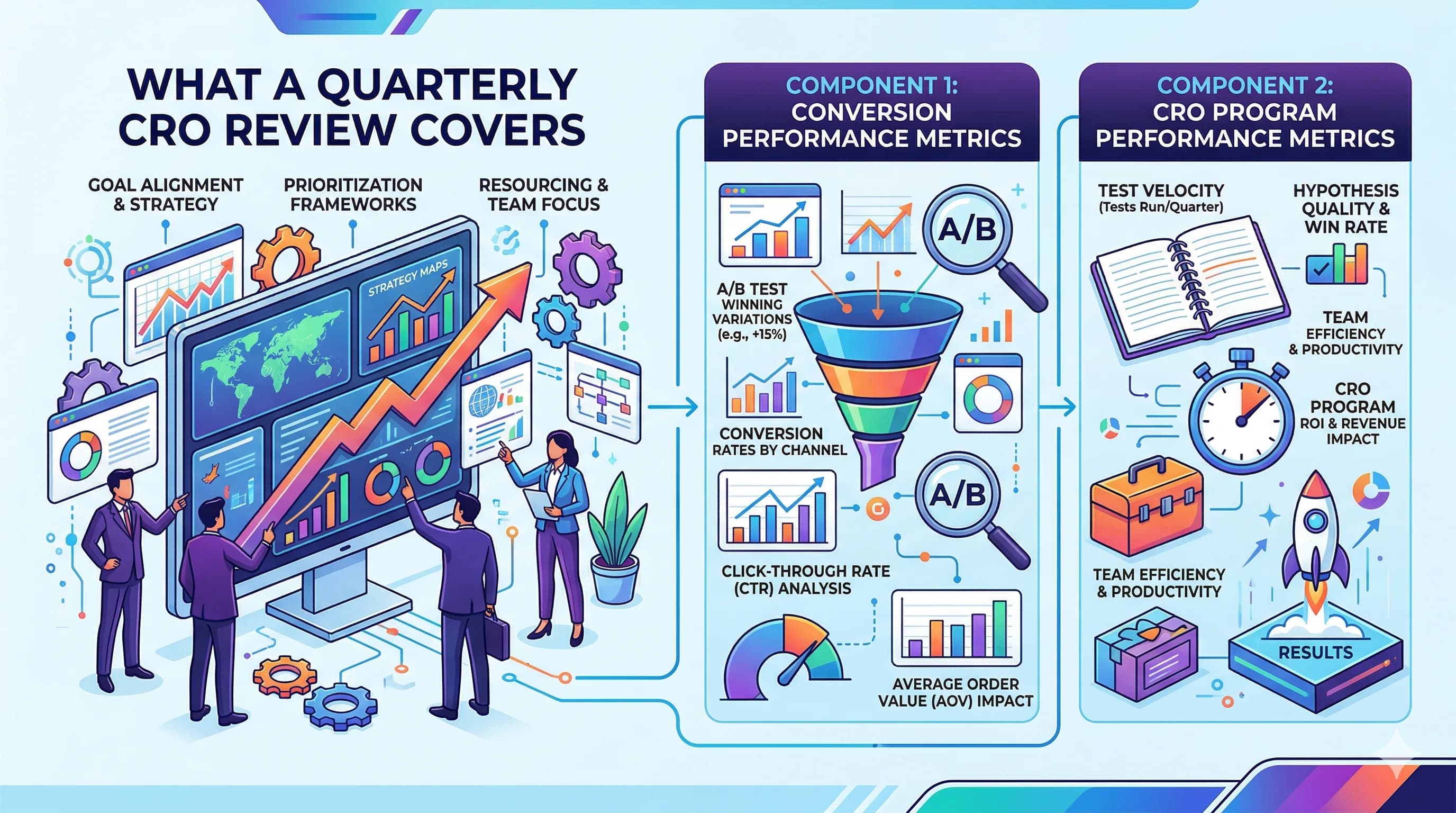
An annual plan is only useful if it's reviewed and adjusted quarterly. The quarterly CRO review process takes your annual plan and assesses:
- Are we on track for annual goals?
- Did Q[N] results reveal new high-priority hypotheses?
- Do resource allocations need adjustment?
- What does this season's data tell us about the next quarter's focus?
Treating the annual plan as a living document — updated quarterly with real data — keeps the program aligned with business reality.
Key Takeaways
- Annual CRO planning creates the structure that maintains testing velocity year-round
- Start with a baseline audit before setting goals; you can't improve what you haven't measured
- Set revenue-impact-linked goals, not just CVR goals in isolation
- Build a seasonal testing calendar that accounts for India's festive period (August–November is preparation; November peak is low-change period)
- Plan resources upfront: most effective programs need 0.5 FTE ownership + design support
- Review and update the plan quarterly; a plan that isn't adjusted to real data becomes irrelevant