From the conversion glossary
Concepts referenced in this article, defined.
Concepts referenced in this article, defined.
Run rigorous A/B tests and personalize every visit on Shopify or any storefront — no engineers required.
Conversion rate optimization (CRO) doesn't require a developer, a data scientist, or coding knowledge. With no-code A/B testing tools and a structured approach, any marketer on a D2C team can run experiments that genuinely improve store performance. CRO is fundamentally about asking questions — "why aren't more visitors buying?" — and using controlled tests to find answers. This guide starts from zero and walks you through your first real A/B test.
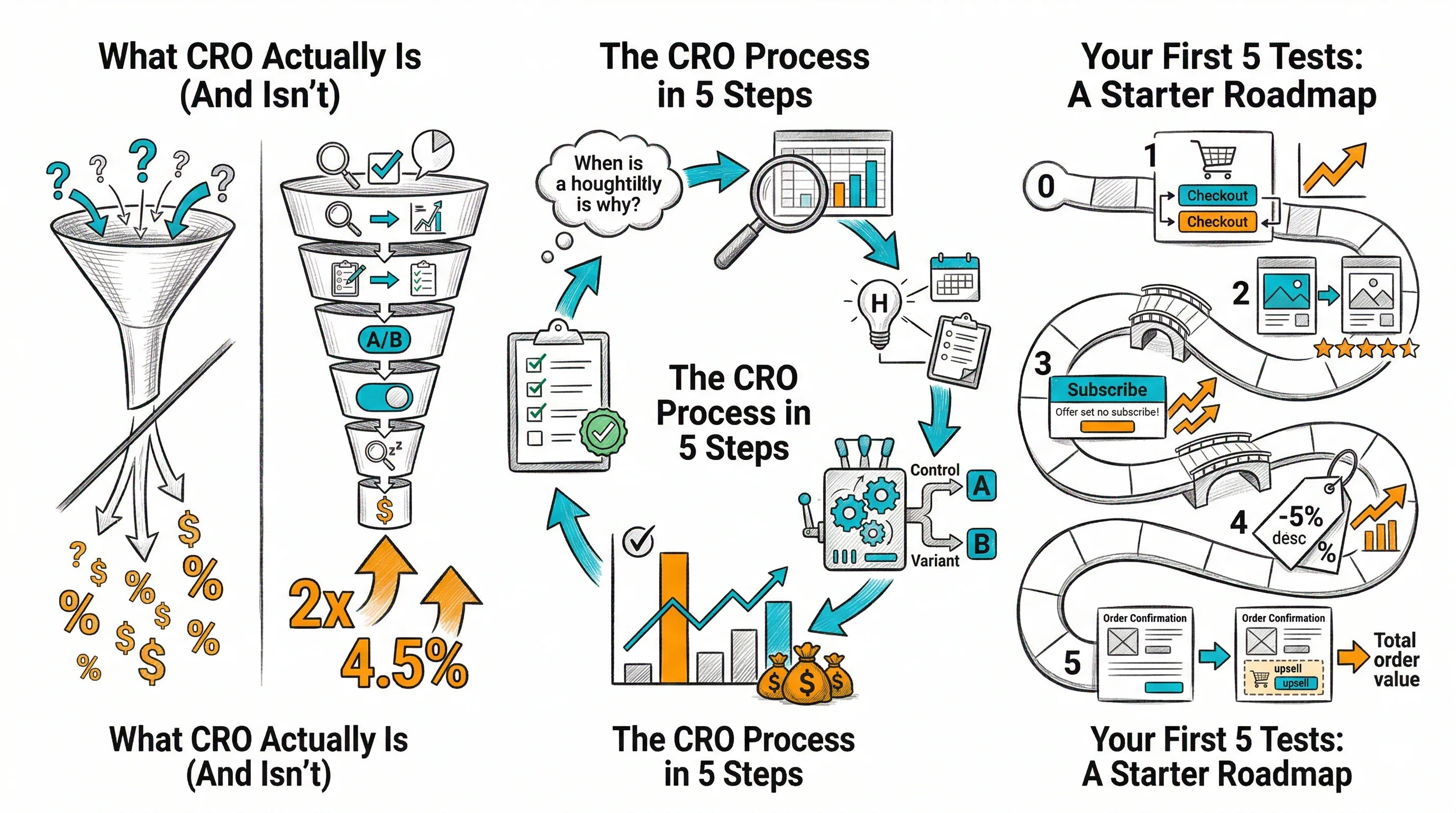
CRO is improving the percentage of visitors who take the action you want them to take. For ecommerce, the primary action is purchase — but CRO also applies to micro-conversions: clicking add-to-cart, reaching checkout, completing a form.
CRO is not:
CRO is:
The key distinction: CRO replaces "I think this will work" with "here's what the data shows."
Step 1: Find the drop-off
Before testing, identify where buyers are leaving your store. You need:
Look for pages with high bounce rate or low progression to the next funnel step. Those are your testing priorities.
Step 2: Form a hypothesis
A hypothesis is not a guess — it's an evidence-based prediction.
Format: "Because [evidence], I believe changing [element] will improve [metric] by [estimated amount] for [audience]."
Example: "Because session recordings show 40% of mobile buyers try to zoom in on product images (indicating they want a closer look), I believe adding a swipe-to-zoom feature on mobile PDPs will improve mobile add-to-cart rate."
Step 3: Design the test
Define:
Step 4: Run the test
Set up in your testing tool. For non-technical marketers on Shopify, CustomFit.ai lets you make visual changes (text, images, buttons, layout) through a point-and-click interface. No HTML, no CSS, no JavaScript.
Run the test until you reach statistical significance (95% confidence) OR until the pre-defined sample size is reached. Don't stop early.
Step 5: Analyze and decide
When the test completes:
Document every result in your hypothesis library. Even losing tests teach you something.
These are the highest-impact, lowest-effort tests for non-technical marketers on Shopify:
Test 1: CTA Button Copy
Test 2: Trust Badges Placement
Test 3: Product Image Order
Test 4: Urgency Messaging
Test 5: Social Proof Positioning
You don't need to understand p-values. You need to understand three things:
1. Statistical confidence (look for 95%) Your testing tool will show a percentage confidence. "95% confidence" means you can be 95% sure the result isn't random. Below 90%: too uncertain to act on. 90–95%: borderline. 95%+: sufficient to make a decision.
2. Relative improvement "Variant increased add-to-cart rate by 12%" is relative improvement. That means: if control was 8%, variant was 8.96%. Sounds small — but multiplied across 10,000 monthly visitors, that's 96 additional add-to-cart events per month.
3. Revenue impact estimate Convert the result to rupees. Add-to-cart rate improvement × purchase completion rate × average order value = estimated monthly revenue impact. This is how you justify continuing to invest in CRO.
Stopping tests early: You see your variant is winning by 10% after 3 days. You stop the test and ship the change. This is the #1 mistake in A/B testing. Early results are volatile. Tests that look like winners at 3 days often show no difference at 3 weeks. Always run to your pre-defined sample size.
Testing too many things at once: If your variant changes the CTA, the image, and the heading simultaneously, and it wins, you don't know which change drove the win. Test one change at a time (or use proper multivariate testing if you need to test multiple changes together).
Choosing the wrong primary metric: Don't track 10 metrics and call the test based on whichever one looks best. Define one primary metric before the test starts. Secondary metrics provide context; the primary metric determines the decision.
Testing low-traffic pages: Testing a page with 30 visitors/day will take months to reach significance. Prioritize high-traffic pages — even if lower-converting pages seem like better optimization opportunities, results take too long to get.
Not documenting results: Every test result — win, loss, or inconclusive — should be documented. Three months later, a "losing" test might contain a hypothesis that unlocks a major win on a related page.
A/B Testing and Personalization:
Analytics (free):
Heatmaps and Session Recording (free tier available):
Post-Purchase Surveys:
Hypothesis and Test Tracking:
Starting a CRO program as a non-technical marketer without a dedicated team can feel overwhelming. Start small:
The compound effect of running 2 tests/month — with a typical 30% win rate and 5–10% average CVR lift per winner — generates meaningful improvement over 12 months. You don't need a technical background to achieve this. You need discipline, curiosity, and the right tools.