From the conversion glossary
Concepts referenced in this article, defined.
Concepts referenced in this article, defined.
Run rigorous A/B tests and personalize every visit on Shopify or any storefront — no engineers required.
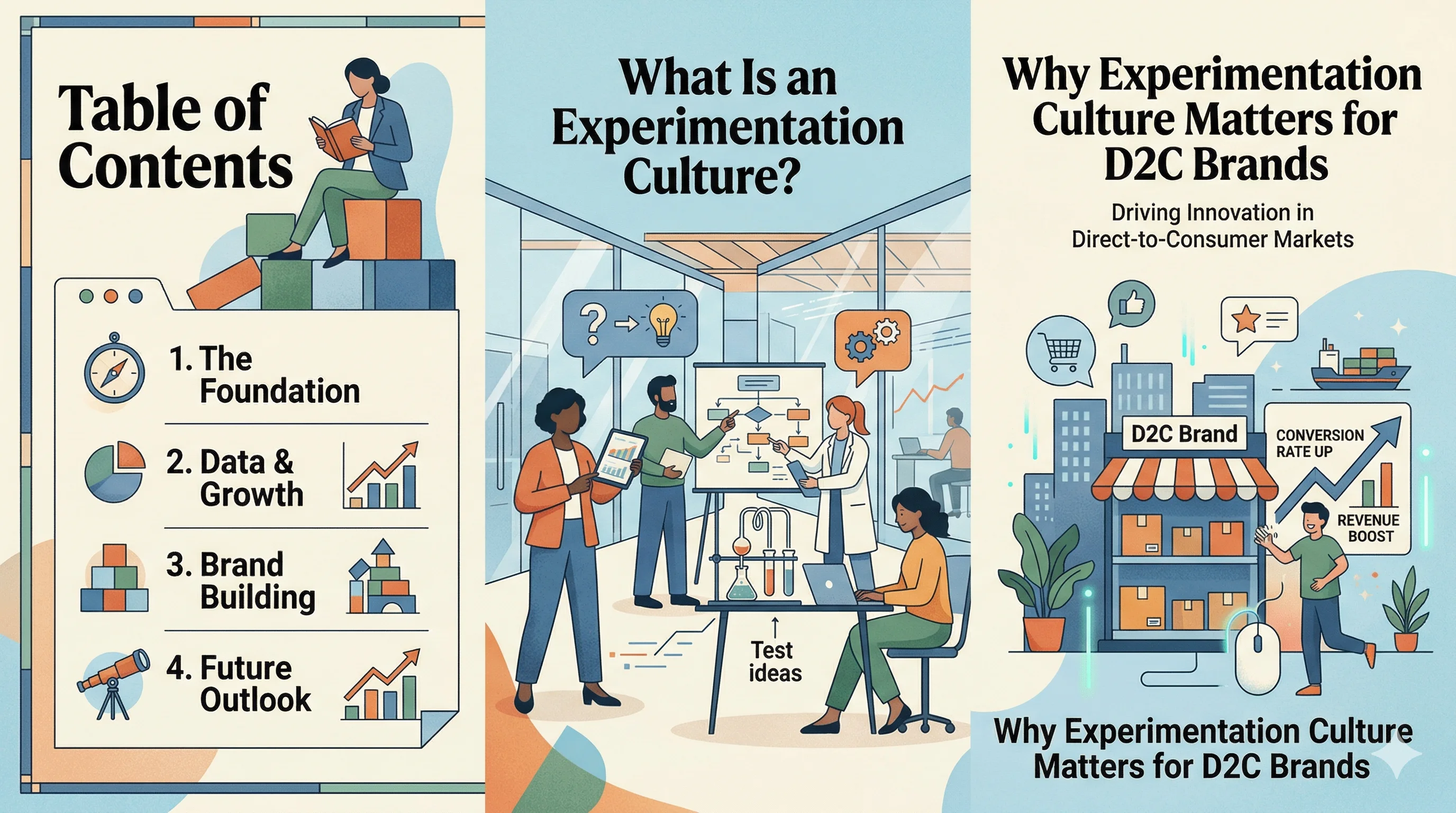
An experimentation culture is an organizational operating system where decisions are validated through data and controlled tests rather than opinion, convention, or the most senior person's gut feeling. For D2C brands, building this culture is the difference between optimizing once and optimizing continuously, compounding small improvements into a dramatically better-converting, more profitable store over 12 to 24 months. This guide covers how to build, sustain, and scale an experimentation culture at your brand.
An experimentation culture is an organizational mindset and set of practices where teams treat uncertain decisions about website design, pricing, messaging, product features, or marketing tactics as hypotheses to be tested rather than opinions to be debated.
In brands with a strong experimentation culture, the default response to "should we change the CTA button?" is not "let's discuss" or "let's copy what our competitor does." It's "let's form a hypothesis, run an A/B test, and let our customers tell us." Data wins arguments. Losing tests are celebrated for the insight they provide. The question is always "what does the evidence say?" not "what does the CMO prefer?"
Amazon, Booking.com, and Netflix have built multi-billion-dollar advantages on experimentation cultures. Indian D2C brands that are building this muscle now are creating a compound advantage that grows with every test they run.
Experimentation culture is not just about A/B testing. It covers:
Without experimentation, D2C brands make decisions based on what the founder prefers, what competitors do, what an agency recommends, or what felt right in a meeting. Each of these is a guess. Some guesses are right; many are wrong. Without a testing mechanism, you don't know which is which until you've shipped to all your customers, and by then the damage from a bad decision is already done.
A brand that runs one test per month and finds a 3% improvement each time compounds to a 42% better-converting store in 12 months. That compounding is the real power of an experimentation culture: not one big win, but dozens of small wins stacking.
| Months of Testing | CVR Improvement (3%/test compounded) | Revenue Impact on ₹10L/mo store |
|---|---|---|
| 3 months | +9.3% | +₹93,000/mo |
| 6 months | +19.4% | +₹1,94,000/mo |
| 12 months | +42.6% | +₹4,26,000/mo |
This is not theoretical. It's the documented outcome of brands like Bellavita (11% CVR lift) and Kapiva (9.48% CVR lift) that have committed to ongoing experimentation.
Every test result, winner or loser, teaches your team something about your customers. After 50 documented tests, your team knows which trust signals work for your specific audience, how your customers respond to urgency versus education, whether your metro customers and tier-2 customers behave differently (they do), and what messaging your most loyal customers respond to compared to first-time buyers.
That organizational knowledge is not replicable by competitors. It took years and hundreds of tests to build, and it's your most defensible competitive advantage.
Indian D2C brands are under pressure to show profitability. The clearest path there is improving CVR, AOV, and retention, all of which are improved through systematic experimentation. A brand that increases CVR by 1% without increasing ad spend has improved profitability substantially. Experimentation is the profit engine.
1. Designate an experimentation owner. One person, a growth marketer, a product manager, or a CRO specialist, must own the testing program. Without clear ownership, testing becomes everyone's responsibility and no one's priority.
2. Choose and implement your tools. Install a no-code A/B testing platform (CustomFit.ai for Shopify brands). Get analytics tracking clean, because you can't run experiments on broken data. Set up funnel analysis to see where visitors drop off.
3. Run your first 3 to 5 simple tests. Start with obvious, low-risk tests: CTA button copy, hero image, trust badge placement. The goal is not to land huge wins. It's to build the muscle: learn the tool, practice forming hypotheses, get comfortable reading statistical significance results.
4. Build a hypothesis template. Standardize how your team forms test ideas: "If we [change X], then [metric Y] will improve by [estimate], because [customer insight Z]." This format pushes evidence-based hypothesis generation.
5. Create a test documentation system. A shared spreadsheet or Notion database with hypothesis, launch date, variant description, result, statistical significance, key insight, and next hypothesis. Documentation is what separates running 50 tests from learning from 50 tests.
1. Expand the hypothesis backlog. Move from "what should we test next?" to "which of our 15 prioritized hypotheses should we run next?" The backlog is the lifeblood of an experimentation program.
2. Run 2 to 4 tests simultaneously. With clear page-level ownership (one test per page template at a time), you can run multiple tests in parallel across different pages. A product page test plus a homepage test plus an email subject line test equals 3x the learning velocity.
3. Share learnings across teams. Establish a monthly "what we learned" session where experimentation results are shared with marketing, product, creative, and leadership. A learning from a product page test often informs ad creative. A customer insight from a pricing test informs product development.
4. Introduce segmentation analysis. Stop looking only at aggregate test results. Break down every result by device (mobile versus desktop), acquisition source, geo (metro versus tier-2), and new versus returning visitors. Often, the most valuable insight is that the winner performed differently across segments.
1. Democratize hypothesis generation. The best hypotheses come from customer-facing teams. Customer support knows what questions buyers ask, the product team knows what features confuse users, and the logistics team knows what causes returns. Build a system for anyone to submit test ideas.
2. Implement personalization as the logical extension of testing. Once you know which variant wins for each segment, use personalization to serve each segment their optimal experience simultaneously. Testing finds the winners; personalization serves them at scale.
3. Build a "never test again" list. Tests that have been run multiple times with consistent results graduate to settled science. You don't re-test fundamental insights every year. This frees your testing capacity for unexplored hypotheses.
The most common form. Two versions of a page element are tested against each other with traffic split randomly between them. Works for CTAs, images, headlines, trust signals, pricing displays, and layout changes.
Testing multiple elements simultaneously to find the winning combination. Requires significantly more traffic than A/B testing, typically 50,000+ visitors per month to get meaningful results. Used for full-page redesigns.
Testing whether a personalized experience outperforms a generic one for a specific segment. Example: does showing returning customers a "welcome back" banner lift RPV compared to showing them the standard homepage?
Testing price points, bundle configurations, free-shipping thresholds, and discount structures. High-impact tests that require careful execution: consistent pricing per visitor, legal review in some markets.
Running controlled tests on ad headlines, visuals, copy, and CTAs within your performance marketing campaigns. The same hypothesis framework applies: form a hypothesis, test one variable, measure the downstream metric. That means not just CTR, but ROAS and CVR on your site.
Testing subject lines, send times, content structure, and offer types within retention channels. These run simultaneously with website tests because they affect different customer touchpoints, so there's no interference risk.
1. One primary metric per test. Decide what you're optimizing for before you launch: conversion rate, AOV, RPV, or add-to-cart rate. Don't change the primary metric mid-test because the variant looks like it's losing on your original metric.
2. Write hypotheses before experiments, not after. Forming your hypothesis after seeing results is called HARKing (Hypothesizing After Results are Known). It's a data integrity failure. Write the hypothesis, record it, then run the test.
3. Protect tests from interference. Don't run promotions, change prices, or launch major marketing campaigns that disproportionately affect one variant's traffic during a test. Contamination invalidates results.
4. Treat losing tests as wins. A losing test is a pre-mortem that worked. You avoided implementing something that would have hurt your revenue. Every losing test contributes to the "what doesn't work for our customers" knowledge base.
5. Never skip the documentation step. The biggest failure mode of experimentation programs is running tests without recording learnings. A program that runs 30 tests with no documentation is operationally equivalent to a program that ran no tests at all. The knowledge doesn't persist.
6. Adjust for seasonality. Festive-season tests (Diwali, Navratri, Big Billion Days, Republic Day sale) reflect abnormal customer behavior. Mark these results with the seasonal context and validate conclusions on normal-period traffic before implementing permanently.
7. Require statistical significance without exception. 95% confidence minimum, 100 conversions per variant minimum, 2 weeks minimum. No exceptions for early stopping driven by gut feel, budget constraints, or deadline pressure. Underpowered tests destroy the value of experimentation programs.
8. Use funnel analysis to prioritize test locations. The highest-ROI tests are on the highest-drop-off pages. Run funnel analysis quarterly to refresh your prioritization as your store evolves.
9. Budget for testing infrastructure. Experimentation has real costs: an A/B testing tool ($99 to $300/mo), analyst time (4 to 8 hours/week), and design support for variant building (2 to 4 hours/week). Budget them explicitly rather than treating testing as something that happens in spare time.
10. Make experimentation results visible to leadership. A monthly dashboard showing tests run, winners implemented, CVR trend, and projected revenue impact turns experimentation from a team activity into a company priority. Visibility creates accountability and resources.
| Tool | Purpose | Best For | Starting Price |
|---|---|---|---|
| CustomFit.ai | A/B testing + personalization | D2C Shopify brands: no-code, D2C metrics, 1000+ targeting | $99/mo |
| VWO | A/B testing + heatmaps | Mid-market, bundled qualitative + quantitative | ~$300/mo |
| Optimizely | Enterprise experimentation | Large teams, feature flags + web | Custom |
| Hotjar | Qualitative research | Heatmaps, session recordings, surveys | Free/$39/mo |
| Looker/Data Studio | Results analysis | Visualizing test results and trends | Free |
| Notion/Coda | Test documentation | Building the hypothesis backlog and learning library | Free/$8/mo |
Why CustomFit.ai works as the foundation for a D2C experimentation program:
Compare CustomFit.ai vs VWO | Compare vs Optimizely | Compare vs Google Optimize
Booking.com runs 1,000+ concurrent A/B tests at any given time. Any employee can propose and run an experiment. The test result decides, not the VP's opinion. That culture produced a conversion machine that consistently outperforms competitors with technically similar products.
The lesson for Indian D2C brands: the number of tests matters less than the discipline of trusting results over hierarchy. You don't need 1,000 tests. You need the consistency to let data win the argument.
Bellavita began structured experimentation with CustomFit.ai in early 2024. Month 1, they installed the tool and ran their first test on CTA button copy on the hero product page. By month 3, they were running 3 simultaneous tests and had documented 8 experiments. By month 6, they were running 8 tests per month with 25 documented experiments and a weekly learning review with the founding team.
Their CVR had improved 11% cumulatively by month 6. More importantly, they had built a knowledge base about their customers: which trust signals mattered, how metro and tier-2 customers differed, which social proof formats worked. That knowledge fed their ad creative, email campaigns, and product page design.
Kapiva's breakthrough came from including their customer support team in hypothesis generation. Support agents knew that customers consistently asked the same question about supplement dosage timing. That became a test hypothesis: adding a clear dosage FAQ section above the fold on product pages would lift CVR.
Result: 9.48% CVR increase. The insight came from a team member who would not traditionally be in a CRO meeting. Cross-functional hypothesis generation is one of the most underused practices in experimentation culture.
The Man Company treated each winning test as the starting point for the next hypothesis. When a social proof test won on the product page, they asked: does social proof also work at checkout? What about on the homepage? When a COD prominence test won for tier-2 visitors, they asked: what other checkout changes would help tier-2 customers?
This "winner generates the next hypothesis" approach created a testing flywheel. Each experiment answered one question and raised three more. Within 9 months, they had 40+ documented experiments and a clear model of their customers' decision-making process.
Nykaa's growth marketing team runs a weekly experiment review where all active and recently completed tests are discussed, results shared, and next hypotheses prioritized. The meeting takes 45 minutes and includes representation from marketing, design, product, and analytics.
That institutional cadence, not the tools or the headcount, is what makes Nykaa's experimentation program systematic rather than episodic. Any D2C team of 3 or more people can implement a version of this cadence immediately.
1. Building a testing team without building a testing culture. Hiring a CRO specialist and expecting a testing culture to emerge is backwards. Culture comes from leadership decisions and org-wide behaviors, not from one person running tests in isolation.
2. Declaring winners on insufficient data. Stopping a test at 75% statistical significance because the variant looks good and you want to implement it is one of the most common and damaging mistakes. False positives pollute your learning library and your store.
3. Testing trivial things to show activity. Testing button color when your checkout abandonment is 75% is optimizing the wrong thing. Use funnel analysis to test where impact is highest, not where testing is easiest.
4. Not sharing losses. If losing tests are quietly forgotten and only winners are shared, you lose half the value of experimentation. Create a culture where losing tests are presented with the same care as winning ones. The learning is the asset, not the result.
5. Testing seasonally without labeling. Running tests during Diwali without flagging the results as festive period data leads to incorrect conclusions being applied to the full year. Always label test results with the traffic context.
6. Allowing HiPPO to override test results. The most corrosive force in an experimentation culture is a leader who overrides a losing test result because they still believe in the change. Leadership must model trust in data, especially when the data contradicts their preference.
7. No fallback hypothesis planning. Running your top-priority test and finding no result leaves you without a clear next step if you haven't maintained a backlog. Always have the next 5 hypotheses prioritized before launching the current test.
1. Build a meta-analysis of your test results annually. After 30 to 50 tests, you have enough data to find patterns. What types of changes reliably win for your audience? What types consistently lose? What is the average CVR lift per category of test? This meta-analysis sharpens future hypothesis quality substantially.
2. Use cohort analysis to measure long-term impact of experiments. A product page change that improves CVR in the short term might affect customer quality, specifically purchase frequency and LTV. Run cohort analysis on customers acquired during winning test periods to see if the improvement holds over 90 days.
3. Implement always-on personalization as the final state of successful tests. The output of a mature experimentation program is not just a better default experience. It's personalization that serves different segments their optimal experience simultaneously. Use CustomFit.ai to move from "test found a winner" to "personalization serves the right variant to each segment."
4. Extend experimentation to post-purchase. Most D2C experimentation programs stop at checkout. Post-purchase optimization, including thank-you page upsells, unboxing experience, first-order email sequence, and review request timing, is a largely untested area with significant LTV upside. Heatmaps on the order confirmation page often reveal surprising engagement patterns.
5. Build a test velocity metric. Track tests launched per month, tests completed with significance per month, and insights documented per month. Make test velocity a team KPI. What gets measured gets prioritized, and experimentation velocity is the most direct measure of your program's health.
What is an experimentation culture? An experimentation culture is an organizational mindset where decisions are validated through controlled tests rather than HiPPO (highest-paid person's opinion) or gut feeling. Everyone, from marketing to product to leadership, treats hypotheses as things to be tested, not assumed. Data wins arguments, and losing tests are documented for the insight they provide.
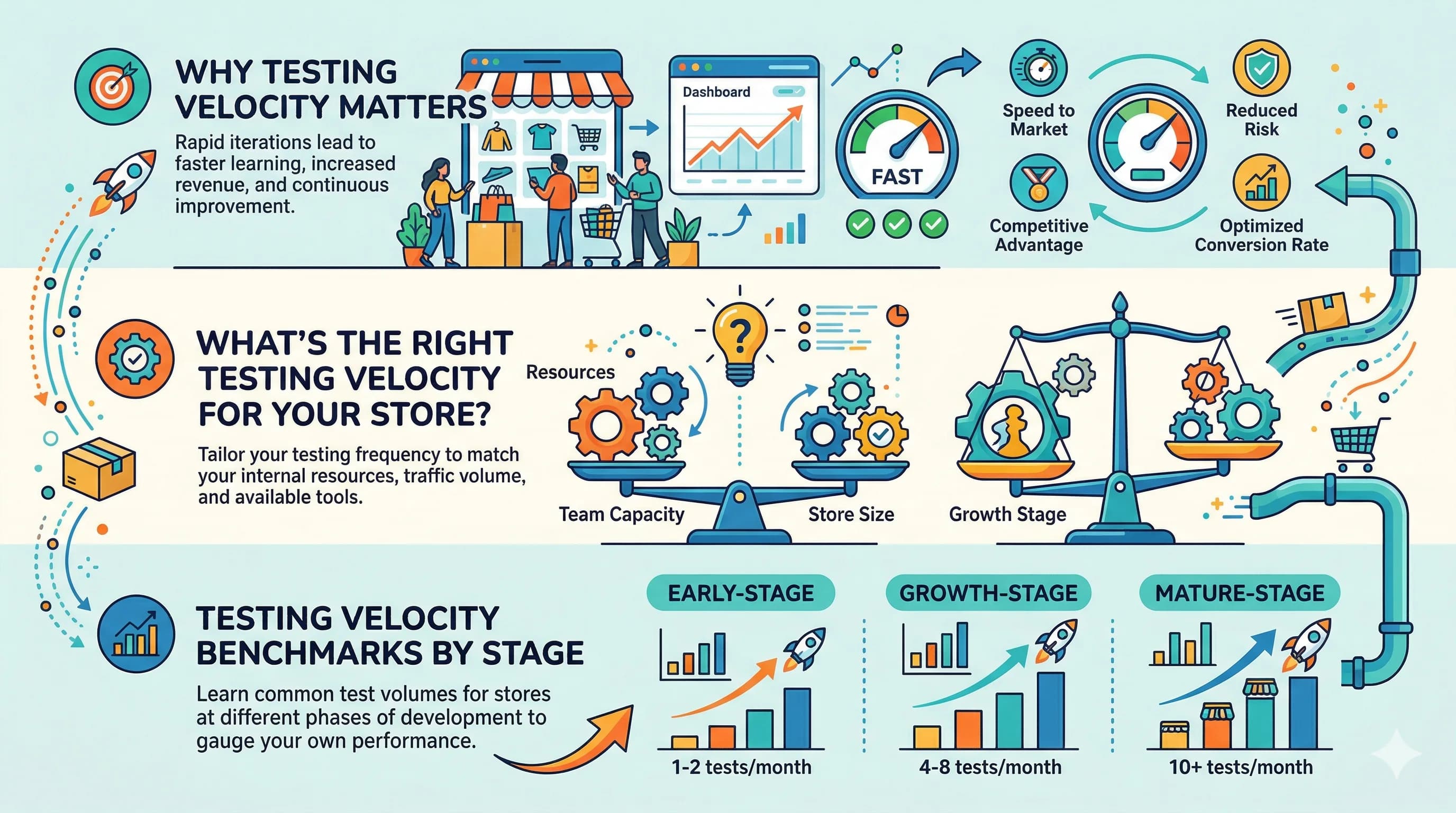
How many A/B tests should a D2C brand run per month? Start with 1 to 2 tests per month in year one. Mature programs at brands like Nykaa or Mamaearth run 15 to 25 tests per month across website, email, and product. The number matters less than the quality of hypotheses and the rigor of analysis. Consistency matters more than volume.
How do you get leadership buy-in for an experimentation program? Show the math: a 1% CVR improvement on your current traffic translates to X rupees per month in additional revenue. Run your first test and show the result. Present a "cost of not testing" analysis, because every untested assumption is a potential revenue leak. Leadership that sees one data-driven win rarely needs convincing twice.
What is the difference between A/B testing and experimentation culture? A/B testing is a tool. Experimentation culture is a way of operating, where the whole organization treats uncertain decisions as experiments to run, not debates to win. Tools enable experimentation; culture ensures it happens consistently and compounds over time.
How do you handle a losing A/B test in an experimentation culture? Document it and understand what the result reveals about your customers. A losing test eliminated a bad idea before you shipped it to all your customers. That's a prevention, not a failure. The goal is learning, not winning. Every losing test makes your next hypothesis sharper.
What stops most D2C brands from building an experimentation culture? Three things: (1) Leadership decisions based on opinion rather than data, undermining trust in results. (2) No clear ownership, so testing is everyone's job and therefore no one's job. (3) A "we'll do it when we have time" mindset. Brands that experiment consistently create time for it because they've seen the financial return.
Can a small D2C team build an experimentation culture? Yes. A 3-person marketing team can run 2 to 4 tests per month with the right tool. CustomFit.ai's no-code editor means tests don't require engineering hours. The constraint is usually discipline and hypothesis quality, not team size. Some of the most rigorous experimentation programs are in lean teams.
How long does it take to build a mature experimentation culture? Expect 6 to 12 months from first test to a consistent team-wide testing rhythm. The first 3 months are about building muscle: learning the tool, running simple tests, documenting results. Months 4 to 12 are about depth: complex hypotheses, segmentation analysis, cross-team learning. Year 2 is when the compounding becomes visible in revenue metrics.
Start your free trial of CustomFit.ai: 14 days, no credit card. Setup under 30 minutes.