From the conversion glossary
Concepts referenced in this article, defined.
Concepts referenced in this article, defined.
Run rigorous A/B tests and personalize every visit on Shopify or any storefront — no engineers required.
Choosing the right experimentation platform determines whether your CRO program runs tests every week or struggles to ship one per month. The best platform for your team depends on your technical resources, test velocity goals, budget, and the complexity of tests you want to run. For Shopify D2C brands, the most common mistake is buying an enterprise platform with a high developer dependency when a no-code tool would run more tests at a fraction of the cost. This guide cuts through the vendor noise to help you make the right choice.
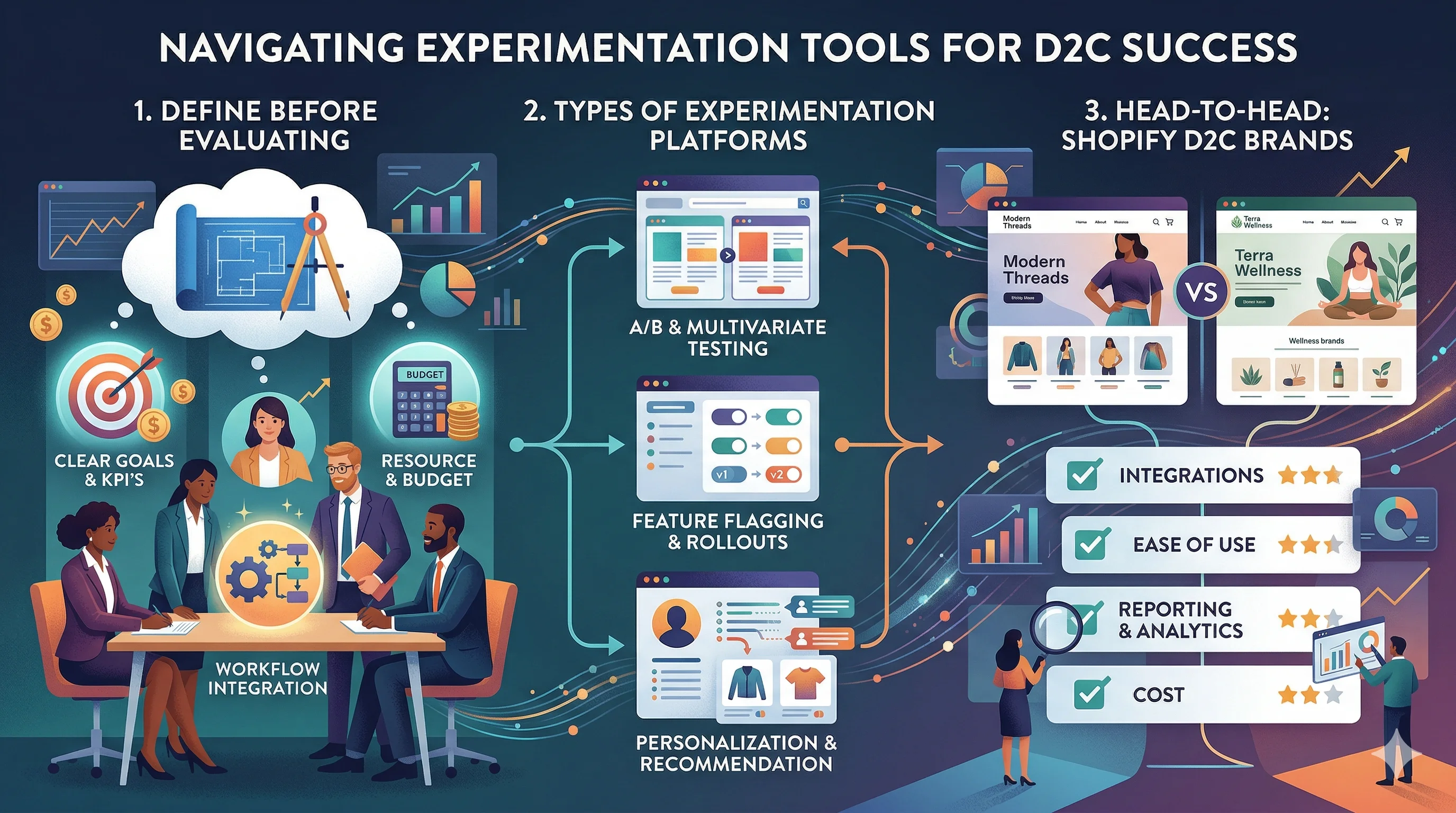
Start with requirements, not features lists. Answer these questions first:
Who will run tests? If the answer is "the marketing team without developer involvement," you need a no-code tool. If "engineering builds and marketing analyzes," you can consider developer-focused platforms.
How many tests per month do you plan to run? Under 4/month: any tool works. 4–10/month: workflow efficiency matters. 10+/month: you need a platform with strong test management and hypothesis libraries.
What do you need to test? Simple copy/color changes on PDPs: any tool. Cart and checkout flows: requires Shopify-specific integrations. Feature-level tests: may require feature flag functionality.
What's your budget? Be honest. A ₹50,000/mo enterprise platform that your team uses for 2 tests/month delivers lower ROI than a ₹8,000/mo no-code tool running 10 tests/month.
Do you need personalization alongside testing? Many brands want to combine A/B testing with personalization. Some platforms do both; others are testing-only.
Built for marketing and growth teams to run tests without engineering involvement.
Characteristics:
Examples: CustomFit.ai, VWO (lighter tier), Convert.com
Best for: D2C brands where marketing owns CRO, teams without dedicated engineers, stores wanting to run 4+ tests/month
Require engineering involvement for test implementation but offer more flexibility.
Characteristics:
Examples: Optimizely Web, VWO (full tier), AB Tasty
Best for: Larger engineering teams with dedicated CRO developers, complex technical implementations
Combine feature flag management with A/B testing. Used by product and engineering teams for server-side testing.
Characteristics:
Examples: LaunchDarkly, Unleash, Split.io, GrowthBook (open source)
Best for: Product engineering teams testing app features, backend experiments, or complex multi-page flows
Comprehensive platforms with advanced statistics, hypothesis management, and integration ecosystems.
Characteristics:
Examples: Optimizely Full Stack, Statsig, Amplitude Experiment
Best for: Large engineering-led organizations with dedicated experimentation teams
| Criterion | CustomFit.ai | VWO | Optimizely | Convert.com |
|---|---|---|---|---|
| Shopify native | Yes | Partial | No | Partial |
| No developer needed | Yes | Partial | No | Partial |
| A/B testing | Yes | Yes | Yes | Yes |
| Personalization | Yes | Yes | Yes | Yes |
| Statistical engine | Yes | Yes | Advanced | Yes |
| Starting price | ~₹8,200/mo | ~₹16,000/mo | ~₹65,000+/mo | ~₹12,000/mo |
| Free trial | 14 days | Yes | Demo only | 15 days |
| India support | Yes | Yes | No | No |
The statistical engine is the brain of any experimentation platform. Weak statistics = misleading results = bad decisions.
Must-have features:
Frequentist significance testing: Standard p-value based testing. Should default to 95% confidence. Should allow you to configure this.
Sample size calculator: Before starting a test, you should be able to input your current conversion rate and minimum detectable effect to know how many visitors you need.
Peeking protection: Running a test until you see a good result (peeking) produces false positives. Good platforms prevent this with sequential testing or explicit warnings about peeking.
Segmentation in results: Ability to analyze test results by device type, traffic source, new vs. returning visitors, and other segments.
Nice-to-have features:
Bayesian statistics: Alternative to frequentist, gives probability-based results that some teams find more intuitive.
CUPED variance reduction: Advanced technique that uses pre-experiment data to reduce noise and reach significance faster.
Interaction detection: Identifies when multiple simultaneous tests affect the same metric (test collision).
Shopify-specific considerations that general platform reviews often miss:
Checkout page access: Shopify's checkout is locked — only Shopify Plus merchants can customize it. Any platform claiming to test checkout elements on standard Shopify is misleading. Verify what "checkout testing" actually means for your Shopify plan.
Page speed impact: A/B testing tools inject JavaScript that can slow page loads. On mobile in India, where network speeds vary significantly, this matters. Ask vendors for their performance benchmarks.
Theme compatibility: Some tools work better with specific Shopify themes. Test with your actual theme in a staging environment before committing.
Metafield support: Advanced Shopify personalization often uses metafields. Verify the platform can read and act on Shopify metafields for advanced targeting.
App conflicts: Some Shopify apps conflict with A/B testing tools (especially other JavaScript-heavy apps). Run a compatibility check.
Some technical teams consider building their own experimentation infrastructure. For most D2C brands, this is the wrong call:
Arguments for building:
Arguments against building:
The verdict: Unless you're testing at Google or Meta scale, buy a platform. The operational cost of building exceeds the SaaS cost at virtually every scale a D2C brand operates at.
"No flicker" claims without proof: Most client-side A/B testing tools cause a brief flicker (original content shown, then variant loads). Vendors often claim to have solved this but haven't. Ask for a demo on a slow connection.
Statistical results that always show winners: If a platform's demo shows every test winning by wide margins, it's using an overly permissive statistical threshold. Real experimentation sees 30–40% of tests produce genuine winners.
Pricing that scales punitively by traffic: Platforms that charge per pageview can become very expensive as you scale. Understand the pricing model fully before committing.
No segmentation in test results: If you can't analyze test results by device type, new vs. returning, or traffic source, you can't learn enough from your tests to improve your hypothesis generation.
Step 1: Define requirements using the questions at the top of this guide
Step 2: Shortlist 3 platforms that fit your budget and technical profile
Step 3: Run each on a free trial with a real test on your store (not just a demo environment)
Step 4: Evaluate: setup time, result clarity, statistical reporting, page speed impact
Step 5: Check reference customers in your industry — especially other Shopify D2C brands
Step 6: Negotiate on price; most vendors will offer a discount, especially for annual commitment
For most Indian D2C brands on Shopify, CustomFit.ai is the practical starting point: native Shopify integration, no developer needed, 14-day free trial, and pricing that makes sense for brands at ₹5 Cr–₹100 Cr revenue.