From the conversion glossary
Concepts referenced in this article, defined.
Concepts referenced in this article, defined.
Run rigorous A/B tests and personalize every visit on Shopify or any storefront — no engineers required.
A visitor who clicked a Diwali discount Meta ad and a visitor who Googled "best protein powder India" both land on your product page — but they are in completely different mindsets. Showing them the same page is a missed opportunity. Landing page personalisation by traffic source means tailoring the headline, offer, and social proof to the visitor's context, and it consistently delivers higher conversion rates without increasing ad spend.
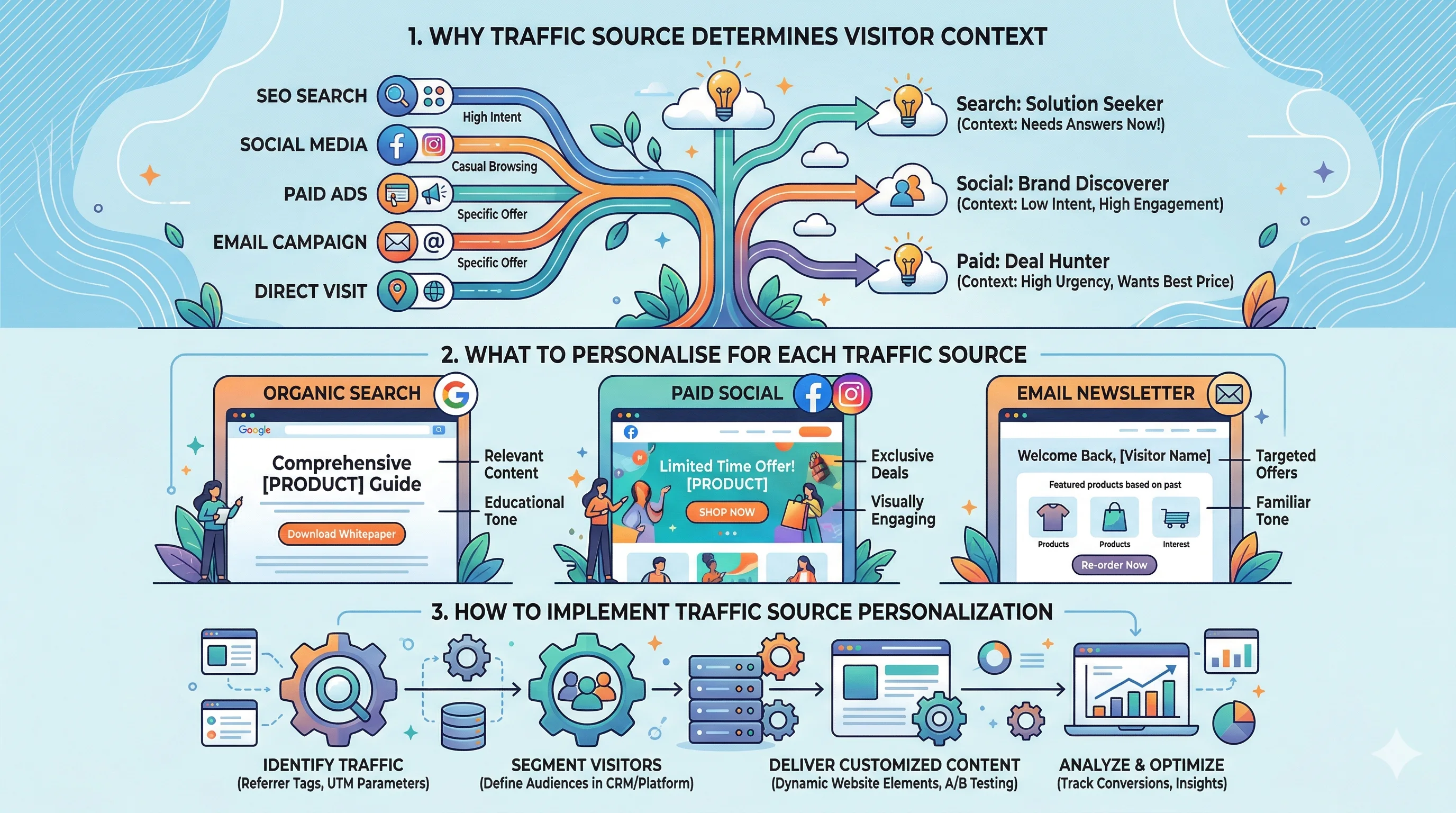
Every traffic source sends visitors with a different level of intent, a different reason to be interested, and a different objection set.
Paid social (Meta/Instagram): The visitor was not looking for your product. Your ad interrupted their scrolling. They are in discovery mode — emotionally open but logically sceptical. They need to be wowed quickly and given a clear reason to act (usually an offer).
Paid search (Google/Shopping): The visitor was actively searching for a product in your category. They have intent but are comparing options. They need proof that your product is the right choice — specifications, reviews, and differentiators matter more than emotional appeal.
Email campaign: The visitor already knows your brand. They opened your email about a sale or new product and clicked through. They need the landing page to fulfil the promise of the email — if the email said "New Arrivals: Festive Collection", the landing page hero must show the festive collection, not your homepage banner.
Organic search: The visitor found you via a blog post or SEO ranking. They may be early in their research phase. They need more education and evidence than a paid search visitor.
Influencer / affiliate link: The visitor came from a creator they trust. Social proof from that creator (or creator type) on the landing page extends the trust the visitor already has.
When every traffic source sees the same landing page, you optimise for an average visitor who does not really exist. Message match by traffic source is the fix.
The highest-impact change. The headline should echo the language and context of the source.
| Source | Ad/Email copy | Landing page headline |
|---|---|---|
| Meta retargeting | "You left something behind — 15% off for 24 hours" | "Your 15% Off Expires in 24 Hours — Complete Your Order" |
| Google brand search | "CustomFit.ai — A/B Testing for Shopify" | "The Fastest Way to A/B Test Your Shopify Store — No Developer" |
| Festive Meta campaign | "Diwali Sale: 30% Off Sitewide" | "30% Off This Diwali — Free Gift Wrapping on Orders Above ₹999" |
| Email re-engagement | "We miss you — here's ₹150 to come back" | "Welcome Back — Your ₹150 is Waiting" |
Different sources respond to different offer types:
Match the testimonials to the audience:
Festive and sale traffic responds to countdown timers and stock scarcity. Organic traffic visitors are research-mode and may find aggressive urgency off-putting. Turn urgency elements on for paid traffic, off or muted for organic.
UTM parameters are the tags added to URLs to track traffic source. They look like this:
https://yourbrand.com/product?utm_source=facebook&utm_medium=paid_social&utm_campaign=diwali_sale
When a visitor arrives with these parameters, you can use them to trigger different content variants on the page.
The five standard UTM parameters:
utm_source — the platform (facebook, google, email)utm_medium — the channel type (paid_social, cpc, email)utm_campaign — the specific campaign (diwali_sale, retargeting_jan25)utm_content — the specific ad creative (hero_video_v1, carousel_ad)utm_term — the keyword (for paid search)CustomFit.ai reads UTM parameters and swaps content blocks based on rules you define — no developer needed.
Setup:
The same page URL serves different experiences to different visitors. No separate landing page URLs to manage.
For paid search specifically, dynamic text replacement inserts the visitor's search keyword into the headline. A visitor who searched "whey protein for women" sees "Whey Protein Designed for Women — 25g per Scoop". A visitor who searched "best protein powder India" sees "India's Best-Reviewed Protein Powder — 4.8 Stars, 45,000+ Orders".
This is the most direct form of message match and has the highest impact on paid search landing page conversion rate.
For each traffic source variant, track:
Compare each personalised variant against the control (same source traffic seeing the default page) to measure the lift.
A basic personalisation programme should produce 15–30% lift in conversion rate per traffic source within the first 60 days. Bellavita saw an 11% overall CVR improvement after implementing source-based personalisation across their key campaigns.
Personalising too many variables at once. Start with the headline only. It is the highest-impact element and the easiest to change. Once headline personalisation is working, add offer and social proof variation.
Not tagging all traffic with UTMs. If UTMs are missing, the personalisation rule does not trigger and the visitor sees the default page. Audit your UTM tagging in every active campaign.
Creating variants for sources that do not have enough traffic. Personalising a landing page for a traffic source that sends 50 visitors per month is not worth the effort. Focus on your top 3–4 sources by volume.
Forgetting to update personalised variants when campaigns change. If a campaign ends, the variant tied to that campaign's UTM becomes stale. Review and update personalisation rules every time a major campaign launches or ends.
Use UTM naming conventions consistently. Decide on a naming scheme (lowercase, underscores, no spaces) and stick to it across all campaigns. utm_source=Facebook and utm_source=facebook are treated as different sources by most tools.
Test personalisation variants against the control. Run an A/B test for 2 weeks before committing to a personalised variant full-time. Personalisation that feels right often does not match what the data shows.
Combine source personalisation with retargeting segmentation. A Meta retargeting visitor who saw your ad 5 times in the last week needs a different message than a first-time Meta visitor. Segment by both source and visit history.
Account for festive seasons. During Navratri, Diwali, or Republic Day sales, create a "festive" variant that triggers for all paid traffic, regardless of source. Festive messaging outperforms evergreen messaging during peak seasons across every traffic channel.
For more on landing page strategy, see the Landing Pages pillar guide and the articles on landing page hero section optimization and mobile landing page optimization.