From the conversion glossary
Concepts referenced in this article, defined.
Concepts referenced in this article, defined.
Run rigorous A/B tests and personalize every visit on Shopify or any storefront — no engineers required.
Sending paid ad traffic to your homepage is one of the most common and costly conversion mistakes in D2C ecommerce. A homepage is built for all visitors and all purposes, so it can't be focused. A landing page built for a specific campaign, audience, and message converts 30 to 50% better than a homepage for paid traffic. Knowing when to use each, and how to build landing pages that match your ad message, is one of the fastest ways to improve ROAS and reduce CAC.
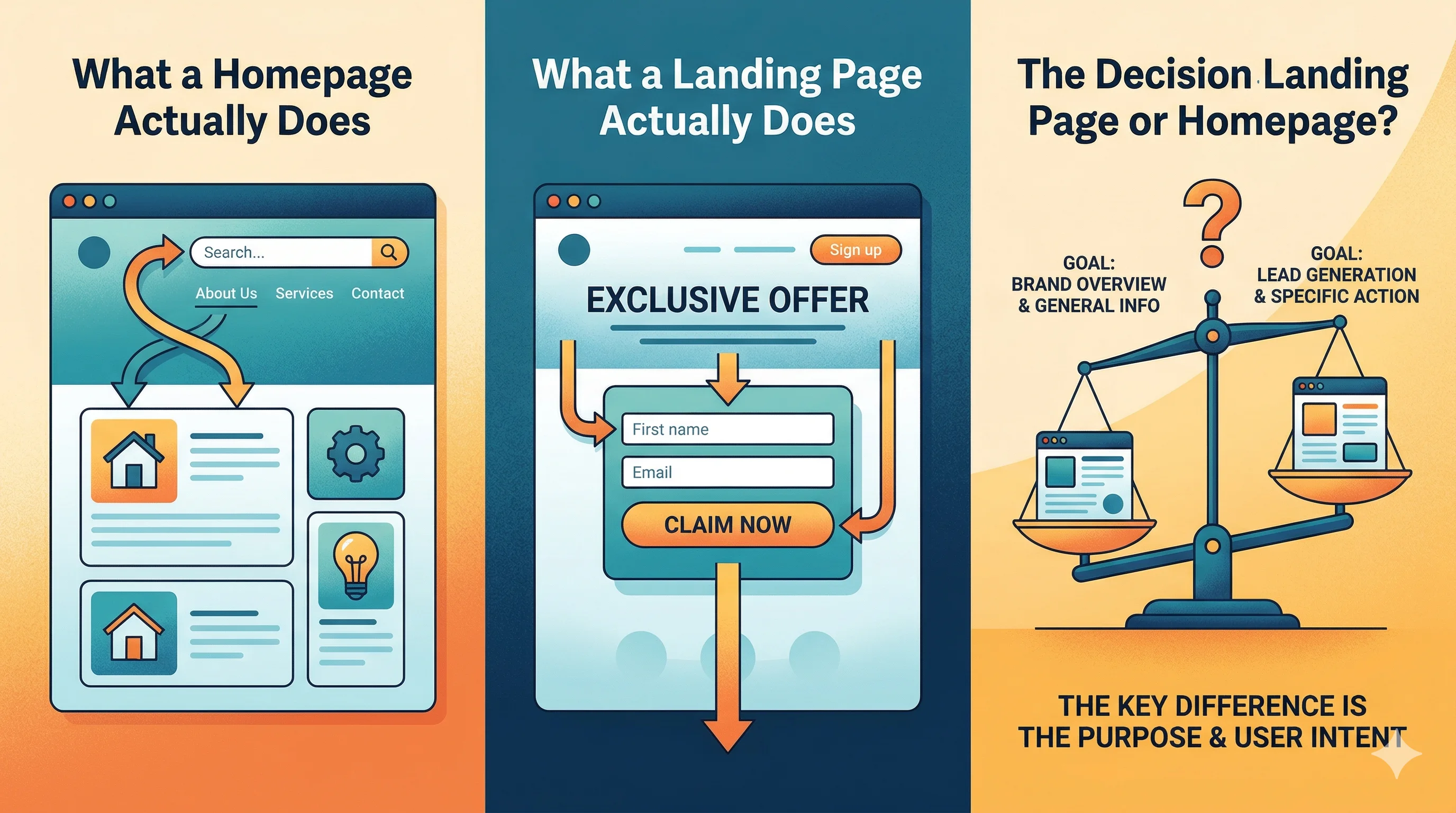
Your homepage is your brand's front door. It needs to welcome and orient every kind of visitor:
That breadth helps with organic visitors. It works against you for paid traffic that arrives with a specific intent.
When someone clicks your Instagram ad for a Vitamin C Serum and lands on your homepage, they see your full product range, your brand story, your bestsellers section, links to your blog, and your collection navigation. They then have to hunt for the specific product they clicked to see.
Every extra step between "this is what I want" and "I can buy this" costs conversions. The homepage adds those steps. A landing page removes them.
A landing page is built for a specific campaign or traffic source. It has one primary audience, which is the segment of visitors coming from this campaign. It carries one message, aligned with what the ad or email promised. It drives one goal, usually a single CTA such as Buy Now, Start Trial, or Sign Up. And it often drops the top navigation bar entirely, which removes exit paths.
The concept that ties all of this together is message match: the headline and content of the landing page should continue the conversation the ad started. If the ad says "Brighten Skin in 4 Weeks with Our Vitamin C Serum," the landing page headline should reference Vitamin C brightening right away, rather than a generic homepage banner about your brand story.
Message match is the biggest driver of landing page performance. Brands that get strong message match between ad and landing page consistently see 30 to 50% higher CVR than those that don't.
Send to a landing page when:
Send to the homepage when:
Send to a product page when:
The most important landing page optimization is getting message match right.
Example of poor message match:
Ad copy: "India's First Ayurvedic Hair Oil With Clinical Proof, See Results in 21 Days" Landing page: Generic brand homepage with a "Shop Our Range" hero message
The visitor who clicked that ad came specifically for the Ayurvedic hair oil with clinical proof. The homepage doesn't deliver that up front, so they either search around and lose momentum, or they leave.
Example of strong message match:
Ad copy: "India's First Ayurvedic Hair Oil With Clinical Proof, See Results in 21 Days" Landing page headline: "21-Day Hair Transformation: Our Clinically Tested Ayurvedic Formula" Landing page subhead: "Used by 80,000+ customers across India. Now available with free shipping."
The visitor arrives and sees the ad's promise continue. Trust is established, and the conversion path is clear.
A high-converting D2C landing page usually contains:
Hero section:
Social proof section:
Product/offer section:
Trust and risk reduction:
Secondary CTA:
FAQ (optional but useful):
What landing pages usually omit:
For D2C brands that don't have dedicated landing page infrastructure, Shopify collection pages can work as landing pages for category-specific campaigns.
A "Summer Skincare" collection page can work as a landing page for a summer skincare campaign, without building a separate page, when it's designed with:
See Collection Page as Landing Page: Shopify Guide for the detailed approach.
The most direct way to know whether a landing page beats your homepage for a given traffic source is to test it.
The test:
Variant A: Campaign traffic directed to homepage Variant B: Campaign traffic directed to a purpose-built landing page
Measure: Conversion rate, time on page, bounce rate, revenue per visitor.
In most cases the landing page wins, but the size of the win tells you how much message mismatch you had before. If the landing page converts 2% and the homepage converts 1.2%, the homepage was leaving 40% of conversions on the table.
CustomFit.ai supports URL-level A/B testing on Shopify. You can send a traffic split to different pages and compare conversion data without developer setup.
Links: Landing Page Optimization | Conversion Rate | Message Match | Landing Page Optimization Pillar | Ad Landing Page Message Match | Collection Page Landing Page Shopify