CustomFit.ai — Website personalization, A/B testing and CRO for Shopify and D2C
Product
Features
✱
Website Personalization
Adapt to each visitor's behavior & intent
⧖
A/B & Multivariate Testing
Rigorous experimentation
✨
AI CopilotNEW
Personalize with a prompt
🤖
AI WingmanNEW
Auto-optimize toward winners
🎯
AI Conversion OptimizerNEW
GPT-grade test ideas
✎
No-Code Visual Editor
Drag-and-drop edit any element
▦
Product Recommendations
Personalized recs that lift AOV
⚑
Feature Flags
Ship safely with kill-switches
◧
Chrome Extension
Edit your store in the browser
⧉
Shopify, WooCommerce & more
All platform integrations
View all features →
Use Cases
$
Price A/B Testing
Test price points to maximize revenue
▦
Theme A/B Testing
Compare whole layouts & designs
🗂
Template A/B Testing
Test whole PDP/PLP templates
🏷
Discount A/B Testing
Find the offer that converts
🚚
Shipping A/B Testing
Thresholds, speed & copy
✍
Content A/B Testing
Copy, images & reviews
💳
Checkout Gateway A/B
Payments & one-click
⌖
Geo-Based Personalization
Per-location content & offers
⚡
Buyer-Intent Nudges
Exit-intent & retargeting
↔
Split-URL / Redirection
Full-page redirect tests
View all use cases →
Solutions & Guides
⤢
Conversion Rate Optimization
The complete CRO guide
⧖
A/B Testing Software
Buyer's guide for D2C
🛒
Cart Abandonment Recovery
Win back lost carts
📰
Landing Page Optimization
Convert more paid traffic
S
Shopify A/B Testing
Test your store, no code
S
Shopify Personalization
Tailor the store per shopper
◔
First-Time Visitor Offers
Convert new shoppers with trust & offers
★
Repeat-Customer Experiences
Reward and re-engage loyal buyers
◎
Campaign-Matched Pages
Match the landing page to the ad
⌖
Location-Based Experiences
Currency, language & regional offers
Explore CRO →
Customer stories
GIVA
+32%
conversion via personalized recs
GIVA
Mamaearth
+18%
revenue lift from PDP A/B tests
ME
The Sleep Company
+24%
AOV from product recommendations
TSC
Read customer stories →
Integrations
SWsfGA+15
✦
Not sure where to start?
Let AI Copilot pick your first tests

“We wake up to evidence-backed tests ready to deploy — not a backlog of maybe ideas.”

AN
Anirudh S.
Growth · Chargebee
★★★★★4.8on G2 · 2,400+ brands
Talk to our team →
Widgets
Integrations
Ecommerce & Checkout
Shopify
Shopline
Shoplazza
GoKwik
ShopFlo
Razorpay Magic Checkout
Breeze
Shiprocket
View all integrations →
Analytics & Behavior
Google Analytics 4
Microsoft Clarity
Hotjar
Mixpanel
Amplitude
Heap
Adobe Analytics
Segment (CDP)
View all integrations →
Engagement, CRM & More
Klaviyo
MoEngage
CleverTap
WebEngage
HubSpot
Salesforce
Slack
Meta Ads
View all integrations →
CustomersPricing
Resources
CRO
▤
Playbooks
Proven strategies to boost conversions
🎙
Interviews
D2C leaders & marketing experts
▶
Webinars
Live deep dives & product sessions
Learn
✎
Blog
Tips, experiments & best practices
📕
Free E-Books
Mastering personalization
📖
Conversion Glossary
Every CRO term, defined
✦AI CopilotNEWLog inBook a demo
Start free trial
Select your platform — Install in 2 minsWe'll tailor the setup
⚡ Risk-free 14-day trial · No credit card · Cancel anytime
S
Shopify
Install from Shopify App Store
›
W
WooCommerce
Install the WooCommerce plugin
›
B
BigCommerce
Install from BigCommerce App Marketplace
›
SL
Shopline
Install from Shopline App Store
›
M
Salesforce / Magento
Install from the marketplace
›
SZ
Shoplazza
Install from Shoplazza App Store
›
WP
WordPress / Webflow
Install plugin or paste the script
›
◧
Others
Custom-built on React, Next.js, etc.
›
Tip: pick your platform — we handle the restBook a demo →
Product
Website PersonalizationA/B & Multivariate TestingAI CopilotAI WingmanAI Conversion OptimizerNo-Code Visual EditorProduct RecommendationsFeature FlagsView all features →
Use Cases
Price A/B TestingTheme A/B TestingTemplate A/B TestingDiscount A/B TestingShipping A/B TestingContent A/B TestingCheckout Gateway A/BGeo-Based PersonalizationBuyer-Intent NudgesSplit-URL / Redirection
Solutions & Guides
Conversion Rate OptimizationA/B Testing SoftwareCart Abandonment RecoveryLanding Page OptimizationShopify A/B TestingShopify Personalization
Explore
WidgetsIntegrationsCustomersPricing
Resources
BlogPlaybooksWebinarsInterviewsE-BooksConversion Glossary
Platforms
ShopifyShoplineShoplazzaChrome ExtensionAll integrations
Start free trialBook a demo
Home›Blog›landing pages›Ad-to-Landing Page Message Match

Ad-to-Landing Page Message Match

AKAshwin KumarCo-Founder & CEO, CustomFit.aiJanuary 15, 20259 min read
On this page
  1. The Psychology of Message Match
  2. The Four Dimensions of Message Match
  3. Diagnosing Message Match Problems
  4. Building Message-Matched Landing Pages
  5. Multiple Ads, Multiple Landing Pages
  6. UTM Parameter-Based Personalization
  7. Testing Message Match
  8. Message Match for Google Ads: Search Intent Alignment
  9. Tips / Best Practices
  10. Key Takeaways
0%
Ad-to-Landing Page Message Match

From the conversion glossary

Concepts referenced in this article, defined.

Definition
What Is Variant? Definition, Formula & Guide
Definition
What Is UTM Parameters? Definition & Guide
Definition
What Is Baseline? Definition, Formula & Guide
Definition
What Is Discount Code? Definition & Guide
Definition
What Is Paid Traffic? Definition, Formula & Guide
← Back to Landing Pages guide
Try CustomFit.ai

Run A/B tests and personalize your store without code. 14-day free trial, no credit card.

Start free trial →
Share
XLinkedInEmail

Related articles

landing pages

Mobile Landing Page Optimization Checklist

Sapna Johar· 8 min read
landing pages

Long-Form vs Short-Form Landing Pages

Sharan Kumar· 6 min read
landing pages

Landing Page vs Homepage: When to Use Which

Sharan Kumar· 7 min read

Start lifting conversions today.

Run rigorous A/B tests and personalize every visit on Shopify or any storefront — no engineers required.

Start free trialBook a demo

Built for every D2C category

🧴
Skincare
💄
Beauty
🌿
Wellness
☕
F&B
👟
Apparel
💍
Jewelry
🛋️
Home
🍼
Baby
Live · Right now
Mamaearth — free-shipping band +12.4% AOVGIVA — festive collection page +34% revenueBellavita — PDP CTA test +27.4% CVRKapiva — Quiz-driven recs +9.48% CTRThe Sleep Co — landing personalized 2× capturesPlum — Returning shopper swap +18.2% CVRMamaearth — free-shipping band +12.4% AOVGIVA — festive collection page +34% revenueBellavita — PDP CTA test +27.4% CVRKapiva — Quiz-driven recs +9.48% CTRThe Sleep Co — landing personalized 2× capturesPlum — Returning shopper swap +18.2% CVR
Get in touch

Tell us about your store.

We reply within an hour during business hours. No sales pitch, no spam — just answers from someone who's seen 2,400+ D2C stores.

✓ Reply within 1 hour✓ No spam, ever✓ Free demo & setup help
✓ Thanks! We'll be in touch shortly.
CustomFit.ai

The all-in-one website personalization, A/B testing & CRO platform for high-growth D2C brands. Made by marketers, fueled by coffee.

in𝕏◎▶f
Product
  • Features
  • A/B Testing
  • Personalization
  • AI Copilot
  • AI Wingman
  • AI Conversion Optimizer
  • Feature Flags
  • Widgets
  • Integrations
  • ROI Calculator
Platforms
  • Shopify
  • Shopline
  • Shoplazza
  • Salesforce
  • Chrome Extension
  • All Integrations
Resources
  • Blog
  • Playbooks
  • Webinars
  • GrowthFit Interviews
  • Free E-Books
  • Conversion Glossary
  • Case Studies
Compare
  • vs VWO
  • vs Optimizely
  • vs Google Optimize
  • vs Mutiny
  • vs Intelligems
  • vs Shoplift
  • vs AB Tasty
  • vs Convert
  • vs Kameleoon
Company
  • About Us
  • Partners
  • CustomFit Awards
  • Recognition
  • Contact
  • Privacy Policy
  • Terms & Conditions
© 2026 CustomFit.ai · Valley Monks Pvt Ltd · Made by marketers, fueled by coffee, and obsessed with conversions.
SOC 2 Type II · GDPR · CCPA · ISO 27001

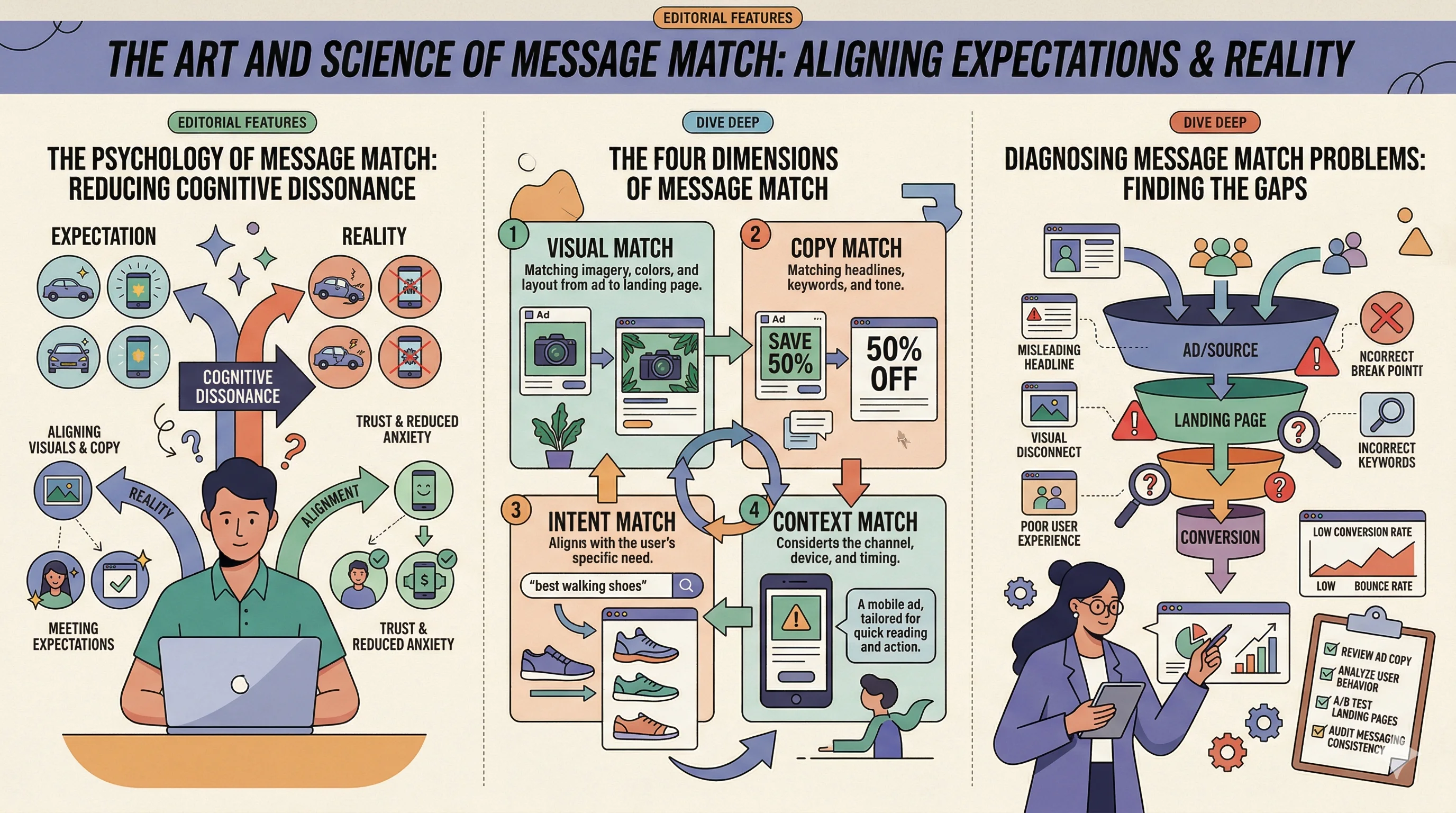
Message match is the single most impactful landing page optimization that most D2C brands get wrong. When a customer clicks your ad promising "11% CVR boost for Shopify brands" and lands on a homepage about your company, conversion drops—not because the offer is bad, but because the experience is discontinuous. The customer's mental model set by the ad ("I'm going to learn about this specific offer") is immediately shattered. Message match is about protecting that continuity, from the ad headline through to the landing page CTA.

The Psychology of Message Match

When someone clicks an ad, they've made a small commitment based on a specific promise. Their brain is in a specific mode: "I'm looking for X, and this ad says it has X."

If they land on a page that immediately confirms X—"Yes, you're in the right place, here's X"—they continue with elevated confidence. The decision momentum carries through.

If they land on a page that doesn't immediately confirm X—a homepage, a generic collection, a mismatched message—cognitive dissonance kicks in. "Is this the right place? Did I click the right thing?" The mental energy spent re-orienting is borrowed from the energy needed to convert. Bounce rate rises; conversion drops.

This effect is not subtle. The gap between high-match and low-match experiences regularly produces CVR differences of 30–50%—the same traffic, the same offer, the same product, performing dramatically differently based solely on the continuity of the experience.

The Four Dimensions of Message Match

Message match isn't just about repeating the headline. It involves alignment across four dimensions:

1. Verbal match: The headline and key phrases on the landing page should directly echo the ad copy. If the ad says "Get 21% more conversions," the landing page shouldn't say "Improve your store's performance." The specific language creates a recognition moment.

2. Visual match: The images or visual style of the landing page should align with the ad creative. An ad featuring a model in a specific product using a specific styling should lead to a page showing the same product in a similar visual context.

3. Intent match: The landing page should address the specific intent implied by the ad. An ad targeting "best protein for weight loss" should land on a weight-loss-specific context page, not the full supplement catalog.

4. Audience match: The tone, imagery, and examples on the landing page should match the audience the ad targeted. An ad targeted at Indian women 25–35 interested in sustainable beauty should land on a page featuring relatable models, culturally relevant references, and the specific brand values that audience cares about.

Diagnosing Message Match Problems

Before improving message match, diagnose where your current gaps are.

The scan test: Open your ad in one window and your landing page in another. In 5 seconds of looking at the landing page, can you identify the exact offer or promise the ad made? If not, you have a message match problem.

The question test: Ask five people who haven't seen your ad to look at your landing page and describe what the main offer or value proposition is. Then ask five people who've seen your ad to do the same. If the descriptions differ significantly, there's a match gap.

The UTM analysis: Check your Google Analytics or Shopify analytics for conversion rates by UTM source and landing page. If your "vitamin-c-serum-promo" campaign traffic converts at 0.8% while your branded search traffic converts at 3.2% on the same product page, message mismatch (not product or price) is likely the cause.

The heatmap review: Session recordings of ad-traffic visitors often show them scrolling quickly looking for the specific thing the ad promised, then bouncing when they can't find it quickly. This behavioral pattern is diagnostic of message mismatch.

Building Message-Matched Landing Pages

Step 1: Map your ads to intents

List every active ad group or creative. For each, write a one-sentence description of:

  • Who clicked this? (demographic and psychographic)
  • What did they think they'd get?
  • What action do I want them to take?

This mapping becomes your landing page brief.

Step 2: Match headline to ad promise

The H1 on the landing page should contain the core promise of the ad. If the ad says "Certified Organic Skincare Starting at ₹499," the headline might be "Certified Organic Skincare — Starting From ₹499. Real Ingredients, Real Results."

The customer's internal monologue: "Good, I'm in the right place. This is what I came for."

Step 3: Show the specific product or offer immediately

If the ad featured Product X, Product X should be the first thing visible on the landing page. Not a related product, not a category, not a promotional banner about something else—Product X.

Step 4: Mirror the emotional register

If the ad was aspirational ("Skin so bright, you'll stop wearing filters"), the landing page copy should have similar emotional energy. If the ad was factual ("Clinically tested, dermatologist approved"), the landing page should lead with evidence, not aspiration.

Step 5: Maintain the offer through to checkout

If the ad promised a discount, make that discount immediately visible on the landing page (ideally auto-applied to cart). Customers who see an ad discount and then have to search for the discount code at checkout lose trust and often abandon.

Multiple Ads, Multiple Landing Pages

The most effective brands create dedicated landing pages for each significant ad group—not one landing page for all traffic.

Why this matters:

An ad targeting new-to-D2C buyers (interested in basic skincare, price-sensitive) should land on a different page than an ad targeting skincare enthusiasts (interested in advanced ingredients, willing to spend on quality). The same product, different message, different social proof, different CTA emphasis.

For a D2C brand running 5–10 ad groups:

  • 5–10 landing page variants, each matched to a specific audience and message
  • Each variant shows the same products but with different positioning, emphasis, and proof points
  • CVR is measured per ad-to-page combination

This sounds like a lot of work. With a tool like CustomFit.ai, it's actually manageable—you create one base landing page and variants that adjust specific elements (headline, hero image, testimonials) based on URL parameters (UTM), without rebuilding pages from scratch.

UTM Parameter-Based Personalization

The practical mechanism for message match at scale is UTM parameters.

When you build your ad links, include UTM parameters: ?utm_source=meta&utm_campaign=vitaminc-serum&utm_content=brightening-variant

On your landing page, CustomFit.ai (or similar tools) can read these parameters and show a specific variant of the page tailored to that campaign.

Result: The "brightening-variant" Meta ad lands on a landing page version emphasizing brightening results. The "anti-aging-variant" Meta ad lands on a version emphasizing anti-aging benefits. Same page URL; different content served to each visitor based on their ad entry point.

This is personalization at the top of the funnel—and it directly addresses the message match problem at scale.

Testing Message Match

Run A/B tests to quantify message match impact and optimize variants.

Test 1: Homepage vs. landing page

Variant A: Send campaign traffic to homepage Variant B: Send campaign traffic to a message-matched landing page

This baseline test establishes the magnitude of the message match opportunity. In most cases, the landing page wins by 20–50% CVR. The gap size tells you how much opportunity you've been leaving on the table.

Test 2: Tight vs. loose match

Variant A: Landing page headline exactly mirrors ad copy Variant B: Landing page headline is related but not verbatim

This tests whether exact verbal match outperforms conceptual match.

Test 3: Visual match

Variant A: Landing page hero image matches the ad creative Variant B: Landing page hero image is different from ad creative

Tests whether visual continuity (or discontinuity) affects CVR.

CustomFit.ai enables all of these tests on Shopify without developer involvement—route UTM parameters to page variants, split traffic, and analyze results.

Message Match for Google Ads: Search Intent Alignment

For Google Search campaigns, message match works slightly differently. The "ad" is the search query + ad headline. Message match means the landing page should directly address the specific search intent.

Example:

Search query: "ayurvedic hair oil for hair fall in India" Ad headline: "Ayurvedic Hair Oil for Hair Fall — See Results in 21 Days" Landing page headline: "Clinically Tested Ayurvedic Hair Oil: 21-Day Hair Fall Reduction"

The keyword, the ad, and the landing page all address the same specific intent—hair fall specifically, ayurvedic specifically, and a time frame for results.

If this search traffic went to a generic "hair care collection" page, conversion would drop significantly even with a good ad.

Tips / Best Practices

  1. Write landing page headlines that mirror ad copy language. Recognition = trust = lower bounce rate.
  2. Show the specific product featured in the ad as the hero element. Don't make visitors search for what they came for.
  3. Make offers visible immediately. A discount promised in the ad should be visible—ideally auto-applied—on the landing page.
  4. Match visual tone as well as copy. Aspirational ads need aspirational landing pages; evidence-based ads need data-forward pages.
  5. Create separate landing pages for distinct audience segments. Different personas need different messages even for the same product.
  6. Use UTM parameters for personalization at scale. Route different campaign segments to different landing page variants without rebuilding pages.
  7. Remove top navigation from paid traffic landing pages. Exit paths hurt conversion; message-matched pages don't need them.
  8. Test homepage vs. landing page regularly. Benchmarking this gap helps quantify the value of your landing page investment.
  9. Audit message match quarterly. Ads change, landing pages stay static—regular audits catch message drift.
  10. Extend match to the checkout flow. If the ad promises free shipping or a discount, make sure both are visible through checkout.

Key Takeaways

  • Message match is the alignment between what your ad promises and what your landing page delivers. It's the #1 driver of landing page conversion rate, often producing 30–50% CVR differences.
  • Message match operates across four dimensions: verbal (headline language), visual (imagery and design), intent (addressing the specific query/need), and audience (tone, examples, proof points).
  • Creating multiple landing page variants—one per significant ad group—is the highest-impact implementation of message match for brands running multiple campaigns.
  • UTM parameter-based personalization allows one base landing page to show different content to different traffic segments, solving the scale problem.
  • A/B testing is essential: compare homepage vs. landing page, tight vs. loose match, and visual match variants to quantify and optimize the impact.
  • CustomFit.ai enables UTM-based landing page personalization and A/B testing on Shopify without development resources.

Links: Landing Page Optimization | Conversion Rate | Personalization | Landing Page Optimization Pillar | Landing Page vs Homepage | Landing Page Copy Headlines