From the conversion glossary
Concepts referenced in this article, defined.
Concepts referenced in this article, defined.
Run rigorous A/B tests and personalize every visit on Shopify or any storefront — no engineers required.
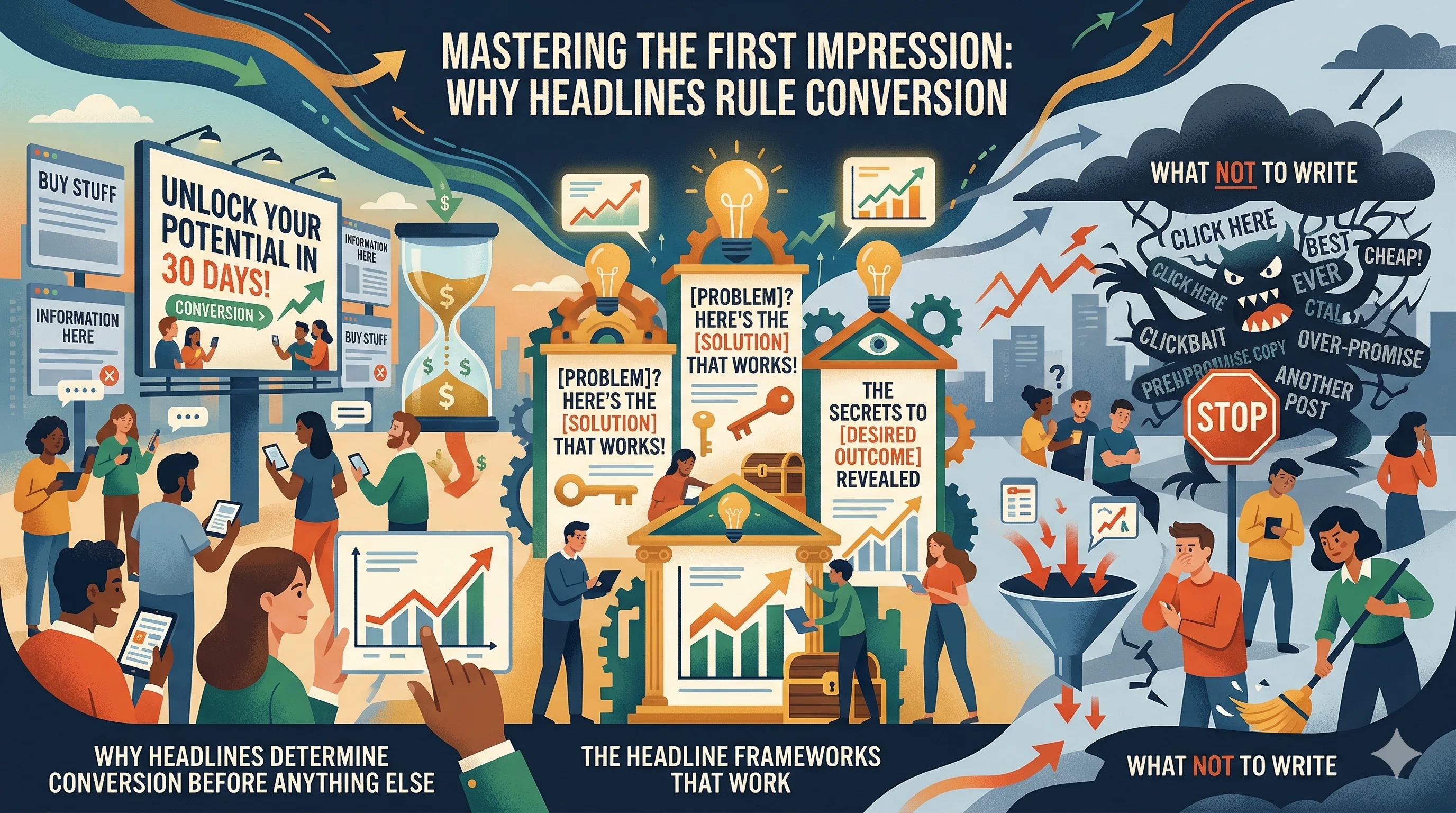
The landing page headline is the highest-leverage single element in conversion optimization. Visitors decide within 3–5 seconds whether they're in the right place—and the headline does most of the convincing. A weak headline loses visitors who would have bought; a strong headline holds them through the full page. Learning to write and test headlines is one of the most valuable CRO skills a D2C brand can develop, because the same principles compound across every page, ad, and email subject line.
Eye tracking research shows that visitors land on a page and immediately look at the headline. In 3–5 seconds, they form an impression: "Is this what I came for? Is this relevant? Do I trust this?"
If the headline fails to pass this test, the visitor bounces—regardless of how good the product, photography, reviews, or price are. The rest of the page never gets evaluated.
This is why headline optimization generates disproportionate conversion lift. Changing a headline from weak to strong can produce 20–40% CVR improvement. The same improvement from price changes, design tweaks, or additional trust badges would require multiple compound changes.
The three jobs of a landing page headline:
A headline that does all three in 8–12 words is gold.
1. Outcome + Time Frame
"Brighter Skin in 21 Days — Our Vitamin C Serum, Money-Back Guaranteed"
Specificity is the key: 21 days (not "fast"), and a specific product benefit (brighter skin). Adding a risk reducer (money-back) in the headline addresses the hesitation before it forms.
Indian D2C examples:
2. Problem + Solution
Lead with the pain, follow with the cure. This pattern works because it demonstrates understanding before offering a product—empathy first, pitch second.
"Tired of Oily Skin by Noon? This Serum Keeps Your Skin Matte for 12 Hours"
"Post-Delivery Hair Fall Destroying Your Confidence? 80,000 Mothers Found Relief With This"
The effectiveness comes from validation: the visitor feels understood. Someone who understands their problem this specifically probably has a real solution.
3. Specific Number + Claim
Numbers signal precision and credibility. "11% more conversions" is more believable than "increase conversions." "9.48% CVR improvement" is more credible than "significant improvement."
"Our Customers Lose an Average of 4.2 kg in Their First Month" "Join 1.2 Lakh Indian Women Who Trust Our Biotin Formula" "The Sunscreen That Gets 94% Repurchase Rate in India"
Numbers in headlines also help with message match to ads that often feature specific statistics.
4. Social Proof Lead
Lead with what others have achieved or believe, rather than a direct claim.
"80,000+ Indian Shoppers Can't Be Wrong — India's #1 Ayurvedic Supplement" "Why 3 Lakh Customers Choose Sugar Cosmetics Over Global Brands"
This pattern is particularly effective for second-purchase and retargeting campaigns, where the visitor already has some familiarity with the brand.
5. Contrast/Comparison
Positioning against the alternative—not necessarily a competitor, but the "old way" vs. the "new way."
"Stop Guessing at Sizing — Our AI Recommends Your Perfect Fit" "No More ₹200 Skincare That Does Nothing. Here's What Actually Works"
This works by establishing the problem context and then immediately contrasting the solution.
Vague aspiration: "Unlock Your True Potential" says nothing. "Achieve Radiant, Even-Toned Skin in 6 Weeks" says something.
Brand name first: "Plum Goodness: Quality Skincare" puts brand before benefit. The visitor knows whose site they're on. Lead with the benefit.
Feature-forward: "With 3% Retinol, 5% Niacinamide, and 2% HA" — this is a feature list, not a benefit statement. Convert it to: "Clinically Dosed Anti-Aging Serum: Reduced Wrinkles in 8 Weeks for 87% of Users"
Cleverness over clarity: "Skin. Reinvented." is memorable but doesn't communicate anything actionable. "Skin Visibly Brighter in 4 Weeks. No Filters." is both clear and compelling.
Forbidden words: "Leverage your wellness journey with our robust, seamless skincare ecosystem." None of these words should appear anywhere near your landing page copy.
The H1 headline carries the primary message. The subheadline (H2 below the H1, or deck text) adds context, specificity, and secondary selling points.
Structure:
Example:
H1: "Clinically Tested Hair Oil. 21-Day Results or Money Back."
Subheadline: "Formulated by Ayurvedic experts in Rishikesh with 12 cold-pressed ingredients. Trusted by 90,000+ customers across India. Delivered free in 3–5 days."
The subheadline does three things the H1 couldn't: adds credibility (clinical, Ayurvedic experts, 90,000+ customers), specificity (12 ingredients, 3–5 day delivery), and answers the "is this legitimate?" question.
Indian audiences respond to specific cultural and contextual signals in copy:
Specificity about India: "Formulated for Indian skin tones" or "designed for India's humid climate" or "trusted by Indian women" creates relevant differentiation from global brands.
Regional trust signals: Specific cities, regions, or ingredients associated with quality ("Himalayan herbs," "Kerala-sourced coconut oil," "Bangalore dermatologist-approved").
Numbers that resonate: "1 lakh customers" reads more naturally than "100,000 customers" for Indian audiences. ₹ signs instead of $ or £ immediately signals India relevance.
Festival and occasion context: During festive season, headlines that acknowledge the occasion ("The Perfect Diwali Gift for Every Skin Type") outperform generic headlines for festive campaign traffic.
Language sensitivity: For Tier-2/3 markets or certain demographics, Hindi copy or Hindi-English mixing (Hinglish) can significantly outperform pure English. Consider testing language variants for relevant audiences.
Headlines get visitors to stay; body copy gets them to buy.
The conversion copy arc:
CTA copy matters:
All of these outperform generic "Shop Now" or "Learn More" in A/B tests for motivated buyers.
Headline testing produces some of the highest-ROI results in CRO because:
How to test headlines:
Set up two variants:
Primary metric: CVR (conversion rate from page visit to add-to-cart or purchase) Secondary metric: Bounce rate (high bounce = headline isn't relevant enough) Sample size: Minimum 500 visitors per variant, or 2+ weeks, whichever comes later
What to vary in headline tests:
Round 1: Framework test (problem-solution vs. outcome + timeframe vs. social proof lead) Round 2: Specificity test (specific numbers vs. general benefits) Round 3: Emotional register test (aspirational vs. evidence-based vs. fear-of-missing-out)
Run sequentially; don't test multiple elements simultaneously (it makes it hard to know what drove the difference).
CustomFit.ai enables headline A/B tests on Shopify landing pages without developer involvement—set up, split, and analyze in the dashboard.
Links: Landing Page Optimization | Conversion Rate | A/B Testing | Landing Page Optimization Pillar | Ad Landing Page Message Match | Landing Page Load Speed