From the conversion glossary
Concepts referenced in this article, defined.
Concepts referenced in this article, defined.
Run rigorous A/B tests and personalize every visit on Shopify or any storefront — no engineers required.
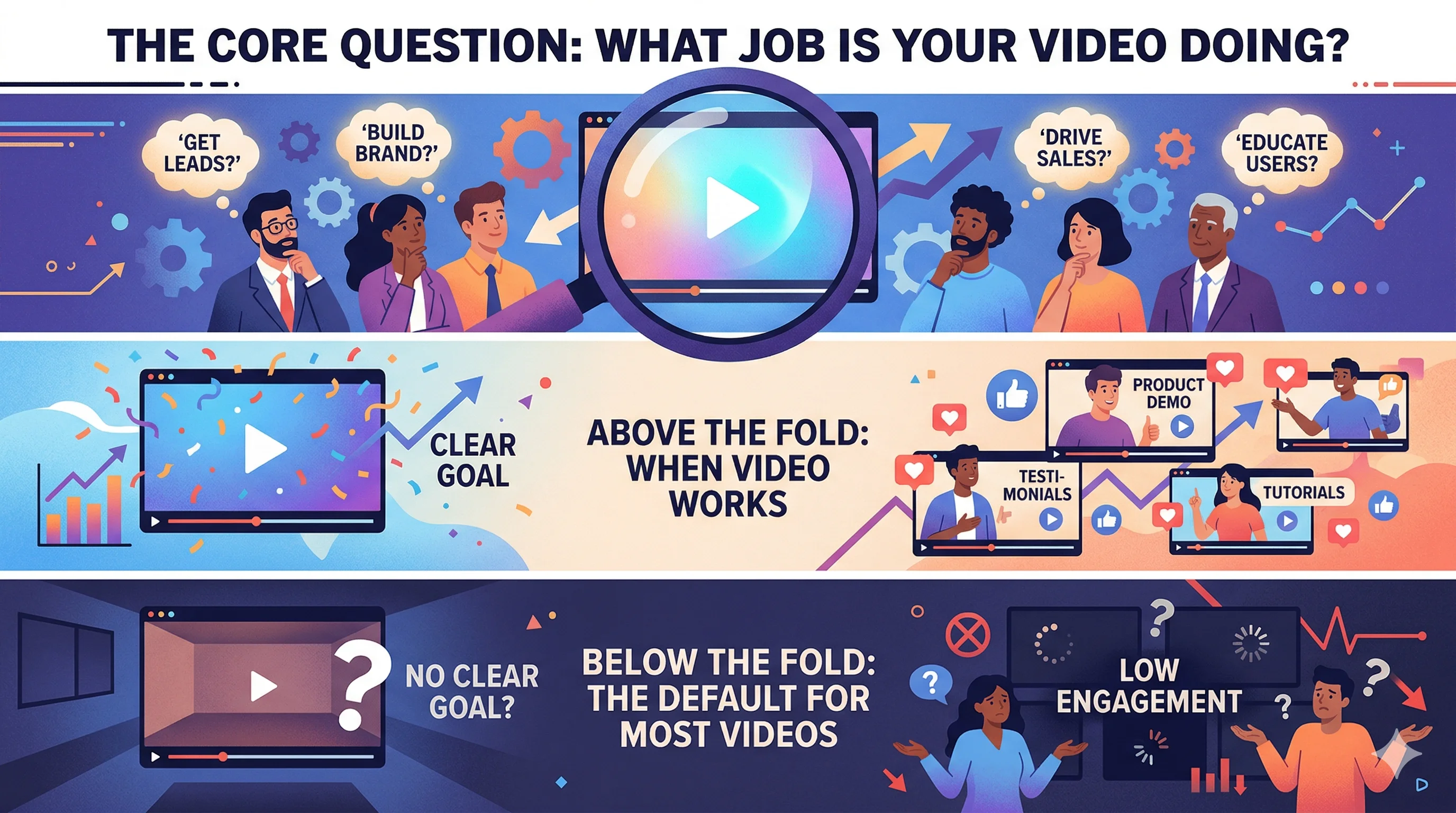
Video on landing pages can lift conversions significantly or tank them — the outcome depends almost entirely on placement, autoplay behaviour, and whether the video earns its position above the fold. The short answer: short product loops belong above the fold; explainer and testimonial videos belong below it, after the CTA has already been visible. Here is how to decide which applies to your page and how to test your way to the right answer.
Before debating placement, identify what role the video plays on your landing page:
Each type has a different ideal placement. Mixing them up — putting a 2-minute explainer above the fold — is the most common video mistake on landing pages.
A short (5–10 second) looping video as a hero background can work when:
The loop must not compete with the headline. Movement draws the eye, so if the background video is too dynamic, visitors will watch it instead of reading the headline or clicking the CTA.
Indian D2C brands in food, beauty, and fitness do this well — a slow-motion shot of a smoothie being blended or an oil being applied reinforces the sensory appeal of the product without slowing the page.
A product demo above the fold only makes sense if:
If your product is straightforward (a protein bar, a moisturiser, a T-shirt), putting a demo video above the fold adds weight without adding understanding. Use a strong static image instead and save the video for below the fold.
For most landing page videos — especially explainers and testimonials — below the fold is the right position. Here is why:
The CTA must come first. Above-the-fold real estate has one job: get the visitor to understand the offer and take action. A video that plays before the visitor even sees the CTA forces them to watch before they can decide. That is friction, not persuasion.
Visitors who scroll are already interested. By the time a visitor has scrolled past the hero section, they have chosen to engage. A video that appears after the hero — as supporting evidence — speaks to an audience that is already partially convinced. Conversion rates from video CTAs placed at the end of a below-the-fold video are often higher than those from above-the-fold video CTAs.
Mobile performance. In India, a significant share of D2C traffic comes from Android devices on 4G connections in tier-2 and tier-3 cities. A 15MB video file above the fold means the CTA does not render for 3–5 seconds. That is enough time to lose the visitor. Below-the-fold videos load lazily (after the main page content), so they do not block the initial render.
After the feature/benefit section. Once you have explained what the product does and why it matters, a video showing it in action reinforces the claim with real evidence.
Next to or above testimonials. A video testimonial placed within a broader social proof section benefits from context — it is one data point among many.
Just above the final CTA. An explainer or demo video placed just before the last CTA gives visitors who have consumed everything a final push. The CTA that follows a well-watched video converts at higher rates because the visitor is primed.
In India, mobile accounts for over 70% of D2C ecommerce traffic. Video placement decisions made for desktop often fail on mobile.
The main mobile video mistakes:
Video pushes CTA below the fold. On a 375px-wide screen, a 16:9 video takes up the entire viewport. If the video is above the fold, the CTA is invisible until the visitor scrolls. This directly reduces conversion rate.
Autoplay video with sound. iPhones block autoplay with sound by default. Android does not, which means some visitors get sound blasting unexpectedly. The result: annoyance, not engagement.
Video does not load. On a 4G connection with intermittent signal, a video that does not load creates a broken-looking page. Always add a poster image (a static frame) that displays while the video loads, so the page looks complete even before the video plays.
Full-width video breaks layout. Test your video placement on a real Android device in portrait mode at 375px width before you launch. What looks fine in the desktop browser preview often breaks on the device your customer actually uses.
Run a clear A/B test with a single variable: placement. Use the same video, same page content, same CTA — only change whether the video appears above or below the fold.
| Test setup | Control | Variant |
|---|---|---|
| Primary metric | CTA click rate | CTA click rate |
| Secondary metric | Scroll depth | Scroll depth |
| Video position | Above fold (below hero headline) | Below fold (after feature section) |
| Sample size | 500 visitors per variant minimum | 500 visitors per variant minimum |
If scroll depth is higher in the variant but CTA click rate is lower, the video is engaging but in the wrong position. If both are lower in the variant, the video may be the wrong type for above-the-fold use.
Tools like CustomFit.ai let you run this test without developer involvement — create two versions of the page, assign traffic splits, and read results from the dashboard.
Before adding any video to a landing page:
Captions are not optional. Most people watch landing page video without sound — in a quiet office, on a train, or because they muted the tab. Without captions, the video communicates nothing. With captions, it is a full selling tool.
Short beats long. A 45-second video watched entirely is more valuable than a 2-minute video abandoned at 30 seconds. Edit ruthlessly.
Do not use YouTube embeds. YouTube embeds show recommended videos after playback (your competitor's ads), add YouTube branding, and load more slowly. Host videos on your own CDN or a tool like Wistia/Vimeo with no-branding settings.
Track video completion rate. A video that has a 20% completion rate is not converting visitors — it is wasting their time. Either shorten it or move it below the fold where only engaged visitors will encounter it.
Festive campaigns need updated video. During Diwali and other peak seasons, a landing page with an outdated product video (showing non-festive use cases) misses an opportunity. Swap in a festive-themed video clip or at least update the poster image.
For more on landing page optimisation, see the Landing Pages pillar guide and the article on mobile landing page optimization.