From the conversion glossary
Concepts referenced in this article, defined.
Concepts referenced in this article, defined.
 marketing channels
Social commerce conversion optimization for Instagram and TikTok Shop — where checkout friction actually happens and how to fix it on each platform.
 marketing channels
 marketing channels
Run rigorous A/B tests and personalize every visit on Shopify or any storefront — no engineers required.
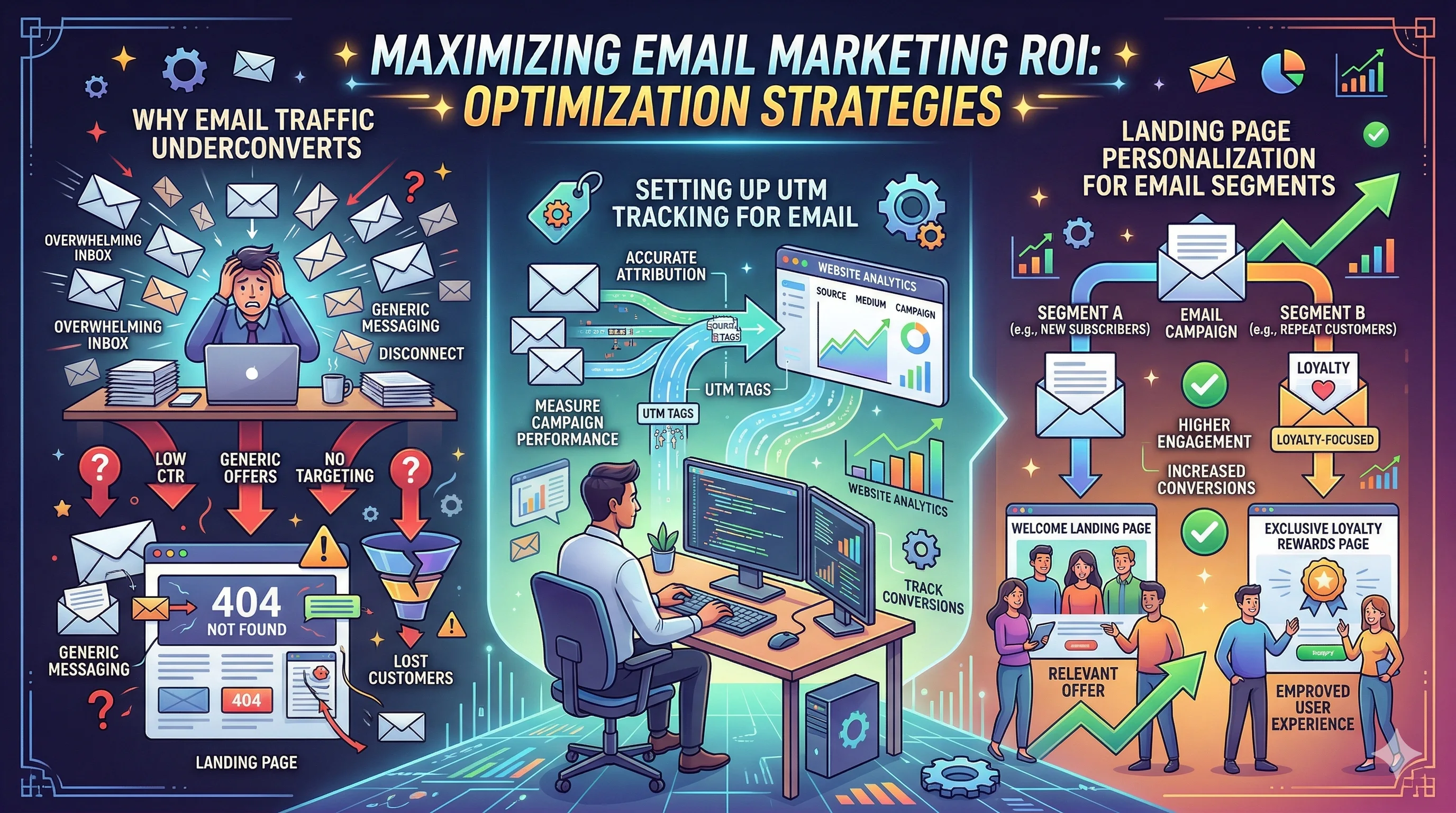
Email traffic is your highest-intent channel — these are people who know your brand, chose to subscribe, and clicked a link you sent them. They should convert at 3–8%, but most brands see 1–2% because the landing page experience ignores everything the email communicated. Fix message match, personalize by campaign segment, and watch email-sourced revenue climb without sending a single extra email.
Email is consistently ranked among the highest-ROI marketing channels. But the benchmark data hides a common failure: most of the value is in list quality, not landing page optimization. Email traffic clicks through with high intent and then hits a page that ignores why they came.
The core problem: message mismatch.
Your email says: "Exclusive 20% off for our VIP members — today only." Your landing page says: "Shop our new collection."
The visitor feels the disconnect immediately. The offer that motivated the click is not visible without scrolling. There is no "VIP" acknowledgement. The urgency ("today only") is not reinforced. So they leave.
Message match — the degree to which your landing page reflects the specific promise of the email — is the most under-optimized lever in email marketing.
Before you can personalize or test anything, you need to know which visitors came from email and which specific campaign they responded to.
Use UTM parameters in every email link:
https://yourstore.com/sale?utm_source=email&utm_medium=newsletter&utm_campaign=vip_sale_june&utm_content=hero_cta
This lets your personalization tool (and analytics) identify:
CustomFit.ai reads UTM parameters natively — you can create audience rules like "show this homepage variant to anyone with utm_source=email" without any developer work.
Different email segments deserve different landing experiences. The same homepage converts differently when it matches vs ignores the email context.
Email promise: "Welcome to [Brand] — here's 15% off your first order." Optimal landing page: Homepage with welcome banner showing the 15% discount code, featured product collection, and brand story strip. What most brands show: Generic homepage with no mention of the discount.
Test: Does showing the welcome discount code in a visible banner above the fold increase CVR for visitors from welcome emails?
Email promise: "48-hour sale — up to 40% off." Optimal landing page: Sale collection page with countdown timer matching the email's deadline, discount badges on all products, clear sale end time. What most brands show: Homepage or main category page with no countdown visible.
Test: Sale landing page with countdown vs homepage with sale banner — which produces higher conversion rate and revenue per visitor?
Email promise: "We miss you — here's something new since you last visited." Optimal landing page: "What's new" page or personalized "picks for you" collection based on their last browsed category. What most brands show: Standard homepage.
Re-engagement visitors have lapsed — they need a reason to care again. The landing page should serve as a curated "here's what you missed" experience, not a generic welcome.
If your email platform segments subscribers by purchase history or browsing behaviour, align landing pages to match:
| Email segment | Landing page |
|---|---|
| Past skincare buyers | Skincare new launches + loyalty offer |
| Browsed footwear, no purchase | Footwear with social proof + COD badge |
| High-AOV past buyers | Premium collection + membership upgrade |
| Tier-2/3 city subscribers | COD-prominent layout + free delivery threshold visible |
Run the same headline from your email subject line on the landing page hero.
Email-matched headlines typically improve CVR by 5–15% because they confirm the visitor is in the right place.
Is your discount or offer visible without scrolling on mobile?
For promotional emails, the offer should be the first thing visible — not decoration around the offer.
If your email included a deadline or urgency signal, test reinforcing it on the landing page:
Urgency reinforcement on landing pages for time-limited email campaigns increases CVR by 8–20% in our testing across D2C brands.
For segmented emails about a specific product:
Product-specific emails should drive traffic to the product page — collection pages create additional clicks and decision points.
For cart abandonment emails, the email link should restore the cart, not send visitors to the homepage. Test:
The variant should significantly outperform. Pre-loaded carts reduce friction by removing the "re-find my products" step.
The conversion rate of cart abandonment emails changes dramatically with timing. Benchmark data for Indian D2C:
Test your timing — for COD-heavy audiences, the 24-hour send can perform better than 1-hour because COD buyers often need to confirm they'll be home to receive the delivery.
Sending more emails generally reduces individual email CVR while increasing total email-sourced revenue — to a point. Monitor:
Related reading: