From the conversion glossary
Concepts referenced in this article, defined.
Concepts referenced in this article, defined.
Run rigorous A/B tests and personalize every visit on Shopify or any storefront — no engineers required.
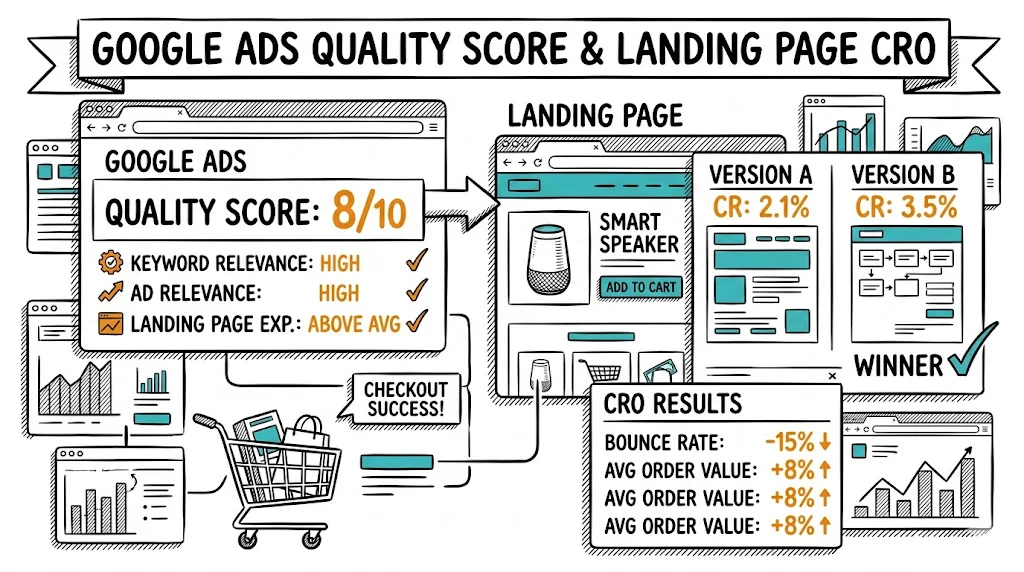
Google Ads Quality Score is a 1–10 score that Google assigns to each keyword in your account. It determines how much you pay per click and where your ad appears. Landing page experience — one of the three Quality Score components — is directly within your control, and improving it can cut your CPC by 25–50% while simultaneously improving your conversion rate. This guide covers exactly how Google evaluates your landing page, what to change, and how to use CRO to improve both Quality Score and CVR at the same time.
Quality Score is calculated from three components, each rated Above Average, Average, or Below Average:
Each component rated "Above Average" vs. "Below Average" translates directly to CPC:
| Quality Score | Relative CPC Impact |
|---|---|
| 10/10 | -50% vs. average |
| 8/10 | -25% |
| 6/10 | Baseline |
| 4/10 | +25% |
| 2/10 | +100% |
A brand paying ₹100 per click with a Quality Score of 4 could theoretically pay ₹50 per click for the same position by improving Quality Score to 8. For a brand spending ₹5 lakh/month on Google Ads, that's ₹2.5 lakh/month in savings — without changing the bid or the budget.
Google's documentation on landing page experience covers four areas:
The landing page content must be directly relevant to the keyword. If someone searches "buy vitamin C serum online" and your ad leads to a general skincare collection page, Google rates the experience as low relevance. The landing page should:
Fix: Create keyword-specific landing pages or product pages with meta titles, H1s, and product copy that includes the search terms you're bidding on.
Google evaluates whether your landing page clearly identifies your business, shows genuine contact information, and provides transparent pricing. Pages with hidden fees, aggressive pop-ups immediately on load, or no clear "About" and "Contact" information score lower.
Fix: Ensure your product pages show complete pricing (including taxes/shipping), have visible store contact details, and don't serve disruptive interstitials immediately on page load.
Google looks at whether visitors can easily find what they're looking for and complete their intended action. Poor navigation — cluttered layouts, unclear call-to-action, broken links — correlates with high bounce rates, which Google infers as poor experience.
Fix: Simplify your landing page to a single primary CTA. Remove navigation links that pull visitors away from the conversion path. Make the Add to Cart button prominent above the fold.
Google explicitly uses mobile experience as part of its landing page evaluation. Slow loading pages and non-mobile-optimized layouts receive lower experience ratings. Google's mobile-first indexing means this criterion becomes more important each year.
Fix: Target Core Web Vitals scores of "Good" for your landing pages. Specifically: LCP (Largest Contentful Paint) under 2.5 seconds, FID (First Input Delay) under 100ms, and CLS (Cumulative Layout Shift) under 0.1. See our page speed and conversion rate guide for the specific optimizations that move these metrics.
The good news: most landing page changes that improve Quality Score also improve your conversion rate. The two goals are aligned. Here's what to work on:
Test your product page headline to include the exact keyword phrase you're targeting with Google Ads. If you're bidding on "men's perfume under 500," your product page H1 might become "Men's Luxury Perfume Collection — Starting at ₹499."
This is one of the few CRO changes that simultaneously improves Google's relevance score AND helps organic visitors immediately understand what they've landed on.
Google evaluates whether visitors can take the intended action without scrolling. A/B test having the Add to Cart button visible above the fold on mobile (no scroll required) vs. your current layout. This is typically a significant CRO win, and it also improves Google's ease-of-navigation rating.
Every 1-second improvement in mobile load time is estimated to improve CVR by 7–12% for ecommerce (Deloitte/Google research). The same load time improvement also contributes to better Google Quality Score ratings.
High-impact speed fixes for D2C ecommerce:
Include your star rating (with review count), a key trust badge (COD available, free returns), and at minimum one testimonial visible without any scrolling on mobile. Visitors who see these trust signals immediately are less likely to bounce — which, over time, improves Google's perception of your landing page experience.
The most effective approach is to treat your Google Ads traffic as a separate audience for testing purposes — because Google ad visitors have specific intent that differs from social media visitors or email traffic.
Using UTM parameters to segment tests: Tag all Google Ads URLs with utm_source=google&utm_medium=cpc. In your CRO tool, target your test variant only to visitors with these UTM parameters. This lets you optimize specifically for Google traffic behavior without affecting the experience for your organic or email visitors.
High-priority tests for Google Ads landing pages:
Metric to use as primary: Revenue per visitor (RPV) — this captures both conversion rate and order value changes in one number, giving you a complete picture of each variant's impact.
Work through this checklist for your top 5 Google Ads landing pages:
Don't send all Google Ads traffic to your homepage. Create product-specific or category-specific landing pages for each ad group. The relevance gain alone can improve Quality Score by 2–3 points.
Match your ad description to landing page body copy. Not just the headline — the specific claims in your ad description should appear on the landing page. "Free shipping on orders above ₹499" in the ad means it should be visible on the page.
Use Google Search Console landing page data. Filter by your Google Ads landing URLs and look at average position and CTR. High-traffic pages with below-average CTR suggest the meta title and description need work — which is also part of the relevance signal Google uses.
Test seasonal landing pages. During Diwali or other festive sales, create campaign-specific landing pages with festive creative and offers. The relevance match to "Diwali sale skincare" queries will be significantly higher than a generic product page.
Monitor Quality Score by keyword weekly. Set a column in your Google Ads interface to show Quality Score, Expected CTR, Ad Relevance, and Landing Page Experience for each keyword. Identify keywords rated "Below Average" for Landing Page Experience first — these are your highest-priority CRO targets.
Related reading: Meta Ads + CRO: Post-Click Experience | Page Speed & Conversion Rate | Landing page optimization guide.