From the conversion glossary
Concepts referenced in this article, defined.
Concepts referenced in this article, defined.
Run rigorous A/B tests and personalize every visit on Shopify or any storefront — no engineers required.
Product page optimization is the process of systematically improving every element of your product detail page to turn more browsers into buyers. The fastest wins come from testing images, CTA copy, social proof placement, and price display. These are changes any marketer can make in under 30 minutes using a no-code editor. Brands like Bellavita have recorded an 11% CVR lift purely from PDP-level experiments.
A product detail page (PDP) is where purchase decisions happen. Yet most D2C brands treat PDPs as static templates, set once during store launch and rarely revisited. Product page optimization changes that. It is a continuous, data-driven process of testing and improving every PDP element so that a higher share of visitors click "Add to Cart" and complete checkout.
The discipline sits at the intersection of conversion rate optimization, copywriting, visual design, and consumer psychology. Unlike broad site redesigns, PDP optimization is surgical: you isolate individual variables, measure their effect on revenue per visitor, and ship only the changes that demonstrably move the needle.
Key elements covered under PDP optimization:
For a D2C brand selling through Shopify, the PDP is the single highest-leverage page on the site.
1. Traffic cost is rising. Meta and Google CPCs for Indian D2C categories like beauty, wellness, and fashion have increased 30-50% over the past three years. If your PDP converts at 2% instead of 4%, you are paying double per sale without reducing your ad spend by one rupee.
2. PDPs receive the most direct traffic. Product pages are often the landing page for paid ads, influencer links, and WhatsApp shares. A weak PDP wastes every rupee you spend acquiring that visitor.
3. Small CVR gains compound across SKUs. A 1-percentage-point CVR improvement on a ₹2,000 product with 10,000 monthly visitors generates an additional ₹2,00,000 in monthly revenue without adding a single new customer source.
4. D2C-specific metrics demand PDP excellence. Average order value and revenue per visitor, the metrics that determine your payback period, are both optimized primarily at the PDP level through smart bundling, upsell placement, and variant selection UI.
5. Mobile-first Indian shoppers are less patient. Over 78% of Indian ecommerce traffic is mobile. A cluttered PDP with slow-loading images and a buried CTA loses mobile shoppers in seconds. Optimization for mobile-first experiences is not optional; it is table stakes.
Effective PDP optimization follows a structured cycle: research, hypothesis, experiment, analyse, ship.
Pull these metrics from your analytics for each major product page:
A healthy Shopify D2C PDP should show an add-to-cart rate above 8-12%. If yours is lower, the page has a problem worth diagnosing.
Data tells you what is broken; qualitative research tells you why. Use:
A good hypothesis follows this structure:
"Because [observation from research], we believe that changing [element] to [variation] will increase [metric] for [audience segment]."
Example: "Because 40% of mobile visitors scroll past the price without clicking ATC (session recording data), we believe moving the ATC button above the fold on mobile will increase add-to-cart rate by 15% for mobile visitors."
Score each hypothesis across three dimensions (1-10 each):
Run highest-PIE-score tests first.
With a no-code tool like CustomFit.ai, you can:
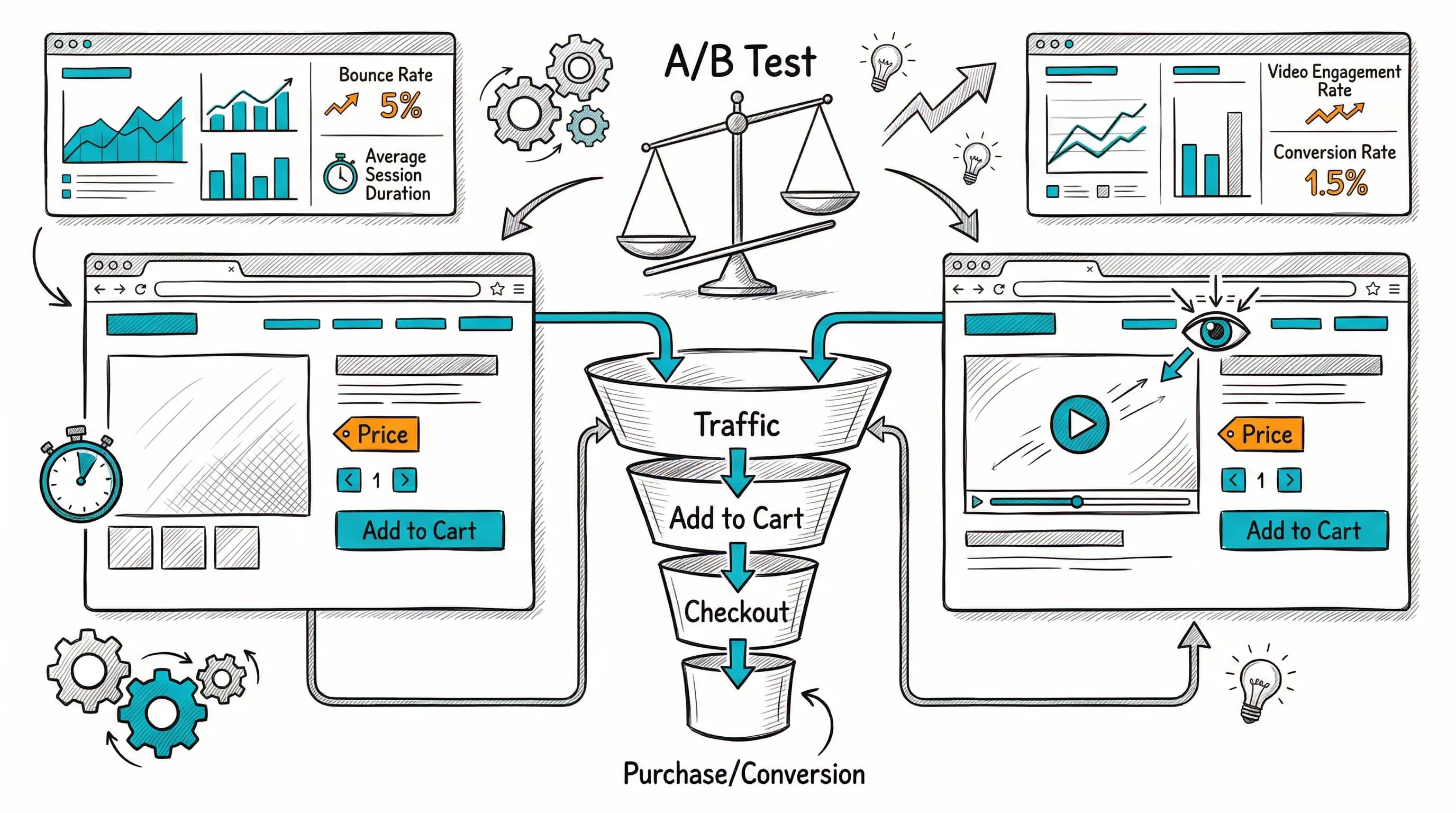
Do not call a winner early. Wait until you reach statistical significance, at least 95% confidence, with a minimum of 100 conversions per variant. Calling tests early on "promising" early data is one of the most common mistakes in CRO.
When a variant wins, ship it permanently. Document the test (hypothesis, result, CVR lift, revenue impact) in a shared test log. Use winning insights to inform the next round of hypotheses.
The primary product image is often the highest-impact element to test. Variables include:
1. Lead with the benefit, not the feature. "Reduces dark circles in 7 days" outperforms "Contains 2% Niacinamide" for most audiences. Feature specs belong in an expandable accordion below the fold; the hero copy should answer "what does this do for me?"
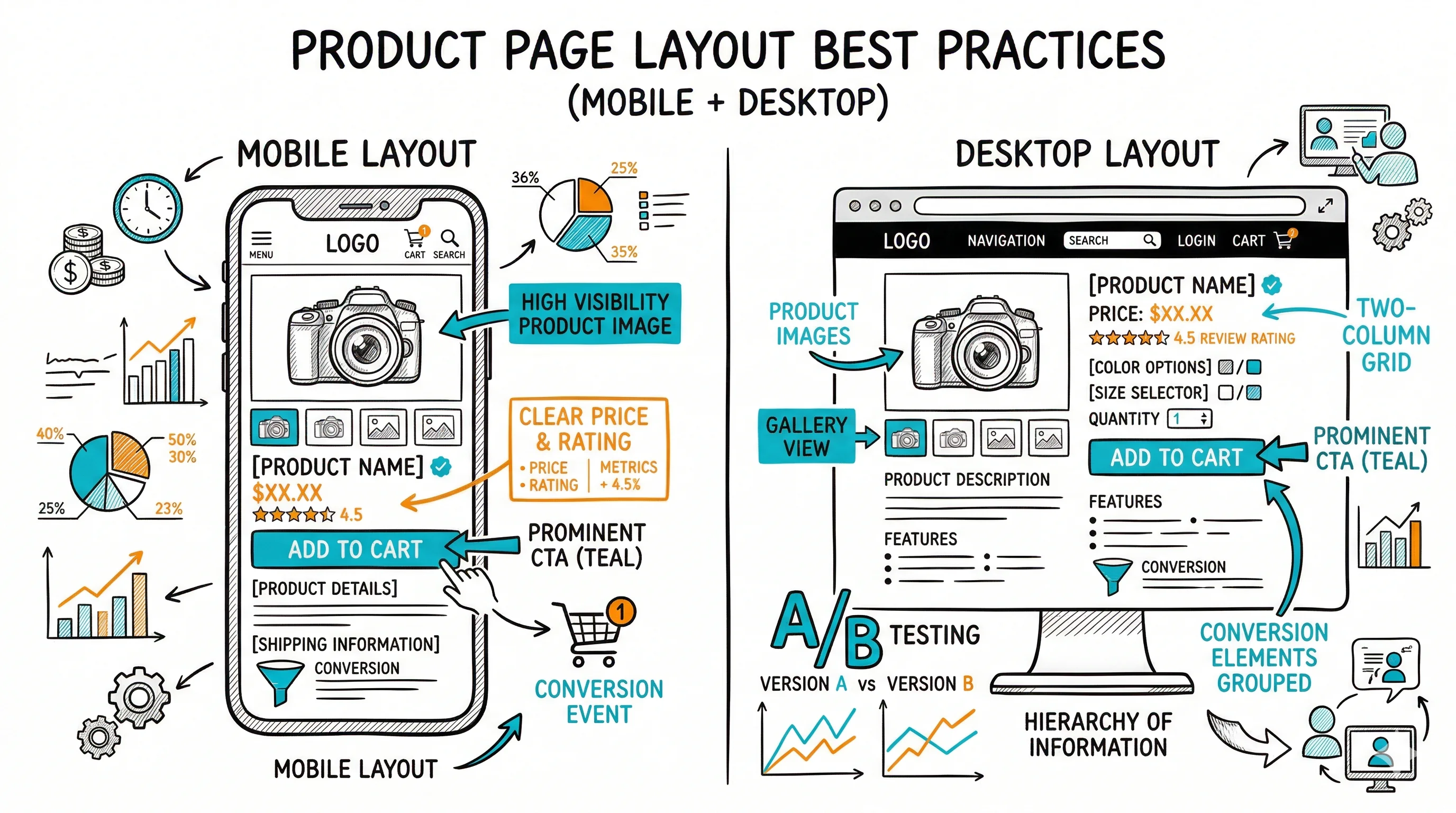
2. Make the CTA the most visually prominent element above the fold. On mobile, where 78%+ of Indian D2C traffic arrives, the ATC button should be visible without scrolling. Use high-contrast colour (typically brand primary or a warm orange/red) and ensure tap target size is at least 44x44px.
3. Show social proof early and specifically. "4.7 stars from 2,847 reviews" converts better than generic testimonials. Include review count, not just the star rating. For new products, show "X customers bought this week" to compensate for thin review data.
4. Address the top 3 purchase objections on the page. Mining your reviews and support tickets will reveal recurring concerns, usually around authenticity, delivery time, returns, and sizing. Answer each objection directly on the PDP, not buried in the FAQ page.
5. Use video for complex or high-involvement products. A 30-60 second product demo video placed in the image gallery increases time-on-page and add-to-cart rates, particularly for wellness, electronics, and personal care SKUs. Short-form video outperforms long-form for mobile shoppers.
6. Personalise based on traffic source. A visitor arriving from an Instagram Reel about a specific use case (e.g., "best moisturiser for oily skin") should see a PDP headline and image set that matches that message. A/B testing message-matched variants against generic PDPs consistently yields 10-20% CVR uplifts.
7. Optimise for India-specific payment preferences. Display COD availability prominently if you offer it. Add UPI payment logos. Show EMI options from popular BNPL providers (ZestMoney, LazyPay, Simpl). Indian shoppers who see their preferred payment method confirmed on the PDP are less likely to abandon at checkout.
8. Keep mobile page weight under 1.5MB. Use WebP images, lazy-load below-the-fold content, and avoid autoplay video. Every 100KB reduction in page weight improves load time and reduces bounce rates on 4G connections.
9. Test variant selector UX. For products with multiple variants (shades, sizes, flavours), the variant selector is a high-friction zone. Test pill buttons vs. dropdowns, showing variant names vs. colour swatches, and "Most Popular" labels on best-selling variants.
10. Run a mobile-only test before a desktop test. Since most of your traffic is mobile, run tests on the mobile version of the PDP first. Desktop and mobile visitors behave differently; a combined test can mask mobile-specific wins or losses.
| Platform | Best For | No-Code Editor | D2C Metrics (AOV/RPV) | Shopify Native | Price |
|---|---|---|---|---|---|
| CustomFit.ai | D2C/Shopify brands wanting fast, no-dev PDP testing | Yes | Yes (AOV, RPV) | Yes | From $99/mo |
| VWO | Mid-market with dedicated CRO teams | Partial | Limited | Partial | From $200+/mo |
| Optimizely | Enterprise with developer resources | No | Limited | No | $50,000+/yr |
| AB Tasty | Mid-market agencies | Partial | Limited | Partial | Custom |
| Google Optimize | (Sunset 2023) | N/A | No | No | Free (discontinued) |
Why CustomFit.ai works for D2C PDP testing:
Bellavita, a fast-growing Indian D2C fragrance brand, was driving significant paid traffic to product pages but struggling to convert at scale. Their hypothesis: lifestyle imagery showing the fragrance in a gifting context would outperform the standard product-on-white background for their gifting SKUs.
Using CustomFit.ai's visual editor, the team swapped the primary gallery image for five top-selling fragrance sets. The test ran for three weeks across paid traffic. The lifestyle variant won with an 11% CVR increase, translating to hundreds of thousands of rupees in incremental monthly revenue from the same ad spend.
Key lesson: Image testing is often the fastest path to CVR improvement on PDPs, especially for beauty and lifestyle categories where aspirational imagery drives purchase intent.
Kapiva, an Ayurvedic wellness brand, found through session recordings that mobile visitors were scrolling past the product title without reading the description. Their PDPs used feature-led titles ("Kapiva Aloe Vera Juice - 1L") that did not communicate the benefit.
The test: a benefit-led headline variant ("Improve Digestion & Skin Health in 30 Days") placed directly below the product name on mobile. Result: 9.48% CVR improvement across tested wellness SKUs.
Key lesson: Mobile visitors make quick decisions. A benefit statement near the top of the page, before the fold, captures intent before the visitor bounces.
Consider a beauty brand running a Diwali sale. Control: product price showing "₹799" with a "25% OFF" badge. Variant A: "₹799 (was ₹1,065) - Save ₹266." Variant B: "₹799 - Free delivery + COD available."
Variant A typically wins during festive periods when shoppers are comparing deals across tabs. Variant B typically wins in non-sale periods when trust signals outweigh discount messaging. This illustrates why PDP optimisation must be contextual. What works in October may not work in January.
Mistake 1: Changing too many elements at once. Multi-element redesigns make it impossible to know which change drove the result. Test one variable at a time, or use a multivariate test with a tool that supports MVT at your traffic volume.
Mistake 2: Calling tests too early. A variant that is ahead after 3 days may be behind after 3 weeks. Wait for statistical significance before shipping a winner.
Mistake 3: Testing on low-traffic pages first. A PDP with 200 monthly visitors will take 6 months to reach significance. Start with your top 5-10 highest-traffic PDPs.
Mistake 4: Ignoring mobile. If you are building and previewing tests on desktop only, you may be shipping a poor mobile experience to 78% of your traffic. Always QA on real mobile devices.
Mistake 5: Optimising copy without reading customer language. The best PDP copy uses exact words customers use in reviews. "Covers my dark circles completely without creasing" converts better than "provides full coverage with crease-proof formula" because it mirrors real customer language.
Mistake 6: Treating PDPs as isolated pages. PDP optimisation interacts with upstream elements (ad creative, category page) and downstream elements (cart, checkout). A great PDP can increase cart abandonment rate if the checkout experience does not match the quality of the product page. Optimise the full funnel.
Mistake 7: Ignoring returning visitors. Returning visitors who viewed a product but did not purchase may respond to different messaging, such as urgency ("Back in stock"), social proof ("3,247 others bought this"), or a first-purchase discount reminder. Personalising PDP content for returning non-purchasers is a high-ROI segment play.
Beyond A/B testing, the highest-performing D2C PDPs use dynamic content that adapts to visitor context in real time. Examples:
CustomFit.ai's 1000+ targeting attributes enable this kind of personalisation without developer involvement.
The product page is the right place to introduce bundles, not the cart. "Frequently Bought Together" modules placed between the product description and the reviews section typically outperform those placed below the reviews. Test:
Indian D2C brands see 40-60% of annual revenue during Diwali, Holi, and wedding season (October to February). PDPs benefit from festive-specific variants:
Pre-building these variants in CustomFit.ai and scheduling their activation means you are ready before the season starts, not scrambling to update 100 PDPs during peak traffic.
PDP optimisation and SEO reinforce each other. A PDP that answers customer questions thoroughly (longer, structured content) ranks better in Google Shopping and organic search and converts better because it addresses purchase objections. Structured product descriptions with FAQ schema also qualify for rich results in Google Search.
Add FAQ schema to your PDPs targeting high-volume "vs" and "review" queries. CustomFit.ai can inject schema changes without touching your theme code.
What is product page optimization? Product page optimization is the process of improving every element of a product detail page (PDP), including images, copy, pricing, social proof, and CTAs, to increase the percentage of visitors who add to cart and complete a purchase.
How much can product page optimization improve conversions? Well-executed product page tests typically yield 5-20% CVR lifts. Bellavita achieved an 11% CVR increase using CustomFit.ai to test hero images and CTA placement on PDPs.
What are the most impactful product page elements to test? Product images (especially the first image), CTA button text and placement, price display (showing vs. hiding EMI/savings), social proof placement, and product description format drive the most measurable impact.
Do I need a developer to run product page A/B tests? No. Tools like CustomFit.ai offer a no-code visual editor so marketers can create, launch, and analyse PDP tests without writing a single line of code.
How long should a product page A/B test run? Run tests until you reach statistical significance, typically 95% confidence with at least 100 conversions per variant. For most Indian D2C brands, this means 2-4 weeks depending on traffic volume.
What is a good product page conversion rate? Industry benchmarks range from 2-4% for ecommerce PDPs. Top-performing D2C brands on Shopify achieve 5-8% by combining strong social proof, fast load times, and personalised content.
How do I prioritise which product pages to optimise first? Use the PIE framework (Potential, Importance, Ease). Prioritise high-traffic, high-revenue pages with above-average bounce rates or low add-to-cart rates, as these offer the biggest revenue upside.
Does product page speed affect conversions? Yes. A 1-second delay in page load time reduces conversions by up to 7%. Compress images, use a CDN, and defer non-critical scripts to keep PDP load time under 2.5 seconds.
Ready to start optimizing your product pages? CustomFit.ai gives D2C brands a no-code visual editor, D2C-native metrics, and AI-powered targeting, all on Shopify, with no developer needed.