CustomFit.ai — Website personalization, A/B testing and CRO for Shopify and D2C
Product
Features
✱
Website Personalization
Adapt to each visitor's behavior & intent
⧖
A/B & Multivariate Testing
Rigorous experimentation
✨
AI CopilotNEW
Personalize with a prompt
🤖
AI WingmanNEW
Auto-optimize toward winners
🎯
AI Conversion OptimizerNEW
GPT-grade test ideas
✎
No-Code Visual Editor
Drag-and-drop edit any element
▦
Product Recommendations
Personalized recs that lift AOV
⚑
Feature Flags
Ship safely with kill-switches
◧
Chrome Extension
Edit your store in the browser
⧉
Shopify, WooCommerce & more
All platform integrations
View all features →
Use Cases
$
Price A/B Testing
Test price points to maximize revenue
▦
Theme A/B Testing
Compare whole layouts & designs
🗂
Template A/B Testing
Test whole PDP/PLP templates
🏷
Discount A/B Testing
Find the offer that converts
🚚
Shipping A/B Testing
Thresholds, speed & copy
✍
Content A/B Testing
Copy, images & reviews
💳
Checkout Gateway A/B
Payments & one-click
⌖
Geo-Based Personalization
Per-location content & offers
⚡
Buyer-Intent Nudges
Exit-intent & retargeting
↔
Split-URL / Redirection
Full-page redirect tests
View all use cases →
Solutions & Guides
⤢
Conversion Rate Optimization
The complete CRO guide
⧖
A/B Testing Software
Buyer's guide for D2C
🛒
Cart Abandonment Recovery
Win back lost carts
📰
Landing Page Optimization
Convert more paid traffic
S
Shopify A/B Testing
Test your store, no code
S
Shopify Personalization
Tailor the store per shopper
◔
First-Time Visitor Offers
Convert new shoppers with trust & offers
★
Repeat-Customer Experiences
Reward and re-engage loyal buyers
◎
Campaign-Matched Pages
Match the landing page to the ad
⌖
Location-Based Experiences
Currency, language & regional offers
Explore CRO →
Customer stories
GIVA
+32%
conversion via personalized recs
GIVA
Mamaearth
+18%
revenue lift from PDP A/B tests
ME
The Sleep Company
+24%
AOV from product recommendations
TSC
Read customer stories →
Integrations
SWsfGA+15
✦
Not sure where to start?
Let AI Copilot pick your first tests

“We wake up to evidence-backed tests ready to deploy — not a backlog of maybe ideas.”

AN
Anirudh S.
Growth · Chargebee
★★★★★4.8on G2 · 2,400+ brands
Talk to our team →
Widgets
Integrations
Ecommerce & Checkout
Shopify
Shopline
Shoplazza
GoKwik
ShopFlo
Razorpay Magic Checkout
Breeze
Shiprocket
View all integrations →
Analytics & Behavior
Google Analytics 4
Microsoft Clarity
Hotjar
Mixpanel
Amplitude
Heap
Adobe Analytics
Segment (CDP)
View all integrations →
Engagement, CRM & More
Klaviyo
MoEngage
CleverTap
WebEngage
HubSpot
Salesforce
Slack
Meta Ads
View all integrations →
CustomersPricing
Resources
CRO
▤
Playbooks
Proven strategies to boost conversions
🎙
Interviews
D2C leaders & marketing experts
▶
Webinars
Live deep dives & product sessions
Learn
✎
Blog
Tips, experiments & best practices
📕
Free E-Books
Mastering personalization
📖
Conversion Glossary
Every CRO term, defined
✦AI CopilotNEWLog inBook a demo
Start free trial
Select your platform — Install in 2 minsWe'll tailor the setup
⚡ Risk-free 14-day trial · No credit card · Cancel anytime
S
Shopify
Install from Shopify App Store
›
W
WooCommerce
Install the WooCommerce plugin
›
B
BigCommerce
Install from BigCommerce App Marketplace
›
SL
Shopline
Install from Shopline App Store
›
M
Salesforce / Magento
Install from the marketplace
›
SZ
Shoplazza
Install from Shoplazza App Store
›
WP
WordPress / Webflow
Install plugin or paste the script
›
◧
Others
Custom-built on React, Next.js, etc.
›
Tip: pick your platform — we handle the restBook a demo →
Product
Website PersonalizationA/B & Multivariate TestingAI CopilotAI WingmanAI Conversion OptimizerNo-Code Visual EditorProduct RecommendationsFeature FlagsView all features →
Use Cases
Price A/B TestingTheme A/B TestingTemplate A/B TestingDiscount A/B TestingShipping A/B TestingContent A/B TestingCheckout Gateway A/BGeo-Based PersonalizationBuyer-Intent NudgesSplit-URL / Redirection
Solutions & Guides
Conversion Rate OptimizationA/B Testing SoftwareCart Abandonment RecoveryLanding Page OptimizationShopify A/B TestingShopify Personalization
Explore
WidgetsIntegrationsCustomersPricing
Resources
BlogPlaybooksWebinarsInterviewsE-BooksConversion Glossary
Platforms
ShopifyShoplineShoplazzaChrome ExtensionAll integrations
Start free trialBook a demo
Home›Blog›product page›Size Guide Optimization for Fashion Ecommerce

Size Guide Optimization for Fashion Ecommerce

SJSapna JoharHead of Growth & CRO, CustomFit.aiJanuary 15, 20258 min read
On this page
  1. The Scale of the Size Problem
  2. What a Complete Size Guide Needs
  3. Size Guide Placement: Make It Easy to Find
  4. Ethnic Wear Sizing: India-Specific Considerations
  5. Technology Solutions for Size Guidance
  6. Fit Notes and Honest Communication
  7. Measuring and Reducing Return Rates
  8. Tips / Best Practices
  9. Key Takeaways
0%
Size Guide Optimization for Fashion Ecommerce

From the conversion glossary

Concepts referenced in this article, defined.

Definition
What Is Lift? Definition, Formula & Guide
Definition
What Is Cognitive Load? Definition & Guide
← Back to Product Page guide
Try CustomFit.ai

Run A/B tests and personalize your store without code. 14-day free trial, no credit card.

Start free trial →
Share
XLinkedInEmail

Related articles

product page

Product Video: How It Impacts Conversion Rates

Ashwin Kumar· 9 min read
product page

Product Reviews Strategy for Ecommerce

Ashwin Kumar· 8 min read
product page

Product Photography for Higher Conversions

Ashwin Kumar· 9 min read

Start lifting conversions today.

Run rigorous A/B tests and personalize every visit on Shopify or any storefront — no engineers required.

Start free trialBook a demo

Built for every D2C category

🧴
Skincare
💄
Beauty
🌿
Wellness
☕
F&B
👟
Apparel
💍
Jewelry
🛋️
Home
🍼
Baby
Live · Right now
Mamaearth — free-shipping band +12.4% AOVGIVA — festive collection page +34% revenueBellavita — PDP CTA test +27.4% CVRKapiva — Quiz-driven recs +9.48% CTRThe Sleep Co — landing personalized 2× capturesPlum — Returning shopper swap +18.2% CVRMamaearth — free-shipping band +12.4% AOVGIVA — festive collection page +34% revenueBellavita — PDP CTA test +27.4% CVRKapiva — Quiz-driven recs +9.48% CTRThe Sleep Co — landing personalized 2× capturesPlum — Returning shopper swap +18.2% CVR
Get in touch

Tell us about your store.

We reply within an hour during business hours. No sales pitch, no spam — just answers from someone who's seen 2,400+ D2C stores.

✓ Reply within 1 hour✓ No spam, ever✓ Free demo & setup help
✓ Thanks! We'll be in touch shortly.
CustomFit.ai

The all-in-one website personalization, A/B testing & CRO platform for high-growth D2C brands. Made by marketers, fueled by coffee.

in𝕏◎▶f
Product
  • Features
  • A/B Testing
  • Personalization
  • AI Copilot
  • AI Wingman
  • AI Conversion Optimizer
  • Feature Flags
  • Widgets
  • Integrations
  • ROI Calculator
Platforms
  • Shopify
  • Shopline
  • Shoplazza
  • Salesforce
  • Chrome Extension
  • All Integrations
Resources
  • Blog
  • Playbooks
  • Webinars
  • GrowthFit Interviews
  • Free E-Books
  • Conversion Glossary
  • Case Studies
Compare
  • vs VWO
  • vs Optimizely
  • vs Google Optimize
  • vs Mutiny
  • vs Intelligems
  • vs Shoplift
  • vs AB Tasty
  • vs Convert
  • vs Kameleoon
Company
  • About Us
  • Partners
  • CustomFit Awards
  • Recognition
  • Contact
  • Privacy Policy
  • Terms & Conditions
© 2026 CustomFit.ai · Valley Monks Pvt Ltd · Made by marketers, fueled by coffee, and obsessed with conversions.
SOC 2 Type II · GDPR · CCPA · ISO 27001

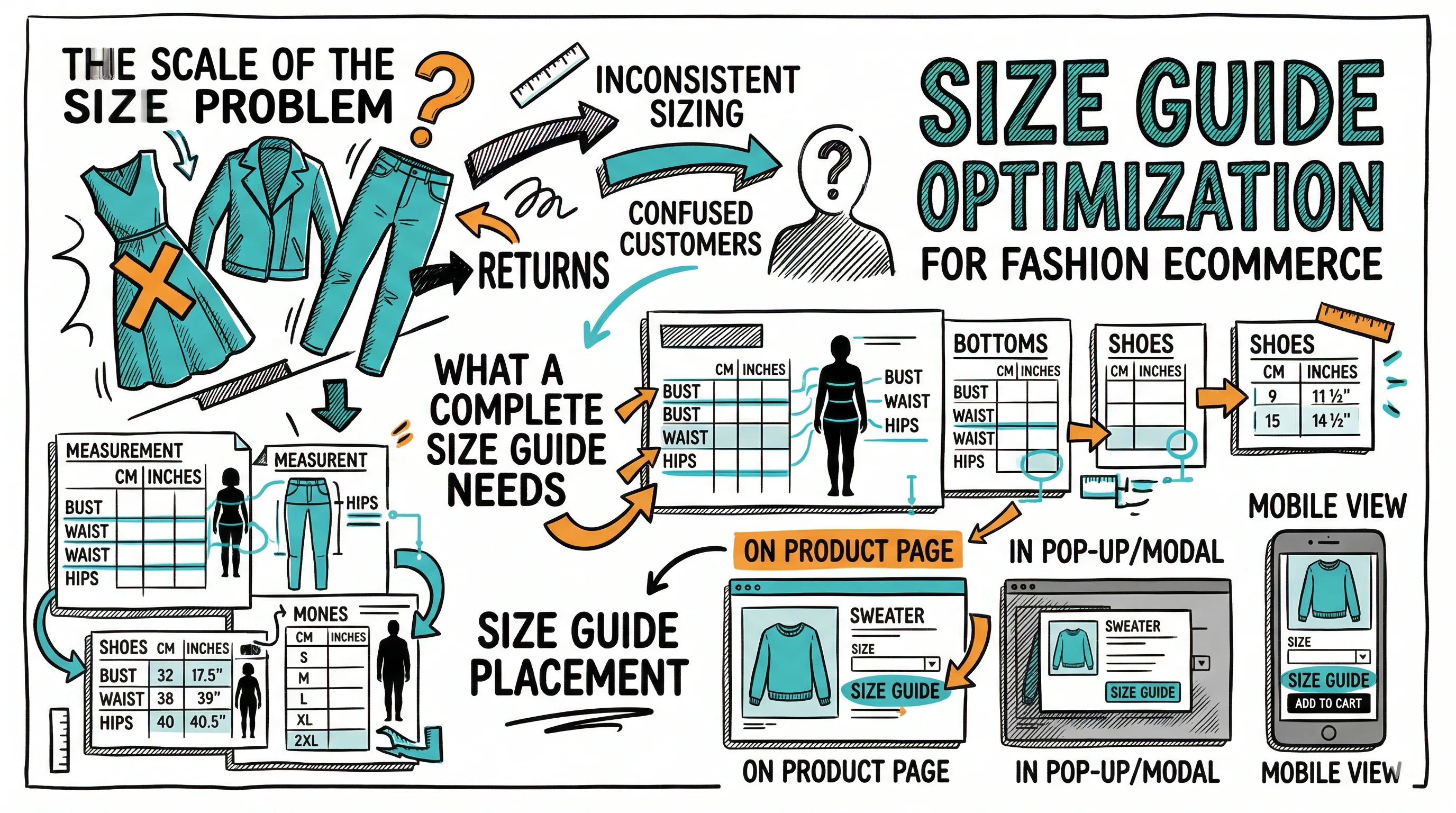
Size-related hesitation is the leading conversion killer in fashion ecommerce. A customer who isn't confident about sizing won't buy—and a customer who buys the wrong size returns, costing you reverse logistics, restocking, and often the customer relationship. Size guide optimization is one of the highest-ROI investments a fashion D2C brand can make: it lifts conversion rate at the top (more buyers confident enough to purchase) and improves margins at the bottom (fewer returns).

The Scale of the Size Problem

Returns are the silent margin killer of fashion ecommerce. Industry data consistently shows that 40–60% of fashion returns are size-related—the item didn't fit as expected. For Indian fashion D2C brands, this problem is compounded by:

  • No standardized sizing across brands (a Medium at one brand fits differently than a Medium at another)
  • Cultural diversity in body proportions that global size charts don't account for
  • High COD return rates (COD orders return at 2–3x the rate of prepaid)
  • Ethnic wear sizing conventions that differ from western wear

A single investment in better size guidance can reduce returns by 20–40% and lift CVR by 5–15% simultaneously—because the same information that reduces post-purchase returns also gives pre-purchase buyers the confidence to click "Add to Cart."

What a Complete Size Guide Needs

Most fashion brand size guides are inadequate. A table showing "S = 36 inches, M = 38 inches" without context doesn't help a customer who doesn't know their chest measurement and has no idea if the brand runs true to size.

A complete size guide includes:

1. Measurement chart in centimeters

Indian customers often understand centimeters better than inches for body measurements. Include: chest (bust), waist, hip, length/height, and inseam for lower body garments. Provide centimeter measurements in a clear table, not just generic S/M/L/XL labels.

2. How to measure (with visuals)

Tell customers exactly how to take each measurement. "Measure around the fullest part of your chest, keeping the tape horizontal" is actionable. A simple line drawing showing where to measure eliminates ambiguity. This is where many brands fail—they provide the chart but not the instructions.

3. Model information

For every product listing that includes a model, state: model height, weight (optional but helpful), and size worn in the photos. "Our model is 5'6" (168cm) and wears a size M" gives customers an immediate visual reference.

4. Brand-specific fit notes

Every brand has sizing quirks. "This style runs small—we recommend sizing up if you're between sizes." "Our kurtas are cut for a relaxed fit through the hips." These notes, when honest, build trust and reduce mismatch.

5. Fabric and stretch information

Does the fabric have stretch (elastane content)? Is it structured or drapey? Fabric behavior significantly affects fit—a fitted kurta in woven cotton fits very differently from the same size in a stretch jersey. State this clearly.

6. Care instructions' impact on size

Some fabrics shrink with washing. State expected shrinkage clearly: "This cotton blend may shrink up to 5% on first wash—we recommend sizing up if you're between sizes."

Size Guide Placement: Make It Easy to Find

Even the best size guide fails if customers can't find it during the purchase decision.

Best placement options:

Size selector accordion/pop-up: A size guide link immediately adjacent to the size selector is the gold standard. When a customer is choosing between M and L, the size guide needs to be one click away—not buried in a footer link or a separate URL.

Inline size guide: For simpler products, embedding a condensed size table directly on the product page (in an accordion below the size selector) is even better than a separate pop-up.

Persistent size guide button: A floating or sticky "Size Guide" button that remains visible as the customer scrolls is particularly effective on mobile, where size uncertainty often derails mobile add-to-carts.

What to avoid: Linking to a separate size guide page that requires page navigation. Customers in the decision-making flow abandon when required to navigate away and back.

Ethnic Wear Sizing: India-Specific Considerations

Indian fashion D2C brands serving ethnic wear categories face sizing complexity that western fashion doesn't:

Category-specific measurement conventions:

  • Kurtas: Typically sized by chest measurement. Also include torso length and sleeve length options.
  • Salwar suits: Require chest, waist, hip, and length for each component (kurta, salwar, dupatta).
  • Lehengas: Sized by waist and sometimes hip; skirt length and blouse sizing are separate.
  • Sarees: One-size for the saree itself; blouse sizing needs separate guidance.
  • Dupattas: Width, length, and fabric weight/drape characteristics.

Indian size number conventions (size 36, 38, 40 for women's ethnic wear) exist alongside western S/M/L/XL. Include both in your size charts.

Regional fit preferences: Body proportions vary across regions—broader shoulders in certain geographies, different hip-to-waist ratios. If your brand caters to a specific region, or if you're expanding nationally, consider whether your size chart reflects regional fit needs.

Technology Solutions for Size Guidance

Beyond static size charts, technology can meaningfully improve size confidence and conversion:

Size recommendation apps: Tools like Kiwi Sizing, Bold Size Chart, or Size Me collect customer measurements and recommend the best size for a specific product. These reduce cognitive load significantly—instead of comparing measurements to a chart, the customer inputs their measurements and gets a clear recommendation.

Virtual try-on: Available through select Shopify apps, virtual try-on lets customers see how a garment looks on a virtual model that matches their body type. Still emerging in Indian fashion, but showing strong CVR lift data for brands that implement it well.

Social sizing: "47 people with your measurements chose size M for this product" uses crowd-sourced data to provide size recommendations. Reduces decision anxiety by showing what others like them chose.

A/B testing size guide placement: CustomFit.ai enables testing size guide placement without developer work—test whether a size guide pop-up adjacent to the size selector vs. a separate size guide page link drives better add-to-cart rates.

Fit Notes and Honest Communication

The brand that tells you honestly "this runs small, size up" earns more trust than the brand that leaves you guessing and returns the wrong size.

Honest fit notes—even when they acknowledge limitations—build brand credibility and reduce returns:

  • "This style has a relaxed fit through the hips; if you prefer a fitted silhouette, consider sizing down."
  • "Due to the structured fabric, this kurta may feel snug through the shoulders. If you have broad shoulders, we recommend sizing up."
  • "Our jeans run true to size, but the waistband is fitted—if you're between sizes, go up."

These notes also serve as SEO content—customers searching "does [brand] run true to size" or "is [brand] kurta true to size" are answered directly on the page.

Measuring and Reducing Return Rates

The test of size guide optimization is your return rate, not just your CVR.

Track these metrics:

  • Return rate by size reason: "Too small / too large" separately. If "too small" is high, your size chart may be understating garment size or your guide is directing customers to size down when they shouldn't.
  • Return rate by category: Ethnic wear returns often have different patterns than western wear.
  • Return rate by size: If size XL has dramatically higher return rates than other sizes, the XL measurements or cut may have issues.
  • Return rate COD vs. prepaid: COD returns include impulse returns that aren't size-related, but if COD size-related returns are significantly higher, it suggests size anxiety is driving speculative purchases ("I'll order in M and L and return one").

Tips / Best Practices

  1. Place size guide one click from the size selector. Not in the footer, not on a separate page—directly adjacent to the size choice.
  2. Include "how to measure" instructions with every size chart. A chart without measurement instructions is incomplete.
  3. State model height and size worn for every photo. This is the fastest size reference for visual learners.
  4. Write honest fit notes. "Runs small—size up" prevents returns and builds trust simultaneously.
  5. Provide measurements in centimeters. The majority of Indian shoppers measure themselves in centimeters.
  6. Create category-specific size guides. A kurta size guide is different from a trouser size guide—use category-appropriate charts.
  7. Include fabric stretch information. Stretch vs. structured fabric changes fit dramatically; buyers need to know.
  8. Consider a size recommendation app for high-traffic stores. The CVR lift from personalized size recommendations typically pays for the app cost within weeks.
  9. A/B test size guide placement using CustomFit.ai—measure impact on add-to-cart rate and return rate.
  10. Review return reasons monthly. Size-related return patterns reveal size guide gaps that can be fixed.

Key Takeaways

  • Size-related hesitation is the leading conversion barrier in fashion ecommerce, and size-related returns are the leading return category. Solving this problem simultaneously lifts CVR and reduces return costs.
  • A complete size guide includes: measurement charts in centimeters, how-to-measure instructions, model sizing information, brand-specific fit notes, and fabric/stretch details.
  • Size guide placement matters as much as content—it must be accessible within one click of the size selector, without leaving the product page.
  • Indian fashion brands need category-specific guides for ethnic wear (kurtas, lehengas, salwar suits) that account for Indian measurement conventions.
  • Technology solutions (size recommendation apps, virtual try-on) can lift CVR 10–25% for high-traffic fashion stores.
  • Honest fit communication ("this runs small") builds more trust than ambiguous guidance—and reduces returns by setting accurate expectations.

Links: Conversion Rate Optimization | Bounce Rate | Product Page Optimization Pillar | Product Page Layout Best Practices | Product Photography Conversions | D2C Brand Growth