CustomFit.ai — Website personalization, A/B testing and CRO for Shopify and D2C
Product
Features
✱
Website Personalization
Adapt to each visitor's behavior & intent
⧖
A/B & Multivariate Testing
Rigorous experimentation
✨
AI CopilotNEW
Personalize with a prompt
🤖
AI WingmanNEW
Auto-optimize toward winners
🎯
AI Conversion OptimizerNEW
GPT-grade test ideas
✎
No-Code Visual Editor
Drag-and-drop edit any element
▦
Product Recommendations
Personalized recs that lift AOV
⚑
Feature Flags
Ship safely with kill-switches
◧
Chrome Extension
Edit your store in the browser
⧉
Shopify, WooCommerce & more
All platform integrations
View all features →
Use Cases
$
Price A/B Testing
Test price points to maximize revenue
▦
Theme A/B Testing
Compare whole layouts & designs
🗂
Template A/B Testing
Test whole PDP/PLP templates
🏷
Discount A/B Testing
Find the offer that converts
🚚
Shipping A/B Testing
Thresholds, speed & copy
✍
Content A/B Testing
Copy, images & reviews
💳
Checkout Gateway A/B
Payments & one-click
⌖
Geo-Based Personalization
Per-location content & offers
⚡
Buyer-Intent Nudges
Exit-intent & retargeting
↔
Split-URL / Redirection
Full-page redirect tests
View all use cases →
Solutions & Guides
⤢
Conversion Rate Optimization
The complete CRO guide
⧖
A/B Testing Software
Buyer's guide for D2C
🛒
Cart Abandonment Recovery
Win back lost carts
📰
Landing Page Optimization
Convert more paid traffic
S
Shopify A/B Testing
Test your store, no code
S
Shopify Personalization
Tailor the store per shopper
◔
First-Time Visitor Offers
Convert new shoppers with trust & offers
★
Repeat-Customer Experiences
Reward and re-engage loyal buyers
◎
Campaign-Matched Pages
Match the landing page to the ad
⌖
Location-Based Experiences
Currency, language & regional offers
Explore CRO →
Customer stories
GIVA
+32%
conversion via personalized recs
GIVA
Mamaearth
+18%
revenue lift from PDP A/B tests
ME
The Sleep Company
+24%
AOV from product recommendations
TSC
Read customer stories →
Integrations
SWsfGA+15
✦
Not sure where to start?
Let AI Copilot pick your first tests

“We wake up to evidence-backed tests ready to deploy — not a backlog of maybe ideas.”

AN
Anirudh S.
Growth · Chargebee
★★★★★4.8on G2 · 2,400+ brands
Talk to our team →
Widgets
Integrations
Ecommerce & Checkout
Shopify
Shopline
Shoplazza
GoKwik
ShopFlo
Razorpay Magic Checkout
Breeze
Shiprocket
View all integrations →
Analytics & Behavior
Google Analytics 4
Microsoft Clarity
Hotjar
Mixpanel
Amplitude
Heap
Adobe Analytics
Segment (CDP)
View all integrations →
Engagement, CRM & More
Klaviyo
MoEngage
CleverTap
WebEngage
HubSpot
Salesforce
Slack
Meta Ads
View all integrations →
CustomersPricing
Resources
CRO
▤
Playbooks
Proven strategies to boost conversions
🎙
Interviews
D2C leaders & marketing experts
▶
Webinars
Live deep dives & product sessions
Learn
✎
Blog
Tips, experiments & best practices
📕
Free E-Books
Mastering personalization
📖
Conversion Glossary
Every CRO term, defined
✦AI CopilotNEWLog inBook a demo
Start free trial
Select your platform — Install in 2 minsWe'll tailor the setup
⚡ Risk-free 14-day trial · No credit card · Cancel anytime
S
Shopify
Install from Shopify App Store
›
W
WooCommerce
Install the WooCommerce plugin
›
B
BigCommerce
Install from BigCommerce App Marketplace
›
SL
Shopline
Install from Shopline App Store
›
M
Salesforce / Magento
Install from the marketplace
›
SZ
Shoplazza
Install from Shoplazza App Store
›
WP
WordPress / Webflow
Install plugin or paste the script
›
◧
Others
Custom-built on React, Next.js, etc.
›
Tip: pick your platform — we handle the restBook a demo →
Product
Website PersonalizationA/B & Multivariate TestingAI CopilotAI WingmanAI Conversion OptimizerNo-Code Visual EditorProduct RecommendationsFeature FlagsView all features →
Use Cases
Price A/B TestingTheme A/B TestingTemplate A/B TestingDiscount A/B TestingShipping A/B TestingContent A/B TestingCheckout Gateway A/BGeo-Based PersonalizationBuyer-Intent NudgesSplit-URL / Redirection
Solutions & Guides
Conversion Rate OptimizationA/B Testing SoftwareCart Abandonment RecoveryLanding Page OptimizationShopify A/B TestingShopify Personalization
Explore
WidgetsIntegrationsCustomersPricing
Resources
BlogPlaybooksWebinarsInterviewsE-BooksConversion Glossary
Platforms
ShopifyShoplineShoplazzaChrome ExtensionAll integrations
Start free trialBook a demo
Home›Blog›d2c brand growth›Why D2C Brands Plateau After 6 Months (And How to Fix It)

Why D2C Brands Plateau After 6 Months (And How to Fix It)

SJSapna JoharHead of Growth & CRO, CustomFit.aiJanuary 15, 20259 min read
On this page
  1. Why the 6-Month Wall Appears
  2. The CAC Trap: Why Spending More Makes It Worse
  3. The Retention Gap Most D2C Founders Miss
  4. Conversion Rate: The Highest-Leverage Fix
  5. A/B Testing: How to Find What Actually Works
  6. Personalization: Beyond One-Size-Fits-All
  7. Pricing Strategy at the Plateau
  8. Tips / Best Practices
  9. Key Takeaways
0%
Why D2C Brands Plateau After 6 Months (And How to Fix It)

From the conversion glossary

Concepts referenced in this article, defined.

Definition
What Is Urgency? Definition & Guide
Definition
What Is Bundle? Definition & Guide
Definition
What Is Friction? Definition & Guide
Definition
What Is Repeat Purchase Rate? Definition & Guide
Definition
What Is Social Proof? Definition & Guide
← Back to D2c Brand Growth guide
Try CustomFit.ai

Run A/B tests and personalize your store without code. 14-day free trial, no credit card.

Start free trial →
Share
XLinkedInEmail

Related articles

d2c brand growth

Top D2C Brands in India: What They Do Right

Sapna Johar· 10 min read
d2c brand growth

Sports & Fitness D2C India: Building Online

Sapna Johar· 6 min read
d2c brand growth

Pet Care D2C India: Growth Strategies

Sapna Johar· 6 min read

Start lifting conversions today.

Run rigorous A/B tests and personalize every visit on Shopify or any storefront — no engineers required.

Start free trialBook a demo

Built for every D2C category

🧴
Skincare
💄
Beauty
🌿
Wellness
☕
F&B
👟
Apparel
💍
Jewelry
🛋️
Home
🍼
Baby
Live · Right now
Mamaearth — free-shipping band +12.4% AOVGIVA — festive collection page +34% revenueBellavita — PDP CTA test +27.4% CVRKapiva — Quiz-driven recs +9.48% CTRThe Sleep Co — landing personalized 2× capturesPlum — Returning shopper swap +18.2% CVRMamaearth — free-shipping band +12.4% AOVGIVA — festive collection page +34% revenueBellavita — PDP CTA test +27.4% CVRKapiva — Quiz-driven recs +9.48% CTRThe Sleep Co — landing personalized 2× capturesPlum — Returning shopper swap +18.2% CVR
Get in touch

Tell us about your store.

We reply within an hour during business hours. No sales pitch, no spam — just answers from someone who's seen 2,400+ D2C stores.

✓ Reply within 1 hour✓ No spam, ever✓ Free demo & setup help
✓ Thanks! We'll be in touch shortly.
CustomFit.ai

The all-in-one website personalization, A/B testing & CRO platform for high-growth D2C brands. Made by marketers, fueled by coffee.

in𝕏◎▶f
Product
  • Features
  • A/B Testing
  • Personalization
  • AI Copilot
  • AI Wingman
  • AI Conversion Optimizer
  • Feature Flags
  • Widgets
  • Integrations
  • ROI Calculator
Platforms
  • Shopify
  • Shopline
  • Shoplazza
  • Salesforce
  • Chrome Extension
  • All Integrations
Resources
  • Blog
  • Playbooks
  • Webinars
  • GrowthFit Interviews
  • Free E-Books
  • Conversion Glossary
  • Case Studies
Compare
  • vs VWO
  • vs Optimizely
  • vs Google Optimize
  • vs Mutiny
  • vs Intelligems
  • vs Shoplift
  • vs AB Tasty
  • vs Convert
  • vs Kameleoon
Company
  • About Us
  • Partners
  • CustomFit Awards
  • Recognition
  • Contact
  • Privacy Policy
  • Terms & Conditions
© 2026 CustomFit.ai · Valley Monks Pvt Ltd · Made by marketers, fueled by coffee, and obsessed with conversions.
SOC 2 Type II · GDPR · CCPA · ISO 27001

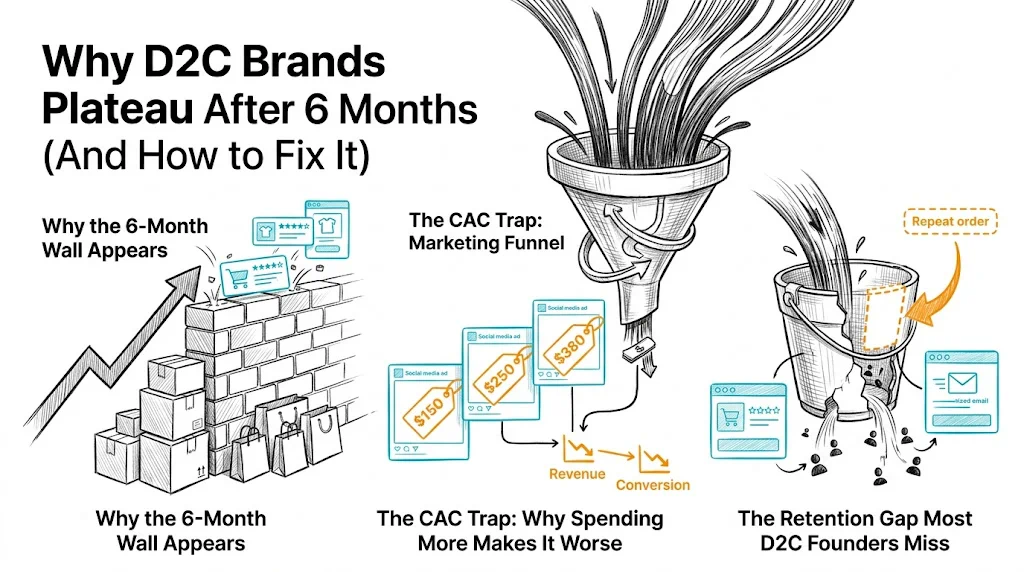
Most D2C brands hit a growth ceiling around the six-month mark—traffic is steady, ad spend is rising, but revenue refuses to budge. The plateau happens because the tactics that drove early growth stop working once the easiest customers have already converted. Breaking through requires shifting from acquisition-only thinking to a balanced approach that improves conversion, retention, and unit economics simultaneously.

Why the 6-Month Wall Appears

The first months of a D2C brand are deceptively easy. You launch with a warm audience—friends, followers, early adopters—who are already sold on what you're building. Your CAC looks great because these people cost almost nothing to reach. Your CVR looks great because they were already half-converted before they landed on your site.

Then that pool runs out.

By month six, you're paying Meta and Google to reach strangers. Cold traffic converts at a fraction of the rate warm traffic does. Your blended CAC doubles or triples. The ROAS numbers that looked so promising at launch start looking scary.

Meanwhile, your early customers have bought once—but most haven't come back. If you haven't built retention into the business, you're essentially starting from scratch every month, spending to replace customers you should be keeping.

Three forces create the plateau:

  1. CAC inflation: Cold audiences cost 2–5x more to convert than warm ones. As you exhaust your warm audience, blended CAC rises sharply.
  2. CVR decay: Most D2C sites convert at 1–2% for cold traffic. If you haven't optimized for this audience, your store is leaking revenue constantly.
  3. LTV stagnation: Without deliberate repeat-purchase mechanics, a large share of customers buys once and disappears. You're running a leaky bucket.

Brands like Mamaearth and Plum didn't escape this pattern by just spending more on ads. They invested in understanding why customers weren't coming back—and fixed those reasons.

The CAC Trap: Why Spending More Makes It Worse

When growth stalls, the instinctive response is to increase ad spend. This almost always accelerates the problem rather than solving it.

Here's why: if your CVR is 1.5% and your average order value is ₹900, you're generating ₹13.50 in revenue per 1,000 rupees of traffic (simplified). Doubling your ad budget doubles your traffic—but it also doubles your CAC in absolute terms. If your LTV doesn't grow proportionally, you're burning money faster.

The math only works when your conversion rate improves alongside (or ahead of) your traffic growth. A brand that grows CVR from 1.5% to 2.5% suddenly generates ₹22.50 per ₹1,000 of traffic—a 67% improvement in marketing efficiency without touching the ad budget.

What to do instead of scaling spend:

  • Audit your funnel for drop-off points (where are people leaving?)
  • Identify which traffic sources have the best CVR, not just volume
  • Fix conversion problems before scaling any channel

Kapiva, an Ayurvedic D2C brand, found that fixing product page clarity improved CVR by 9.48%—that single change unlocked scaling potential that more ad spend alone never would have.

The Retention Gap Most D2C Founders Miss

Acquisition gets all the attention. Retention is where the money actually is.

A customer who buys twice is worth 3x a customer who buys once—not 2x, because you've already paid for the acquisition. The second purchase is nearly pure margin.

Most D2C brands plateau partly because their repeat purchase rate is too low. If your 90-day repurchase rate is below 20%, you're essentially starting from zero every month. Brands with healthy unit economics typically see 30–40%+ of customers returning within 90 days.

Why retention suffers at the 6-month mark:

  • No post-purchase email sequence beyond the order confirmation
  • No reason for customers to come back (no loyalty program, no new product cadence)
  • No segmentation—everyone gets the same generic newsletter

Retention fixes that work:

  1. Build a post-purchase sequence: Day 3 (product tips), Day 10 (how are you getting on?), Day 21 (related product suggestion), Day 45 (replenishment reminder for consumables)
  2. Create a reason to return: New arrivals, subscriber-only pricing, loyalty points
  3. Segment by purchase history: A customer who bought a Kapiva juice pack responds to different content than someone who bought supplements for the first time

Sugar Cosmetics built much of its retention through education—tutorials, skin tips, product pairing guides—that kept customers engaged between purchases. The content gave them a reason to come back even before they needed to replenish.

Conversion Rate: The Highest-Leverage Fix

If your store converts at 1.5% and you push it to 2.5%, you've effectively added 67% more revenue from the same traffic. That's the highest-leverage move available to any D2C brand in a plateau.

The conversion problem is almost always in one of three places:

1. Product pages that don't convince

Cold traffic needs more convincing than warm traffic. If your product page looks great but doesn't answer the "why should I trust this?" question, cold visitors will leave.

What product pages need for cold traffic:

  • Reviews with specifics (not just "Great product!" but "Used this for 3 weeks and my skin cleared up")
  • Clear ingredient/benefit breakdown
  • UGC photos alongside professional shots
  • Urgency signals (stock levels, limited offers) that are honest, not manufactured

2. Checkout friction

Every extra step in checkout costs conversions. COD (cash on delivery) is still the preferred payment method for a significant share of Indian D2C shoppers, especially for first orders from new brands. If you're not offering COD, you're losing a meaningful chunk of potential buyers.

UPI has transformed the checkout experience for shoppers who do pay online—fast, familiar, and trusted. Offering UPI prominently at checkout removes a real conversion barrier.

3. Mobile experience that doesn't work

Over 70% of D2C traffic in India comes from mobile. If your product pages load slowly, your images are oversized, or your add-to-cart button requires scrolling to reach, you're losing mobile conversions continuously.

A/B Testing: How to Find What Actually Works

Opinions are cheap. Test results are valuable.

The D2C brands that break plateaus fastest are the ones running systematic A/B tests rather than making gut-feel changes. A/B testing lets you know with certainty whether a change improved conversions—or just felt like it did.

What to test first when you're in a plateau:

  • Hero image on product pages: Lifestyle vs. product-only vs. UGC-style
  • CTA button text: "Add to Cart" vs. "Buy Now" vs. "Try it Today"
  • Pricing display: ₹899 vs. ₹900, with or without strikethrough, with or without savings callout
  • Above-the-fold content: How much information is visible before scroll?

Bellavita ran personalization tests on their Shopify store using CustomFit.ai and saw an 11% conversion rate improvement. That came from showing different content to different visitor segments—not from a complete redesign.

Tools like CustomFit.ai make this accessible without a developer. You can set up tests, run them across your Shopify store, and see results—all within the platform, at ₹8,200/month (roughly $99).

Personalization: Beyond One-Size-Fits-All

Most D2C sites show every visitor the same experience. That's a missed opportunity, because your visitors are not all the same.

A first-time visitor from a Meta ad needs social proof and education before they'll buy. A returning customer who's already purchased knows your brand—they need to see what's new or what pairs well with what they bought.

Personalization matches the experience to the visitor:

  • New vs. returning: Show trust signals to newcomers, loyalty rewards to returners
  • Traffic source: Visitors from an influencer's link might respond better to UGC and social proof than visitors from a search ad
  • Category interest: Someone who browsed skincare last time shouldn't see a generic homepage—they should see skincare-forward content

This is what Chargebee discovered when they personalized by visitor segment—AOV increased by 40% because the right products were surfaced to the right people.

Pricing Strategy at the Plateau

If CAC is rising and CVR isn't improving, many brands try to fix the economics through pricing. Sometimes this works; often it backfires.

What works:

  • Bundle pricing: Increasing AOV through bundles is often more effective than raising individual product prices. If your average order is ₹800 but a bundle brings it to ₹1,400, your CAC-to-AOV ratio improves dramatically.
  • Free shipping thresholds: Setting a free shipping minimum above your current AOV (e.g., free shipping above ₹999 when your AOV is ₹750) pulls average orders up.
  • Subscription offers: For consumables—supplements, skincare, snacks—offering a 10–15% discount for subscribe-and-save improves LTV and reduces churn.

What usually backfires:

  • Across-the-board price cuts to drive volume (destroys margins without building loyalty)
  • Flash sales without strategy (trains customers to wait for discounts)

Tips / Best Practices

  1. Fix conversion before scaling traffic. Every rupee you spend on ads goes further when your CVR is higher. Audit your funnel first.
  2. Calculate your real repeat purchase rate. If fewer than 20% of customers buy again within 90 days, retention is your biggest lever.
  3. Run at least two A/B tests per month. Small, consistent tests compound into significant CVR improvements over quarters.
  4. Offer COD and UPI at checkout. Payment friction is a real conversion killer in the Indian market.
  5. Segment your email list by behavior. A customer who bought twice gets a different email than someone who bought once 60 days ago.
  6. Personalize by traffic source. Visitors from different channels have different intentions—meet them where they are.
  7. Use bundles to raise AOV before raising prices. Customers perceive bundles as value, not price increases.
  8. Build urgency that's real. Low stock alerts and time-limited offers work—but only if they're true. Manufactured urgency destroys trust.
  9. Audit mobile experience quarterly. Mobile UX degrades as your catalog grows. Regular audits prevent silent conversion loss.
  10. Track LTV by acquisition channel. Some channels bring high-CAC, high-LTV customers. Others bring cheap, one-and-done buyers. Know the difference.

Key Takeaways

  • The 6-month D2C plateau happens when the warm audience runs out, CAC rises, and retention hasn't been built into the business.
  • Scaling ad spend into a broken funnel accelerates the problem. Fix CVR and retention first.
  • A/B testing and personalization are the fastest routes to CVR improvement without requiring a full redesign.
  • Retention—post-purchase sequences, loyalty mechanics, and segmented communication—is where sustainable D2C economics are built.
  • Indian D2C brands have specific nuances: COD preference, UPI adoption, festive spikes, and price sensitivity. Strategies that ignore these miss significant conversion opportunities.
  • Brands using CustomFit.ai for no-code A/B testing and personalization have seen 9–11% average CVR improvements—the kind of gains that break plateaus.

Links: Conversion Rate Optimization | Customer Acquisition Cost | A/B Testing | Personalization | D2C Brand Growth Pillar | D2C Unit Economics