From the conversion glossary
Concepts referenced in this article, defined.
Concepts referenced in this article, defined.
Run rigorous A/B tests and personalize every visit on Shopify or any storefront — no engineers required.
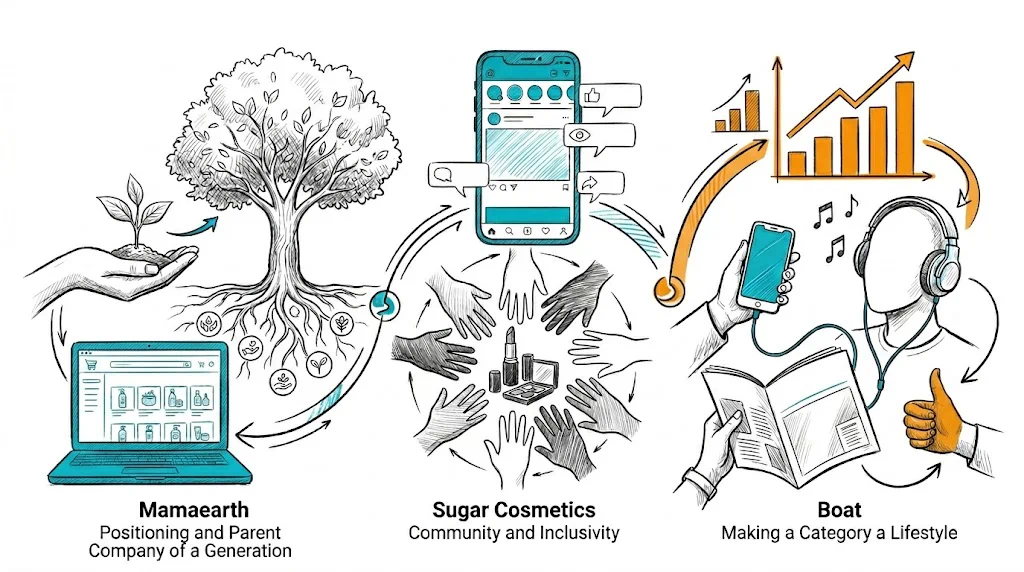
India's D2C brands have built some of the most compelling growth stories in global consumer markets over the last decade. Mamaearth went from kitchen startup to listed company. Sugar Cosmetics changed what an Indian cosmetics brand could look like. Boat made audio accessories a lifestyle statement. These brands did not succeed by accident. They executed a clear playbook — and understanding that playbook is the fastest way to build your own D2C brand. Here is a breakdown of what India's top D2C brands do right, with specific tactics you can apply.
What they do: Natural, toxin-free personal care products for babies, mothers, and modern consumers.
Revenue: ₹1,920 crore FY2024 (Honasa Consumer Group).
Clear "free from" positioning: Mamaearth built its brand on what it does not contain — no parabens, no SLS, no artificial fragrances, no harmful chemicals. This negative positioning was counterintuitive but powerful because it spoke directly to anxious, first-time parents who were overwhelmed by ingredient lists.
Community before commerce: Mamaearth built its initial community on Facebook groups for mothers, answering questions and providing value before selling. This community trust is what made their first sales.
Influencer marketing at scale: Mamaearth was an early mover in Indian influencer marketing, partnering with mom bloggers and parenting creators when influencer rates were low and trust was high.
Cause-based marketing: "Goodness inside" and their tree plantation campaign created an emotional connection with environmentally conscious consumers.
Category expansion discipline: Mamaearth started with baby care, then expanded to adult personal care for mothers, then to the broader personal care market under multiple sub-brands (Derma Co., Aqualogica). Each expansion was adjacent and credible.
What to apply: Start with a problem your customer is anxious about and position your brand as the solution. "Free from" or "formulated for" positioning can cut through a crowded category.
What they do: Makeup and beauty products designed for Indian skin tones.
Revenue: Estimated ₹500+ crore FY2024.
Filling a real gap: Indian makeup consumers were long underserved by global brands that did not formulate for darker skin tones. Sugar was built explicitly for Indian skin — from foundation shades to lip colors.
Founder-as-brand: Vineeta Singh's presence on Shark Tank India and social media made her a brand asset. Founder visibility builds trust and drives brand recall in a way no campaign budget can replicate.
Content that educates: Sugar's Instagram and YouTube content teaches makeup application, not just shows products. Tutorial content builds a community of skilled users who become loyal customers.
Offline + D2C hybrid: Sugar expanded from online-first to over 40,000 retail touchpoints, using its D2C brand credibility to command premium shelf placement. D2C data informed where to open retail.
Strong product photography: Sugar's visual identity is consistently bold, editorial, and aspirational. Product photography that looks premium drives both organic social sharing and conversion rate on the website.
What to apply: Identify a demographic that existing brands in your category underserve. Build product and content explicitly for them. Let your founders be visible.
What they do: Audio accessories, wearables, and personal tech at accessible prices.
Revenue: ₹4,000+ crore FY2024 (by far the largest Indian consumer electronics D2C).
Lifestyle positioning, not specs: Boat sells its products as lifestyle accessories, not just earphones. The association with music, sports, gaming, and youth culture is central to everything they do.
Celebrity and cricket partnerships: Boat's Hardik Pandya, KL Rahul, and other cricket star associations gave it the credibility of a premium brand at mid-market prices.
Product velocity: Boat launches new products extremely frequently — keeping its community engaged and giving media something to write about. This high product velocity creates constant fresh content opportunities.
Manufacturing in India: The "Made in India" positioning resonated with a post-2020 wave of consumer nationalism, and let Boat reduce costs while building goodwill.
Amazon-first, then D2C: Unlike many D2C brands, Boat built scale on Amazon India first and used that cash flow to invest in its own D2C infrastructure. Neither model is inherently superior — Boat's hybrid approach was strategically sound.
What to apply: Ask whether your product can be a lifestyle symbol rather than just a utility purchase. Lifestyle positioning allows premium pricing and drives social sharing.
What they do: Ayurveda-inspired nutritional supplements and health foods.
Known result: 9.48% conversion rate improvement with CustomFit.ai.
Ayurveda + modern evidence: Kapiva does not just say "ancient wisdom" — it backs formulations with clinical references and modern packaging. This positions it credibly for both traditional Ayurveda believers and modern health-conscious consumers.
Education-led content: Kapiva's YouTube and blog content explains Ayurvedic ingredients — what ashwagandha does, how giloy works, what to expect from triphala. This builds a community of informed consumers who trust the brand because the brand trusted them with information.
Subscription model: Kapiva's subscription offering locks in customer lifetime value for consumable products. Customers who subscribe have 3–4x higher LTV than one-time buyers.
Personalization: Kapiva uses data to recommend products based on health goals — weight management, immunity, sleep, digestion. This segmentation approach drives higher average order value because customers buy the right products for their specific needs.
Data-driven CRO: Kapiva's 9.48% CVR improvement through CustomFit.ai came from systematically testing product page layouts, review placement, and checkout flow — standard CRO practice applied consistently.
What to apply: If your category has traditional or scientific credibility, build an educational content program that earns trust before asking for a purchase. Then personalize product recommendations based on customer goals.
What they do: Caffeine-infused personal care products.
Positioning: India's first caffeinated personal care brand.
Category creation: mCaffeine did not enter "face wash" — it created "caffeinated face wash" as a distinct category. Category creation is the most defensible positioning because you own the mental space.
Ingredient storytelling: Every mCaffeine product is built around caffeine's benefits — stimulating, de-puffing, energizing. The ingredient is the story, consistently told across packaging, social, and content.
Gender-inclusive positioning: While many personal care brands default to female audiences, mCaffeine explicitly markets to men and women. This doubled their addressable market.
D2C-first with marketplace presence: mCaffeine built strong D2C infrastructure and used Nykaa and Amazon as incremental channels rather than primary ones — preserving better margins and customer data ownership.
Community of coffee enthusiasts: mCaffeine taps into the growing Indian coffee culture — not just skincare culture. This cross-category community gives them awareness channels competitors do not have.
What to apply: Can you define your product by a signature ingredient or technology and own that space? Single-ingredient branding (caffeine, niacinamide, retinol) creates memorable positioning and SEO opportunities.
What they do: Premium perfumes and personal care at accessible price points.
Known result: 11% conversion rate improvement with CustomFit.ai.
Price-to-quality disruption: Bellavita positioned itself between mass-market and luxury fragrance — premium quality at ₹500–1,500 price points. This sweet spot was underserved by both ends of the market.
Direct consumer education: Fragrance buying online is notoriously difficult without smell. Bellavita invested heavily in fragrance note education, comparison guides, and sample sets — making the online purchase feel less risky.
Gifting as a growth channel: Fragrance is a high-frequency gifting category in India. Bellavita's packaging and pricing made them a perfect gifting brand for festivals, birthdays, and occasions. Their gifting-oriented marketing drives seasonal spikes.
Conversion optimization focus: Bellavita's 11% CVR improvement with CustomFit.ai came from A/B testing product page elements — including fragrance note visualization, review placement, and "add to wishlist" vs. immediate purchase CTAs. Small improvements across a premium-priced catalogue add up to significant revenue.
What to apply: For categories where online purchase involves risk (fragrance, fashion fit, skincare compatibility), invest in education and trial mechanisms — samples, consultation tools, detailed guides — that reduce purchase anxiety.
What they do: Vegan, cruelty-free skincare and cosmetics.
Positioning: "Good Science. Great Skin."
Values-led brand: Plum's commitment to cruelty-free and vegan formulations is genuine and verifiable — PETA certified, no animal testing. This values alignment drives a loyal community that advocates without being asked.
Science-backed claims: Unlike brands that lean on vague "natural" claims, Plum specifies active concentrations and references clinical data. This positions them well with the growing "skincare enthusiast" consumer segment who reads ingredient labels.
Packaging sustainability: Plum's packaging is designed to be refillable, recyclable, and minimal. This reduces packaging cost while aligning with consumer values.
SEO and content investment: Plum has one of the more developed content programs among Indian D2C beauty brands — ingredient guides, skin type guides, and skincare routine recommendations that drive organic traffic and build trust before the first purchase.
What to apply: If your brand has a genuine values-based commitment (vegan, sustainable, ethical sourcing), build content and certification programs around it. Verifiable values outperform claims-based positioning.
Looking across these brands, seven patterns emerge:
Clear, specific positioning: Each brand owns a mental slot. Mamaearth = toxin-free family care. Sugar = Indian skin makeup. Boat = affordable lifestyle audio. Ambiguity kills brand recall.
Product quality that matches promise: Every top Indian D2C brand invests seriously in product R&D. Marketing can drive first purchase; product quality drives repeat purchase.
Community before scale: Each brand built an engaged early community — often through content, not ads — before scaling paid media.
Conversion optimization as discipline: Bellavita and Kapiva's documented CVR improvements show that top D2C brands treat CRO as ongoing work, not a one-time project.
Retention mechanics from day one: Subscription, loyalty programs, and post-purchase sequences are standard at every brand listed above.
Data-informed personalization: Top brands use customer data to show different content and offers to different segments — new vs. returning, high-value vs. low-frequency.
Founder visibility: Almost every top Indian D2C brand has a founder who is publicly visible. This is not vanity — founder authenticity is a trust-building asset that no campaign can replicate.
Find your category white space: The most successful brands address a specific gap — an underserved skin tone, a missing ingredient category, an accessible price point in a premium market.
Invest in product photography early: Every brand on this list has exceptional visual content. It is a competitive requirement, not a nice-to-have.
Build community before you need it: Social media followers and email subscribers are worth far more before a product launch than after. Start building 6 months before launch.
Treat conversion rate as a key performance indicator from day one: Use tools like CustomFit.ai to test and improve product page and checkout performance continuously.
Measure customer lifetime value by channel: Know which acquisition channels bring customers who actually return and buy again. Invest there.
Plan for festive season: Diwali, Holi, Raksha Bandhan, and Valentine's Day drive 30–40% of annual D2C revenue for many brands. Have gifting packs, seasonal landing pages, and inventory ready 4–6 weeks early.
The D2C playbook in India is now well-documented. The brands that execute it consistently — with genuine product quality, community investment, and data-driven optimization — build businesses that compound in value year over year.