From the conversion glossary
Concepts referenced in this article, defined.
Plan safer ecommerce price tests using revenue per visitor, margin guardrails, consistent assignment and an explicit decision rule.
 Yuvraj Singh5 min read
Concepts referenced in this article, defined.
Run rigorous A/B tests and personalize every visit on Shopify or any storefront — no engineers required.
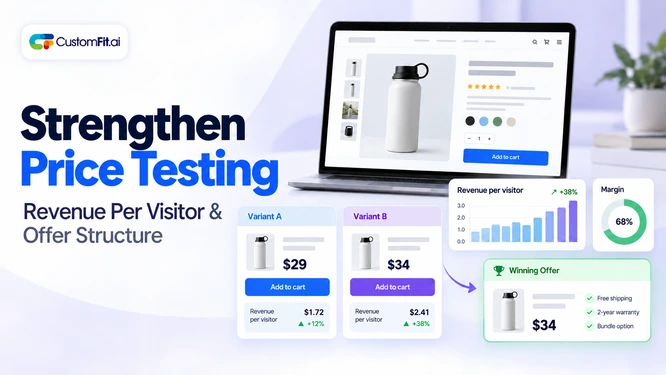
Use a value metric such as revenue or contribution margin per eligible visitor as the primary measure. Conversion rate remains useful, but it cannot show whether the price change created more economic value.
A price test is not a competition to find the version with the highest conversion rate. Lower prices can increase orders while reducing revenue or margin, and higher prices can do the opposite. The decision must reflect the economics of the business.
Across public practitioner discussions, the recurring questions center on price and offer decisions, experiment design and decision reliability.
This guidance answers those decisions directly and makes the practical limits clear before a team acts.
Public context: Community discussion; Community discussion.
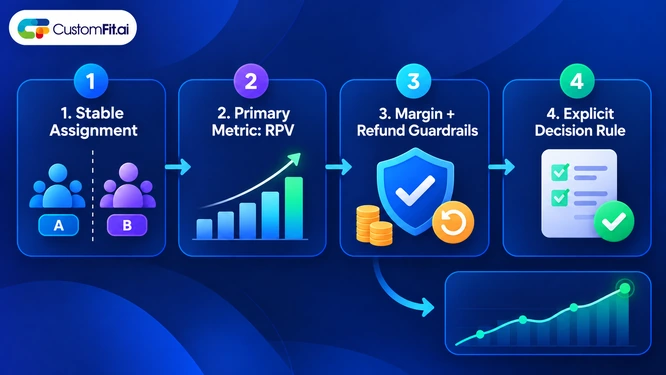
Before-and-after comparisons are easily distorted by campaigns, stock, seasonality and traffic mix. Duplicated products can also create operational and search problems. A trustworthy test assigns eligible visitors consistently, keeps the product experience comparable and defines how value will be judged.
Begin with evidence from the actual journey: the query or campaign that brought the visitor, the page they entered, the action they attempted and the commercial outcome that followed. Search data can reveal demand, analytics can show progression, and behavior evidence can expose friction. The recommendation becomes stronger when at least two independent signals point to the same problem.
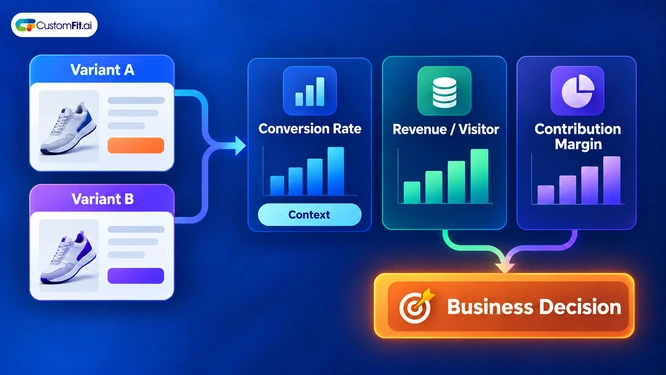
Start with the business question: willingness to pay, offer framing, bundle value or promotional sensitivity. Choose a primary metric such as contribution margin or revenue per eligible visitor, add conversion and refund guardrails, and define the audience and duration before launch.
Describe the moment of uncertainty in plain language. “Visitors do not understand delivery timing before adding to cart” is more useful than “improve the product page.” It identifies the audience, the barrier and the action expected to change.
Change enough to answer the question, but not so much that the result becomes impossible to interpret. Preserve the parts of the experience that are not under investigation. This reduces production risk and makes a successful treatment easier to maintain.
Use a metric tied to the decision: qualified progression, orders, revenue per eligible visitor or another approved business result. Add guardrails for performance, margin, refunds, unsubscribes or downstream behavior where relevant. Document event definitions before the test begins.
Preview every treatment on representative devices, confirm assignment and analytics, test the fallback experience and establish a rollback path. A technically broken variation cannot produce useful customer evidence.
A brand considering a higher price can compare the current price with one carefully chosen alternative for new visitors while keeping product content, delivery terms and merchandising stable. Review revenue per visitor, estimated margin, purchase rate, refund signals and retention before rollout.
Record the hypothesis, eligibility rule, treatment, primary metric, guardrails and planned decision window in one brief.
That record keeps interpretation grounded when results arrive and gives reviewers a clear explanation of what will change on the website.
Begin with data quality. Confirm that assignment remained consistent, events fired for both experiences and no unrelated release affected only one group. Then review the primary metric, its uncertainty and the guardrails. A result may apply only to the tested audience, product category, campaign or period.
An inconclusive result is not automatically a failed test.
It can show that the treatment was too subtle, the audience too broad, the sample insufficient or the original friction not important enough to change behavior.
Document that learning and decide whether to iterate, stop or investigate another barrier.
Do not expose the same visitor to changing prices, run overlapping promotions that invalidate the comparison or call a winner from conversion rate alone. Confirm legal, tax, catalog and merchandising requirements first.
CustomFit.ai helps ecommerce teams prepare targeted website experiences and controlled experiments around defined audiences and measurable outcomes. Teams can move from an observed opportunity to an exact website change, review that change before release and retain a clear connection between the hypothesis and the result.
The platform does not remove the need for sound judgment. The team still chooses the customer problem, approves the treatment, confirms tracking and decides what the evidence supports. Automation is most useful when it reduces repetitive preparation while keeping those decisions visible.
Learn more about Shopify A/B testing, Shopify personalization and ecommerce CRO.
Use a value metric such as revenue or contribution margin per eligible visitor as the primary measure. Conversion rate remains useful, but it cannot show whether the price change created more economic value.
Want help designing a price test that protects revenue, margin and customer trust? See how CustomFit.ai helps ecommerce teams build controlled experiments, target the right audience and measure the outcomes that matter.
Book a CRO strategy call