A/B testing onboarding flows means running controlled experiments on the sequence of touchpoints that take a new visitor or subscriber from first awareness through their first purchase and repeat purchase. Onboarding is the highest-leverage retention intervention available to D2C brands — the experience a new customer has in their first 7 days determines whether they become a loyal buyer or churn after one order. Systematic onboarding testing typically lifts first-purchase rates 20–35% and meaningfully increases 90-day LTV.
Why Onboarding Testing Delivers Outsized Returns
Most ecommerce CRO focuses on product pages, checkout flow, and advertising. Onboarding — the experience new customers have in their first week — is consistently undertested despite being the most economically significant funnel stage.
The math is simple: if your first-purchase rate from new email subscribers is 15% and you lift it to 20%, you have generated 33% more first purchases from the same acquisition spend. Every improvement to onboarding compounds across all future new customer acquisition.
For Indian D2C brands specifically, onboarding testing matters because:
- Many new customers arrive from paid ads with low brand awareness — they need a specific onboarding sequence to convert
- COD customers have higher acquisition cost and often lower LTV than prepaid customers — onboarding can influence payment preference
- Repeat purchase rates in Indian D2C are driven heavily by first-order experience and follow-up communication
The Ecommerce Onboarding Funnel
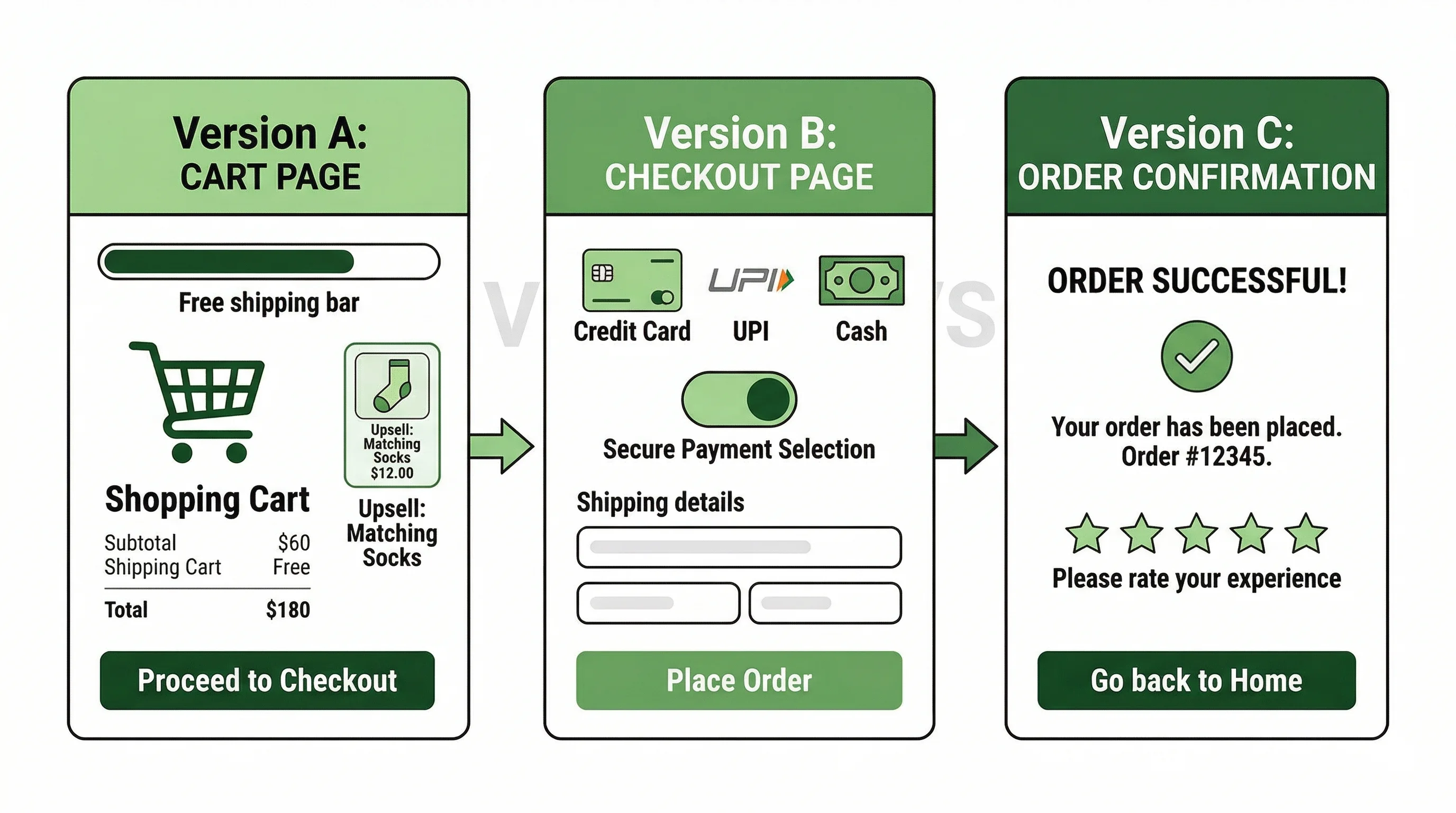
A complete ecommerce onboarding funnel has three stages, each testable independently:
Stage 1: First visit / sign-up experience
- Welcome pop-up or lead capture
- Homepage personalization for new visitors
- Account creation flow (if applicable)
Stage 2: Post-sign-up email/WhatsApp sequence
- Welcome email (immediately after sign-up)
- Education email (product education, brand story, usage guidance)
- First-purchase offer email (conversion trigger with incentive)
- Reminder email (if no purchase in 5–7 days)
Stage 3: Post-first-purchase onboarding
- Order confirmation email (sets expectations)
- Delivery tracking communication
- Product usage guidance (reduces returns, increases satisfaction)
- Review/UGC request (day 5–7 after delivery)
- Repeat purchase prompt (day 20–30)
Each stage has distinct testable elements. Start with the stage that has the highest current drop-off rate.
What to A/B Test at Each Onboarding Stage
Stage 1: First Visit Experience
Welcome pop-up:
- Discount offer (₹200 off first order) vs. free sample offer vs. free content (guide/quiz)
- Pop-up trigger: exit intent vs. 5-second delay vs. scroll-triggered
- Form fields: email only vs. email + name vs. email + WhatsApp
Homepage for new visitors:
- Brand story hero vs. bestseller hero vs. offer/discount hero
- "New here? Start here" navigation prompt vs. standard navigation
- Product recommendation logic (bestsellers vs. quiz-matched recommendations)
Account creation:
- Guest checkout prominently offered vs. account creation encouraged first
- Social login (Google/Facebook) vs. email-only signup
- Account benefits listed (track orders, loyalty points, reorder) vs. generic "create account" prompt
Stage 2: Email Onboarding Sequence
Welcome email:
- Subject: "[Name], welcome to [brand]" vs. "Your ₹200 off coupon is inside" vs. "Start your [product category] journey"
- Single CTA (shop now) vs. two CTAs (shop / learn more)
- Brand story focus vs. offer/discount focus vs. product education focus
- Send time: immediate vs. 1 hour vs. 4 hours after sign-up
Education email (day 2–3):
- Ingredient/product education vs. customer results/transformation
- Long-form guide format vs. short listicle vs. video thumbnail
- "How to use your first product" vs. "Why [ingredient] works" vs. "Our story"
First-purchase offer email (day 4–5):
- Discount amount: ₹100 off vs. ₹200 off vs. 15% off vs. free shipping
- Urgency: "Offer expires in 48 hours" vs. "For a limited time"
- Primary CTA: "Shop Now" vs. "Claim Your Discount" vs. "Start Your Routine"
Reminder email (day 6–7, non-purchasers only):
- "Still thinking it over?" curiosity angle vs. "Last chance: your discount expires today"
- Include additional social proof (new reviews since last email) vs. repeat original offer
- Different product recommendation (complement to what they viewed) vs. same product
Stage 3: Post-First-Purchase Onboarding
Order confirmation:
- Include product usage guide vs. confirmation details only
- Introduce loyalty program immediately vs. after delivery
- Ask about delivery preference (fast vs. sustainable) — this is testable product discovery data, not just CX
Post-delivery (day 5–7):
- Usage tips focused vs. review request focused
- WhatsApp message vs. email for this touchpoint
- Personalized routine suggestions vs. generic "what to try next"
Repeat purchase prompt (day 20–30):
- "Running low?" reminder vs. new product introduction vs. loyalty point redemption prompt
- Timing: day 20 vs. day 25 vs. day 30 after first purchase
- Channel: email vs. WhatsApp vs. push notification
Statistical Design for Onboarding Tests
Onboarding tests have a key difference from page-level tests: you are testing over a cohort of new users, not a snapshot of page visitors.
Acquisition window: How long you collect new users into each variant (typically 14–30 days)
Measurement window: How long after sign-up you track the outcome (7 days for first purchase, 30 days for repeat purchase)
For a 15% first-purchase baseline and a desire to detect a 5-percentage-point lift:
- You need approximately 1,000 new users per variant
- At 50 new sign-ups per day: 20 days of acquisition, then 7 days of measurement = 27-day test
- At 10 new sign-ups per day: 100 days of acquisition — impractical. Focus on higher-volume onboarding elements first.
Practical Example: Mamaearth-Style Onboarding Sequence Test
A clean D2C beauty brand testing two onboarding sequences:
Variant A (education-first):
- Day 0: "Welcome — here's your ₹150 off" (immediate discount)
- Day 2: Skin care routine guide (education)
- Day 4: "Your personalized recommendation is ready" (product CTA)
- Day 6: "Last chance: your discount expires tomorrow" (urgency reminder)
Variant B (story-first):
- Day 0: "Welcome to [brand] — meet our team" (brand story)
- Day 2: "Why customers switched from [competitor category] to us" (social proof)
- Day 4: "Your routine starter kit is waiting — ₹150 off inside" (delayed offer)
- Day 6: "7 days of better skin — here's where to start" (low-friction CTA)
Measurement: First purchase rate at day 7, second purchase rate at day 37, and 30-day LTV by cohort.
Common Onboarding Testing Mistakes
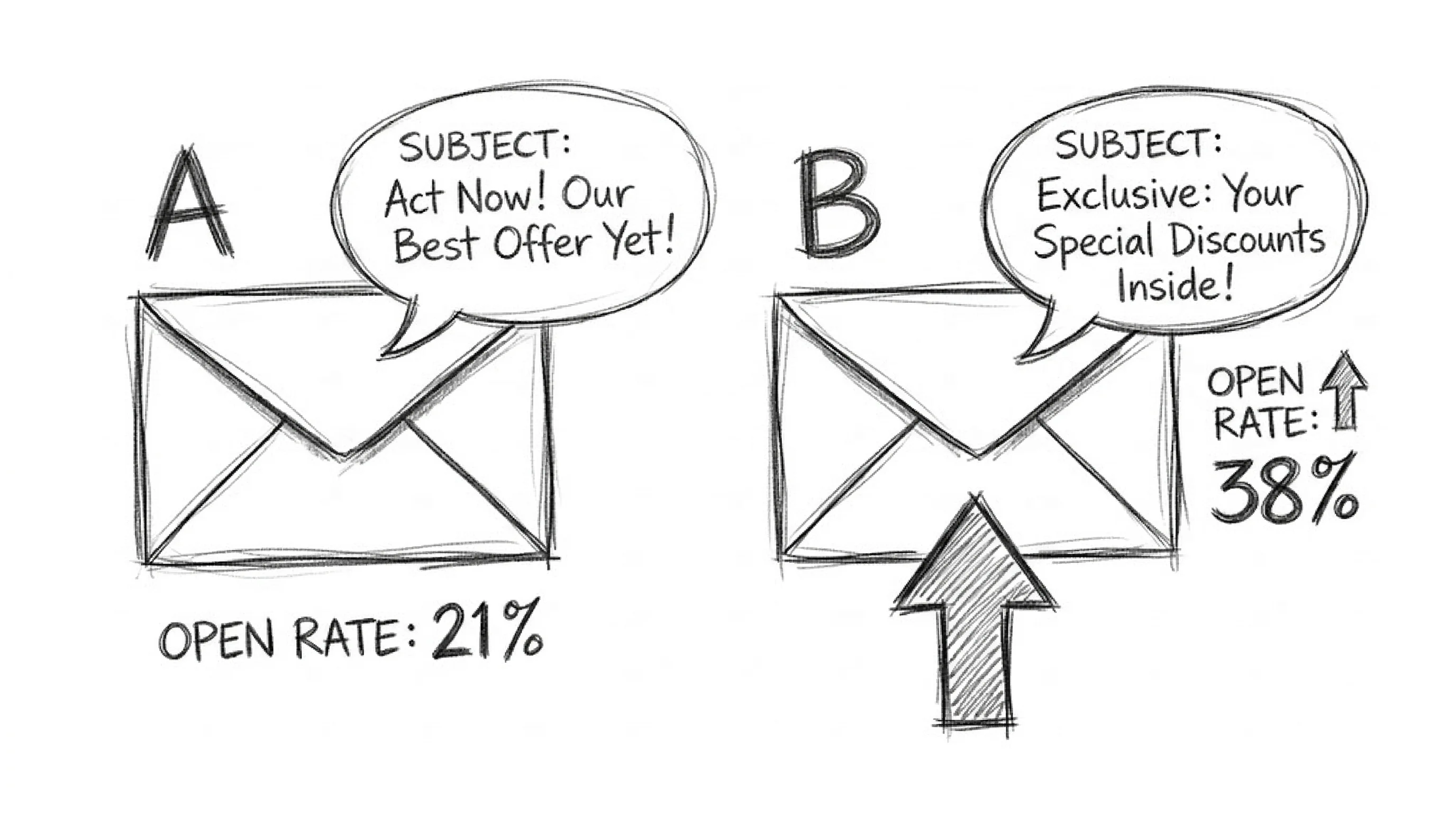
Testing in isolation. An email subject line win means nothing if the email body does not convert. Test the sequence as a system, not just individual emails.
Measuring only email metrics. Email open rate and CTR are leading indicators. The metric that matters is first purchase rate. Do not declare a winner based on email engagement alone.
Not isolating new users. Running onboarding tests on your full email list (including existing customers) contaminating results. Test on new sign-ups only, using cohort-based segmentation.
Ignoring COD vs. prepaid segmentation. Indian D2C onboarding should be tested separately for COD and prepaid cohorts — the payment preference signals purchase intent and LTV that should inform which sequence each group receives.
Over-emailing in the test period. Adding extra emails to one variant creates both a volume difference and a content difference. If you want to test sequence length, make that the explicit test variable.
Key Takeaways
- Onboarding testing measures first-purchase rate, not just email engagement metrics
- Start with the welcome email and first-visit homepage experience — these have the largest impact on first purchase rate
- Test onboarding as a cohort experiment (new users over a 14–30 day acquisition window)
- For Indian D2C, test separately for COD vs. prepaid cohorts — the optimal sequence differs
- A 15% → 20% first-purchase rate lift generates 33% more first purchases from the same acquisition spend
- Do not test individuals — test the full sequence by assigning new users to variant cohorts at sign-up
Related reading:
 ab testing
 ab testing
 ab testing