
From the conversion glossary
Concepts referenced in this article, defined.
10 high-impact A/B test ideas for skincare product pages — with hypotheses, what to change, and how brands like mCaffeine, Plum, and Pilgrim have used them to lift CVR.
Concepts referenced in this article, defined.
 ab testing
A practical framework for discussing winning, losing and inconclusive A/B tests in growth, CRO and ecommerce job interviews.
 ab testing
A/B testing isn't magic. Learn about the common myths that waste traffic and skew results, plus how to run smarter tests that improve conversions.
 ab testing
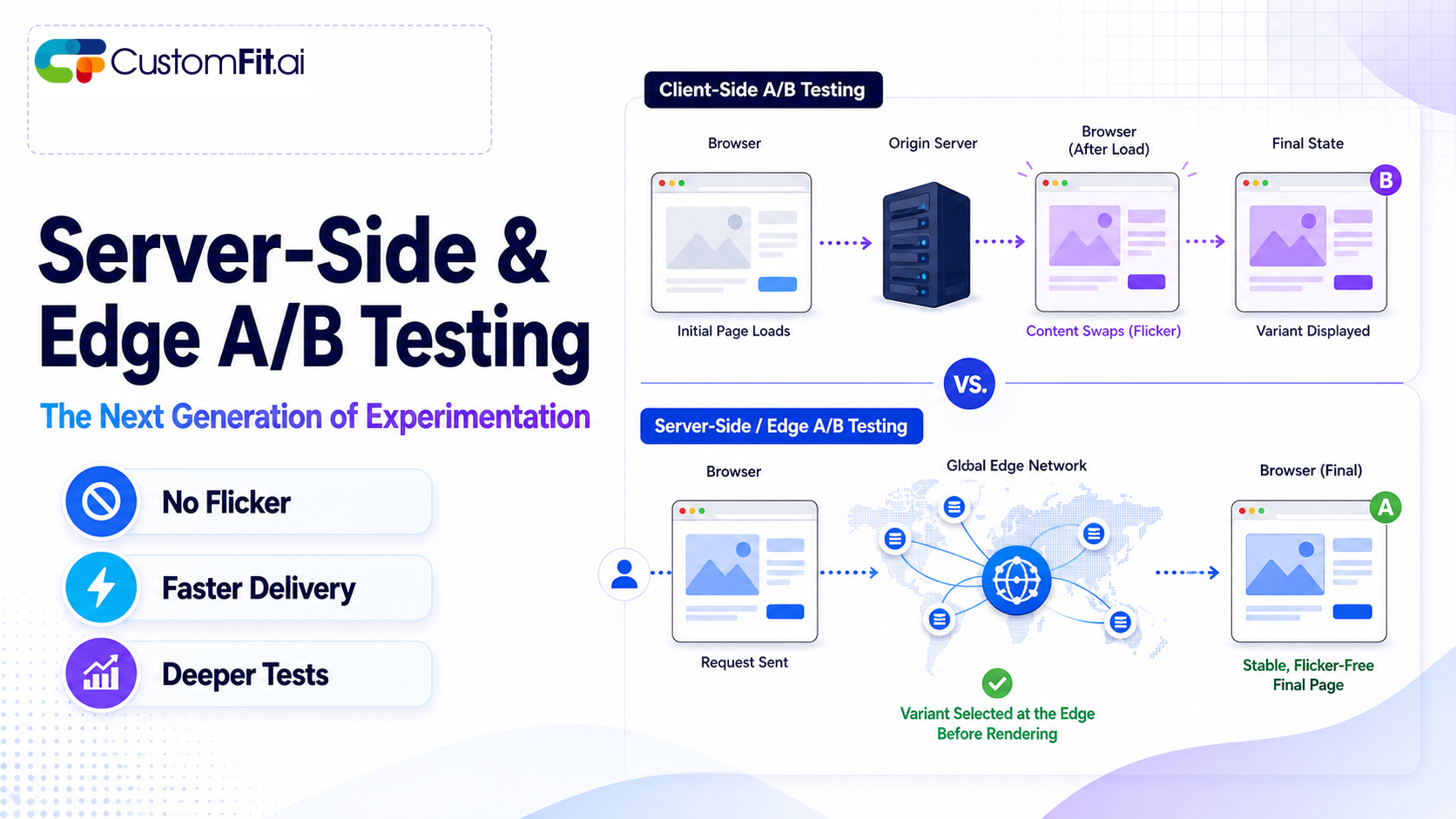
Server-side A/B testing and edge experimentation explained - how they eliminate flicker, improve speed, and where they fit vs client-side testing.
Run rigorous A/B tests and personalize every visit on Shopify or any storefront — no engineers required.
Skincare is one of the most competitive D2C categories in India — mCaffeine, Plum, Pilgrim, The Derma Co., Minimalist, and Sugar Cosmetics are all fighting for the same attention. The difference between a 2% and a 4% conversion rate on your product page is the difference between a sustainable brand and a leaky bucket. These 10 A/B test ideas are drawn from what actually moves CVR for skincare brands — with the hypothesis, the specific change, and the expected impact.
Every test needs:

Hypothesis: First-time visitors who see a before/after skin transformation image will add to cart at a higher rate than those who see a white-background product shot, because transformation images demonstrate outcome rather than packaging.
Control: White-background product bottle image Variant: Model showing skin transformation (before/after or visible skin improvement)
Expected lift: 10–20% add-to-cart rate improvement for social traffic Note: This test often performs differently for search traffic (where ingredient-forward may outperform). Segment your results by utm_source.
Hypothesis: Moving the "Dermatologist Tested" or "Dermatologist Recommended" badge to immediately above the Add to Cart button — instead of in the product description — will increase CVR because it addresses purchase anxiety at the moment of decision.
Control: Trust badge in product description section Variant: Trust badge immediately above the Add to Cart button
Expected lift: 8–15% CVR improvement, especially for high-concern categories (anti-acne, anti-aging)
Hypothesis: Showing a specific review quote ("Cleared my acne in 3 weeks — Priya, Mumbai") near the hero section converts better than just showing an aggregate rating ("4.7 stars, 2,400 reviews"), because a specific story creates more visceral social proof than a number.
Control: "⭐ 4.7 (2,400 reviews)" near the product title Variant: Featured review quote with customer name/city, alongside the rating
Expected lift: 5–12% CVR lift for first-time visitors
Hypothesis: First-time visitors respond better to benefit-forward copy ("Fades dark spots in 4 weeks") than ingredient-forward copy ("2% Alpha Arbutin + Niacinamide"), because outcomes are more universally understandable than ingredient names.
Control: Ingredient list and percentages prominent in product description Variant: Benefit statements with ingredient mentioned as supporting evidence ("Fades dark spots — powered by 2% Alpha Arbutin")
Expected lift: 10–18% CVR improvement for cold traffic from social ads Note: Ingredient-first copy may outperform for warm/returning audiences who are already familiar with active ingredients.
Hypothesis: Presenting a "Complete Routine" option (serum + moisturizer + SPF as a bundled set) alongside the single product purchase increases AOV without significantly hurting individual product CVR.
Control: Standard "Add to Cart" for single product Variant: Two CTAs: "Add Serum — ₹699" + "Get the Complete Routine — ₹1,499 (Save ₹300)"
Expected lift: AOV lift of 25–40%, slight CVR dip of 3–8% (acceptable if RPV increases)

Hypothesis: Offering a free product sample (pay only shipping, e.g., ₹99) on high-consideration skincare products reduces the purchase anxiety of a ₹500–₹1,500 commitment for first-time buyers, increasing overall trial rate.
Control: Standard "Add to Cart" for full-size product Variant: "Try a Sample — ₹99 (shipping only)" as secondary CTA alongside standard add to cart
Expected lift: 30–60% increase in total product trials (combined sample + full-size conversions) Monitor: Sample-to-full-size conversion rate at 30 and 60 days post-trial.
Hypothesis: A brief "What's your skin type?" quiz flow before the product page, which then recommends the most relevant variant or product, increases CVR because visitors feel the product is specifically right for them.
Control: Standard product page with all variants listed Variant: 2-question quiz ("What's your skin type?" + "What's your main concern?") that leads to a personalized product recommendation page
Expected lift: 15–30% CVR improvement for visitors who complete the quiz flow Note: Track drop-off rate on the quiz itself. If >50% abandon, simplify to a single question.
Hypothesis: A short product video (30–60 seconds showing texture, application, and skin result) as the first or second product image increases add-to-cart rate because it answers more purchase questions than static images can.
Control: Static image gallery as primary product media Variant: 30-second product/application video as first gallery item, followed by static images
Expected lift: 10–25% add-to-cart lift, especially on mobile where video autoplay (muted) captures attention immediately
Hypothesis: For skincare products priced ₹500–₹1,500, explicitly mentioning "COD available — no advance needed" prominently on the product page reduces payment anxiety for Tier 2 and 3 city visitors, increasing overall CVR.
Control: Standard product page (COD available during checkout only) Variant: "COD available at checkout" badge near the price and Add to Cart button
Expected lift: 8–15% CVR improvement for visitors from Tier 2/3 cities Segment this test: The effect is primarily for non-metro visitors. Run results segmented by geo.
Hypothesis: Adding a visual "When will I see results?" timeline (Week 1: visible hydration, Week 3: reduced dark spots, Week 6: noticeable brightening) increases CVR by setting expectations and reducing the "does this actually work?" purchase hesitation.
Control: Standard ingredient + benefit product description Variant: Visual results timeline graphic (or table) near the Add to Cart button
Expected lift: 10–20% CVR improvement, particularly for anti-aging and brightening products where results timeline is a common concern
| Test | Element | Primary Metric | Expected Lift |
|---|---|---|---|
| 1 | Hero image | Add-to-cart | 10–20% |
| 2 | Dermatologist badge placement | CVR | 8–15% |
| 3 | Review format | CVR | 5–12% |
| 4 | Ingredient vs. benefit copy | CVR | 10–18% |
| 5 | Bundle CTA | AOV | 25–40% |
| 6 | Free sample offer | Trial rate | 30–60% |
| 7 | Skin type quiz | CVR | 15–30% |
| 8 | Video in gallery | Add-to-cart | 10–25% |
| 9 | COD badge | CVR (Tier 2/3) | 8–15% |
| 10 | Results timeline | CVR | 10–20% |
See also: A/B Testing Pillar | Product page optimization guide | Personalization glossary.