From the conversion glossary
Concepts referenced in this article, defined.
Concepts referenced in this article, defined.
 ab testing
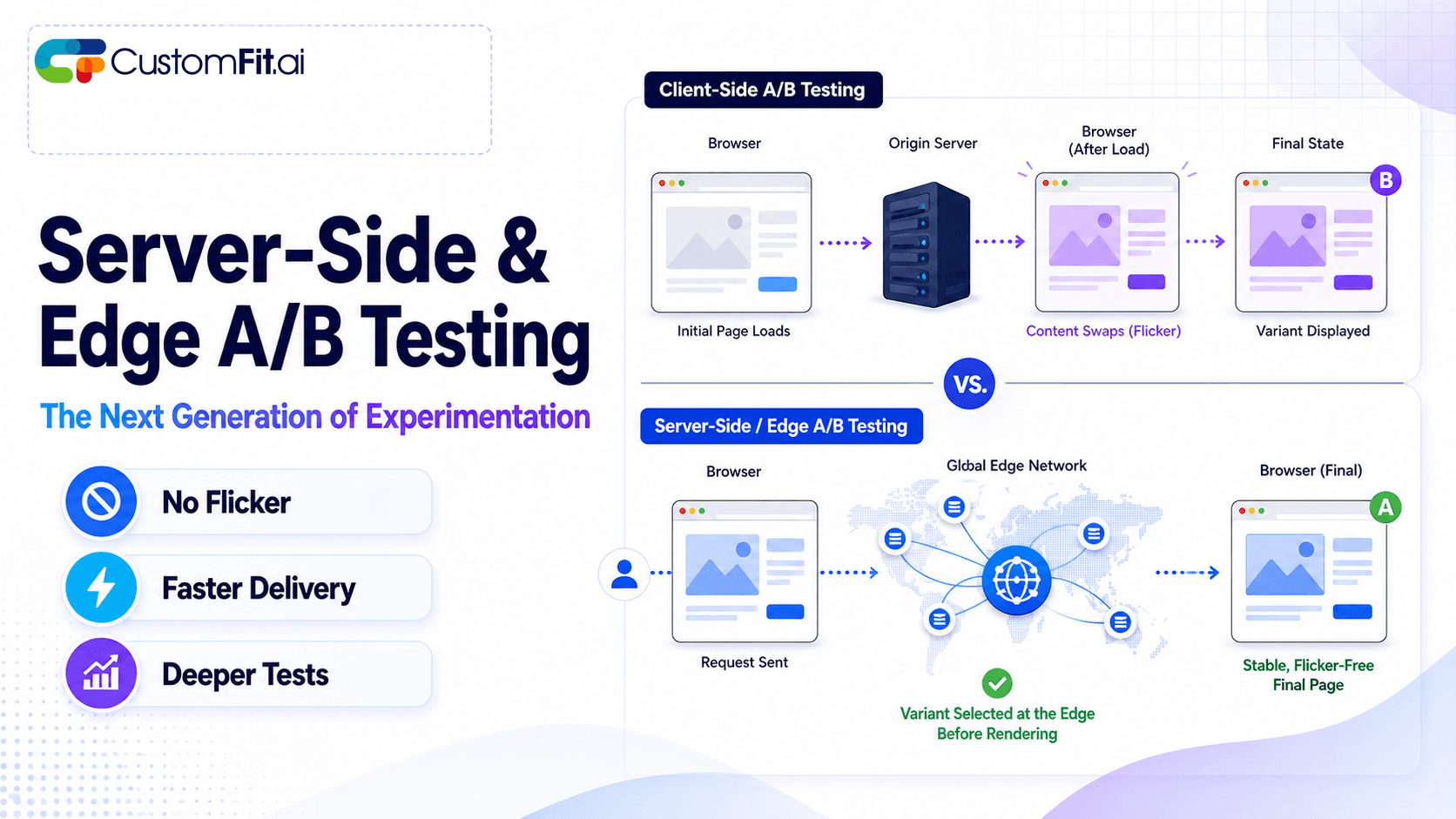
Server-side A/B testing and edge experimentation explained - how they eliminate flicker, improve speed, and where they fit vs client-side testing.
 ab testing
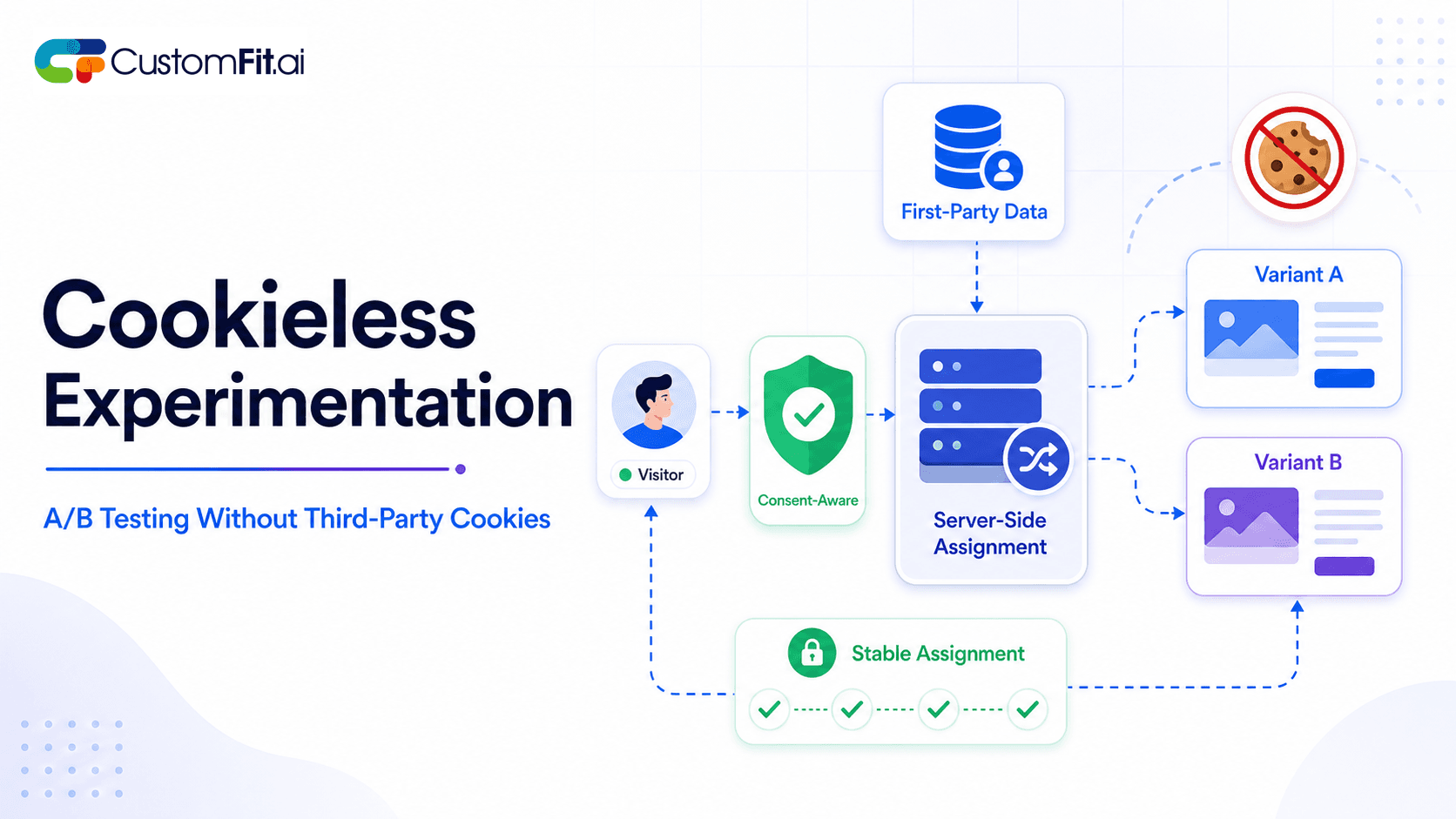
How to run cookieless A/B testing correctly in 2026 - first-party data, GDPR compliant methods, and what actually changed with third-party cookies.
 ab testing
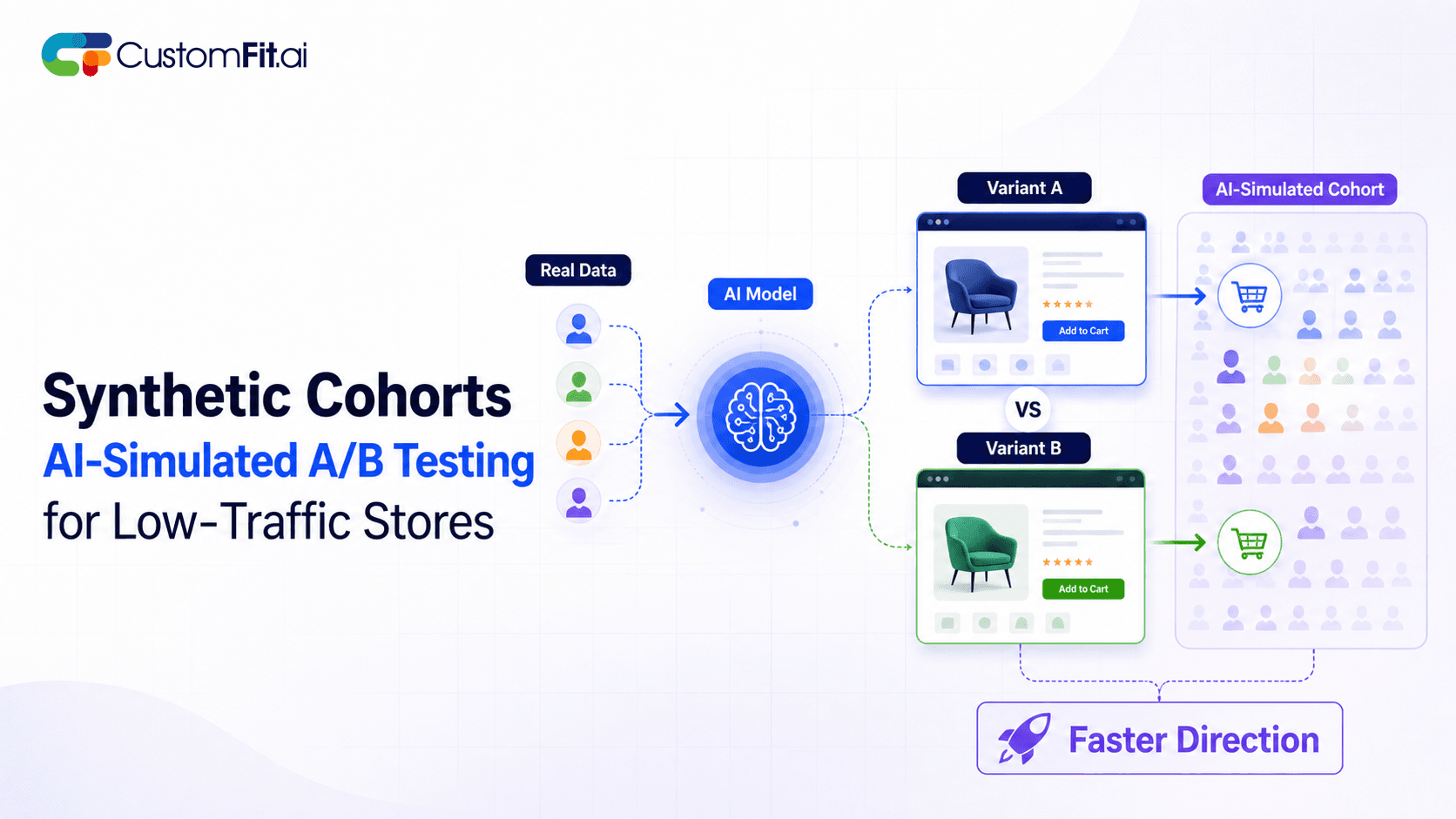
Not enough traffic to A/B test properly? Here's how synthetic cohort testing and AI-simulated experimentation help low-traffic stores test with confidence.
Run rigorous A/B tests and personalize every visit on Shopify or any storefront — no engineers required.
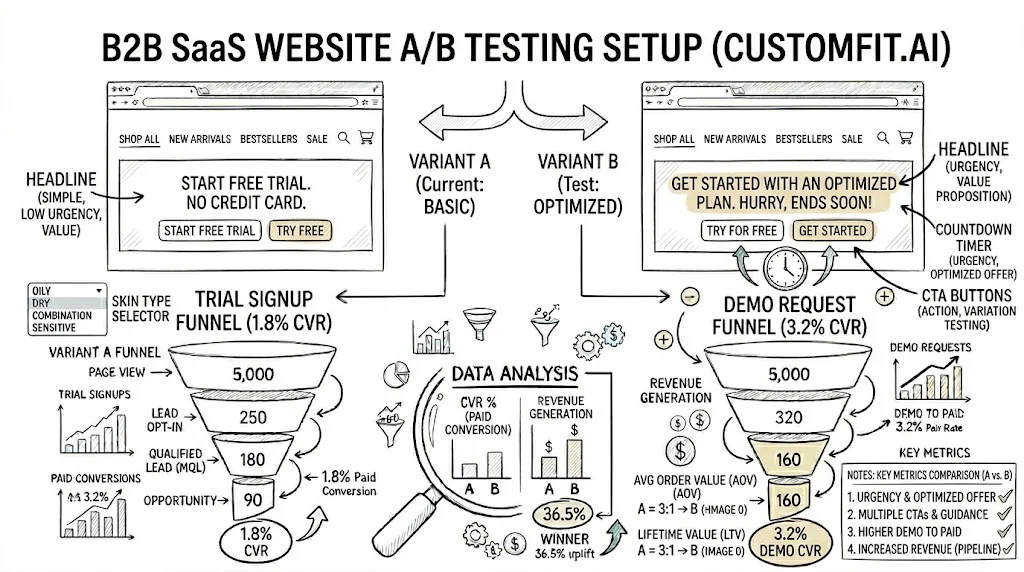
A/B testing for B2B SaaS is fundamentally different from ecommerce testing. Sales cycles are longer (weeks to months, not minutes), conversion goals are proxies for revenue (trial signups, demo requests), multiple stakeholders are involved in purchase decisions, and traffic volumes are typically much lower. These differences change what you test, how long you test, and how you interpret results. This guide covers the B2B SaaS-specific approach to building a valid experimentation program.
The conversion proxy problem: In ecommerce, your primary conversion event (a purchase) directly generates revenue. In B2B SaaS, your website conversion event (a trial signup, a demo request) is a proxy — a step that may or may not lead to revenue, depending on sales execution, fit, and follow-up.
This creates a critical risk: improving your proxy metric (e.g., trial signup rate) without improving qualified trial quality can actually hurt your business. A change that increases trial signups by 20% but reduces the percentage of trials that convert to paid accounts by 25% is a net negative.
Multi-stakeholder journeys: B2B purchases often involve a champion, an evaluator, an economic buyer, and sometimes a procurement team. Your website might need to speak to multiple personas in a single session, or to different personas across different visits. This complicates personalization and testing design.
Long evaluation periods: A visitor who starts a trial might take 30–90 days to convert to a paid account. Test results that measure trial signups may appear positive while downstream revenue impact is negative (or vice versa). This lag makes attribution difficult.
Lower traffic volumes: Most B2B SaaS websites see dramatically lower traffic than ecommerce stores of similar revenue size. This extends test durations significantly.
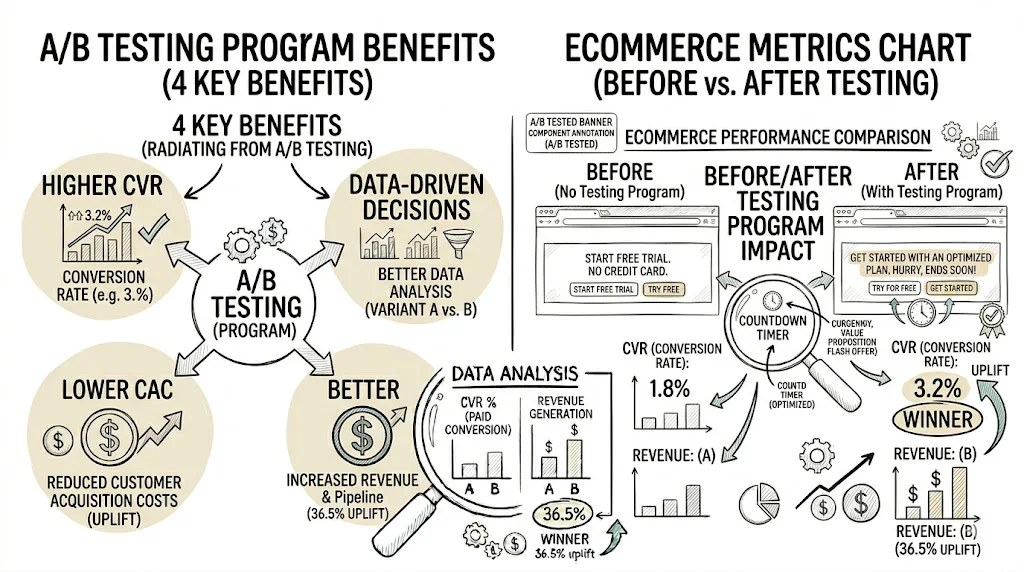
Your homepage hero is the highest-impact test surface. The most common B2B SaaS testing opportunities:
What the product is vs what it does for you: "No-code A/B testing platform" (product description) vs "Increase conversions 11% without a developer" (outcome statement). Outcome-led copy typically outperforms feature descriptions.
Specificity vs breadth: Targeting language like "for D2C ecommerce brands" vs "for any website." Specificity often converts better within the target audience even though it explicitly excludes others.
Social proof placement: Moving customer logos, G2 ratings, or case study metrics into the hero section vs below the fold. Above-the-fold trust signals consistently lift trial signup rates in CRO research.
The pricing page is often the second-highest traffic page for B2B SaaS (after the homepage) and one of the highest-leverage for optimization.
Most common pricing page tests:
Chargebee, notably, achieved a 40% AOV increase through pricing page personalization — demonstrating the high leverage of pricing page optimization for SaaS.
The friction in your trial signup form directly affects signup rate. Tests:
Performance marketing landing pages are high-leverage test surfaces because they have concentrated, high-intent traffic and direct ROI measurement (cost per trial from each variant).
Test: headline relevance to the ad creative, offer (free trial vs demo vs free plan), social proof specificity (logo wall vs specific customer quote), and form placement (above fold vs scrolled to).
While not website A/B tests, trial-to-paid conversion rates are dramatically affected by onboarding emails. Test: subject lines, email timing, activation prompts, personalization by segment (company size, industry, use case).
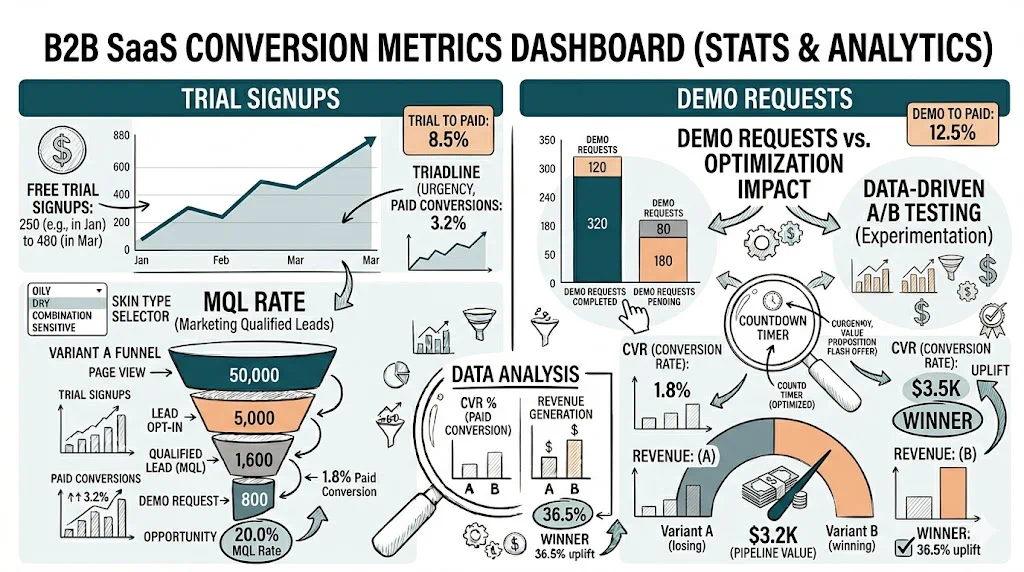
Avoid the "vanity metric" trap. Test toward the most downstream, revenue-relevant conversion you can reliably measure:
Best: Trial accounts that activate (complete a meaningful action in the product within 7 days) Good: Trial signups with email verification Acceptable: Demo requests Risky: Form starts, scroll depth, time on page
If you optimize for trial signups without tracking trial activation, you risk optimizing for signups that never engage with the product.
B2B SaaS websites often have 5,000–50,000 monthly visitors (significantly lower than ecommerce). At these traffic levels:
To detect a 20% relative improvement in trial signup rate (e.g., from 3% to 3.6%) at 95% confidence: Required sample: ~7,000 visitors per variant
At 5,000 monthly visitors and a 50/50 split, this test requires ~3 months. At 20,000 monthly visitors, it takes under a month.
Practical implications:
B2B website traffic has strong day-of-week patterns — peak on Tuesday and Wednesday, trough on weekends. Always run tests for full weeks (7-day multiples) to capture these cycles equally across control and variant.
When your target customers include multiple personas (e.g., the marketer who evaluates the product vs the CTO who approves the budget), single-page tests can produce confusing results.
Approaches:
The most sophisticated B2B SaaS testing programs connect website test results to downstream revenue outcomes. This requires:
This analysis typically requires data warehouse integration (Segment, RudderStack) connecting your website testing tool to your product analytics and billing system. It's complex but produces the only truly valid measure of testing ROI for B2B SaaS.
For B2B SaaS websites specifically:
VWO: Strong visual editor, Bayesian statistics, and good support for lower-traffic B2B websites. Their pricing model works well for mid-size SaaS companies.
Statsig: Developer-friendly, warehouse-native, supports both feature flags and website experiments. Good for tech-forward SaaS teams.
Optimizely Web: Enterprise-grade for large SaaS companies with significant traffic and dedicated experimentation teams.
Posthog: Open-source product analytics with feature flag and A/B testing capabilities — good for SaaS companies wanting product and website testing in one tool.
CustomFit.ai: Primarily built for Shopify ecommerce, but its personalization and A/B testing methodology applies to any conversion-optimization challenge. Note: native Shopify focus means B2B SaaS teams should evaluate other tools for their specific use case.
Segment by company characteristics, not just user characteristics. B2B decisions are company-level, not individual-level. If you can segment test results by company size (SMB vs mid-market vs enterprise), industry, or geography, you'll find dramatically different response patterns.
Don't stop testing at the trial signup. The highest-leverage A/B testing for SaaS companies happens inside the product — onboarding flow, activation features, upgrade prompts. Website testing is just the top of the iceberg.
Connect with sales before testing messaging. Your sales team talks to prospects every day. They know exactly what objections arise, what language resonates, and what causes deals to stall. This knowledge is gold for homepage and pricing page hypothesis generation.
Be skeptical of large early wins. B2B audiences include a higher proportion of evaluators, researchers, and competitors than ecommerce audiences. A large early positive result on trial signups may reflect an influx of low-quality evaluators attracted by changed messaging, not a genuine improvement in qualified conversion.