From the conversion glossary
Concepts referenced in this article, defined.
Concepts referenced in this article, defined.
 ab testing
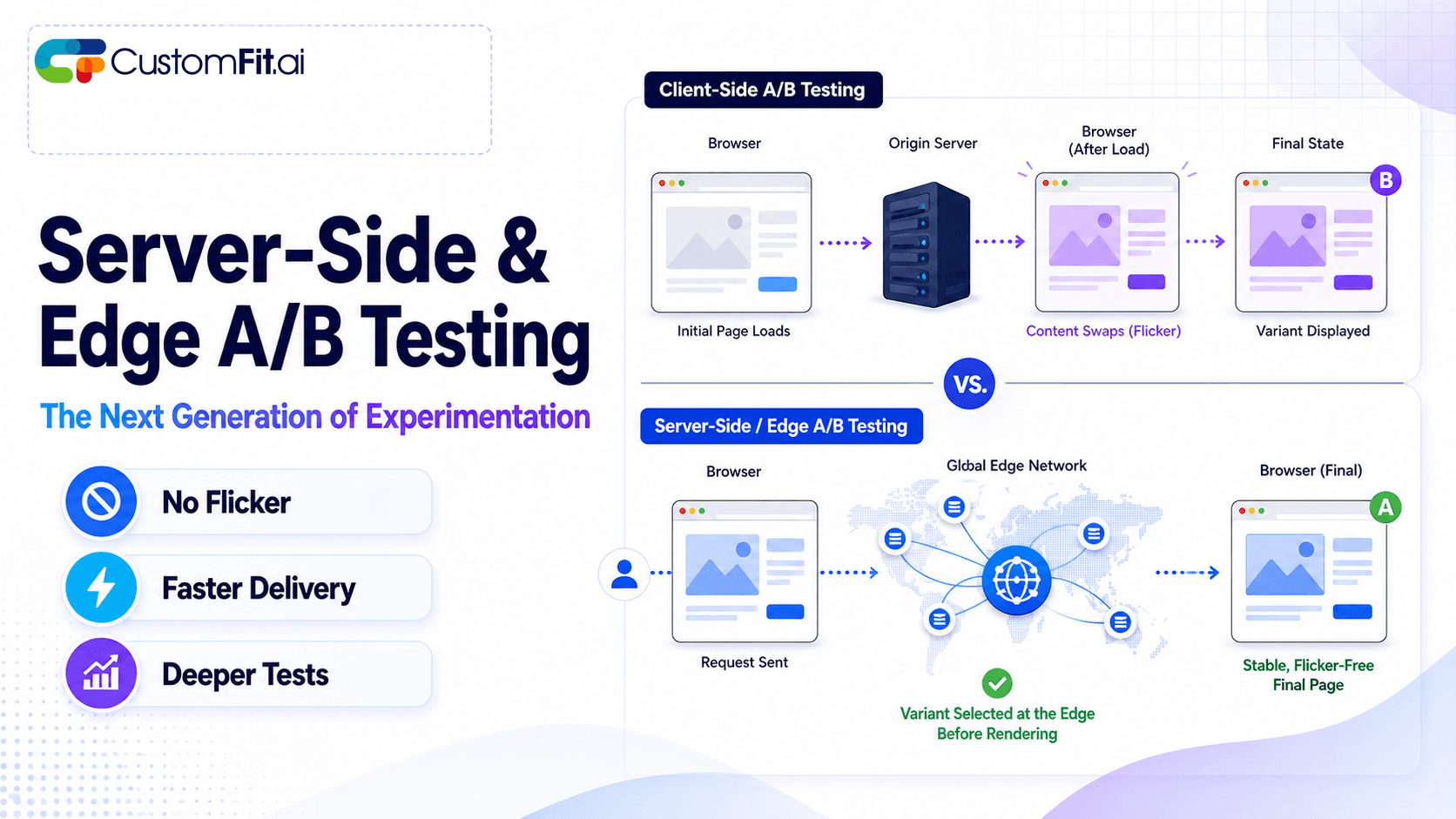
Server-side A/B testing and edge experimentation explained - how they eliminate flicker, improve speed, and where they fit vs client-side testing.
 ab testing
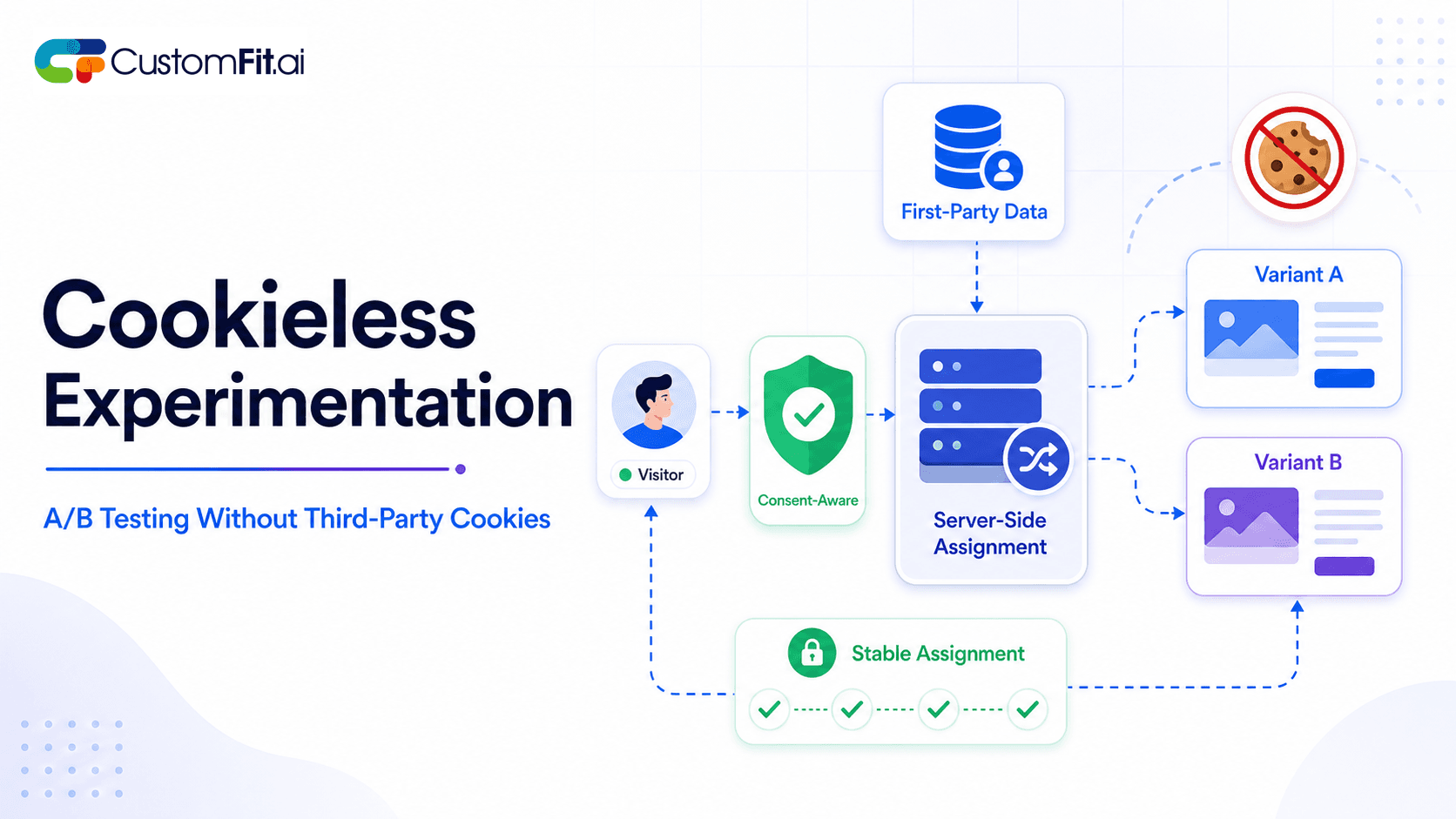
How to run cookieless A/B testing correctly in 2026 - first-party data, GDPR compliant methods, and what actually changed with third-party cookies.
 ab testing
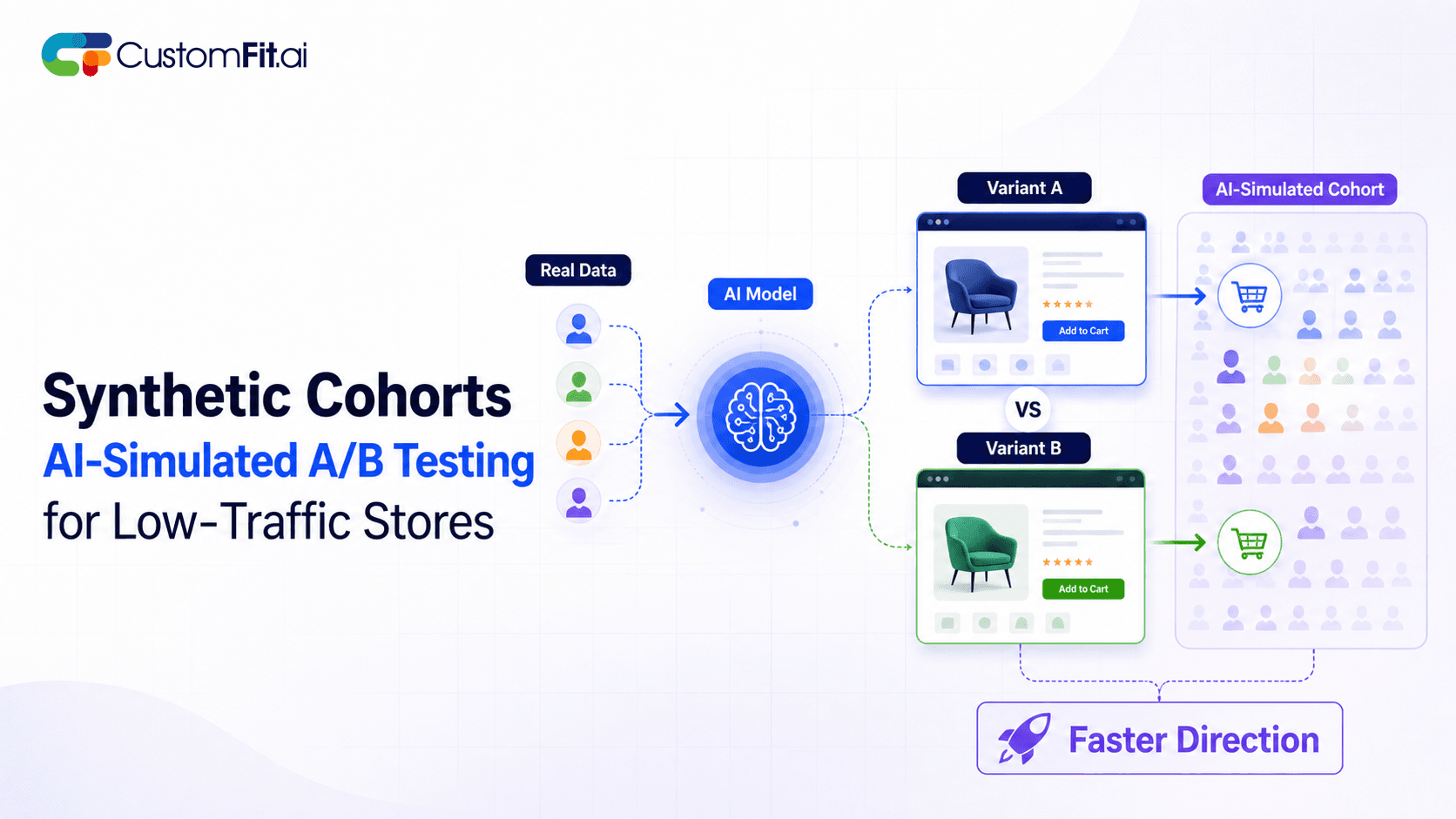
Not enough traffic to A/B test properly? Here's how synthetic cohort testing and AI-simulated experimentation help low-traffic stores test with confidence.
Run rigorous A/B tests and personalize every visit on Shopify or any storefront — no engineers required.
An A/B testing roadmap is a prioritized, time-boxed plan of experiments that aligns your testing program with business goals, traffic availability, and team capacity. Without a roadmap, testing programs run reactively — testing whatever idea someone had recently rather than what will drive the most business impact. This free template gives you the framework to build and maintain a testing roadmap for your Shopify D2C store.
Teams without a testing roadmap share common problems:
Random test selection. Tests are chosen based on whoever made the most persuasive argument in the last meeting, not on expected impact.
No learning continuity. Tests are run without connection to each other. Learnings from test A don't inform the design of test B.
Festive season chaos. No one thought about what to test during Diwali until a week before, when there's no time to design a valid experiment.
Stakeholder conflict. Marketing wants to test one thing, product wants to test another, leadership wants something else. Without a roadmap, these conflicts have no structured resolution.
A testing roadmap solves all of these by making the experimentation program legible, predictable, and aligned.
Before you can build a roadmap, you need a backlog of test ideas. The backlog is an unordered list of every test idea worth considering. Sources:
Quantitative data: Funnel drop-off analysis, page-level analytics, heatmap data, scroll depth reports Qualitative data: Session recordings, customer interviews, customer service chat logs, review content analysis Competitive research: What are similar D2C brands testing? What patterns do you see in industry case studies? Team brainstorming: CRO-specific brainstorm sessions with your growth, product, and design teams Industry research: CXL case studies, Baymard ecommerce UX research, A/B testing idea libraries
For each idea in the backlog, capture:
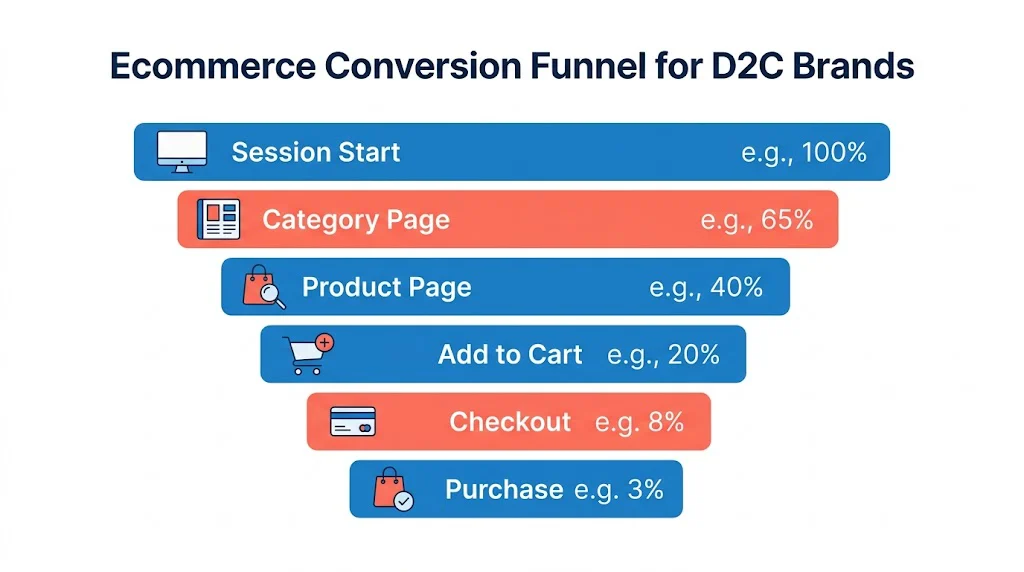
The PIE framework (by Chris Goward) scores each test on three dimensions:
P — Potential (1–10): How much improvement is possible? If this page converts at 1% and similar pages convert at 3%, potential is high. If the page already converts well, potential is lower.
I — Importance (1–10): How much traffic and revenue flows through this page? Testing your highest-traffic product page is more important than testing a low-traffic landing page, even if both have the same improvement potential.
E — Ease (1–10): How difficult is it to design, implement, and run this test? A simple headline change scores 9; a checkout flow redesign requiring developer involvement scores 3.
PIE score: (P + I + E) / 3 = Priority score
Tests with PIE scores above 7 go to the top of the roadmap. Tests with scores below 4 stay in the backlog for reconsideration.
Example PIE scoring:
| Test Idea | Potential | Importance | Ease | PIE Score |
|---|---|---|---|---|
| Hero headline on homepage | 7 | 9 | 9 | 8.3 |
| Add urgency copy to cart page | 7 | 8 | 8 | 7.7 |
| Testimonial carousel on product page | 6 | 8 | 7 | 7.0 |
| Complete checkout redesign | 9 | 9 | 2 | 6.7 |
| Footer color change | 2 | 3 | 9 | 4.7 |
Copy this template into Notion, Airtable, or a spreadsheet. Create one row per planned test.
Quarter: [Q1 2026 / Q2 2026 / etc.]
Goal: [Primary business goal this quarter's tests are designed to improve]
Example: "Reduce cart abandonment rate from 72% to below 65%"
Traffic forecast: [Expected monthly visitors during this quarter]
Testing capacity: [Max concurrent tests you can run given traffic and team size]
Test ID: [Sequential number, e.g., T-001]
Test name: [Descriptive name]
Status: [Backlog / Planned / Running / Completed / Abandoned]

Hypothesis (1 sentence):
[If we [change], we expect [outcome] because [reason]]

Target page(s): [Homepage / Product page / Cart / Checkout]
Primary metric: [Purchase rate / Add-to-cart rate / Revenue per session / etc.]
PIE score: [1–10]

Planned start week: [Week of YYYY-MM-DD]
Planned duration: [X weeks]
Planned end week: [Week of YYYY-MM-DD]

Required sample size: [N visitors per variant]
Traffic available per week: [N visitors to target page]
Feasibility: [Yes / Marginal / No — reconsider]

Dependencies:
[Other tests that must complete before this one can run]
[Other team resources required (design, dev, legal review)]

Test lead: [Name responsible for this test]
Actual start date: [Date]
Actual end date: [Date]
Result: [Variant wins / Control wins / Inconclusive]
Primary metric change: [+/- X%]
Statistical significance: [X% confidence]
Implementation status: [Implemented / Not implemented / Pending]
Key learning (1–2 sentences): [What did this test teach us?]
Follow-up tests generated: [List test IDs or descriptions]
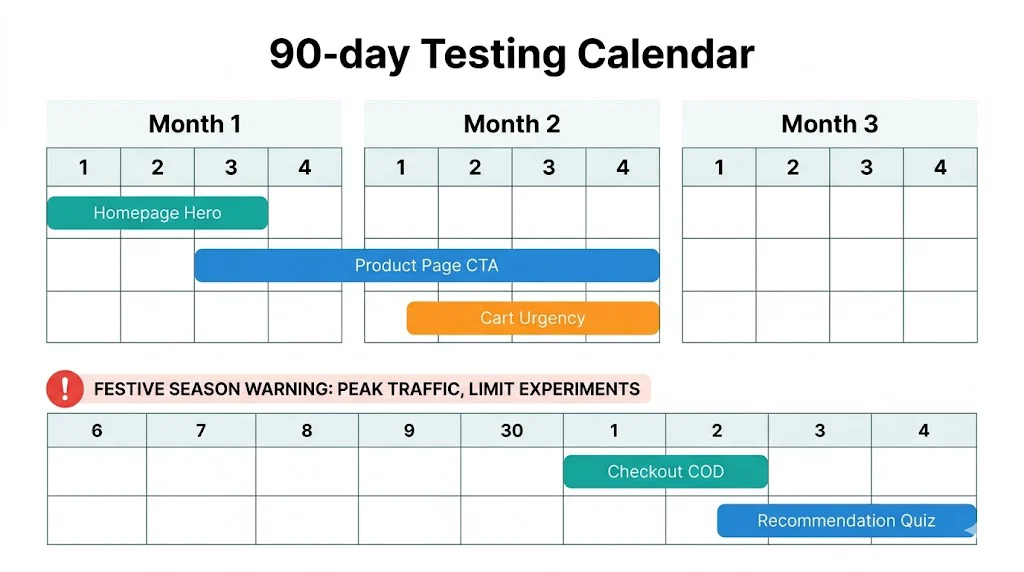
One of the most common roadmap mistakes is running major tests during unusual traffic periods — festive seasons, sale events, product launches — and then trying to generalize those results to normal behavior.
Map your testing roadmap against your marketing calendar:
Before Diwali (4–6 weeks out): Run checkout optimization tests and payment presentation tests. You want results validated before you're driving your heaviest paid traffic. Don't start new, unvalidated tests during the campaign itself.
During Diwali: Minimal new test launches. If any tests are running, they're pre-planned and account for festive traffic behavior. Analyze how festive traffic segments respond to existing tests.
Post-festive (January lull): Perfect time for structural tests that need longer run times — mobile UX overhauls, value proposition testing, navigation changes.
Republic Day and Holi: Similar planning applies — validate conversion changes before the campaign, not during.
Normal traffic periods: Run your baseline tests. This is when your results are most generalizable to typical customer behavior.
At the start of each quarter, review:
What ran last quarter: Review all completed tests. What worked? What didn't? What did we learn?
Carry-over tests: Tests that started but didn't complete move to the next quarter with priority.
New ideas from learnings: Test learnings generate new hypotheses. Add them to the backlog and PIE-score them.
Business priority alignment: Have company goals shifted? Adjust test priorities accordingly. If the company is now focused on AOV rather than conversion rate, reprioritize tests that increase basket size.
Traffic availability update: Did your traffic grow or shrink? Adjust expected test durations accordingly.
Month 1 — Foundation Tests
Month 2 — Funnel Tests
Month 3 — Conversion Intensification
This 90-day plan runs 6 tests across the full funnel, with built-in sequencing (T-003 builds on T-001 learnings) and a mix of quick wins (T-002) and strategic tests (T-006).
Keep the roadmap visible. A roadmap that lives in one person's head doesn't align the team. Share it in a shared workspace and review it in monthly team meetings.
Don't plan too far ahead. Testing roadmaps beyond 6 months are largely fiction — priorities shift, traffic changes, test results redirect your focus. Plan the next quarter in detail; keep a loose backlog for everything beyond.
Assign a test lead for every experiment. Without ownership, tests slip. Every test on the roadmap needs one person responsible for getting it live, monitoring it, and completing post-test documentation.
Build buffer capacity. Don't fill 100% of your available testing slots. Leave 20–25% capacity for reactive tests — opportunities that arise from customer feedback, competitive moves, or surprising analytics data that should be tested quickly.
Use your roadmap to say no. When a stakeholder asks you to "just quickly test" a pet idea that scored a 4 on PIE, point to the roadmap. "We'd love to test that — let's add it to the backlog and PIE-score it against what's planned." This creates a structured prioritization conversation rather than an authority conflict.