From the conversion glossary
Concepts referenced in this article, defined.
Concepts referenced in this article, defined.
Run rigorous A/B tests and personalize every visit on Shopify or any storefront — no engineers required.
Optimizely is one of the most capable experimentation platforms on the market. It's also one of the most expensive and complex. It's built for companies like Visa, Microsoft, and The Guardian, not for a D2C brand running a Shopify store. If you've priced Optimizely and stepped back from the quote, or if you're already on the platform and wondering whether you're getting value for the cost, this guide covers the alternatives worth considering in 2026 across different use cases and budgets.
Optimizely's Web Experimentation product is genuinely capable. The problem is everything that comes with it.
Optimizely removed its self-serve pricing in 2022, so you can't sign up online. You have to talk to sales, and the quotes typically start at $36,000 to $60,000 a year for web experimentation. Feature management and full-stack capabilities add significantly more.
Deploying Optimizely on a website takes engineering time, especially once you add server-side and feature-flag components. A typical enterprise implementation runs 4 to 8 weeks with dedicated developer support.
The interface and reporting are aimed at product managers and data scientists running feature-level experiments. Ecommerce marketers who just want to test a headline or CTA find the experience more complicated than it needs to be.
There's also no native Shopify integration. Shopify brands have to set up Optimizely manually, which means developer work to track Shopify events properly and avoid slowing down checkout.
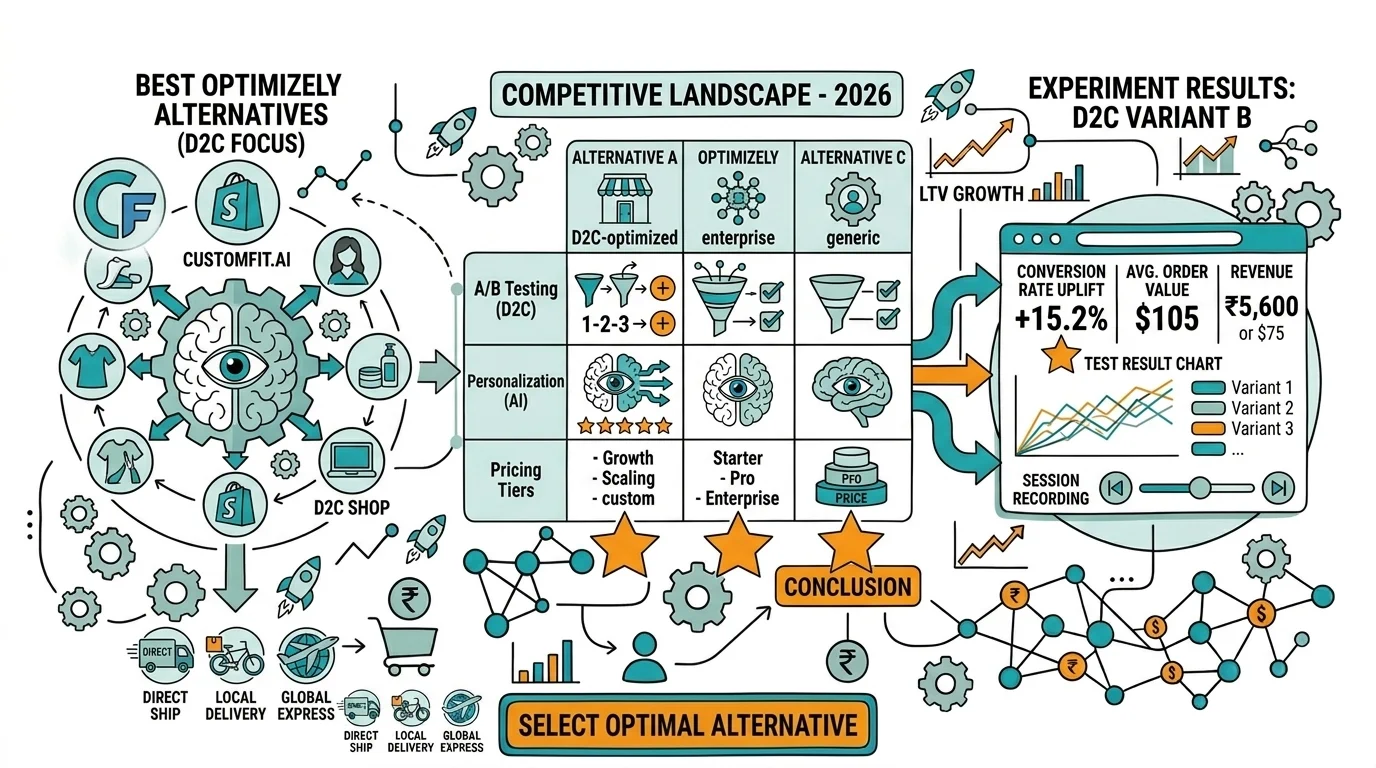
| Tool | Best For | Starting Price | Shopify Native | Ease of Use |
|---|---|---|---|---|
| CustomFit.ai | D2C ecommerce / Shopify | $99/mo | Yes | High |
| VWO | Mid-market websites | $99 to $999+/mo | Partial | Medium |
| AB Tasty | Mid-market with CRO team | ~$2,000/mo | No | Medium |
| Convert.com | Agencies / developers | $199/mo | No | Medium |
| Kameleoon | Enterprise AI testing | Custom | No | Low |
| LaunchDarkly | Feature flag / DevOps | $20/seat/mo | No | Low |
| Statsig | Engineering teams | Free tier / custom | No | Low |
If you're running an ecommerce business on Shopify, CustomFit.ai is the most direct Optimizely alternative that fits how you actually work. Optimizely needs weeks of implementation and a technical team. CustomFit.ai installs in one click and has your first test live in under 30 minutes.
It's built specifically for direct-to-consumer ecommerce rather than horizontal enterprise testing. That focus means it tracks the metrics that matter for your business (add-to-cart rate, AOV, RPV, conversion rate) without custom event setup or a data engineering team.
The visual editor works on your live Shopify store. You point and click to change headlines, images, CTAs, layout elements, and trust badges, then set targeting rules using 1000+ attributes: device type, traffic source, geo, Shopify customer tags, new vs. returning visitor, and more.
Results from D2C brands:
Pricing: $99/month Starter, $249/month Growth. 14-day free trial, no credit card required.
Best for: Shopify D2C brands at any revenue stage that want to run A/B tests and AI personalization without a developer or CRO agency.
VWO (Visual Website Optimizer) is the most direct Optimizely alternative for mid-market teams. It covers a similar feature set (A/B testing, multivariate testing, heatmaps, session recordings, and personalization) at a fraction of Optimizely's price, and you can sign up on your own.
Key strengths:
Pricing: $199/month for testing only, scaling significantly with traffic volume. Full platform access with insights tools costs $500 to $1,500+/month at meaningful traffic levels.
Best for: Mid-market brands (500k to 5M sessions/month) with a marketing team that includes at least one technically comfortable person.
Limitation: Like Optimizely, VWO has no native Shopify integration. D2C brands will still hit friction with checkout testing and Shopify-specific event tracking. See our VWO alternatives guide for more context.
AB Tasty competes with Optimizely on personalization. Its Emotion AI features try to predict visitor intent and emotional state from behavioral signals, then serve more relevant experiences automatically.
Key strengths:
Pricing: Starts around $2,000/month. Custom pricing for enterprise plans.
Best for: Mid-to-large brands with a dedicated CRO or personalization manager who want AI-driven personalization without full enterprise complexity.
Limitation: Pricing is still substantial, and the platform assumes you have some marketing operations maturity. It isn't self-serve the way VWO or CustomFit.ai are.
Convert.com has carved out a niche as the "ethical A/B testing platform." It doesn't share data with third parties, doesn't use cookies by default, and focuses on first-party data. For brands with GDPR requirements or those serving European markets, that's a meaningful difference.
Key strengths:
Pricing: $199/month for 800k monthly tested users.
Best for: CRO agencies with multiple clients, or European brands with strict data compliance requirements.
Limitation: Non-trivial tests need developer involvement. It isn't a fit for non-technical teams that want to move fast on their own.
Kameleoon is an AI-first experimentation platform that predicts visitor conversion probability in real time and adjusts which variant each visitor sees. This "predictive testing" approach can speed up results on lower-traffic sites and surface winning segments faster than traditional testing.
Key strengths:
Pricing: Custom enterprise pricing, typically $24,000 to $100,000+/year.
Best for: Enterprise brands with data science teams who want to move beyond hypothesis-driven testing into AI-driven experimentation.
Limitation: Pricing and implementation complexity put it out of reach for any brand without a dedicated engineering team.
LaunchDarkly is not an A/B testing platform in the marketing sense. It's a feature management and feature flag system for engineering teams. It belongs on this list because many teams searching for Optimizely alternatives are actually engineering teams who used Optimizely for feature rollouts and feature experiments, not marketing tests.
Key strengths:
Pricing: From $20/seat/month for Growth, scaling significantly for enterprise.
Best for: Engineering and product teams running controlled feature rollouts. It isn't relevant for marketing teams optimizing ecommerce conversion.
Limitation: No visual editor and no marketer-facing interface. This is a developer tool, not a CRO platform.
Statsig is a newer entrant in the feature flag and experimentation space, with a free tier that has drawn engineering teams looking for a self-serve Optimizely alternative. Its statistical engine is well-regarded, and it connects directly to data warehouses.
Key strengths:
Pricing: Free tier (up to 1M checks/day), then custom enterprise pricing.
Best for: Data-driven engineering teams at growth-stage or enterprise companies that want rigorous product experimentation with warehouse-native analytics.
Limitation: Like LaunchDarkly, this is an engineering tool. No visual editor, no D2C ecommerce focus, no Shopify integration.
If you run a Shopify D2C brand and want fast, no-code testing, go with CustomFit.ai. Nothing else on this list combines native Shopify integration, no-code operation, D2C metrics, and accessible pricing.
If you need a self-serve alternative to Optimizely's enterprise complexity, look at VWO or AB Tasty, depending on budget.
If you're a CRO agency with technical resources, Convert.com fits well.
If you're an engineering team managing feature rollouts, choose LaunchDarkly or Statsig, depending on how mature your data stack is.
If you want AI-driven enterprise personalization, Kameleoon or AB Tasty are the options to weigh.
Compare related tools: Best VWO Alternatives in 2026 | Best Google Optimize Alternatives in 2026.