From the conversion glossary
Concepts referenced in this article, defined.
Concepts referenced in this article, defined.
Run rigorous A/B tests and personalize every visit on Shopify or any storefront — no engineers required.
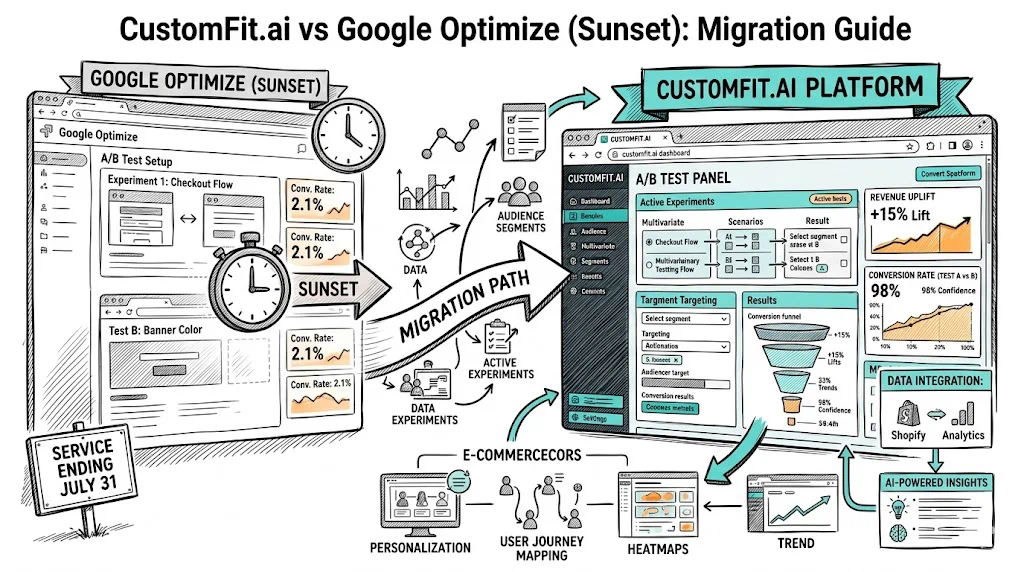
Google Optimize was discontinued on September 30, 2023. If you're still looking for a replacement, CustomFit.ai suits D2C and ecommerce teams in particular: it offers native Shopify integration, a no-code visual editor, and tracks revenue-first metrics (AOV, RPV, add-to-cart) that Google Optimize never supported out of the box. Google Optimize relied on Google Analytics as its data backbone and needed GA goal configuration for every metric, whereas CustomFit.ai pulls Shopify order data automatically. Migrating from a Google Optimize workflow usually takes one business day.
| Feature | CustomFit.ai | Google Optimize (defunct) |
|---|---|---|
| Shopify native integration | ✓ (one-click) | ✗ (JS snippet only) |
| No-code visual editor | ✓ | ✓ |
| D2C/ecommerce metrics (AOV, RPV) | ✓ native | ✗ (required GA goal setup) |
| AI-powered optimization | ✓ predictive intent + dynamic allocation | ✗ |
| 14-day free trial | ✓ | Free (now sunset) |
| Starting price | $99/mo | $0 (no longer available) |
| Developer required for setup | No | No (basic); Yes (360 version) |
| ISO 27001 / SOC 2 | ✓ | Google's infrastructure |
| Currently available | ✓ | ✗ (shut down Sept 2023) |
| Personalization | ✓ | Basic (Optimize 360 only) |
Google announced the sunset in January 2023 and ended service on September 30, 2023. The stated reason was that Google wanted to focus on GA4 and its newer experimentation infrastructure. In practice, Google Optimize came with known limitations: limited traffic rules, no native revenue tracking, a 3 concurrent test limit on the free tier, and session-based rather than user-based targeting. For D2C brands, the missing native ecommerce metrics were a constant frustration, because you had to create GA4 custom events and conversion goals just to track whether a test increased orders.
Google Optimize 360, the paid enterprise tier, offered more concurrent tests and advanced targeting, but pricing was enterprise-level and required a Google Marketing Platform contract.
CustomFit.ai's setup removes the multi-step GA4 dependency that Google Optimize required. You don't create GA4 events, configure conversion goals in GA4, then link Optimize to GA4, then link GA4 to your site tag. On Shopify stores you install the app and CustomFit.ai reads your store's order data directly. On non-Shopify sites you add one JS snippet and revenue tracking is ready without any extra GA4 configuration.
Google Optimize needed Google Tag Manager (or a manual GA4 snippet), a linked GA4 property, conversion goals defined in GA4, and the Optimize snippet. That four-step setup broke whenever GA4 changed its data model, which happened often.
CustomFit.ai supports A/B tests, multivariate tests, split URL tests, and multi-page funnel experiments with no concurrent test limits. The visual editor handles element-level changes (text, images, layout, CTA buttons) without touching code, and AI-driven traffic allocation shifts visitors toward winning variants in real time, something Google Optimize's free version never had.
Google Optimize, in its prime, supported A/B, multivariate, and redirect (split URL) tests. The free tier was limited to 3 simultaneous tests. Its visual editor worked but had known inconsistencies on JavaScript-heavy storefronts. Targeting was session-based, so you couldn't reliably exclude previous purchasers or target users by Shopify purchase history.
Targeting in CustomFit.ai uses 1000+ attributes, including purchase history, cart abandonment, product page views, UTM parameters, device type, and AI-predicted buyer intent. Google Optimize's targeting covered basic dimensions: device, location, behavior, and custom JavaScript conditions, the last of which needed developer help.
CustomFit.ai's personalization is available on all plans rather than being an enterprise add-on. You can serve different homepage content, product callouts, banners, and CTAs to different audience segments based on behavioral, demographic, and ecommerce signals. Brands like Bellavita (11% CVR uplift) used it to match landing page content to traffic source and geography.
Google Optimize's personalization ("Experiences") was available only in Optimize 360 (enterprise). The free Google Optimize product was purely an A/B testing tool with no personalization. That was one of the reasons many D2C brands hit a ceiling with Google Optimize and looked for alternatives even before the shutdown.
CustomFit.ai reports on revenue per visitor (RPV), average order value (AOV), conversion rate, and add-to-cart rate without any additional setup. Statistical confidence and significance appear per test, and Shopify order value data is pulled automatically.
Google Optimize reported on GA4 goals, which meant your experiment reports were only as good as your GA4 goal configuration. Revenue reporting required ecommerce tracking in GA4 to be set up correctly, a common source of data quality issues. Statistical significance was calculated automatically, but the reporting UI was minimal next to modern CRO tools.
| Plan | CustomFit.ai | Google Optimize |
|---|---|---|
| Starter | $99/mo (50K MUV) | N/A (sunset) |
| Growth | $249/mo (100K MUV) | N/A (sunset) |
| Enterprise | Custom | N/A (Optimize 360 ~$150K+/yr) |
| Free trial | 14 days, no credit card | N/A (sunset) |
Google Optimize free was, of course, free, and that remains its strongest legacy advantage. The replacement cost is real, and CustomFit.ai's $99/month Starter plan aims to be the most accessible paid alternative for brands that were on the free Optimize tier.
If you were a Google Optimize user, here's the fastest path to CustomFit.ai:
<head>. Tracking begins immediately, with no GA4 linking required for core functionality.The full migration takes less than a day for most teams.
Is Google Optimize coming back? No. Google shut down Google Optimize permanently on September 30, 2023. There's no successor product from Google for small and mid-size businesses, and Google has directed users to its enterprise-level tools or third-party platforms.
What is the best free alternative to Google Optimize? No maintained free tool offers the same breadth. CustomFit.ai offers a 14-day free trial without a credit card. After the trial, the $99/month Starter plan covers 50,000 monthly unique visitors, well above what most Google Optimize free users needed.
Does CustomFit.ai require Google Analytics 4? No. CustomFit.ai operates independently of GA4. On Shopify stores it reads order data directly, and GA4 integration is optional if you want to cross-reference experiment data in your GA4 reports.
Can I recover my old Google Optimize test results? Google Optimize experiment data was available in GA4 Explorations for accounts that linked before the sunset. That data is historical only, so you can't export raw variation-level data retroactively from Optimize itself.
How does A/B testing accuracy compare to what Google Optimize offered? CustomFit.ai uses frequentist statistical testing with automatic significance detection. The core statistical methodology is comparable to what Google Optimize used. CustomFit.ai adds AI-driven dynamic traffic allocation, which Google Optimize did not offer on its free tier.
Is CustomFit.ai suitable for non-Shopify ecommerce sites? Yes. CustomFit.ai works on any website via a JS snippet. The automatic revenue tracking works on Shopify; for other platforms (WooCommerce, Magento, custom), you configure revenue events using CustomFit.ai's event API, which is simpler than the GA4 goal setup Google Optimize required.