From the conversion glossary
Concepts referenced in this article, defined.
Concepts referenced in this article, defined.
Run rigorous A/B tests and personalize every visit on Shopify or any storefront — no engineers required.
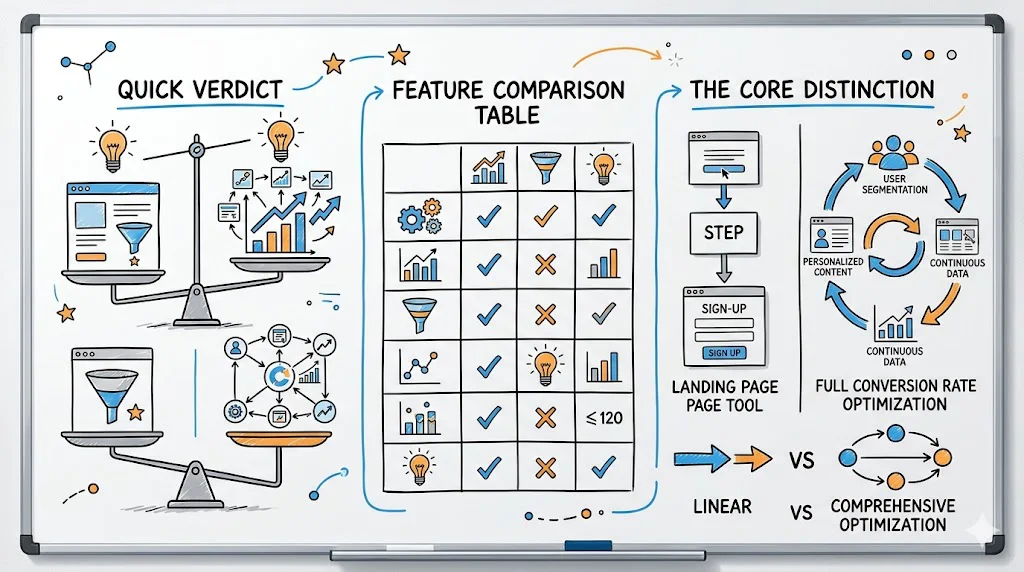
Unbounce is a landing page builder with smart traffic features. It is built for creating standalone campaign landing pages outside your main website. CustomFit.ai is a CRO platform that tests and optimizes your existing Shopify store pages, personalizes experiences for different audience segments, and tracks D2C-specific metrics like revenue per visitor and average order value. These tools solve different problems. Unbounce builds dedicated campaign pages, while CustomFit.ai optimizes your existing store's conversion performance through A/B testing and AI-driven personalization.
| Feature | CustomFit.ai | Unbounce |
|---|---|---|
| Shopify native integration | ✓ | Via JS/redirect only |
| No-code visual editor | ✓ (for testing) | ✓ (for building) |
| A/B testing on existing pages | ✓ | Limited (Unbounce pages only) |
| Full multivariate testing | ✓ | No |
| AI traffic optimization | ✓ | ✓ (Smart Traffic) |
| Personalization engine | ✓ | Smart Builder (limited) |
| D2C/ecommerce metrics (AOV, RPV) | ✓ | No |
| Standalone landing page builder | No | ✓ (core feature) |
| 14-day free trial | ✓ | 14-day trial |
| Starting price | $99/mo | $74/mo (Build) |
| Developer required | No | No |
| Purpose | CRO / Experimentation | Landing page creation |
Unbounce is a landing page builder. Its primary use case is creating standalone, conversion-focused pages for marketing campaigns. Those pages live outside your main website or Shopify store, and they're typically used for paid traffic campaigns (Google Ads, Facebook Ads). Unbounce's "Smart Traffic" feature uses AI to automatically route visitors to the variant most likely to convert them, based on their attributes.
CustomFit.ai optimizes the pages you already have: your Shopify product pages, collection pages, homepage, and checkout flow. It runs structured experiments to find which version of each page converts better, personalizes experiences for different audience segments, and tracks exact revenue impact per experiment.
Most D2C brands need both capabilities: dedicated campaign landing pages (Unbounce's strength) and systematic optimization of their core store experience (CustomFit.ai's strength). If you have to choose one and you're focused on improving your Shopify store's conversion rate, CustomFit.ai is the direct answer.
CustomFit.ai installs from the Shopify App Store in one click. Ecommerce events (add-to-cart, checkout, purchase) are tracked automatically. You're running your first experiment the same day.
Unbounce requires creating new pages within the Unbounce builder, then directing traffic to those pages from ads or other sources. There's no native Shopify App Store integration. For campaigns that drive traffic to your existing Shopify product pages rather than standalone pages, Unbounce doesn't apply.
CustomFit.ai runs experiments on your live Shopify pages:
Results: 11% average CVR increase across CustomFit.ai customers. Bellavita saw an 11% CVR lift, Kapiva a 9.48% CVR improvement, and Chargebee a 40% AOV increase.
Unbounce's A/B testing is limited to Unbounce-built pages. You can test two variants of an Unbounce landing page with basic traffic splitting. It doesn't cover your Shopify store pages, doesn't support multivariate tests, and the testing capabilities are secondary to the page-building function.
Unbounce's "Smart Traffic" is a genuine AI feature. It analyzes visitor attributes (device, browser, location, behavior) and automatically routes traffic to the variant of an Unbounce page most likely to convert that specific visitor. This works well within Unbounce's ecosystem.
CustomFit.ai's AI optimization covers a broader scope. It dynamically reallocates traffic across all variants on any Shopify page during an experiment, while at the same time running personalization rules based on 1000+ audience attributes. The AI also predicts buyer intent in real time, so it can personalize the experience before the visitor has taken many actions. See personalization for how this works.
CustomFit.ai's personalization engine is built for ecommerce depth: 1000+ targeting attributes including traffic source, device, geographic market, cart value, purchase history, session depth, and predictive buyer intent. Different audience segments automatically see different page versions, so your returning high-AOV customers see different social proof than first-time discount seekers.
Unbounce's "Smart Builder" includes basic personalization for Unbounce pages. It can dynamically insert location or company name into page copy. The targeting is more limited than CustomFit.ai's full segmentation engine.
CustomFit.ai tracks the metrics D2C brands care about at the experiment level: revenue per visitor, average order value, add-to-cart rate, and conversion rate, broken down by variant and audience segment. You know exactly what each experiment is worth in revenue.
Unbounce reports on landing page conversion rates, form submissions, and Smart Traffic variant performance. For ecommerce revenue metrics, you'd need to integrate with a separate analytics tool and configure custom tracking.
| Plan | CustomFit.ai | Unbounce |
|---|---|---|
| Starter | $99/mo (50K MUV) | $74/mo (Build, 1 domain, 500 conversions) |
| Growth | $249/mo (100K MUV) | $149/mo (Optimize, A/B testing included) |
| Scale | Enterprise | $240/mo (Accelerate) |
| Free trial | 14 days, no credit card | 14-day trial |
Note: Unbounce's $74/month Build plan doesn't include A/B testing. You need the $149/month Optimize plan for that. At that tier, CustomFit.ai at $99/month includes more comprehensive A/B testing, AI optimization, and personalization across your entire Shopify store.
Unbounce is the right tool if you're running high-volume paid advertising campaigns that need dedicated, conversion-optimized landing pages separate from your main Shopify store. If you run agency-style campaign management with many separate landing pages per campaign, Unbounce's page building speed is valuable. It's particularly useful for lead generation businesses, SaaS, or ecommerce brands with product launch campaigns that need standalone pages. Many D2C brands use both: Unbounce for campaign-specific landing pages, CustomFit.ai for their ongoing store optimization.
If you're using Unbounce for Shopify store optimization and want to move to a dedicated CRO platform:
Does Unbounce work with Shopify? Unbounce creates standalone pages that are separate from your Shopify store. You can link buttons on Unbounce pages to Shopify products, but Unbounce doesn't integrate natively with Shopify's product catalog or checkout. It's not an App Store integration.
Can CustomFit.ai build standalone landing pages like Unbounce? CustomFit.ai is designed to optimize existing Shopify pages, not create standalone pages hosted outside Shopify. For campaign-specific standalone landing pages, Unbounce or a similar page builder is more appropriate.
Is Unbounce's Smart Traffic the same as CustomFit.ai's AI optimization? They use AI for traffic allocation, but they operate in different scopes. Unbounce's Smart Traffic routes visitors between Unbounce page variants. CustomFit.ai's AI optimization allocates traffic across experiment variants on your Shopify pages while also running real-time personalization based on 1000+ audience attributes.
Which tool is better for increasing Shopify store conversions? CustomFit.ai. Unbounce creates separate pages, while CustomFit.ai optimizes the pages your Shopify visitors actually land on: product pages, collection pages, and the cart. The conversion rate improvement happens directly on your store.
How does CustomFit.ai track revenue per visitor? CustomFit.ai connects to Shopify's native order data and calculates revenue per visitor for each experiment variant. It shows you exactly how much incremental revenue each test generates compared to the control.
What happens to my Unbounce pages if I switch to CustomFit.ai? You can keep your Unbounce pages running for paid campaigns while using CustomFit.ai for your Shopify store optimization. They operate independently and don't conflict.